Location :
Orlando, FL, USA
Location :
Orlando, FL, USA +1 (407) 714-1616
 info@biz4group.com

















Imagine a digital system that doesn’t wait for instructions but instead, understands your business goals, learns from real-time feedback, and takes independent actions to get the job done.
Read More

 AI Summary Powered by Biz4AI
Why does one company estimate $60,000 for a cardiology RCM platform while another quotes more than $300,000 for what appears to be the same solution?
Because one estimate focuses on basic billing automation, while another includes AI-driven coding, denial prediction, AI EHR integrations, specialty cardiology workflows, and enterprise-grade compliance.
If you've started evaluating a custom platform, you've probably noticed how quickly development estimates change, making it difficult to understand what your organization actually needs and where your investment is going.
The reality is that there isn't a fixed AI cardiology revenue cycle management system cost. Every project is shaped by its scope, AI capabilities, interoperability requirements, deployment architecture, and the complexity of cardiology-specific revenue cycle workflows.
That's why the overall investment can range from $40,000+ for a focused MVP to $450,000+ for a fully customized enterprise platform built around your operational goals.
So, if questions like these are already on your mind, you're asking the right ones:
This guide answers those questions with a practical budgeting approach, helping you understand where your investment goes, what influences development costs, and how to plan your project with confidence before development begins.
A realistic estimate for the cost to build a cardiology revenue cycle management system starts with understanding the major investment areas before discussing individual features or technical decisions. This practical estimator gives you a clear starting point, helping you estimate your project budget based on the factors that have the greatest impact on overall development cost.
Every cardiology RCM platform is built differently, but the overall investment is typically influenced by six major cost areas.
Estimated Development Cost = Product Scope + AI Capabilities + Cardiology Workflow Complexity + Healthcare Integrations & Interoperability + Compliance & Security + Infrastructure & Scalability
What Each Cost Variable Includes
Defines the overall size of your platform, including core RCM modules, user roles, workflows, dashboards, reporting capabilities, and the level of functionality your organization requires.
Includes AI-powered coding, claim validation, denial prediction, prior authorization support, billing automation, revenue insights, and other intelligent features that improve financial performance.
Covers specialty-specific billing workflows, procedure coding, payer rules, modifier management, and the operational requirements unique to cardiology revenue cycle management.
Includes EHR connectivity, clearinghouses, payment gateways, insurance verification services, and healthcare interoperability standards required for seamless data exchange.
Covers HIPAA compliance, secure authentication, encryption, audit trails, access controls, data protection, and other safeguards required for healthcare applications.
Includes cloud infrastructure, deployment architecture, AI hosting, database management, system performance, and scalability required to support future business growth.
The example below shows how these investment areas typically contribute to the budget of a mid-scale cardiology RCM platform with AI-assisted coding, automated claims management, denial prediction, payer integrations, and specialty billing workflows.
|
Investment Area |
Estimated Cost |
|---|---|
|
Product Scope |
$62,000 |
|
AI Capabilities |
$38,000 |
|
Cardiology Workflow Complexity |
$26,000 |
|
Healthcare Integrations |
$28,000 |
|
Compliance & Security |
$18,000 |
|
Infrastructure & Scalability |
$18,000 |
|
Estimated Development Cost |
$190,000 |
The formula gives you a high-level budgeting framework, but each investment area influences the final project cost differently. Understanding how these cost drivers affect development effort makes it easier to evaluate proposals, prioritize business requirements, and identify the factors that deserve closer attention.
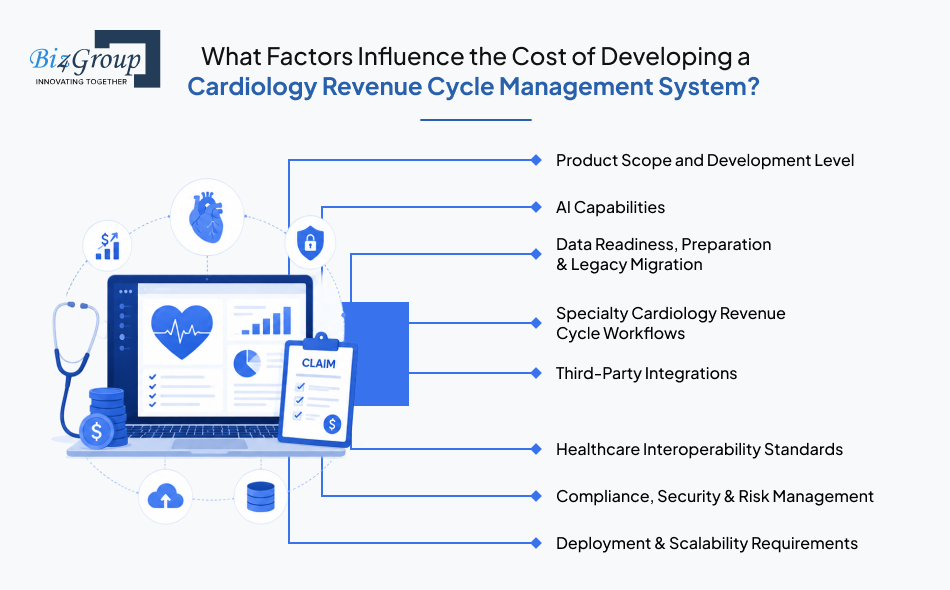
Several factors influence the cost to build a cardiology revenue cycle management system, and each one affects your investment differently. The platform's scope, AI capabilities, cardiology-specific billing workflows, integrations, compliance requirements, and infrastructure decisions collectively determine the final development budget.
Let's go through them one by one.
The overall scope of your platform determines how many modules, workflows, and user experiences need to be developed. While an MVP focuses on core billing and reimbursement processes, enterprise platforms require dedicated workflows for physicians, medical coders, billing teams, finance departments, practice managers, and administrators.
Each user group needs role-specific dashboards, permissions, and task flows, increasing both development effort and the overall UI/UX design cost required to deliver an intuitive and efficient experience across the platform.
|
Product Scope |
What It Typically Includes |
Estimated Cost |
|---|---|---|
|
MVP Level Cardiology RCM System |
Core RCM modules, basic automation, essential dashboards |
$40,000–$120,000 |
|
Mid-Level Cardiology RCM System |
AI capabilities, workflow automation, system integrations |
$120,000–$250,000 |
|
Advanced Level Cardiology RCM System |
Enterprise AI, interoperability, advanced analytics, scalability |
$250,000–$450,000+ |
As the scope expands from MVP to advanced level, the volume of testing and validation also increases. More modules, user roles, AI features, and integrations require deeper testing around coding accuracy, claim integrity, system interoperability, and HIPAA compliance. This additional validation effort contributes meaningfully to the overall cardiology revenue cycle management software development cost.
Also Read: Top 15+ Software Testing Companies in USA
AI capabilities represent one of the largest investments in a cardiology revenue cycle management system because every feature automates a different stage of the revenue cycle.
As more intelligent workflows are introduced, the overall AI model development effort grows, making it important to prioritize the AI capabilities that deliver the greatest operational and financial impact.
|
AI Capability |
Business Value |
Estimated Cost |
|---|---|---|
|
Automates code suggestion and improves coding speed & accuracy using AI |
$5,000–$10,000 |
|
|
Detects claim errors before submission |
$8,000–$15,000 |
|
|
Identifies high-risk claims before submission |
$8,000–$15,000 |
|
|
AI Prior Authorization |
Automates and accelerates prior authorization workflows using intelligent data extraction and submission |
$8,000–$15,000 |
|
AI Appeals |
Generates and assists with appeal letters based on denial reasons and supporting documentation |
$5,000–$12,000 |
|
Revenue Leakage Detection |
Identifies patterns of missed charges and under-coding through AI analysis |
$10,000–$20,000 |
|
Predictive Analytics for Payments |
Forecasts payment likelihood and expected collection timelines using AI models |
$7,000–$12,000 |
|
AI Billing Assistant |
Handles routine billing queries and tasks through intelligent automation |
$5,000–$10,000 |
|
Clinical Documentation Intelligence |
Analyzes clinical notes to surface missing or weak documentation that impacts reimbursement |
$10,000–$20,000 |
Also Read: How to Build an AI Medical Billing Software
Two distinct but related data activities influence the development cost of an AI Cardiology RCM system. The first is preparing data so that AI model training or fine tuning can be carried out effectively.
The second is migrating historical patient, claims, and financial records from existing systems so the new platform can go live without disrupting billing operations or reporting. Both require assessment, cleansing, and validation, but they serve different purposes and should be budgeted separately.
|
Data Preparation Activity |
Development Consideration |
Estimated Cost |
|---|---|---|
|
Data Readiness Assessment |
Evaluate the quality and completeness of existing healthcare data |
$2,000–$5,000 |
|
Data Cleansing & Standardization |
Improve consistency across clinical and billing datasets |
$5,000–$10,000 |
|
Data Annotation & Labeling |
Prepare domain-specific datasets for custom AI development |
$8,000–$15,000 |
|
Legacy System Assessment |
Evaluate data structure, quality, and migration complexity |
$2,000–$4,000 |
|
Data Mapping & Transformation |
Convert legacy data into the new platform structure |
$6,000–$12,000 |
|
Historical Data Migration |
Transfer patient, claims, and financial records |
$6,000–$12,000 |
|
Migration Validation & Cutover |
Verify accuracy and support production transition |
$3,000–$8,000 |
Cardiology introduces billing complexity that generic RCM systems rarely handle well. Specialty procedures, complex CPT coding, modifiers, medical-necessity rules, and electrophysiology or remote-monitoring workflows all require custom logic.
These are primarily rule-based, and configuration-driven capabilities that increase development effort but are often essential to avoid ongoing revenue leakage and high denial rates on high-value procedures.
|
Specialty Cost Driver |
Business Impact |
Estimated Cost |
|---|---|---|
|
Specialty Procedure Billing |
Supports ECG, echocardiography, catheterization, and other cardiology procedures |
$8,000–$15,000 |
|
Cardiology CPT & Coding Rules |
Implements specialty-specific CPT logic and coding guidelines for cardiology |
$12,000–$20,000 |
|
Modifier Management Rules |
Applies cardiology-specific modifiers correctly across claims |
$6,000–$12,000 |
|
Medical Necessity Validation Rules |
Enforces payer-specific medical necessity criteria for cardiology services |
$10,000–$18,000 |
|
Specialty Claim Rules Engine |
Handles complex payer-specific cardiology billing requirements |
$10,000–$18,000 |
|
Remote Patient Monitoring Billing |
Supports recurring RPM billing and reimbursement workflows |
$10,000–$18,000 |
|
Advanced Diagnostic Workflows |
Manages imaging and diagnostic billing processes |
$8,000–$15,000 |
|
Electrophysiology Billing Logic |
Supports complex EP procedure reimbursement rules |
$10,000–$18,000 |
Integrations determine how seamlessly the new system fits into your existing technology stack. Connecting to EHRs (Epic, Cerner, athenahealth), clearinghouses, eligibility services, and payment gateways involves API work, data mapping, testing, and ongoing maintenance.
The number and depth of required integrations frequently become one of the largest line items in the budget and should be scoped carefully against actual operational needs.
|
Integration |
Development Consideration |
Estimated Impact |
|---|---|---|
|
Epic |
Enterprise EHR connectivity and bidirectional data exchange |
$8,000–$15,000 |
|
Cerner |
Clinical, patient, and billing data synchronization |
$5,000–$10,000 |
|
athenahealth |
Practice management and RCM workflow integration |
$10,000–$15,000 |
|
Clearinghouses |
Electronic claims submission and remittance processing |
$8,000–$15,000 |
|
Real-time coverage and benefits verification |
$6,000–$12,000 |
|
|
Payment Gateways |
Secure patient payment processing and reconciliation |
$5,000–$10,000 |
|
OCR System & Document Processing |
Automated extraction of billing and clinical documents |
$8,000–$15,000 |
Also Read: AI Document Analysis Tool Development
Supporting healthcare interoperability goes far beyond connecting two systems. Every standard follows its own data structure, messaging format, validation rules, and testing requirements.
Making patient, clinical, and financial information exchange accurately across multiple healthcare platforms requires significant implementation effort, which is why interoperability often becomes a major part of the overall development budget.
|
Interoperability Standard |
Development Consideration |
Estimated Cost |
|---|---|---|
|
FHIR |
Modern API-based clinical data exchange |
$4,000–$10,000 |
|
HL7 |
Legacy hospital system communication |
$6,000–$12,000 |
|
X12 Transactions |
Standardized payer and billing communication |
$5,000–$10,000 |
|
837/835 Claims |
Electronic claims and remittance workflows |
$6,000–$12,000 |
|
270/271 Eligibility Transactions |
Real-time eligibility and benefits verification |
$5,000–$10,000 |
Meeting healthcare security and compliance expectations extends well beyond adding a few security features. It requires building governance, access controls, auditability, and data protection into the platform from the ground up, making it an essential part of the overall development effort.
|
Compliance Investment |
Development Consideration |
Estimated Cost |
|---|---|---|
|
HIPAA Compliance |
Privacy safeguards, regulatory controls, and PHI protection |
$10,000–$20,000 |
|
Identity & Access Management |
User authentication, role-based permissions, and access governance |
$6,000–$12,000 |
|
Audit & Activity Logging |
End-to-end user activity tracking and compliance reporting |
$5,000–$10,000 |
|
Data Protection |
Encryption, secure storage, and sensitive data handling |
$6,000–$12,000 |
|
Business Continuity |
Backup, disaster recovery, and system resilience planning |
$8,000–$15,000 |
Deployment decisions often become more demanding as cardiology practices expand into multi-site operations or hospital networks. Supporting different deployment models, uninterrupted system availability, and future growth requires additional planning, architecture, and testing.
|
Business Requirement |
Development Consideration |
Estimated Cost |
|---|---|---|
|
Multi-Tenant Platform |
Separate environments for multiple organizations on a shared application |
$6,000–$13,000 |
|
On-Premise Deployment |
Dedicated deployment for organizations with internal infrastructure |
$6,000–$15,000 |
|
Hybrid Deployment |
Unified experience across cloud and on-premises environments |
$8,000–$16,000 |
|
High Availability |
Redundancy, failover, and uninterrupted platform access |
$6,000–$12,000 |
|
Multi-Site Operations |
Centralized management across hospitals and practice locations |
$8,000–$15,000 |
Each of these factors shapes a different part of your total investment, and together they explain why two cardiology RCM quotes can look nothing alike for the same platform.
Stop estimating in the dark and get a breakdown built around your actual cardiology workflows
Get My Cost Breakdown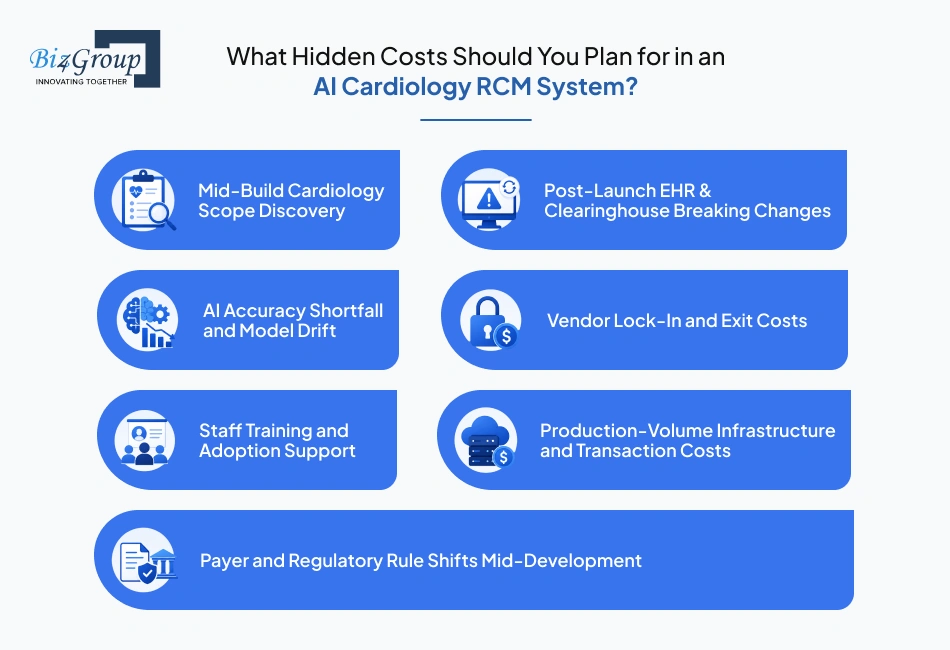
The ones that surface after launch, once real claims, real payers, and real staff start using the system every single day. The development quote covers what a team can plan for on paper. Product managers running RFPs and practice owners signing off on budgets both get caught out here, because none of this shows up as a line item.
Here are seven costs that tend to surface only once development is already underway or the system is already live.
The cardiology workflows price cover what a team can map out before writing a single line of code. Real claims tell a different story.
A modifier combination nobody flagged, a payer rule that only shows up once test claims go through, a coding edge case buried inside EP or remote monitoring billing these get found once developers are already inside the build, not during planning. This usually shows up as:
Estimated impact: $7,000–$15,000, depending on how many edge cases surface once real claims start moving through the system.
Building your Epic, Cerner, or clearinghouse connection is one cost; what happens after that connection goes live is a separate one. These vendors change their endpoints, data formats, and login requirements on their own schedule. When that happens, here's what usually lands on the desk:
Estimated impact: $5,000–$10,000 per breaking change, and most platforms see at least one or two of these a year.
Training your coding or denial-prediction model is priced upfront. What isn't priced is what happens after training ends. Two costs tend to follow it. The model may not hit the accuracy you need the day it launches, so it needs extra tuning before it's actually usable.
Even once it clears that bar, payer rules and coding sets change every year, so the model needs regular upkeep to stay reliable. That upkeep usually looks like:
Estimated impact: $8,000–$15,000 in the first year alone, between launch tuning and the first retraining cycle.
Before signing anything, compare AI-powered cardiology revenue cycle management software pricing across a few vendors, because moving your data and rebuilding integrations later rarely comes cheap. Contracts rarely spell out what it costs to leave, and that gap tends to show up as:
Estimated impact: $10,000–$30,000, and it climbs fast the longer you've been with a vendor before deciding to leave.
The platform itself gets priced. The people who actually use it every day usually don't. Cardiology practice owners in particular tend to underestimate this one, because it feels like a soft cost until go-live week arrives and billing staff are stuck relearning their entire workflow. That relearning curve tends to bring:
Estimated impact: $5,000–$12,000 for the first full onboarding round, plus smaller recurring costs after every major update.
Designing a system that can scale is one cost but actually running it at full volume is another. Cloud compute, storage, and per-transaction fees that looked reasonable during a pilot can climb once the system is handling your practice's entire claim volume day in and day out, usually through:
Estimated impact: 15%–30% higher than pilot-stage estimates once the system hits full production volume.
Compliance costs cover building privacy and security safeguards into the platform. This is different. Payer policies and CPT codes can change while your system is still being built, which means the claims engine your team is coding against today might need updating before the project even ships. When timing works against you, this shows up as:
Estimated impact: $6,000–$15,000 in rework, plus whatever a delayed launch costs you in lost billing time.
These seven costs don't replace the cost estimate; they extend it. Price them early and your cardiology RCM budget stays accurate long after development wraps up.
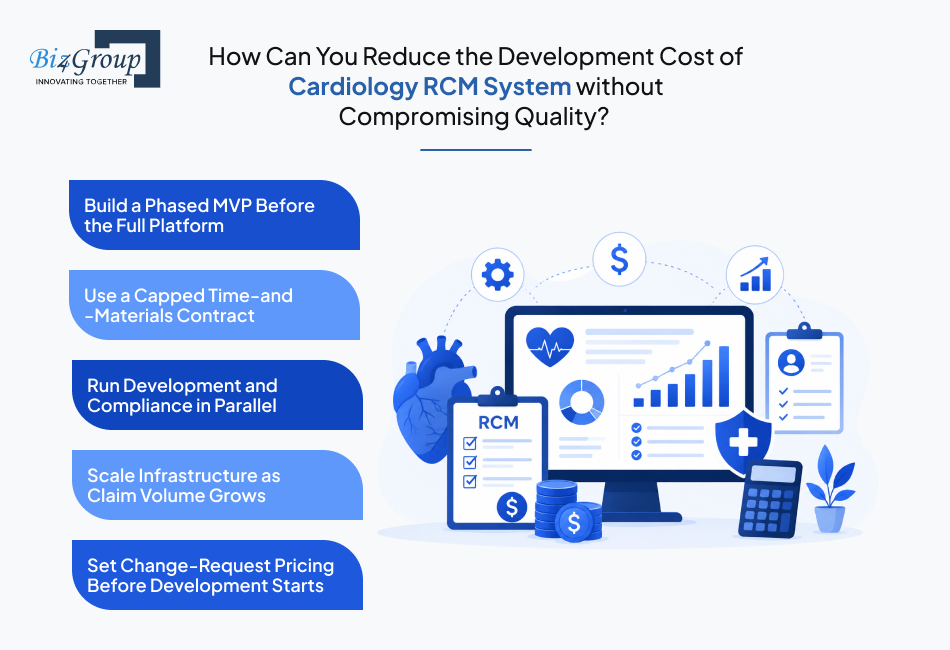
Cost control comes down to how the project is structured, not what gets left out. A custom cardiology revenue cycle management software cost stays predictable when teams sequence work smartly, price contracts right, and provision infrastructure to match real usage instead of guesswork.
Here's how each of these plays out once you put it into practice, and what it actually saves you along the way.
Cardiology RCM platforms don't need every feature live on day one. Core billing, claims submission, and one or two priority integrations can go live first, with AI-driven denial prediction and predictive analytics layered in once real usage data starts flowing.
This is where MVP development services genuinely earn their keep, since the smaller first release lets your team validate what cardiology workflows actually need before paying to build features nobody ends up using.
Cost saved: 20%-30% lower upfront spend compared to building the full platform in one go.
Also Read: Top MVP Development Companies in USA
Fixed-price contracts sound safer, but vendors usually build in a buffer of 15% to 30% to cover their own risk, whether the project hits snags or not. A time-and-materials contract with a spending cap keeps that flexibility while still protecting your budget from running away.
AI MVP software development in particular benefits from this model, since AI features often need a few rounds of tuning that a rigid fixed-price scope doesn't leave room for.
Cost saved: 10%-15% lower total spend compared to a fixed-price contract with a built-in risk buffer.
Development, testing, and compliance review often happen one after another by default, and that stretches the calendar more than it needs to. Running compliance checks alongside development instead of waiting until the end shortens the whole timeline without touching what actually gets built.
Cost saved: 15%-20% shorter timeline, which translates directly into fewer billed hours.
Provisioning cloud infrastructure for projected future volume before you've even launched means paying for capacity that sits unused for months. Setting up usage-based pricing at pilot volume and scaling it up as real claim volume grows keeps your infrastructure bill tied to what you're actually using.
Cost saved: 25%-35% lower infrastructure spend during the first several months post-launch.
Mid-build discoveries are going to happen on a cardiology platform, given how much specialty complexity only shows up once real claims are tested. What separates a controlled budget from a runaway one is agreeing on how those changes get priced before development starts, not after a surprise invoice shows up.
Cost saved: 10%-20% reduction in unplanned budget overruns tied to mid-project scope changes.
These cost optimization strategies work together, not in isolation, and each one keeps spend predictable without cutting a single feature your cardiology revenue cycle management platform needs.
Let's find every dollar your cardiology platform can save without cutting a single feature
Show Me Where to SaveThe vendor you hire changes the final number as much as any feature on your list. Two proposals covering identical cardiology workflows can land tens of thousands apart, and the gap almost always comes down to who's building it, not what's being built.
Here's what actually moves that number once you start comparing vendors side by side.
Where a vendor's engineering team sits changes the hourly rate before a single feature gets discussed. Onshore teams in the US typically charge the most. Offshore teams in regions like South Asia or Eastern Europe charge the least, and nearshore teams sit somewhere in between with better time-zone overlap for daily collaboration.
HealthTech founders and CTOs often default to onshore for comfort, without realizing offshore or nearshore teams can deliver the same HIPAA-compliant cardiology RCM software development cost outcome at a fraction of the rate, provided the vendor has real healthcare delivery experience.
Cost impact: Offshore or nearshore delivery can bring total project cost down by 30%-50% compared to a fully onshore team, for comparable skill level.
A vendor who's already built cardiology or specialty RCM workflows walks in with reusable logic for modifiers, medical necessity rules, and payer-specific quirks. A generalist team learns all of that on your project, which means more discovery cycles and more billable hours before the platform even works the way you expect.
This is exactly where CIOs and IT decision-makers should be asking pointed questions during vendor evaluation, not just requesting a quote.
Cost impact: Working with a team that already understands cardiology billing can lower development costs by 15%-25%, mainly through fewer rework cycles.
A team stacked with senior engineers costs more per hour, but a junior-heavy team often costs more overall once rework, missed edge cases, and slower debugging get factored in. The cost to build a cardiology revenue cycle management system with AI features depends heavily on this mix, since AI features in particular punish inexperienced teams with longer tuning cycles and lower accuracy on the first attempt.
Cost impact: A poorly balanced junior-heavy team can add 10%-20% in unplanned rework cost over the course of a project.
Some vendors treat go-live as the finish line and price every post-launch fix, update, or support request separately. Others build ongoing support into the relationship from day one, so training, minor fixes, and small adjustments are already accounted for instead of showing up as surprise invoices.
CMOs and founders evaluating vendors long-term should ask directly how support is structured before signing anything, not after launch week.
Cost impact: Bundled post-launch support can save 10%-15% annually compared to paying for fixes and updates on a per-request basis.
The four factors explain why vendor proposals for the same platform can land far apart. What that gap looks like in practice depends on the vendor you choose, so here's how Biz4Group plays out against those factors.
Biz4Group LLC is a HIPAA compliant AI healthcare software development company with more than 20 years of experience building for providers, payers, and specialty practices, and that experience directly changes where your budget goes. Work is built to hold up against HIPAA compliance and FDA regulatory guidelines, which avoids the rework costs that show up later when AI-driven decisions don't meet regulatory scrutiny after launch.
Here's where that shows up on the actual invoice:
Custom cardiology RCM software development cost stays lower under this setup mainly because fewer hours go toward learning, correcting, or re-explaining things mid-build.
There's no single number that answers what a cardiology RCM platform costs, and by now that probably makes more sense than it did at the start. The real number depends on how much AI you build in, how deep your cardiology workflows go, and which vendor ends up building it. What matters more than any single figure is knowing where your money actually goes, so you can catch scope creep before it catches you.
The estimated cost of building a HIPAA-compliant cardiology revenue cycle management system will always shift based on your specific goals, but a clear budgeting framework keeps that shift predictable instead of alarming. Once you factor in hidden costs, smart cost-saving strategies, and the right delivery partner like Biz4Group LLC, the AI cardiology revenue cycle management system cost stops feeling like a guessing game and starts looking like a plan you can execute.
Ready to see what your platform would actually cost? Get in touch with us and get a clear, itemized estimate built around your practice, not a generic template.
Most custom builds fall between $40,000 and $450,000+, depending on how much AI functionality and specialty complexity the platform needs. A focused MVP sits at the lower end, while a full enterprise deployment with advanced analytics and interoperability sits at the upper end.
A focused MVP usually takes 2 to 4 weeks, while a mid-to-advanced platform with AI capabilities and multiple integrations can run 4 to 8+ weeks. Timeline depends heavily on how many EHR connections and specialty workflows need to be built before go-live.
Off-the-shelf platforms usually cost less upfront, but they rarely handle cardiology-specific billing logic without heavy customization or workarounds. Custom cardiology revenue cycle management software cost is higher initially, but it avoids the recurring licensing fees and workflow limitations that off-the-shelf tools carry long-term.
Yes, mainly because enterprise deployments need multi-site management, role-based access across larger teams, and infrastructure built for much higher claim volume. A single-practice build can stay lean since it's supporting one location and a smaller user base.
Most practices start seeing measurable returns within 6 to 12 months post-launch, mainly through fewer denied claims and faster reimbursement cycles. The exact timeline depends on current denial rates and how much of the billing process was manual before the system went live.
Yes, payer mix and state-specific regulations can add real cost, since different payers enforce different medical necessity rules and claim formats. A practice working across multiple states or a wide payer network usually needs a more configurable rules engine than one working with a handful of regional payers.

Our website require some cookies to function properly. Read our privacy policy to know more.