 Location :
Orlando, FL, USA
Location :
Orlando, FL, USA +1 (407) 714-1616
 info@biz4group.com

- AI multi-specialty patient portal development for hospitals connects departments, unifies patient data, and automates workflows.
- It improves care coordination, patient experience, and efficiency in AI hospital portal development for multi-specialty care.
- Use cases like chronic disease monitoring, triage, and cross specialty care highlight the value of AI multi-specialty patient system development.
- Development requires the right steps, tech stack, and scalable architecture, with costs around $40,000 to $300,000+.
- Challenges like data silos and compliance can be solved with the right approach and partner like Biz4Group for development of AI multi specialty patient portal.
What happens when a patient visits three different specialists in your hospital but ends up with three disconnected experiences?
Or when your care teams have the data, but not at the right time or in the right place?
If you are managing a multi-specialty hospital, this probably sounds familiar. Systems exist, but they do not work together the way they should. And that gap shows up everywhere. Delayed decisions, operational inefficiencies, and patients who expect more than what current systems deliver.
Now ask yourself this - can your existing setup truly support connected, real time, patient-first care?
Because the industry is already moving forward.
According to a report, AI has the potential to contribute up to $150 billion annually to the US healthcare economy by 2026, driven by automation and smarter clinical workflows.
At the same time, another report highlights that health systems are rapidly increasing investments in AI to improve patient engagement, operational efficiency, and care outcomes.
This is exactly why AI multi specialty patient portal development for hospitals is gaining momentum. Instead of relying on disconnected systems, hospitals are now choosing to develop AI patient portal for multi-specialty hospitals that unify data, streamline workflows, and improve care delivery.
If you have been evaluating solutions around AI patient portal development, you already know this is not just about building another portal. It is about creating a smarter, connected system.
In this guide, we will walk you through how the development of AI multi specialty patient portal works and how you can approach it the right way.
So, let’s start with the basics. What exactly are we building here, and why are hospitals moving toward it so quickly?
What Is AI Multi Specialty Patient Portal Development for Hospitals and Why Are Hospitals Moving Towards It?
What does it actually mean to build an AI multi-specialty patient portal development for hospitals solution?
It means creating a single digital platform where every department in your hospital connects, shares, and acts on patient data in real time. Instead of running separate systems for each specialty, you bring everything into one intelligent environment. Patients interact through one portal. Doctors access unified records. Admin teams manage operations without switching between tools.
This is what AI multi specialty patient portal development enables. A system that does not just store data but actively supports care delivery across specialties.
With the development of AI multi-specialty patient portal, your hospital gets:
- One unified patient profile across all departments
- Real time data sharing between specialists
- Automated workflows for appointments, follow ups, and communication
- AI-driven insights to support faster clinical decisions
- A consistent patient experience across the entire care journey
When this is connected with systems like AI EMR/EHR software, the portal becomes a central layer that keeps all medical data structured, accessible, and usable across your organization.
Why Are Hospitals Moving Towards It?
Hospitals are not adopting this just for innovation. They are solving real operational and patient care challenges.
Here is what is driving the shift:
- Fragmented systems across departments
Different specialties often use separate tools, leading to disconnected care - Lack of real time data access
Doctors do not always have complete patient history when making decisions - Rising patient expectations
Patients want a single, seamless digital experience across all services - High administrative workload
Manual coordination, scheduling, and follow ups slow down operations - Underutilized healthcare data
Hospitals generate large volumes of data but struggle to turn it into actionable insights - Need for scalable digital infrastructure
Growing hospital networks require systems that can expand without breaking workflows
This is why more organizations are choosing to develop AI patient portal for multi-specialty hospitals that can unify operations, improve care coordination, and support long term growth.
So the real question is not whether this shift is happening. It is whether your hospital is ready to operate on a connected, intelligent system that keeps up with both patient expectations and operational demands.
Still relying on disconnected systems?
If your hospital systems are not talking to each other, it is already costing you time and efficiency. Let’s fix that with the right AI approach.
Talk to Our ExpertsWhat Are the Key Benefits of AI Multi Specialty Patient Portal Development for Hospitals?
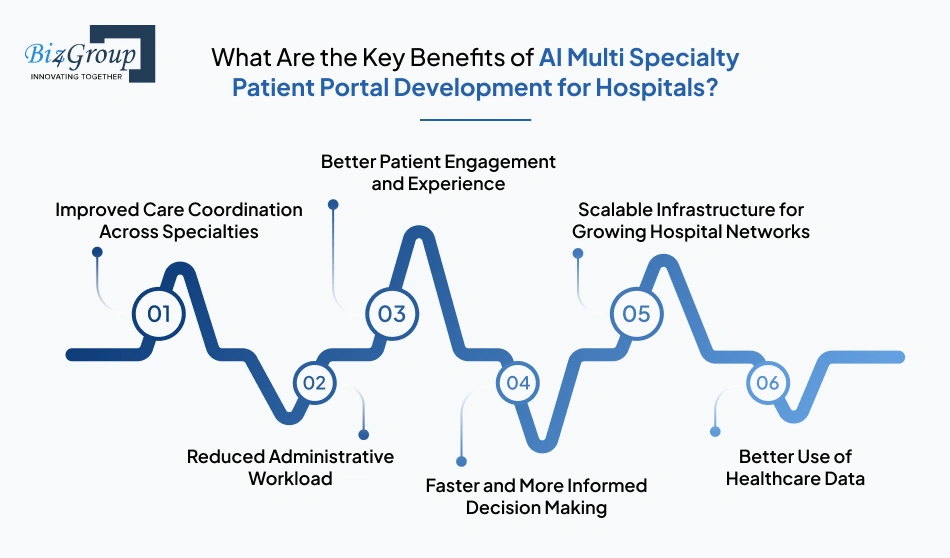
If you are considering AI multi specialty patient portal development for hospitals, the real question is simple. What do you actually gain from it in real operations, patient care, and long-term scalability?
Here are the key benefits that make AI hospital portal development for multi specialty care a practical investment.
1. Improved Care Coordination Across Specialties
With AI multi specialty patient system development, all departments operate on shared, real time patient data. Doctors no longer depend on incomplete records or delayed updates. Every specialist gets a full view of the patient journey, which reduces errors and leads to more accurate treatment decisions.
2. Reduced Administrative Workload
Administrative tasks like scheduling, follow-ups, and documentation often slow down your teams. AI helps automate these repetitive processes, reducing manual effort and improving efficiency. This allows your staff to focus more on patient care instead of routine operational work.
3. Better Patient Engagement and Experience
Patients expect a smooth, connected experience across your hospital. A unified portal allows them to manage appointments, access records, and communicate with providers from one place. This convenience improves satisfaction and builds long-term patient trust.
4. Faster and More Informed Decision Making
AI analyzes patient data across multiple specialties and highlights important insights in real time. Doctors receive alerts, patterns, and recommendations that support quicker and more confident decisions. This becomes especially valuable in complex, multi-condition cases.
5. Scalable Infrastructure for Growing Hospital Networks
As your hospital grows, your systems must handle more data, users, and departments without slowing down. A well-planned AI multi specialty patient portal development approach ensures your platform remains stable and scalable as your operations expand.
6. Better Use of Healthcare Data
Hospitals generate large volumes of data every day, but much of it is not fully utilized. With AI, this data becomes actionable and valuable. Solutions like AI healthcare analytics software help turn raw information into insights that improve both operations and patient outcomes.
This is where the real impact starts to show. Now let’s look at how these benefits play out in actual hospital use cases.
Where Does AI Truly Make an Impact? Real Use Cases in Multi-Specialty Hospitals
You might be wondering, where does this actually make a difference in day-to-day hospital operations?
The value of AI multi specialty patient portal development for hospitals becomes clear when you look at how it supports real workflows across departments. These are not theoretical benefits. These are practical use cases that directly impact care delivery, efficiency, and patient experience.
Cross Specialty Care Coordination
In multi specialty hospitals, patients often move between departments for related conditions. Without a connected system, this leads to gaps in communication and duplicated efforts. With AI multi specialty patient software development, all specialists access the same real time patient data, ensuring aligned diagnosis and treatment plans across departments.
Example:
A patient with diabetes and heart disease visits both endocrinology and cardiology. Through a unified portal, both specialists view shared reports, medications, and history, allowing coordinated treatment without repeated tests or conflicting prescriptions.
Chronic Disease Monitoring
Managing long term conditions requires continuous tracking and timely intervention. AI helps monitor patient data over time and flags any irregular patterns. This creates an AI patient portal for multi specialty care especially effective for proactive treatment across departments. For hospitals planning AI multi specialty patient portal development, AI chronic disease management directly improves long term patient outcomes while reducing emergency visits.
Example:
A patient with hypertension regularly uploads health data through the portal. AI detects abnormal trends and alerts both the primary physician and cardiologist, enabling early intervention before the condition worsens.
Real World Implementation by Biz4Group
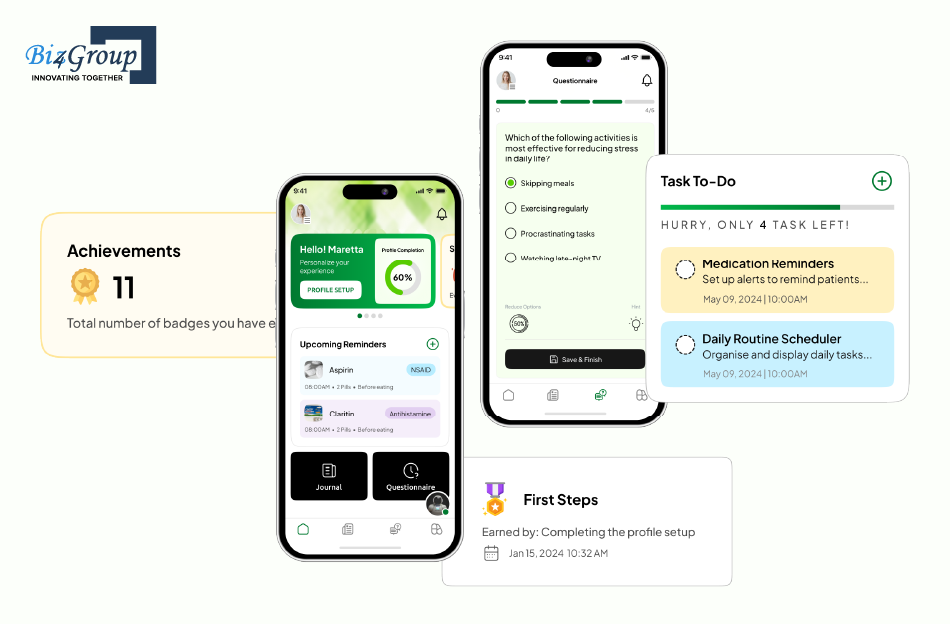
A strong example of this approach is by Biz4Group, an AI-powered mobile solution designed to support patients with cognitive conditions like dementia. This project shows how AI can continuously monitor patient behavior, provide timely assistance, and support long term care outside traditional hospital settings.
Key Highlights and Features:
- AI-powered memory support and daily routine assistance
- Personalized reminders for medication and tasks
- Mood tracking and behavioral pattern analysis
- Voice to text journaling and cognitive exercises
- Caregiver collaboration tools for better monitoring and support
- Real time insights to improve patient independence and well being
This directly connects with AI multi specialty patient system development, where continuous monitoring, patient engagement, and proactive care become essential across departments.
In a multi specialty hospital setup, similar capabilities can be extended to chronic disease patients. Instead of waiting for symptoms to escalate, your system can track, analyze, and alert care teams in real time.
That is the difference between reactive care and proactive care.
Oncology Patient Journey Management
Cancer care involves multiple specialties such as oncology, radiology, and pathology. Coordinating this journey manually can be complex and error prone. A unified system built through AI multi specialty patient system development connects all stages of care, improving visibility and collaboration across teams.
Example:
An oncology patient undergoing chemotherapy and imaging scans has all reports, treatment plans, and schedules available in one system. Oncologists and radiologists collaborate seamlessly without delays in accessing critical information.
Smart Follow Ups and Readmission Reduction
Hospitals often struggle with missed follow-ups and avoidable readmissions. AI tracks patient recovery patterns and automates follow ups based on real time inputs. This is a key advantage of development of AI multi specialty patient portal, helping maintain continuity of care after discharge.
Example:
After surgery, a patient receives automated follow-up reminders and symptom checks through the portal. If any concerning input is detected, the system alerts the care team, helping prevent complications and readmissions.
Virtual Care and Remote Monitoring
Not every patient needs to visit the hospital physically. AI-powered portals enable virtual health assistant and remote monitoring system. Hospitals adopting AI hospital portal development for multi specialty care can extend services beyond physical boundaries while maintaining care quality.
Example:
A patient recovering from orthopedic surgery shares progress updates and consults with the doctor through the portal. The care team monitors recovery remotely and adjusts treatment plans without requiring frequent hospital visits.
Multi Department Appointment Optimization
Scheduling across multiple specialties can become inefficient when handled manually. AI scheduling appointments based on availability, urgency, and patient preferences. This makes building an AI multi-specialty patient portal for hospital operations more efficient and patient-friendly.
Example:
A patient needing consultations from three departments receives a coordinated schedule in a single visit. The system aligns appointments efficiently, minimizing patient wait time and improving resource utilization.
Emergency Triage and Priority Routing
In urgent situations, identifying patient priority quickly is critical. AI analyzes symptoms, history, and inputs to route patients to the right department instantly. This is where how to develop AI multi specialty patient portal system strategies often focus on improving emergency response workflows. You can also integrate solutions like AI patient triage software to further enhance accuracy and speed in patient prioritization.
Example:
A patient reporting chest pain through the portal is immediately flagged as high priority. The system directs them to cardiology and alerts emergency staff, reducing delays in critical care.
These use cases show how AI multi specialty patient portal development goes beyond basic functionality and becomes a central system for managing complex hospital operations.
Now let’s break down the features that make all of this possible.
Also Read: Top Use Cases of Computer Vision in Healthcare
What Features Define a Successful AI Multi Specialty Patient Portal System?
When hospitals invest in AI multi specialty patient portal development for hospitals, the real value comes from the features that support daily operations, patient engagement, and clinical workflows. The goal is not to add more functionality. It is to build the right capabilities that connect your entire system and make it easier for both patients and providers to interact, decide, and act.
Here are the core features that define a strong multi specialty patient portal development integrating AI approach.
1. Unified Patient Records Across Specialties
A multi-specialty hospital generates patient data across different departments, but without a unified system, this data often stays fragmented. A well designed portal brings everything into a single view, allowing doctors to access complete medical histories without switching systems. When integrated with solutions like AI EMR/EHR software, this feature ensures structured, real-time data is available across departments. It improves diagnosis accuracy and reduces duplication of tests, making care more efficient and consistent.
2. Appointment and Resource Scheduling
Managing appointments across multiple specialties can quickly become complex. An AI-powered system simplifies scheduling by aligning doctor availability, patient preferences, and urgency levels in one place. This is where AI multi specialty patient system development adds value by optimizing schedules automatically. It reduces patient wait times, improves resource utilization, and helps your staff avoid manual coordination across departments.
3. Secure Messaging and Communication
Communication gaps between patients and providers often lead to delays in care. A centralized messaging system allows patients to interact with doctors, receive updates, and ask questions without unnecessary visits. With capabilities similar to an AI medical agent for patient interaction, hospitals can enable real time, intelligent conversations. This improves responsiveness while reducing the burden on front desk and support teams.
4. Patient Dashboard and Self Service Tools
Patients expect control over their healthcare experience. A well structured dashboard allows them to view reports, track appointments, manage prescriptions, and access care plans from a single interface. As part of AI multi-specialty patient portal development, this feature improves engagement and reduces dependency on hospital staff for routine tasks. It creates a more transparent and user-friendly experience for patients across all specialties.
5. Billing Insurance and Admin Modules
Administrative processes like billing and insurance verification often slow down operations. Integrating these functions into the portal allows patients to view invoices, make payments, and track insurance claims in one place. When supported by systems like AI patient management software, this feature streamlines backend operations. It reduces errors, speeds up processing, and improves overall financial workflows within the hospital.
These features form the foundation of a successful system. But to truly differentiate your platform, you need to go beyond the basics.
Let’s look at the advanced capabilities that take this to the next level.
Got the features in mind but not sure how to build them?
The difference between a good portal and a great one is how it is built. We can help you turn these features into a working system.
Start Your ProjectAre You Leveraging These Advanced AI Capabilities in Your Patient Portal Yet?
Once the core features are in place, the real differentiation comes from advanced capabilities. These are the features that turn your system from functional to intelligent. If you are planning AI multi specialty patient portal development for hospitals, this is where you gain a competitive edge. These capabilities help you move toward predictive, personalized, and automated care delivery.
Here are the advanced features that define next generation systems built through developing a scalable AI multi specialty patient portal software for hospitals:
|
Advanced Feature |
How It Works |
Why It Matters for Your Hospital |
|---|---|---|
|
AI Powered Symptom Checker and Smart Triage |
Patients input symptoms, and AI analyzes them using medical data to suggest possible conditions and route them to the right department. Systems similar to AI patient triage software enhance accuracy and prioritization. |
Reduces unnecessary visits, improves patient routing, and ensures critical cases get immediate attention. |
|
Predictive Analytics for Preventive Care |
AI analyzes historical and real time patient data to identify risk patterns and predict potential health issues before they become severe. This is powered by tools like AI healthcare analytics software. |
Helps your hospital shift from reactive treatment to proactive care, improving outcomes and reducing long term costs. |
|
Conversational AI and Virtual Assistants |
AI driven assistants interact with patients through chat or voice, answering queries, booking appointments, and guiding them through care processes. |
Improves patient engagement, provides 24/7 support, and reduces workload on administrative staff. |
|
Personalized Treatment Recommendations |
AI evaluates patient history, lifestyle data, and clinical inputs to suggest tailored treatment plans across specialties. |
Enables more precise and individualized care, especially for patients with multiple conditions. |
|
AI Driven Workflow Automation |
Routine workflows such as follow ups, alerts, documentation, and care coordination are automated based on patient activity and clinical triggers. |
Reduces manual workload, minimizes errors, and ensures consistent execution of care processes. |
|
Agentic AI for Autonomous Decision Support |
Advanced systems using agentic AI in healthcare can take semi autonomous actions like scheduling interventions or triggering alerts based on real time data. |
Improves speed of response, supports clinical teams, and enhances operational efficiency across departments. |
These advanced capabilities are what make AI multi-specialty patient system development truly impactful.
Now that you know what to build, the next step is understanding how to actually develop it the right way.
How to Develop an AI Multi Specialty Patient Portal for Hospitals Step by Step?
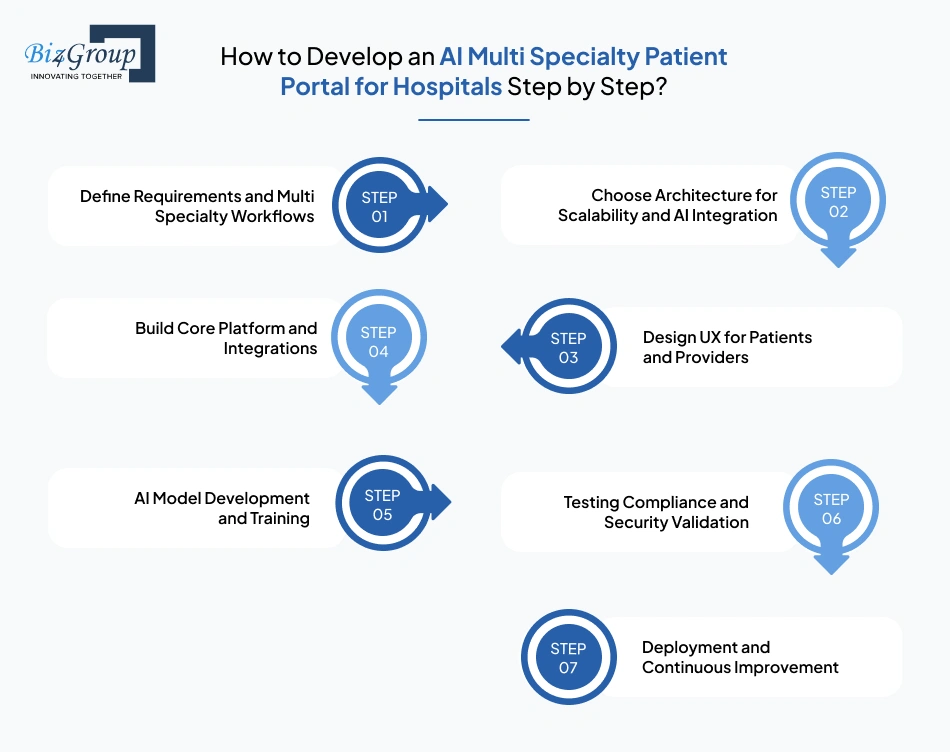
Building a scalable system is not just about coding features. It is about making the right decisions at each stage so your platform can support real hospital workflows. If you are planning how to develop an AI multi-specialty patient portal for hospitals, these steps will help you move from idea to execution without unnecessary delays or rework.
Step 1 Define Requirements and Multi Specialty Workflows
Start by understanding how your hospital actually operates across departments. Identify how patients move between specialties, where delays happen, and what processes need automation. This step sets the foundation for AI multi specialty patient portal development, ensuring your system is built around real use cases instead of assumptions.
- Identify key departments and workflows
- Map patient journeys across specialties
- Define core features and AI use cases
- Align goals with clinical and operational needs
Step 2 Choose Architecture for Scalability and AI Integration
Your architecture determines how well your system handles growth, AI integrations, and data flow. A scalable setup ensures your portal can support increasing users, departments, and AI workloads without performance issues. This is critical for building scalable AI patient portal for multi specialty hospitals strategies where long term scalability is a priority.
- Choose cloud infrastructure (AWS, Azure, or GCP)
- Use microservices for flexibility
- Plan data pipelines for AI processing
- Ensure interoperability with hospital systems
Step 3 Design UX for Patients and Providers
A powerful system fails if users struggle to navigate it. Your portal should be simple for patients and efficient for healthcare providers. Working with experts like UI/UX design ensures that both patient and provider experiences are intuitive, accessible, and aligned with real usage patterns.
- Design patient friendly dashboards
- Simplify doctor workflows
- Ensure accessibility across devices
- Focus on clarity and ease of use
Step 4 Build Core Platform and Integrations
Once the design is ready, development begins with core features and system integrations. This includes connecting EHR, billing systems, and communication tools into one platform. Many hospitals start with MVP development to validate key features before scaling the full system.
- Develop core modules and APIs
- Integrate EHR, EMR, and third party systems
- Enable secure data exchange
- Build communication and scheduling features
Step 5 AI Model Development and Training
AI model capabilities require proper data, training, and validation. This step focuses on building models that can analyze patient data, support decisions, and automate workflows. To ensure quality, many organizations choose to hire AI developers who understand healthcare specific requirements and compliance.
- Train AI models using healthcare datasets
- Implement NLP for patient interaction
- Build predictive analytics models
- Continuously refine model performance
Step 6 Testing Compliance and Security Validation
Healthcare systems must meet strict regulatory standards. Testing ensures your platform is secure, reliable, and compliant with regulations like HIPAA. This step is essential in how to develop AI multi specialty patient portal system strategies where data protection and system stability are non negotiable.
- Conduct functional and performance testing
- Ensure HIPAA compliance
- Validate data encryption and access control
- Test system under real world scenarios
Step 7 Deployment and Continuous Improvement
After testing, the system is deployed in a live environment. But development does not stop here. Continuous monitoring and improvements are required to keep the system efficient and up to date. This is where building an AI multi-specialty patient portal for hospitals becomes an ongoing process rather than a one time project.
- Deploy on secure cloud infrastructure
- Monitor system performance and usage
- Collect feedback from users
- Continuously update features and AI models
Following these steps ensures your AI multi specialty patient portal development for hospitals is structured, scalable, and aligned with real world healthcare needs.
Now that you understand the process, let’s look at the technology stack required to support it.
What Tech Stack Is Required to Build a Scalable AI Multi Specialty Patient Portal?
Choosing the right technology stack is not just a technical decision. It directly impacts how your system performs, scales, and integrates with existing hospital infrastructure. For AI multi-specialty patient portal development for hospitals, your tech stack should support real-time data flow, AI processing, security, and seamless integration across departments.
Here is a practical breakdown of the technologies typically used in build scalable AI patient portal for multi specialty hospitals:
|
Layer |
Technologies |
How It Supports Your System |
|---|---|---|
|
Frontend (Patient and Provider Interfaces) |
React, Angular, Vue.js, Flutter, Swift (iOS), Kotlin (Android) |
Ensures smooth, responsive interfaces for patients and healthcare providers across web and mobile platforms. Improves usability and engagement. |
|
Backend and Microservices |
Node.js, Python (Django, Flask), Java (Spring Boot), .NET Core |
Handles business logic, APIs, and data processing. Microservices architecture allows independent scaling of different modules. |
|
AI and Machine Learning |
TensorFlow, PyTorch, Scikit-learn, OpenAI APIs |
Powers predictive analytics, symptom checking, recommendations, and automation in AI multi specialty patient system development. |
|
Data Management and Storage |
PostgreSQL, MongoDB, MySQL, Redis |
Stores structured and unstructured patient data. Enables fast access and real-time data handling across departments. |
|
Healthcare Data Standards |
FHIR, HL7 |
Ensures interoperability between systems like EHR and EMR. Critical for seamless data exchange in multi specialty environments. |
|
Cloud and Infrastructure |
AWS, Microsoft Azure, Google Cloud |
Provides scalability, high availability, and secure infrastructure for handling large volumes of healthcare data. |
|
APIs and Integrations |
REST APIs, GraphQL, HL7 Interfaces |
Connects third party systems like labs, billing, insurance, and external healthcare services into one platform. |
|
Security and Compliance |
OAuth 2.0, JWT, SSL/TLS, HIPAA compliant frameworks |
Protects sensitive patient data and ensures regulatory compliance, which is critical in healthcare systems. |
|
DevOps and Deployment |
Docker, Kubernetes, CI/CD pipelines |
Enables faster deployment, scalability, and continuous updates without system downtime. |
|
Analytics and Monitoring |
Power BI, Tableau, ELK Stack |
Helps track system performance, patient behavior, and operational metrics for continuous improvement. |
A well-planned stack ensures your AI multi specialty patient portal development is not just functional, but scalable, secure, and future ready.
Now, let’s talk about what it actually costs to build and maintain such a system.
How Much Does AI Multi Specialty Patient Portal Development Cost in 2026?
If you are planning AI multi specialty patient portal development for hospitals, one of the first questions that comes up is cost.
The investment can vary significantly based on features, AI capabilities, integrations, and scale. On average, the cost of AI multi specialty patient portal development ranges between $40,000 to $300,000+.
This range is not fixed. A basic MVP will cost much less than a fully integrated, enterprise grade system designed for large hospital networks. The final cost depends on how complex and scalable you want your solution to be.
Let’s break this down so you can estimate where your project might fall.
What Is the Cost Breakdown by Features in AI Multi Specialty Patient Portal Development?
The biggest cost driver is the feature set you choose. Each module adds development effort, integrations, and testing complexity.
|
Feature / Module |
Estimated Cost Range |
Why It Impacts Cost |
|---|---|---|
|
Patient Registration and Profiles |
$5,000 – $15,000 |
Basic onboarding, user management, and profile handling |
|
$8,000 – $25,000 |
Multi specialty coordination and calendar optimization |
|
|
Unified Medical Records Integration |
$15,000 – $40,000 |
Requires EHR/EMR integration and real time data sync |
|
Secure Messaging and Communication |
$8,000 – $20,000 |
Includes chat systems, notifications, and security layers |
|
Billing and Insurance Management |
$10,000 – $30,000 |
Complex workflows, claim tracking, and payment systems |
|
AI Symptom Checker and Triage |
$20,000 – $60,000 |
Requires AI model development and validation |
|
Predictive Analytics and Insights |
$25,000 – $70,000 |
Advanced data modeling and analytics capabilities |
|
Remote Monitoring and Virtual Care |
$15,000 – $50,000 |
Integration with devices and real time data tracking |
These costs directly relate to development of AI multi specialty patient portal and increase as you move toward advanced AI capabilities.
What Factors Affect the Cost of AI Multi Specialty Patient Portal Development?
Several variables influence the final budget of AI hospital portal development for multi specialty care.
- Feature complexity
More advanced features like predictive analytics and AI triage increase development time - AI model requirements
Custom AI models cost more than prebuilt or API based solutions - Integration with existing systems
Connecting with EHR, billing, and third-party tools adds complexity - Scalability requirements
Systems designed for large hospital networks require stronger infrastructure - Compliance and security needs
HIPAA compliance and data protection increase development effort - Design and user experience
High quality UX requires more planning and testing
What Are the Hidden Costs in AI Multi Specialty Patient System Development?
Many hospitals underestimate these costs when planning AI multi specialty patient system development.
- Data migration and cleaning
Preparing existing data for new systems takes time and effort - AI training and model updates
AI systems require continuous learning and refinement - Maintenance and support
Ongoing updates, bug fixes, and monitoring are essential - Cloud infrastructure costs
Hosting, storage, and computing power increase as usage grows - Compliance audits and certifications
Regular audits are required to maintain regulatory standards
How to Optimize Cost in AI Multi Specialty Patient Portal Development for Hospitals?
You can control costs without compromising quality by making the right decisions early.
- Start with a custom MVP software to validate core features
- Prioritize essential modules before adding advanced AI capabilities
- Use scalable cloud infrastructure to avoid over investment upfront
- Choose modular architecture to expand features gradually
- Work with experienced teams who understand healthcare workflows
A structured approach to developing a scalable AI multi specialty patient portal software for hospitals ensures you invest wisely while building a system that grows with your needs.
Understanding the cost is important, but it is only one part of the equation.
Next, let’s look at the challenges you might face and how to solve them effectively.
Wondering what your exact project will cost?
Every hospital is different, and so is every solution. Get a tailored estimate based on your requirements and scale.
Get Cost EstimateWhat Are the Biggest Challenges in AI Hospital Portal Development for Multi-Specialty Care and How Can You Solve Them?
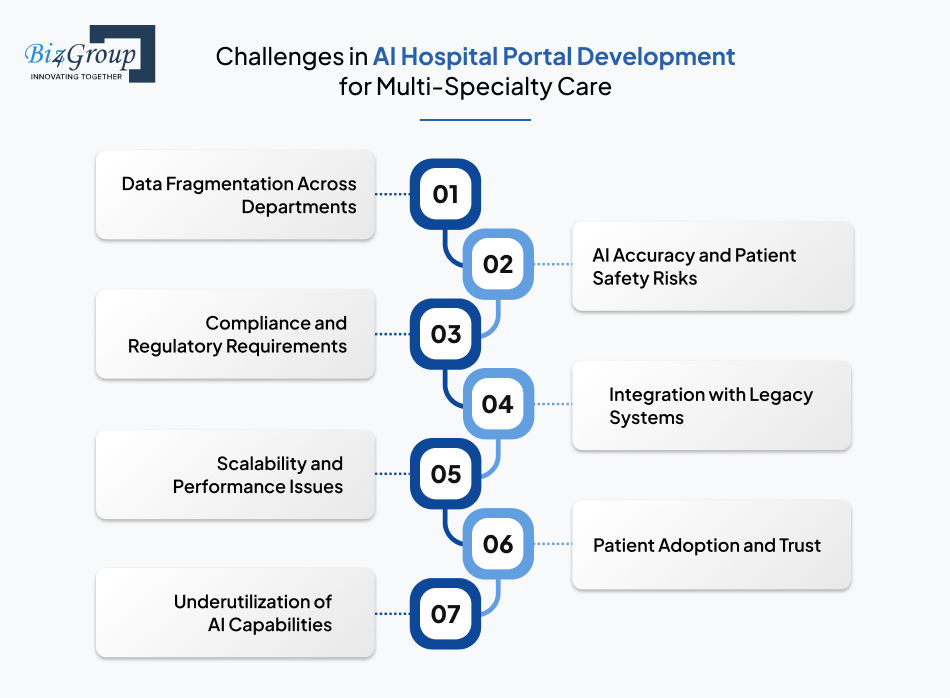
Building a scalable system is not just about features. It is about handling real challenges that come with data, compliance, integrations and adoption.
If you are planning AI multi-specialty patient portal development for hospitals, understanding these challenges early helps you avoid costly mistakes and delays.
Here is a clear breakdown of the most common challenges in AI hospital portal development for multi specialty care and how you can solve them.
|
Challenge |
Why It Happens |
How to Solve It |
|---|---|---|
|
Data Fragmentation Across Departments |
Different specialties often use separate systems, leading to disconnected patient records and incomplete data access. |
Use interoperability standards like FHIR and integrate systems such as AI EHR app to unify patient data across all departments. |
|
AI Accuracy and Patient Safety Risks |
AI models may produce incorrect or incomplete insights if not properly trained or validated. |
Implement human oversight, continuous model training, and validation using real clinical data to ensure safe and reliable outputs. |
|
Compliance and Regulatory Requirements |
Healthcare systems must meet strict regulations like HIPAA, making development more complex. |
Build compliance into the system from the start, use secure architectures, and follow industry standards for data protection and audits. |
|
Integration with Legacy Systems |
Older hospital systems are not designed for modern integrations, making data exchange difficult. |
Use API-first architecture and modern integration layers. Leveraging solutions built through AI medical web development helps bridge the gap between legacy and modern systems. |
|
Scalability and Performance Issues |
As patient data and system usage grow, performance can degrade without proper infrastructure. |
Use cloud-based infrastructure, microservices architecture, and scalable databases to ensure consistent performance under load. |
|
Patient Adoption and Trust |
Patients may hesitate to rely on AI-driven systems due to lack of understanding or trust. |
Focus on simple UX, transparency in AI decisions, and educate users about benefits. Align your system with evolving healthcare AI trends to meet user expectations. |
|
Underutilization of AI Capabilities |
Hospitals often implement AI but fail to use it effectively across workflows. |
Integrate AI into operations such as triage, monitoring, and analytics. Systems like chronic disease management software with AI show how AI can drive continuous patient care improvements. |
These challenges are common, but they are also manageable with the right approach. Now the final step is choosing the right partner who can help you build this the right way.
Why Should You Choose Biz4Group to Develop Your AI Multi-Specialty Patient Portal?
Choosing the right partner is critical when planning AI multi specialty patient portal development for hospitals. The success of your system depends not just on technology, but on how well your partner understands healthcare workflows, compliance, and scalability. Biz4Group positions itself as a reliable AI development company with strong expertise in building healthcare-focused digital systems that go beyond basic functionality.
As an experienced AI healthcare software development company, the focus is on delivering solutions that are practical, scalable, and aligned with real hospital needs.
Here is what sets the approach apart:
- Deep understanding of multi-specialty hospital operations and patient workflows
- Proven experience in AI multi-specialty patient system development with scalable architecture
- Strong capabilities in AI integration, including predictive analytics, triage, and automation
- End to end development from strategy and design to deployment and optimization
- Built in focus on compliance, data security, and interoperability standards
Biz4Group also aligns with industry benchmarks seen across top AI healthcare software development companies in USA, ensuring your solution meets both technical and business expectations.
Whether you are planning to develop AI patient portal for multi-specialty hospitals from scratch or modernize an existing system, the goal is to deliver a platform that supports long term growth, operational efficiency, and better patient outcomes.
If you are serious about building a connected, intelligent healthcare system, the next step is choosing a partner who can execute it the right way.
Ready to build something your hospital will not outgrow?
If you are serious about AI multi specialty patient portal development for hospitals, let’s build a system that scales with you.
Schedule a ConsultationFinal Thoughts: Is Your Hospital Ready for AI Multi-Specialty Patient Portal Development?
Healthcare is moving toward connected, intelligent systems, and hospitals that adapt early are the ones that scale efficiently and deliver better patient outcomes. If your current setup still relies on disconnected tools, it becomes harder to manage multi-specialty workflows, use data effectively, and meet rising patient expectations.
That is why AI multi specialty patient portal development for hospitals is becoming a priority. It helps you unify systems, automate operations, and create a more seamless care experience across departments.
When done right, the development of AI multi specialty patient portal gives you a long term foundation for growth, not just a short term upgrade.
If you are considering scalable solutions like an AI patient portal SaaS platform, the key is choosing the right approach and the right partner. As an experienced AI development company, Biz4Group focuses on building systems that are practical, scalable, and aligned with real healthcare needs.
Ready to turn your hospital into a connected, AI-driven system? Let’s build it right from the start.
FAQ
1. What is AI multi-specialty patient portal development for hospitals?
AI multi-specialty patient portal development for hospitals refers to building a unified platform that connects multiple departments, patient data, and workflows into one system. It allows patients and providers to interact through a single interface while AI supports automation, insights, and decision making. These portals go beyond basic access and help hospitals manage communication, scheduling, and care coordination more efficiently.
2. How to develop an AI multi-specialty patient portal for hospitals?
To develop AI patient portal for multi-specialty hospitals, you need to follow a structured approach that includes requirement analysis, architecture planning, AI integration, and compliance validation. Most healthcare systems start with an MVP, integrate EHR systems, and then scale with advanced AI features like predictive analytics and triage. The key is aligning development with real hospital workflows.
3. How much does AI multi-specialty patient portal development cost?
The cost of AI multi-specialty patient portal development typically ranges from $40,000 to $300,000+, depending on features, integrations, and AI capabilities. Basic portals cost less, while enterprise systems with AI, multi-specialty integrations, and compliance layers require higher investment.
4. What features are essential in AI hospital portal development for multi specialty care?
Core features include unified patient records, appointment scheduling, secure communication, billing systems, and dashboards. Advanced features such as AI triage, predictive analytics, and automation are becoming standard in AI hospital portal development for multi specialty care, helping improve efficiency and patient outcomes.
5. What challenges are involved in AI multi-specialty patient system development?
Common challenges include data fragmentation, integration with legacy systems, compliance requirements, and AI accuracy. Hospitals must also address data security and patient trust, as healthcare data is highly sensitive and requires strong protection measures.
6. How long does it take to build an AI multi-specialty patient portal?
Development timelines vary based on complexity. A basic system may take 4 to 6 months, while advanced platforms with multiple integrations and AI features can take 6 to 12 months or more. Delays often occur during integration with existing systems and compliance approvals.
7. Which company can build AI multi-specialty patient portal software for hospitals?
Choosing the right partner depends on experience in healthcare, AI expertise, and the ability to build scalable systems. Hospitals typically look for companies that understand compliance, integrations, and real-world workflows when selecting a partner for building an AI multi-specialty patient portal for hospital environments.
