Location :
Orlando, FL, USA
Location :
Orlando, FL, USA +1 (407) 714-1616
 info@biz4group.com


















Imagine a digital system that doesn’t wait for instructions but instead, understands your business goals, learns from real-time feedback, and takes independent actions to get the job done.
Read More
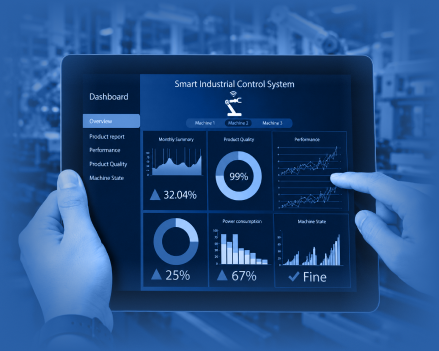
Why does a single press stop still catch you off guard even when everything seems under control? For many printing businesses, one unexpected breakdown quietly turns into a chain reaction: halted jobs, rushed reprints, and emergency service calls that strain both margins and client trust.
The situation is even worse when there is no dedicated technician on-site, which is common for operations under $20M. At the same time, downtime patterns across industries show how frequent and costly this issue has become, with 46% of business owners dealing with 6–10 downtime incidents every week.
That pressure is pushing printing businesses to rethink how they manage machine health. Instead of waiting for failures, many are now exploring AI-driven monitoring systems that can detect early warning signs directly from press sensors. This shift is becoming practical for smaller operations as well, especially as 31% of maintenance leaders have already reported rising downtime costs, making reactive fixes harder to sustain.
This is where conversations around AI predictive maintenance software development for printing press operations start becoming relevant. You must already be thinking:
Yes, you’re asking the right questions, and that’s exactly where most printing businesses reach when downtime starts affecting daily operations.
Let’s break down what actually changes when AI enters your maintenance workflow, how it connects with your printing machines, and what it takes to turn those frequent breakdowns into predictable, manageable events.
AI predictive maintenance software for printing press operations is a system that uses machine data and predictive analysis to identify potential equipment failures before they occur.
In a printing environment, presses run continuously and generate performance signals across key components. Instead of relying on manual checks or fixed service intervals, this software focuses on recognizing early indicators that suggest a machine may develop a fault.
The purpose is not to explain or control machine behavior, but to flag risks in advance so they can be addressed at the right time.
In practical terms, it is used to:
For printing press operations, it introduces a data-driven layer of visibility into machine health, helping teams stay aware of potential issues before they turn into disruptions.
Now that you have a clear understanding of what AI predictive maintenance software is, the next practical question becomes: how is it actually different from the maintenance approach most printing businesses already follow?
In many printing setups, maintenance is still scheduled at fixed intervals or triggered after a breakdown. This creates a gap between when a machine needs attention and when action is actually taken. To make the difference clearer from a decision standpoint, let’s look at how both approaches operate side by side.
|
Basis |
AI Predictive Maintenance |
Preventive Maintenance |
|---|---|---|
|
Approach |
Data-driven, condition-based |
Schedule-based, time-driven |
|
Timing of Maintenance |
Triggered based on machine condition |
Performed at fixed intervals |
|
Failure Handling |
Anticipates issues before failure |
Addresses wear based on routine checks |
|
Resource Requirement |
Reduces dependency on manual inspection |
Requires regular manual planning and checks |
|
Downtime Control |
Focuses on early risk visibility |
May still lead to unexpected breakdowns |
|
Decision Making |
Based on real-time machine signals |
Based on predefined schedules |
The key difference comes down to when and why maintenance decisions are made. Preventive maintenance follows a routine, while AI predictive maintenance responds to actual machine conditions. For printing press operations where timing directly impacts delivery commitments, this distinction shapes how effectively downtime can be managed.
Downtime in printing operations rarely appears as a single disruption; it compounds into missed schedules, material waste, and client dissatisfaction over time. As operational risks increase, investing in developing smart maintenance system for printing press workflow optimization becomes a necessary step to maintain control and stability.
The following factors explain why this shift is becoming unavoidable.
Unplanned downtime has evolved into a major financial risk across industries, with global losses reaching $1.4 trillion annually and $50 billion lost in a year for U.S. manufacturers alone.
These patterns highlight how unmanaged downtime directly impacts operational continuity.
The AI predictive maintenance market itself signals a clear directional shift. It was valued at $1.77 billion in 2025; it is projected to reach $19.27 billion by 2032, growing at a CAGR of 39.5%.
This shift reflects a larger transformation in how industrial systems are managed.
Traditional maintenance approaches rely on responding after issues occur, which significantly increases operational strain. In many cases, reactive maintenance costs 3–5 times more than preventive approaches.
This makes reactive strategies increasingly unsustainable in modern printing environments.
Modern printing presses operate with higher precision and interconnected components, making manual monitoring insufficient.
This complexity requires continuous, system-driven monitoring rather than manual checks.
Printing operations are expected to deliver uniform results across large production volumes without variation.
This creates pressure to maintain stable machine conditions throughout production cycles.
Printing businesses are increasingly evaluated based on how reliably they can maintain production flow without disruption. This is where AI software development for reducing downtime in commercial printing press operations becomes critical.
Operational control is no longer optional; it directly influences competitiveness.
The shift toward predictive maintenance reflects a broader move toward controlled, data-driven operations. Printing businesses that act now gain stronger command over downtime risks, production stability, and long-term operational resilience in an increasingly demanding environment.
Every delay is costing more than you think start acting before machines force the decision
Start Planning Smarter MaintenanceYou already know what the system aims to do. The next step is understanding how it actually operates inside a live printing setup. Before moving into AI predictive maintenance software development for printing press operations, it helps to see how the workflow plays out on the shop floor and how the system is structured behind it.
This workflow reflects how the software interacts with machines, processes data, and delivers predictive insights in real time.
While the workflow explains how the software operates, it is supported by a structured architecture designed for real-time processing, scalability, and continuous learning.
In a typical setup, the software continuously receives data from connected sensors, processes it at the edge for initial refinement, and forwards it to cloud-based AI systems for deeper analysis. The machine learning models evaluate patterns and detect anomalies, and the software delivers these predictions to users through dashboards and alerts.
When both the workflow and structure are aligned, the system starts working as a continuous monitoring loop rather than a one-time check. This is what shifts maintenance from reactive decisions to timely actions, which is the core idea behind printing press downtime prevention AI software development.
AI predictive maintenance software analyzes real-time machine signals to understand component behavior under normal and stressed conditions. It continuously detects subtle changes indicating wear or instability. Understanding this is especially important when planning AI predictive maintenance software development for printing press operations that deliver accurate and reliable predictions.
The software collects vibration signals from rotating components such as bearings, rollers, and motors. These signals reflect how smoothly or irregularly a component is operating during production.
Even small changes in vibration frequency or amplitude can indicate early-stage mechanical issues. The software tracks these variations over time to understand whether the machine is operating within normal limits or drifting toward abnormal behavior.
Temperature sensors monitor heat levels in critical components such as motors, bearings, and electrical systems. The software uses this data to track how heat builds during operation and whether it stays within expected ranges.
Gradual or sudden temperature changes often indicate internal stress or inefficiency. Continuous monitoring allows the software to detect abnormal thermal patterns that are not visible during routine checks.
In printing systems, pressure plays a key role in maintaining consistent ink flow and hydraulic balance. The software analyzes pressure readings from ink delivery systems and other fluid-based components.
Fluctuations in pressure can signal inconsistencies in system performance. By tracking pressure patterns over time, the software identifies irregular behavior that may affect operational stability.
The software monitors rotational speed (RPM) and motor load to understand how hard the machine is working under different conditions. This data provides insight into whether components are operating efficiently or experiencing strain.
Variations in speed consistency or unexpected load changes can indicate performance deviations. The software correlates this data with historical patterns to detect unusual operating conditions.
Some advanced systems also use acoustic sensors to capture sound patterns generated by machine components. The software analyzes these sound signals to detect subtle irregularities that are not captured by vibration or temperature data.
Changes in sound frequency or intensity can reveal early-stage issues in moving parts. This adds an additional layer of monitoring, especially for complex mechanical systems.
The software tracks the alignment and positioning of components such as rollers and moving assemblies. This data helps ensure that machine parts maintain proper positioning during operation.
Small misalignments can affect performance consistency. Continuous tracking allows the software to detect positional deviations over time.
Electrical signals such as voltage, current, and power consumption are also analyzed to understand how efficiently the machine is operating. The software monitors these patterns to detect irregular energy usage.
Unexpected spikes or drops in electrical behavior can indicate inefficiencies or internal issues. This data helps provide a broader view of machine health beyond mechanical performance.
AI predictive maintenance software does not rely on a single data point. It combines multiple signals to build a complete understanding of machine behavior. Each data type provides a different perspective, and together they help the software identify patterns that would not be visible through isolated measurements.
By continuously analyzing these diverse data inputs, the software builds a precise understanding of machine behavior and supports early detection of deviations. This data-driven approach forms the foundation of effective printing machine maintenance AI software development, enabling more accurate predictions and better maintenance.
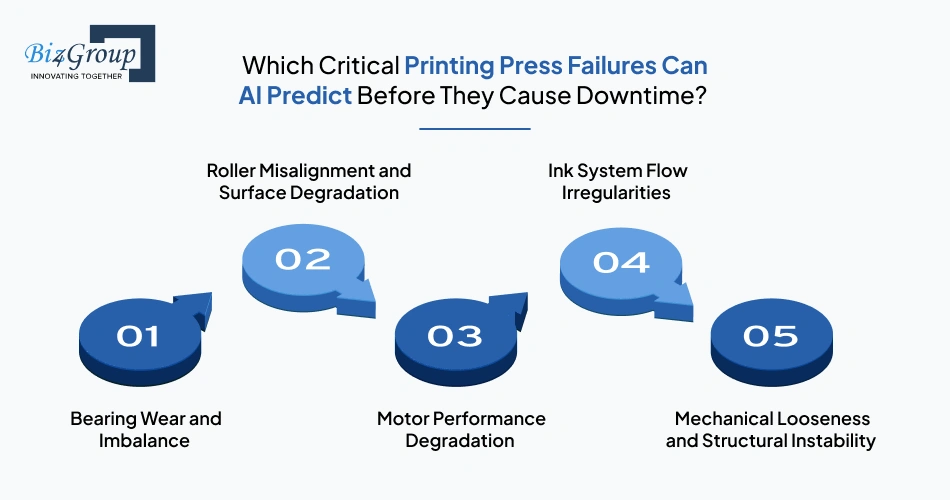
Printing press failures rarely occur without warning; they develop through gradual shifts in machine behavior that are difficult to detect during routine operation. Recognizing these evolving patterns becomes essential during AI printing press predictive maintenance system development as they show where it delivers clear operational control.
Bearings degrade progressively under continuous rotational stress, often without visible signs until failure is close.
AI predictive maintenance systems surface these changes early, allowing controlled intervention before mechanical breakdown.
Rollers directly influence material movement and output consistency, making alignment critical.
AI predictive maintenance software detects these shifts early and maintains consistent production quality and prevents downstream issues.
Motor efficiency declines over time due to internal stress and operational load variations.
AI predictive maintenance software allows early identification of motor issues before complete failure disrupts operations.
Ink delivery systems require stable flow behavior to maintain consistent output.
Early detection by AI predictive maintenance software prevents large-scale defects and reduces material wastage during production.
Continuous printing press operations introduce gradual loosening in interconnected machine parts.
AI predictive maintenance software addresses these changes early and prevents cascading mechanical issues across the system.
Predicting these failure patterns enables a shift from reactive maintenance to controlled, data-driven operations, reflecting how AI in printing industry is reshaping production reliability. Strong AI predictive maintenance software development for printing industry ensures early intervention, reduced downtime, and stable operational performance.
Stop reacting after damage begins start identifying risks while production is still running
See What Your Machines Are Hiding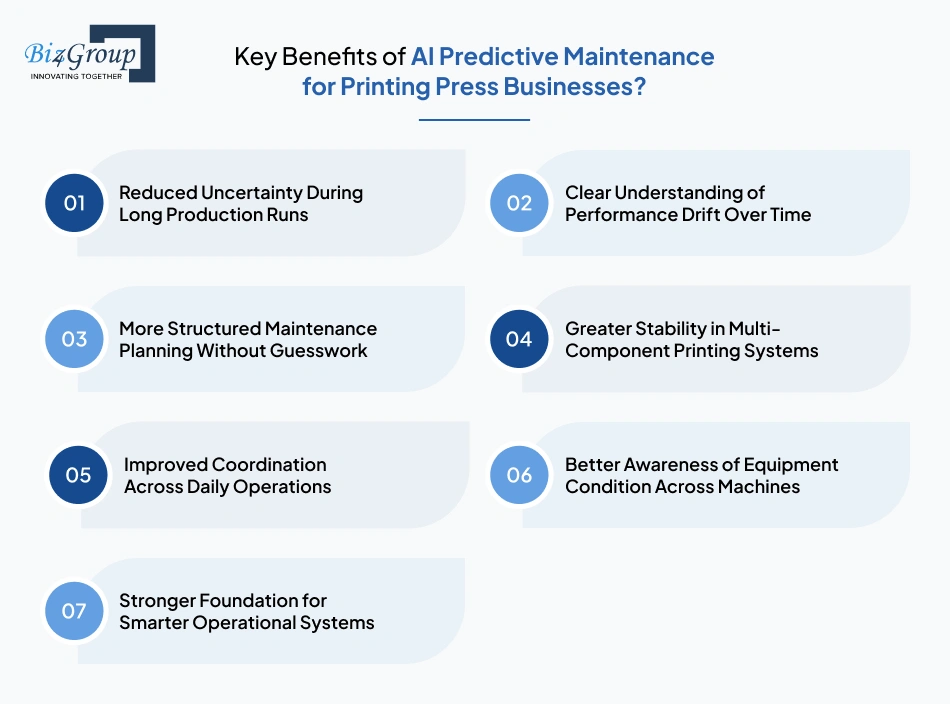
Day-to-day printing operations often depend on routine checks and operator experience, which makes early signs of machine stress easy to miss. This is where AI predictive maintenance software development for printing press operations starts influencing how teams manage machines during actual production.
The following benefits reflect how operations change internally once this approach is in place.
Printing jobs often run continuously for extended hours, where small performance shifts are difficult to notice in real time. AI predictive maintenance software brings clarity during these runs by highlighting subtle changes as they develop, helping teams stay aware of machine condition without interrupting production.
Machines do not fail suddenly; they gradually move away from their normal behavior. AI predictive monitoring makes this drift visible by tracking how performance changes across cycles. This helps teams recognize patterns that are otherwise difficult to identify through periodic checks.
Maintenance decisions are often based on assumptions when there is limited visibility into machine condition. With continuous insights, teams can plan maintenance activities based on actual machine behavior rather than fixed schedules or manual judgment.
Printing presses rely on multiple interconnected components working in sync. When one part begins to behave differently, it can affect the entire system. AI predictive monitoring helps teams understand these interdependencies and manage them more effectively within AI printing management environments.
Unexpected issues often create misalignment between production and maintenance teams. With early visibility into machine condition, both teams can align their actions around the same information, reducing confusion during ongoing operations without disrupting workflow continuity.
In facilities with multiple machines, tracking individual performance manually becomes difficult. AI predictive maintenance software provides a clearer view of how each machine behaves over time, helping teams manage multiple assets more effectively without relying on fragmented observations.
As printing operations evolve, there is a growing need to connect machine insights with broader digital workflows. AI predictive maintenance supports this shift by providing reliable machine-level data that fits naturally into environments focused on building AI software for industrial systems.
With the development of AI predictive maintenance software for printing press operations, businesses move toward a more controlled and insight-driven way of handling machine performance.
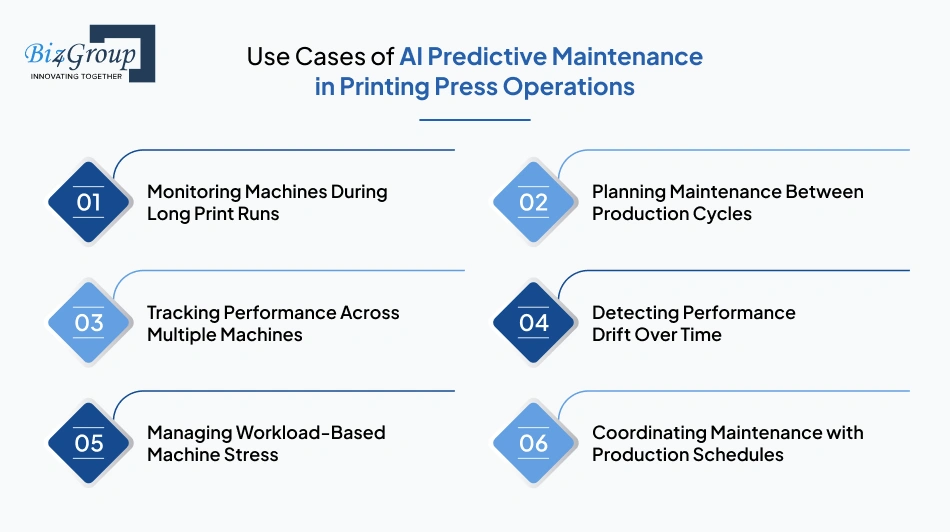
Printing operations do not fail in isolation; they evolve through daily production pressure, long machine cycles, and shifting workloads. This is where industrial printing AI predictive maintenance software solutions begin to shape how teams handle real situations on the shop floor.
During extended production cycles, machines operate continuously without pause, making it difficult to manually track performance changes in real time.
Production schedules often leave limited room for unexpected interruptions, making timing critical for maintenance activities.
Managing multiple printing machines simultaneously makes it challenging to understand how each one is performing at any given time.
Machines rarely show immediate failure signs, but gradual performance changes build up over repeated operations.
Printing machines often operate under varying workloads, which affects how components behave under pressure.
Misalignment between maintenance and production often creates operational friction and delays.
These use cases show how AI predictive maintenance systems become part of everyday decision-making rather than isolated tools. When teams build AI predictive maintenance software for printing press operations, they are shaping workflows that reflect real world use cases of AI in printing industry and support more structured, predictable operations.
Printing operations rely on continuous machine performance, where small changes often go unnoticed during routine checks. As teams move toward developing an AI predictive maintenance software for printing businesses, it becomes important to organize features in a way that supports real operations without adding unnecessary complexity.
|
Feature |
What It Should Do |
|---|---|
|
Continuous Machine Monitoring |
Track how machines behave during production without interrupting ongoing work |
|
Multi-Component Tracking |
Observe different machine parts together to understand overall performance |
|
Performance Trend Tracking |
Highlight how machine behavior changes across production cycles |
|
Multi-Machine Visibility |
Give a clear view of multiple machines from one place |
|
Condition Overview Panel |
Make it easy to understand machine condition during active operations |
|
Feature |
What It Should Do |
|---|---|
|
Unusual Behavior Detection |
Identify changes in machine activity that do not match normal operation patterns |
|
Early Warning Signals |
Highlight potential issues before they become noticeable during production |
|
Pattern Tracking Over Time |
Recognize repeating behavior changes across multiple cycles |
|
Deviation Identification |
Detect when machines begin to move away from their normal condition |
|
Adapting to Machine Behavior Over Time |
Improve understanding of machine patterns as more operational data becomes available |
|
Feature |
What It Should Do |
|---|---|
|
Maintenance Planning Support |
Help teams schedule maintenance around production timelines |
|
Workflow Alignment |
Keep maintenance and production activities working in sync |
|
Task Prioritization Guidance |
Indicate which machine issues need attention first |
|
Activity Coordination View |
Give clarity on ongoing maintenance and production activities |
|
Alert-Based Action Support |
Help teams decide when to act based on system signals |
|
Feature |
What It Should Do |
|---|---|
|
System Connectivity |
Connect with production and maintenance systems already used on the shop floor |
|
Data Flow Management |
Ensure machine data moves smoothly across connected systems |
|
Historical Data Access |
Store and retrieve past machine performance records when needed |
|
Cross-System Visibility |
Provide a unified view of machine and operational data |
|
External System Support |
Allow connection with additional tools used in daily workflows |
|
Feature |
What It Should Do |
|---|---|
|
Simple User Interface |
Make it easy for teams to use the system without extra complexity |
|
Real-Time Status Display |
Show current machine condition during active production |
|
Role-Based Access Control |
Ensure the right people see the right information |
|
Alert Notifications View |
Present alerts clearly so teams can understand them quickly |
|
Activity History View |
Show past actions and system observations for reference |
When features are structured this way, the system becomes easier to understand and use in real operations. This is where printing equipment failure prediction software development integrating AI begins to support more organized maintenance decisions and clearer visibility across daily production workflows.
Build systems that actually fit your workflow not just look good on paper
Build What Actually Works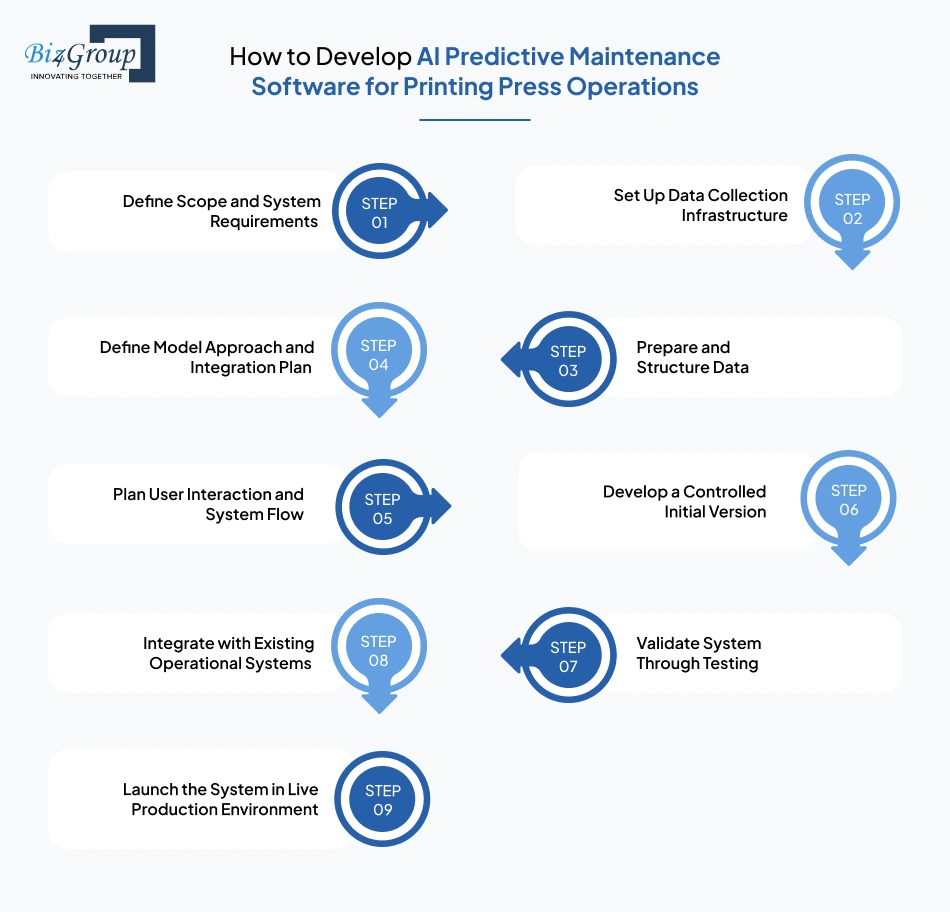
Moving from manual monitoring to a system that can track machine behavior continuously requires a clear development path. When planning AI predictive maintenance software development for printing press operations, each step should focus on what needs to be built and how it fits into existing production environments.
Here’s how the process unfolds in a structured way.
Start by identifying what the system will cover and what problems it needs to address. This sets the direction for the entire development process.
The system needs a reliable way to gather machine data from the shop floor. This step focuses on setting up that foundation.
Collected data must be organized before it can be used effectively within the system.
At this stage, decisions are made on how the system will interpret machine data. This is where AI model selection becomes important for aligning system behavior with real machine conditions.
The AI predictive maintenance must be designed around how teams will interact with it during daily operations. Working with a UI/UX design company helps define how information will be presented and accessed.
Also Read: Top UI/UX Design Companies in USA
Rather than building a full system at once, begin with a focused version that can be tested in real conditions. Many teams approach this stage through MVP development services to validate core functionality early.
Also Read: Top MVP Development Companies in USA
The AI predictive maintenance system must be tested under real production conditions to ensure it performs reliably. This stage often involves collaboration with software testing companies to verify system behavior.
For the system to function effectively, it must connect with tools already used in printing operations. Integration with processes like printing MIS AI automation helps align system outputs with production workflows.
Also Read: AI Prepress Automation Software Development for Printing Companies
Once the system is tested and integrated, the next step is to move it into real production use. This stage focuses on making the system available for daily operations without disrupting ongoing workflows.
A structured approach like this keeps development clear and grounded in real printing operations. Understanding these steps makes it easier to build AI system for industrial printing machine failure prevention with clarity, without overcomplicating the process or losing focus on operational needs.
Setting up the right technology stack is about making sure every part of the system supports how machines are monitored, data is handled, and decisions are delivered in real operations. When planning AI predictive maintenance software development for printing press operations, it helps to break the stack into clear layers so nothing important is missed.
|
Architecture Layer |
Recommended Tools |
Purpose of Tools in Development |
|---|---|---|
|
Data Collection Layer |
IoT Sensors, PLC Systems |
Capture real-time machine signals directly from printing equipment during production |
|
Edge Processing Layer |
Edge Gateways, Raspberry Pi, Industrial PCs |
Filter and organize data close to the machine before sending it further, reducing delay and unnecessary load |
|
Data Streaming Layer |
Apache Kafka, MQTT |
Move continuous machine data reliably across the system without interruptions |
|
Data Processing Layer |
Python, Pandas, NumPy |
Clean and structure incoming data using python development so it becomes usable for system logic |
|
Model Training Layer |
Scikit-learn, TensorFlow, PyTorch |
Train models on historical data so the system learns normal and changing machine behavior |
|
Model Serving Layer |
Flask, FastAPI |
Deliver real-time predictions from trained models so the system can respond during live operations |
|
Backend Layer |
Node.js, Express.js |
Manage system logic and handle data flow between layers through structured API development |
|
Integration Layer |
REST APIs, Webhooks |
Connect with existing production tools and support API development for smooth system communication |
|
Frontend Layer |
React.js, Next.js |
Present machine information clearly using ReactJS development and NextJS development so teams can interact easily |
|
Data Storage Layer |
PostgreSQL, MongoDB, AWS S3 |
Store real-time and historical machine data for tracking and future reference |
|
Alert and Notification Layer |
Firebase, Twilio, Email Services |
Send alerts when system detects important changes so teams can take action at the right time |
|
Security and Access Layer |
OAuth, JWT, Role-Based Access Control |
Control who can access the system and protect operational data from unauthorized use |
|
Monitoring and Deployment Layer |
AWS, Azure, Docker, Kubernetes |
Run the system in production, monitor performance, and ensure stability during continuous operations |
Also Read: 15+ ReactJS Development Companies in USA: 2026 Guide
A structured stack like this keeps each layer focused while ensuring the system works smoothly from data collection to real-time response. It helps teams move forward with clarity and build a system that fits naturally into printing operations without unnecessary complexity.
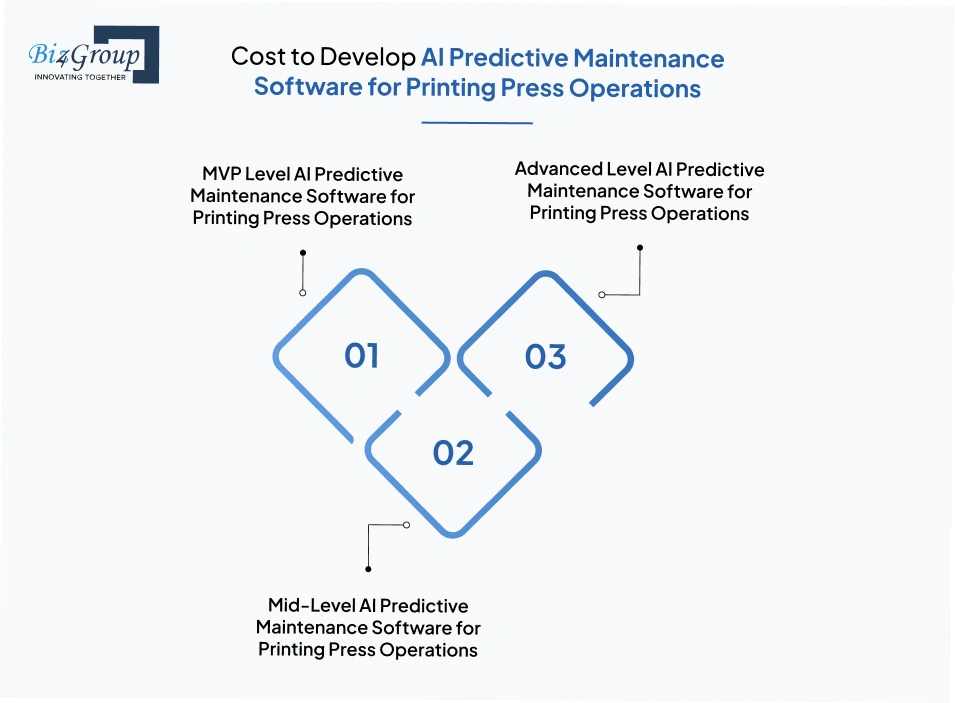
Costs in this space are not fixed because they depend on how much of the system you plan to build and how deeply it connects with your operations. When planning AI predictive maintenance software development for printing press operations, most businesses fall within a range of $25,000 to $250,000+. Let’s break down what that looks like.
|
Development Level |
Estimated Cost Range |
Scope |
|---|---|---|
|
MVP Level AI Predictive Maintenance Software for Printing Press Operations |
$25,000 – $60,000 |
Covers basic data collection, limited machine monitoring, and simple alerts for initial validation |
|
Mid-Level AI Predictive Maintenance Software for Printing Press Operations |
$60,000 – $120,000 |
Includes multi-machine tracking, better data handling, and structured dashboards for daily operations |
|
Advanced Level AI Predictive Maintenance Software for Printing Press Operations |
$120,000 – $250,000+ |
Full-scale system with real-time insights, deeper integrations, and support across multiple production environments |
Costs increase based on how the system is trained to understand machine behavior and how well it connects with real-time data. This is where AI integration costs play a major role in shaping overall system capability.
Estimated impact: $10,000 – $60,000
A clear and usable system requires careful planning of how operators interact with it. UI/UX design cost depends on how detailed the interface is and how closely it matches real workflow needs.
Estimated impact: $5,000 – $25,000
Managing machine data over time requires proper storage and structured handling. The cost depends on how much data is collected and how long it needs to be retained.
Estimated impact: $8,000 – $40,000
Connecting the system with tools already used in operations adds complexity. This includes aligning with production systems and ensuring smooth data flow across platforms.
Estimated impact: $10,000 – $50,000
Ensuring the system performs reliably during real operations requires structured testing. This stage impacts cost based on how extensively the system is validated across machines.
Estimated impact: $7,000 – $30,000
A clear cost structure helps you plan AI software development for reducing downtime in commercial printing press operations with better visibility and control, while keeping the system aligned with real operational needs. With the right approach, overall AI software development cost becomes more predictable and easier to manage, supporting long-term efficiency.
Spending once on the right system avoids repeated losses from unexpected production stoppages
Estimate Your Real Investment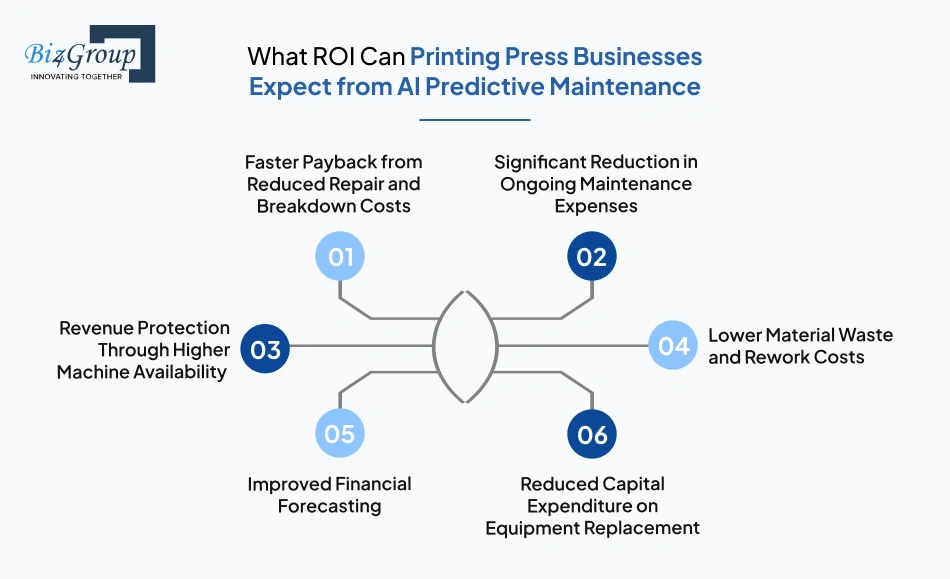
Financial returns in printing operations depend on how much cost is avoided and how much revenue is protected during production. When machines run without unexpected interruptions, the financial impact becomes visible quickly.
This is where AI predictive maintenance software development for printing industry starts delivering measurable returns across cost, output, and long-term investment.
Unexpected breakdowns often lead to repeated repair expenses that add up quickly. Predictive systems reduce these occurrences, which directly improves return on investment.
Maintenance costs increase when machines are repaired only after failure. AI predictive maintenance software shifts spending toward controlled actions rather than repeated fixes.
Production stoppages directly affect revenue, especially in high-volume printing environments where delays lead to financial loss.
Machine instability during production often leads to defective output, which increases material waste and rework expenses.
Unpredictable machine failures make it difficult to plan operational budgets accurately. Predictive systems improve forecasting reliability.
Frequent breakdowns accelerate machine wear and force early replacement, increasing capital investment pressure.
ROI from predictive maintenance comes from multiple financial areas working together, from reduced repair costs to protected revenue and lower capital expenses. With the right approach, industrial printing AI predictive maintenance software solutions enable businesses to achieve faster payback, controlled spending, and stronger financial stability across operations.
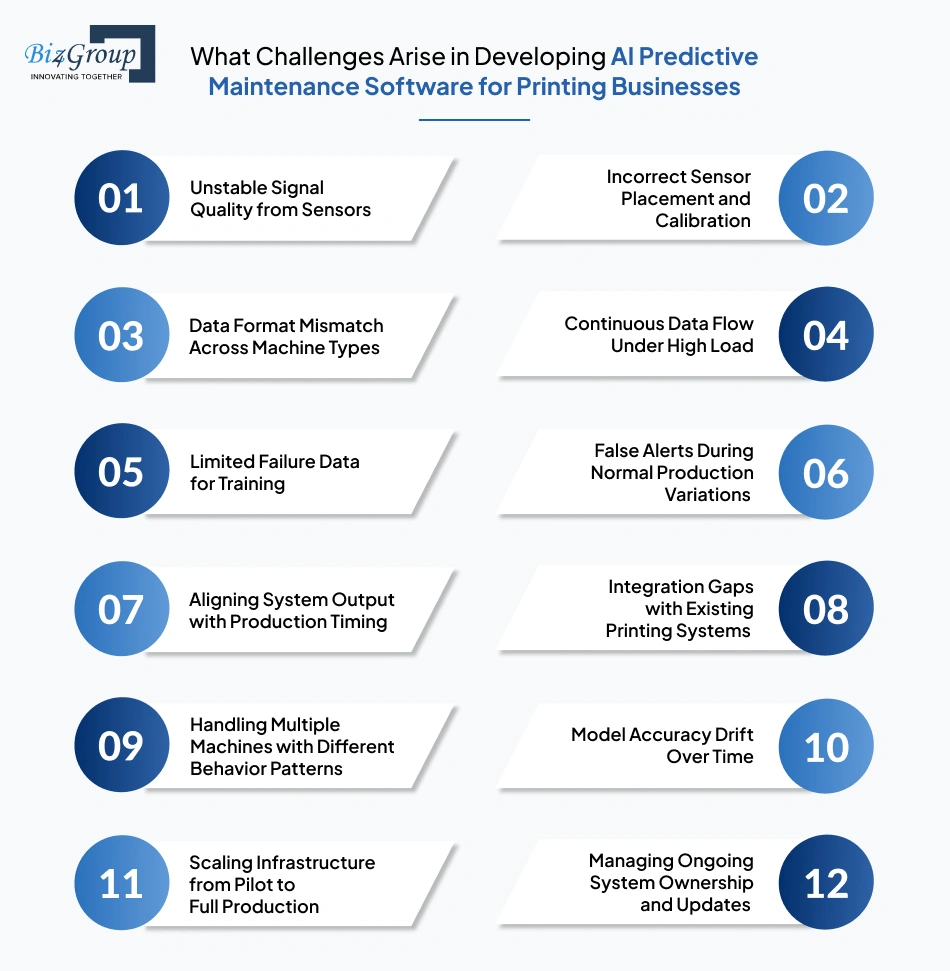
Challenges in this space usually appear when systems interact with real machines, not during planning. When working on AI predictive maintenance software development for printing press operations, issues tend to come from data quality, machine diversity, and system behavior in live environments.
Machine signals can become noisy due to vibration, dust, or worn components. Use calibrated sensors and apply filtering at the collection stage so only stable and usable signals are processed by the system.
Poor sensor positioning can lead to misleading data, even when the system is correctly designed. Define placement standards for each machine type and validate sensor readings during setup to ensure reliable data capture.
Different printing machines generate data in varied formats, which creates inconsistency. Introduce a normalization layer that converts all inputs into a unified structure before they move into processing stages.
Printing environments generate constant data, which can overwhelm the system during peak operations. Use streaming pipelines with buffering so data moves steadily without loss or delay during heavy production cycles.
Most printing setups lack structured records of past failures, which limits system learning. Start with normal operating data and hire AI developers who can structure and label data progressively, so the system improves based on real production behavior.
Also Read: Cost to Hire an AI Software Developer in 2026
Machines behave differently under varying loads, which can trigger unnecessary alerts. Train the system on data from multiple production conditions so it can distinguish between expected variation and actual risk signals.
Alerts that do not match production schedules create confusion for operators. Link system outputs with production timelines, so maintenance actions can be planned without interrupting ongoing jobs.
Many printing environments rely on tools that are not designed to connect easily. Define integration points early and work with an experienced AI development company to ensure compatibility with existing production systems without disrupting workflows.
Also Read: Top 29+ AI Development Companies in USA
Each machine operates differently based on usage and condition, which complicates analysis. Treat machines as independent data sources while maintaining a unified system view for overall monitoring.
Machine behavior changes as components wear, which can reduce system accuracy. Continuously update the system using recent data, so it adapts to evolving machine conditions without losing reliability.
A system that works on a few machines may not perform the same across the entire floor. Design modular architecture so additional machines can be added without affecting system performance.
Systems require regular updates as production conditions evolve. Hire a dedicated AI development team to monitor performance and refine the system over time.
Handling these challenges early keeps development grounded and avoids issues during deployment. With the right approach, printing press downtime prevention AI software development becomes more structured, helping teams build systems that perform reliably under real production conditions without unnecessary complexity.
Handle system complexity early before it turns into production level disruption
Solve It Before It Slows You DownPrinting businesses often reach a point where recurring machine issues start affecting production timelines and overall output reliability. Many teams begin asking practical questions around finding the right partner who understands both technology and real shop-floor challenges.
If you are dealing with frequent breakdowns and exploring reliable partners, you are not alone. Many businesses today are in a similar position, and are asking, “we are struggling with unexpected printing press failures and want to work with US-based AI vendors who can provide predictive maintenance and monitoring solutions. ‘This is where working with an experienced team like Biz4Group LLC becomes critical.
As a US-based custom AI software development company we focus on building systems that align with real operational needs instead of adding unnecessary complexity. Our approach to AI predictive maintenance software development for printing press operations centers on how machines behave during production and how teams interact with that data in real time.
What makes this approach practical is the ability to translate system capabilities into actual production environments. Their experience with AI printing software solutions reflects how machine monitoring, system integration, and workflow alignment come together in real business scenarios.
To understand how this translates into execution, let us look at real implementations delivered by us:
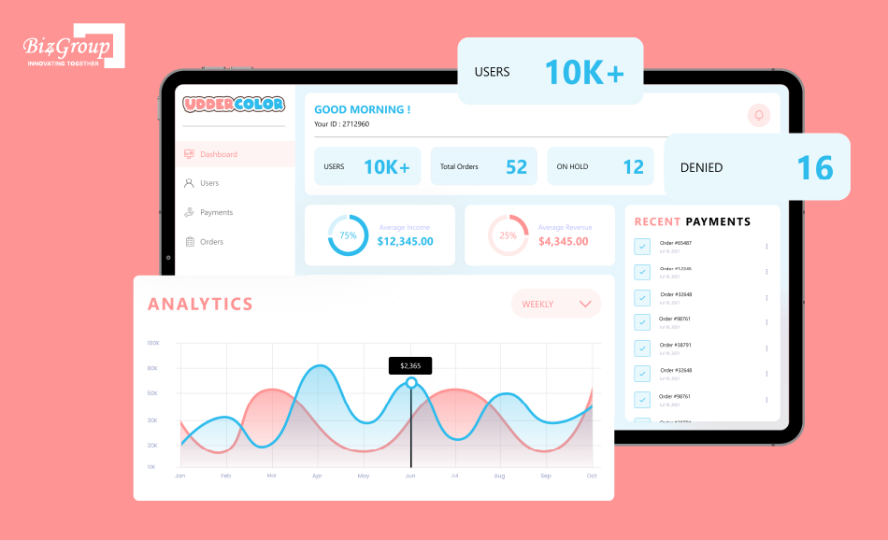
The way artwork validation, order routing, and production flow are structured reflects how controlled workflows and early issue checks reduce operational friction. This brings more consistency and predictability into high-volume printing environments.

The way customization, order handling, and production steps are structured keeps workflows organized and reduces manual effort, which helps maintain consistency and smoother execution in high-volume printing environments.
Here’s what Biz4Group LLC offers beyond development:
We focus on implementing systems that work within your current setup. Our AI integration services ensures that new capabilities connect smoothly with existing production tools without creating additional complexity.
Our work across industries reflects a strong AI portfolio, where each solution is built around real operational needs rather than theoretical models. This helps ensure systems perform reliably in production environments.
We design and deliver AI solutions for enterprises with a focus on scalability, reliability, and long-term usability. This ensures the system continues to perform as your operations grow and evolve.
Working with the right partner is about execution, not just planning. With our experience and approach, we position ourselves as a reliable team among companies that develop predictive maintenance software for printing press machines in USA, helping you move toward stable and predictable production systems. Let’s talk.
AI predictive maintenance brings a shift in how printing operations handle machine performance during daily production. Instead of reacting to breakdowns, teams move toward a more structured approach where machine behavior is tracked continuously and actions are planned before issues escalate.
This shift is already visible as printing companies use AI to predict machine failures and reduce maintenance costs, making operations more controlled and financially stable. The focus stays on reducing disruption and improving how maintenance decisions are made within real production environments.
As systems evolve, the role of AI product development services becomes more practical, especially when they are aligned with actual workflows rather than isolated features. That is where Biz4Group LLC helps translate these ideas into systems that work reliably in day-to-day operations.
For teams planning to modernize printing press with AI predictive maintenance and looking for expert vendors in USA, having the right execution support makes it easier to move forward with clarity and confidence. Connect with us today!
Most teams begin by identifying machines that cause frequent disruptions or high repair costs. Starting with a focused scope helps validate how the system performs before expanding across the entire production setup.
Costs usually fall between $25,000 to $250,000+, depending on system complexity, number of machines, and integration depth. Early-stage implementations are more affordable, while full-scale systems require higher investment due to broader coverage.
A basic version can take around 4–6 weeks, while a more complete system may require 6-16+ months. Timelines depend on data availability, system scope, and how deeply the solution integrates with existing workflows.
Accuracy improves when systems are trained on real production data instead of test environments. Continuous data collection and refinement help the system adapt to machine behavior over time, reducing false alerts and improving reliability.
Focus on real implementation experience, ability to handle production data, and understanding of printing workflows. Teams that have worked on operational systems tend to deliver solutions that fit better into daily processes.
These systems treat each machine independently while maintaining a unified view of operations. This approach allows the system to track unique performance patterns without losing overall visibility across the production floor.

with Biz4Group today!
Our website require some cookies to function properly. Read our privacy policy to know more.