 Location :
Orlando, FL, USA
Location :
Orlando, FL, USA +1 (407) 714-1616
 info@biz4group.com

- Legal templates often carry hidden clause inconsistencies, leading to compliance risks and revenue impact across high-volume contract environments
- AI template clause validation agent development for legal tech helps bring structure to template handling and reduces dependency on repeated manual reviews
- Organizations can develop AI clause validation agent for legal teams to standardize clause usage and maintain consistency across contracts and jurisdictions
- Key use cases include template validation, audit readiness, and pre-signature checks, ensuring clauses remain aligned with defined legal standards
- The cost to build AI template clause validation agent ranges between $30,000 to $200,000+, depending on scope, data readiness, and integration complexity across legal systems
- With experience in legal platforms, Biz4Group LLC understands structured legal workflows and supports building scalable validation solutions
How confident are you that every clause in your legal template is accurate and aligned with current standards? For many organizations, that clarity is difficult to maintain. Templates are reused across contracts and teams, and small inconsistencies often go unnoticed.
Over time, these gaps start affecting outcomes. Companies lose around 9.2% of annual revenue due to poor contract management, and a large part of that risk comes from unchecked clause-level issues handled daily by corporate legal teams.
The growing complexity is pushing law firms to think of solutions that can validate clause templates with minimal human intervention, before they are used. Well, an AI template clause validation agent might be the answer you are looking for as it:
- Handles growing template variations across multiple agreements and teams
- Supports legal consultants working across different contract formats
- Reduces friction when templates are reused in different contexts
The agent is now becoming central to corporate legal and contract management teams that deal with high contract volumes and evolving requirements. This noticeable shift is bringing AI template clause validation agent development to spotlight. Moreover, AI-powered solution can save up to 240 hours per lawyer per year, contributing to a $32 billion annual impact in the US legal and accounting sectors.
Moving forward, this blog will break down how to develop AI clause validation agent for legal teams, what factors influence development decisions, and how a legal software development company supports implementation within real legal workflows.
What is AI Template Clause Validation Agent and How Does it Work?
Legal teams often deal with large volumes of templates that must stay consistent across clients, jurisdictions, and internal standards. This is where an intelligent validation layer becomes useful. So,
What is AI Template Clause Validation Agent?
An AI template clause validation agent is a system designed to review legal document templates and verify whether clauses meet predefined standards, policies, and compliance requirements.
It analyzes clause structure, language, and placement, then flags inconsistencies and missing elements. This allows legal teams to maintain accuracy and consistency across contracts without relying entirely on manual review processes.
Role of AI Template Clause Validation Agent in Legal Workflow
- Acts as an early checkpoint during template creation to ensure clauses follow internal legal standards before being used across contracts.
- Supports pre-signature reviews by identifying missing or inconsistent clauses before documents are finalized and shared with clients.
- Helps maintain consistency when templates are reused across different matters, practice areas, or legal teams within the firm.
- Assists in compliance validation by checking whether clauses align with jurisdiction-specific legal requirements and internal policies.
- Reduces dependency on manual reviews by handling repetitive validation tasks, allowing legal professionals to focus on critical decision-making.
How Does AI Agent for Template Clause Validation Works?
To understand the working of AI agent for template clause validation, let’s walk through each step it follows while reviewing clauses and checking them against defined standards.
1. AI Scanning of Templates
AI agent for template clause validation begins by reviewing uploaded legal templates in various formats. It reads the document structure and prepares the content for analysis. This initial scan ensures the template is ready for deeper validation without requiring manual formatting or preprocessing by the legal team.
2. Identification of Clauses
Once the template is processed, the AI agent breaks the document into individual clauses. It recognizes clause boundaries based on structure and language patterns. This step helps isolate each clause so it can be reviewed independently without losing its context within the document.
3. Analysis of Clause Content
Each identified clause is then examined for its intent and wording. This AI assistant now checks how the clause is written and whether it aligns with expected legal language or not. This step ensures that clauses are not only present but also correctly framed for their intended purpose.
4. Compares Against Standards and Rules
After analysis, clauses are matched against predefined templates, internal policies, or regulatory guidelines. The system checks whether the clause follows approved formats and includes required elements. This comparison helps maintain uniformity across all legal documents used by the firm.
5. Validates Compliance and Accuracy
The AI agent then evaluates whether each clause meets compliance expectations for specific jurisdictions or not. It ensures that required legal terms are included and that no critical elements are missing. This step reduces the risk of non-compliant or incomplete templates being used.
6. Flags Issues and Suggests Corrections
Finally, the AI agent for template validation highlights clauses that need attention and provides suggestions for improvement. It may recommend edits, additions, or replacements based on predefined standards. This allows legal teams to review and finalize templates more efficiently without starting from scratch.
Legal teams that plan to build AI template clause validation agent solutions often start by focusing on this workflow. It creates a structured approach to reviewing templates while reducing dependency on repetitive manual checks.
Core AI Components that Power Legal Template Clause Validation Agent
When a system reviews legal templates, the real work happens behind the scenes through multiple layers that handle reading, understanding, and validating clauses. Each layer plays a specific role, ensuring that the validation process stays structured and reliable without depending on manual checks.
1. Natural Language Processing for Legal Text Parsing
This layer reads legal documents and breaks down the text into smaller parts such as sentences and clauses. It understands legal language patterns and structure. As a result, the legal AI agent processes complex templates and prepares them for accurate clause-level validation.
2. Clause Classification Models
Once the text is parsed, classification models identify the type of each clause based on its purpose. They label clauses such as indemnity, termination, or confidentiality. This helps the system understand what each clause represents before applying any validation logic.
3. Embedding Models for Semantic Similarity
These models focus on meaning rather than exact wording. They compare clauses based on intent, even if phrasing is different. This allows the system to match clauses with standard templates and detect variations that may not follow expected legal language.
4. Rule-Based Validation Engine
This layer applies predefined legal rules and internal policies to each clause. It checks whether required elements are present and correctly structured. During AI template clause validation agent development for legal tech, this engine ensures that validation stays consistent across all templates.
5. Legal Knowledge Base and Ontology
The system relies on a structured collection of legal terms, relationships, and standards. This knowledge base helps it understand how different clauses relate to each other. It provides context that supports accurate validation without relying only on surface-level text analysis.
6. LLMs for Contextual Understanding
LLMs help the system interpret clauses in context rather than in isolation. They understand intent, tone, and variations in legal language. These open source LLMs layer play a key role when teams make AI clause verification agent for contracts that need to handle complex and evolving legal wording.
Each of these components works together to form a reliable validation layer. When aligned properly through structured AI model development, they allow AI agent to review templates with clarity and consistency, without relying entirely on manual effort.
Also Read: NLP vs LLM: Choosing the Right Approach for Your AI Strategy
Bring Structure to Your Contract Templates
Introduce a smarter validation layer to reduce inconsistencies across legal documents and improve overall template reliability.
Start Structuring My TemplatesTop 6 Use Cases of AI Template Clause Validation Agent for Law Firms
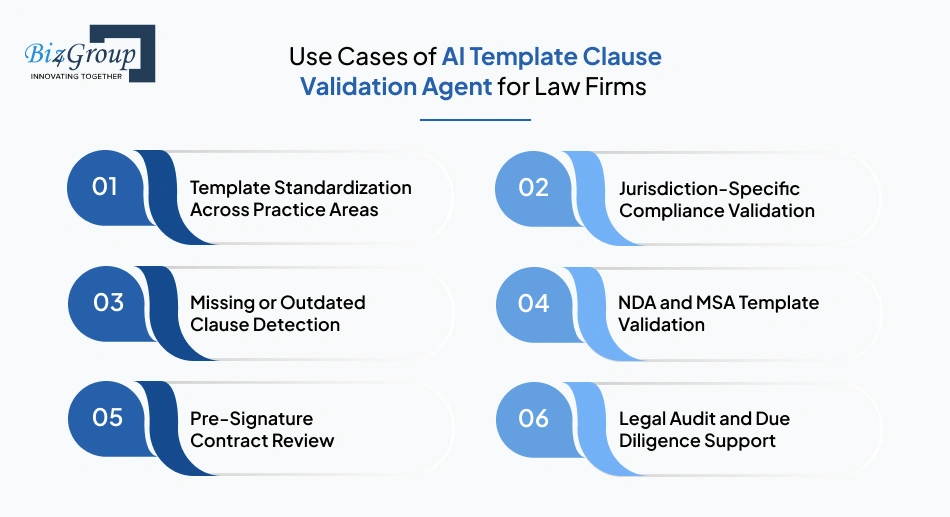
Legal templates are reused across multiple contracts, teams, and jurisdictions. Over time, even small changes can create inconsistencies that are difficult to track manually.
The following 6 use cases show where validation fits into daily legal work and how teams handle these challenges in a more structured way.
1. Template Standardization Across Practice Areas
Different legal teams often maintain their own versions of templates. These variations may seem minor, but they create confusion during reviews and reduce consistency across the firm. A clause validation layer helps bring all templates back to a shared standard without requiring manual comparison and:
- Aligns clause structure and wording across different departments
- Detects variations in similar agreements used by multiple teams
- Maintains a uniform template library for internal use
- Reduces dependency on manual cross-checking between practice areas
2. Jurisdiction-Specific Compliance Validation
Legal templates often need adjustments based on location-specific requirements. Managing these differences manually becomes difficult when templates are reused across regions. AI agent for template clause validation helps ensure that each version meets the required legal expectations and:
- Checks whether required regional clauses are included in templates
- Identifies clauses that may not meet local regulations
- Helps maintain separate variations of templates for different jurisdictions
- Supports consistent handling of cross-border agreements
3. Missing or Outdated Clause Detection
Templates evolve over time, but updates are not always applied consistently. Some clauses may be removed unintentionally, while others remain unchanged even when standards shift. This creates gaps that are hard to detect during routine reviews. The AI template clause validation agent:
- Highlights missing clauses that should be part of standard templates
- Flags outdated sections that need revision
- Detects incomplete structures within agreements and legal document management system
- Supports regular template updates without reviewing each document manually
Also Read: AI Legal Drafting Software Development
4. NDA and MSA Template Validation
Frequently used agreements like Non-Disclosure Agreements and Master Service Agreements require repeated validation as they are customized for different clients. Small edits across versions can introduce inconsistencies that slow down reviews and approvals. The legal AI agent for template clause validation:
- Reviews high-frequency templates before reuse
- Ensures essential clauses are consistently included
- Detects structural differences across similar agreements
- Helps maintain reliability in documents used at scale
5. Pre-Signature Contract Review
Final reviews are often done under tight timelines, which increases the chances of missing important details. A structured validation step helps ensure templates are complete before they are shared for approval or signing. It:
- Identifies gaps or inconsistencies before finalization
- Highlights clauses that may require correction
- Ensures templates meet internal standards before approval
- Supports smoother final review without repeated manual checks
6. Legal Audit and Due Diligence Support
During audits or due diligence, legal teams need to review large volumes of templates within limited time. Manual checks make this process slower and less consistent, especially when documents vary in structure. AI template clause validation agent:
- Analyzes multiple templates in bulk for consistency
- Helps organize validation results for easier review
- Improves accuracy when reviewing large contract sets
- Supports structured document assessment using a legal document analyser tool
These use cases reflect how validation becomes part of everyday legal work rather than a separate task. As firms move forward with AI template clause validation agent development for legal tech, the focus shifts toward maintaining consistency, reducing manual effort, and keeping templates reliable across different legal scenarios.
Key Business Benefits of AI Template Clause Validation Agent Development for Law Firms
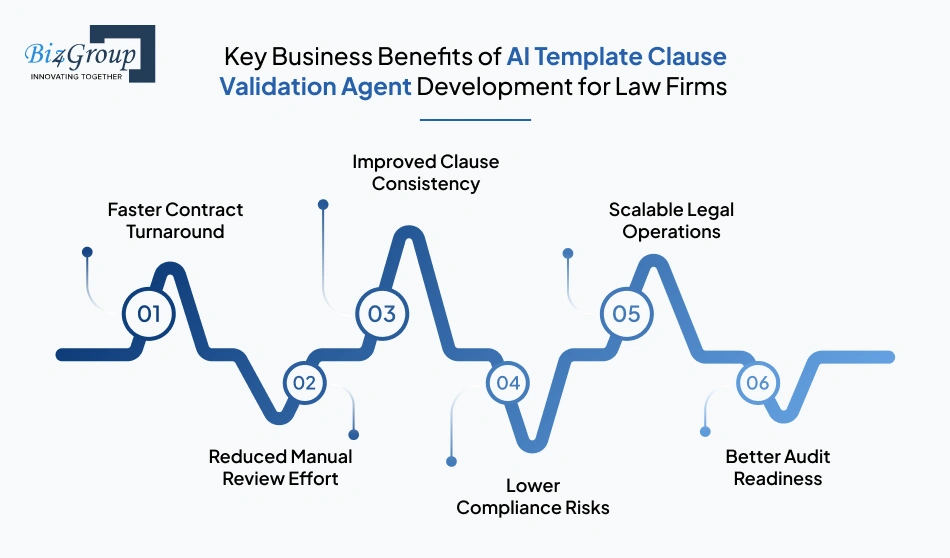
Legal teams are under constant pressure to handle more contracts without increasing costs at the same pace. If you are planning to build or launch AI template clause validation agent for your legal firm, the real question is how this translates into measurable business value, not just operational improvement.
Understanding the outcomes will help you identify where your solution can drive adoption, improve efficiency, and create long-term value for law firms. Let’s break down the key areas where this approach directly impacts costs, revenue flow, and overall financial efficiency.
1. Faster Contract Turnaround
Delays in contract processing often lead to slower deal closures and missed revenue opportunities. When validation becomes faster, contracts move through approval stages without unnecessary waiting time.
- Business Impact: Faster contract cycles directly support quicker deal execution, reducing delays that often slow down deal closures
- Outcome: Firms can reduce turnaround time by 30–50%, which helps accelerate revenue realization and improves client responsiveness while maintaining deal momentum
2. Reduced Manual Review Effort
Manual validation requires significant billable hours from legal professionals. Repetitive review tasks consume time that could otherwise be spent on higher-value legal work. AI template clause validation allows firms to use their resources more effectively across revenue-generating activities.
- Business Impact: Lower dependency on manual effort reduces operational costs by limiting time spent on repetitive validation work
- Outcome: Firms can cut review-related effort by up to 40%, leading to better utilization of legal resources and improved efficiency across teams
3. Improved Clause Consistency
Inconsistent templates often lead to rework, delays, and potential revenue leakage when agreements need correction after review. AI template clause validation agent helps maintain consistency and avoid disruptions in contract finalization while keeping deal timelines stable.
- Business Impact: Consistency reduces the need for repeated revisions and avoids delays in finalizing agreements across different teams
- Outcome: Firms experience fewer correction cycles, which helps maintain steady deal flow and reduces hidden costs linked to rework in contract processing
4. Lower Compliance Risks
Non-compliant clauses can result in financial penalties, legal disputes, or delayed approvals. Even small inconsistencies may lead to costly consequences over time. Reducing these risks helps protect financial stability and avoid unexpected expenses.
- Business Impact: Reduced exposure to compliance-related risks protects the firm from financial losses caused by penalties or disputes
- Outcome: Law firms can lower risk-related costs and avoid penalties, supporting more predictable financial planning and reducing unexpected liabilities in AI solutions for enterprises.
5. Scalable Legal Operations
As contract volume increases, hiring additional legal staff becomes expensive and difficult to manage. Scaling without increasing costs is a key business priority. A structured approach to AI template clause validation agent development allows firms to handle growth without expanding overhead at the same rate.
- Business Impact: Firms can handle higher volumes of contracts without proportional cost increases in staffing and operations
- Outcome: Legal teams can scale operations efficiently by 25%. This allows firms to grow without significantly expanding their workforce while supporting automation for legal workflow.
6. Better Audit Readiness
Audits often require reviewing large volumes of contracts within tight timelines. Delays or inconsistencies can increase compliance costs and create financial exposure. AI agent for template clause avoids last-minute effort while aligning validation with a structured AI contract management system.
- Business Impact: Structured validation improves audit preparedness and reduces time spent on audit-related corrections and document reviews
- Outcome: Law firms can reduce audit preparation time by 35-40%, while maintaining stronger financial and regulatory control across contracts
Also Read: Why AI Projects Fail in Companies That Lack AI Readiness?
In the long run, firms that build AI agent for legal template compliance position themselves to control costs, reduce financial risk, and support consistent revenue movement without increasing dependency on manual legal effort.
Simplify Clause-Level Validation Across Teams
Move toward a more controlled approach where templates are reviewed consistently without adding manual effort at every step.
Improve My Validation ProcessCore Features Required to Build AI Template Clause Validation Agent for Law Firms
A system that handles clause validation needs more than basic document review capabilities. Each feature should support how legal teams manage templates, maintain standards, and review clauses consistently. The focus here is on what the system must be able to do in real-world scenarios.
Before going deeper, let's look at the core capabilities that shape development of intelligent AI clause validation agent and ensure they perform reliably across different legal workflows.
|
Feature |
What It Does |
Why It Matters |
|---|---|---|
|
AI Clause Detection Engine |
Identifies and separates clauses within a legal document so each section can be reviewed independently. |
Enables precise validation at the clause level instead of reviewing the entire document as one block, which improves accuracy for teams that build AI contract clause validation agent workflows. |
|
Template Comparison System |
Compares templates against approved versions to identify differences in structure or wording. |
Helps maintain consistency across legal templates to prevent unnoticed variations that can affect document quality. |
|
Risk Scoring Mechanism |
Assigns a risk level to each clause based on predefined criteria. |
Allows teams to focus on high-risk sections first instead of reviewing every legal clause with the same level of attention. |
|
AI Clause Recommendation Engine |
Suggests corrections or improvements when a clause does not meet expected standards. |
Reduces time spent rewriting legal clauses by guiding users toward acceptable language and structure. |
|
Compliance Rule Configuration |
Allows teams to define and update rules based on internal policies or legal requirements. |
Ensures validation remains aligned with current legal regulations and firm-specific standards. |
|
Multi-Jurisdiction Support |
Adjusts template clause validation based on region-specific legal requirements. |
Supports accurate use of AI template clause validation agent across different locations without manual adjustments each time. |
|
Reporting Dashboard |
Displays validation results in a structured and easy-to-review format. |
Helps teams quickly understand issues and track template clause validation outcomes across multiple legal documents. |
|
Audit Logs |
Records clause validation activities and changes made to templates over time. |
Provides traceability and supports accountability during internal reviews or audits. |
|
Version Control System |
Tracks template versions and maintain a history of clause updates. |
Ensures teams work with the correct version and can review past changes when needed. |
|
User Access and Approval Controls |
Manages permissions for reviewing, editing, and approving legal clause templates. |
Prevents unauthorized changes and maintains control over the validation process. |
Each of these features plays a specific role in AI template clause validation agent development, shaping how the system performs during real legal work. When combined, they create a structured validation layer that supports consistent template management without adding unnecessary complexity.
Step-By-Step Process to Develop an AI Template Clause Validation Agent for Legal Teams
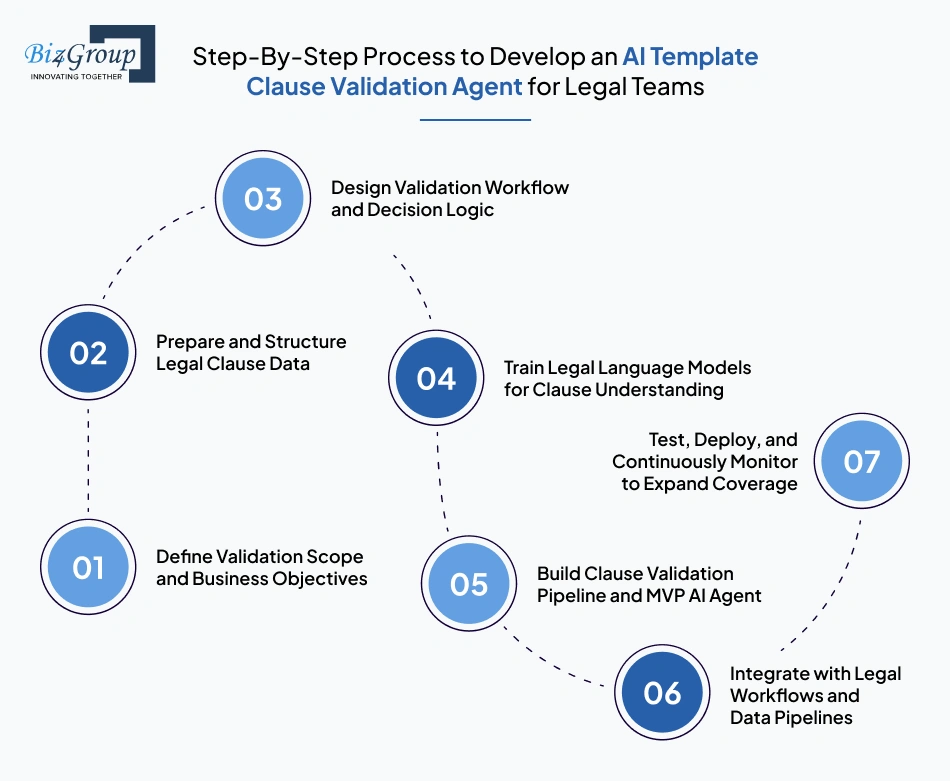
Legal teams approach clause validation based on contract types, internal policies, and compliance needs. To understand how to develop an AI template clause validation agent for legal teams, let us break down the process into clear steps:
1. Define Validation Scope and Business Objectives
This step focuses on setting clear boundaries for what the AI agent should validate before development begins. Without this clarity, the agent may produce inconsistent or irrelevant validation outputs.
- Identify contract types that the AI agent will handle in the initial phase
- Define which clauses must always be validated across templates
- Set clear rules for valid, invalid, or missing clause conditions
- Align business expectations with how the AI agent will perform validation
2. Prepare and Structure Legal Clause Data
The AI agent depends on structured clause data to learn and validate effectively. Raw templates need to be organized so the agent can interpret them correctly during training and validation.
- Extract clauses from existing legal templates and group them by type
- Standardize clause formats to remove inconsistencies
- Label clauses based on intent and usage context
- Create a reference dataset that guides the AI agent during validation
3. Design Validation Workflow and Decision Logic
At this stage, the focus is on defining how the AI agent will make validation decisions. This includes mapping how the agent processes clauses and determines whether they meet defined standards.
- Define how the AI agent evaluates clauses from input to final output
- Create rule paths for identifying valid, invalid, or missing clauses
- Set clear conditions for triggering validation flags
- Structure interaction flow in coordination with a UI/UX design company so outputs are easy to review
Also Read: Top UI/UX Design Companies in USA
4. Train Legal Language Models for Clause Understanding
The AI agent must understand legal language in context to validate clauses accurately. This step focuses on improving how the agent interprets clause meaning across different formats and writing styles.
- Train models on structured legal clause datasets
- Improve recognition of clause intent across variations
- Continuously refine AI models based on validation results
- Apply fine-tuned LLM’s to improve how the AI agent handles complex clause structures
5. Build Clause Validation Pipeline and MVP AI Agent
Once data and validation logic are ready, the next step is to assemble the AI agent into a working flow. The goal is to create an initial version that can perform clause validation in a controlled setup.
- Connect clause input, validation logic, and output generation into one flow
- Assemble a working pipeline that allows the AI agent to process templates end-to-end
- Validate outputs using structured datasets before release
- Work with MVP development services providers to ensure that the AI agent is stable and usable
Also Read: Top MVP Development Companies in USA
6. Integrate with Legal Workflows and Data Pipelines
For the AI agent to be useful, it needs to fit into existing legal processes. This step ensures the agent can operate within the tools and workflows already used by legal teams.
- Connect the AI agent with document management platforms
- Enable validation within ongoing contract workflows
- Set up structured data exchange between tools
- Integrate AI models so the AI agent runs smoothly within the environment
7. Test, Deploy, and Continuously Monitor to Expand Coverage
The final step focuses on validating how the AI agent performs and improving it over time. This ensures the agent continues to handle new templates and clause types accurately.
- Test the AI agent using structured clause datasets before deployment
- Validate outputs across different contract types for consistency
- Deploy the AI agent after confirming stable validation performance
- Monitor validation gaps and update rules or datasets accordingly
- Expand coverage by adding new clause types and improving validation logic
Also Read: Software Testing Companies in USA
These steps give a clear direction for teams looking to implement structured validation in their workflows. When followed with the right intent, these steps to create AI clause validation agent for legal contracts become easier to execute while keeping the process aligns with real legal requirements.
Recommended Technology Stack for AI Template Clause Validation Agent Development
A reliable tech stack is required when planning to develop AI template clause validation agent for legal tech. It ensures validation works smoothly across different document types and workflows.
This becomes important when teams plan to develop AI agent for legal document clause analysis within structured legal environments using full stack development practices. It also keeps the AI agent stable as data volume grows, and requirements evolve.
|
Architecture Layer |
Recommended Technology |
Purpose |
|---|---|---|
|
Frontend Layer |
React.js / Angular |
Provides a clean interface where legal teams can upload templates, review validation results, and manage workflows through structured web development practices. |
|
Backend Layer |
Handles request processing, validation logic execution, and communication between components to build AI contract clause validation agent workflows efficiently. |
|
|
AI/ML Models |
OpenAI API/ Hugging Face / Custom Models |
Powers clause understanding and validation logic by interpreting legal language and identifying inconsistencies. |
|
NLP Processing |
SpaCy / NLTK |
Breaks legal text into clauses and prepares it for analysis by identifying structure and key elements. |
|
Vector Database |
Pinecone / Weaviate |
Stores clause embeddings so similar clauses can be matched based on meaning rather than exact wording. |
|
Primary Database |
PostgreSQL / MongoDB |
Stores templates, validation results, and structured clause data for consistent retrieval and updates. |
|
API Layer |
REST / GraphQL APIs |
Connects frontend, backend, and AI components to ensure smooth data flow across the application. |
|
Cloud Infrastructure |
AWS / Azure / GCP |
Hosts the application and manages scalability, ensuring the platform performs reliably under different workloads. |
|
Monitoring & Logging |
Prometheus / ELK Stack |
Tracks system performance, logs validation activity, and helps identify issues during runtime. |
Each layer in this stack supports a specific part of the validation flow, making it easier to manage and scale as requirements grow. A clear technology foundation in AI template clause validation agent development for legal tech ensures that updates can be handled without disrupting ongoing legal operations.
Make Template Validation More Reliable
Align your legal templates with defined standards and reduce gaps that often go unnoticed during reuse.
Strengthen My Template AccuracyWhat is the Cost to Develop AI Template Clause Validation Agent for Legal Tech?
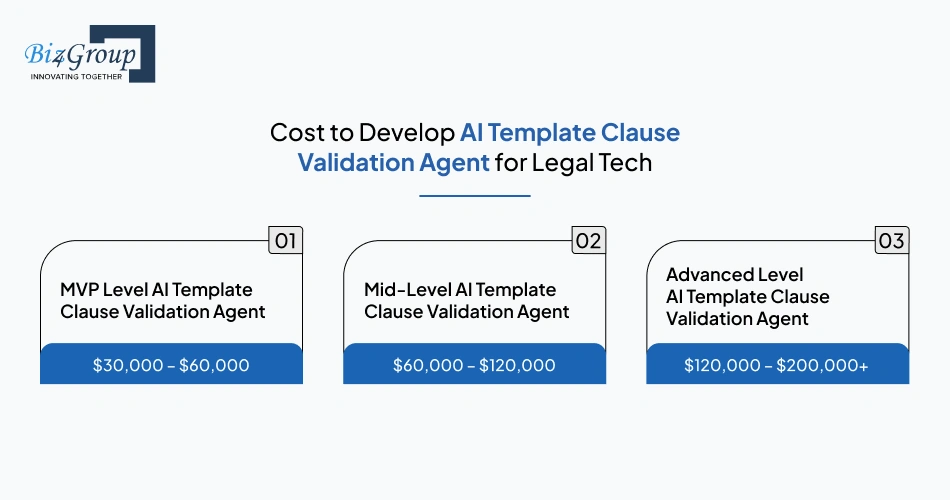
Cost planning depends on how detailed the validation logic needs to be and how widely the AI agent will be used across legal workflows. The cost to develop AI template clause validation agent for legal tech usually falls between $30,000 to $200,000+, depending on scope, complexity, and integration needs.
|
Agent Tier |
Estimated Cost Range |
Scope |
|---|---|---|
|
MVP Level AI Template Clause Validation Agent |
$30,000 – $60,000 |
Covers basic clause validation with limited templates, simple rule checks, and initial generative AI support for clause understanding. Suitable for early-stage validation testing. |
|
Mid-Level AI Template Clause Validation Agent |
$60,000 – $120,000 |
Includes broader template coverage, improved validation accuracy, structured workflows, and deeper use of generative AI for handling clause variations across documents. |
|
Advanced Level AI Template Clause Validation Agent |
$120,000 – $200,000+ |
Supports large-scale validation, multi-jurisdiction handling, advanced clause logic, and enterprise-grade performance with extensive generative AI capabilities. |
Also Read: Generative AI Agents
Factors Affecting the Cost of AI Template Clause Validation Agent
- Validation Scope and Clause Complexity: The more detailed the validation requirements, the higher the effort required. When teams make AI powered agent for validating legal contract clauses, complex clause structures and varied contract types increase development time and impact the overall legal AI agent’s cost.
- Data Preparation and Structuring Effort: Legal templates often require cleaning and organizing before use. Poorly structured data increases preparation time. This directly affects development timelines and adds to the cost of AI integrations required to make the agent function reliably.
- Model Training and Accuracy Requirements: Higher accuracy expectations require more training cycles and testing. Improving how the agent understands clause intent adds effort. This increases both development time and resource allocation during the build process.
- Integration with Legal Workflows: Connecting the agent with existing document systems and workflows requires additional effort. Each integration point adds complexity, especially when multiple tools are involved in the legal process.
- Scalability and Future Expansion Needs: Planning for future growth increases upfront cost. If the agent needs to handle more templates, jurisdictions, or validation rules later, the initial architecture must support expansion, which impacts development effort.
Cost decisions should always reflect how widely the agent will be used and how accurate the validation needs to be. A well-planned approach to AI template clause validation agent development for legal tech helps balance investment with long-term usability and scalability.
Compliance, Security, and Legal Accuracy Considerations in AI Template Clause Validation Agent Development
Handling legal templates goes beyond validation accuracy. It involves compliance obligations, secure handling of sensitive data, and maintaining legal accountability across every clause. When teams make AI agent for detecting clause deviations in contracts, these considerations need to be addressed from the start, as gaps in compliance or security are much harder to fix later in the process.
1. Data Privacy and Client Confidentiality
- Risk: Legal templates often contain sensitive client information that may be exposed during processing or storage
- Control Measure: Apply strict data access controls, encryption, and secure storage practices while using AI automation services for handling document workflows
- Outcome: Ensures confidential data remains protected and reduces the risk of unauthorized access or data leaks
Also Read: AI Automation Use Cases for Enterprises to Scale Faster
2. Regulatory Compliance
- Risk: Legal data processing may violate regional regulations if compliance requirements are not followed properly
- Control Measure: Align data handling practices with regulatory standards (GDPR and similar frameworks) and ensure data usage policies are clearly defined within the validation process
- Outcome: Maintains compliance with legal regulations while avoiding penalties or restrictions on data usage
3. Legal Accuracy Validation
- Risk: Incorrect clause validation can lead to legal errors that impact contracts and client relationships
- Control Measure: Continuously validate outputs against approved clause libraries and ensure the agent is trained to handle real legal scenarios accurately
- Outcome: Improves reliability of validation results and reduces the chances of incorrect legal interpretations
4. Human-in-the-Loop Systems
- Risk: Fully automated validation may overlook context-specific legal nuances that require human judgment
- Control Measure: Include review checkpoints where legal professionals can verify and approve flagged clauses before final decisions
- Outcome: Maintains control over validation outcomes and ensures accountability in decision-making
5. Audit Trails and Traceability
- Risk: Lack of visibility into validation actions makes it difficult to track decisions or investigate issues later
- Control Measure: Maintain detailed logs of validation activity, including changes, flags, and approvals generated by generative AI agents
- Outcome: Provides traceability for audits and supports accountability across validation processes
Also Read: Building Effective Generative AI Solutions
6. Model Explainability
- Risk: If validation results are not explainable, legal teams may not trust or rely on the outputs
- Control Measure: Ensure the agent provides clear reasoning behind each validation decision, especially when teams develop AI agent for template clause compliance across different use cases
- Outcome: Builds trust in validation results and allows teams to confidently act on the outputs
Addressing these considerations early helps ensure that validation remains reliable and aligned with legal expectations. A structured approach to AI template clause validation agent development for legal tech allows teams to manage risks while maintaining control over how validation is performed across different legal scenarios.
Common Mistakes to Avoid During AI Template Clause Validation Agent Development
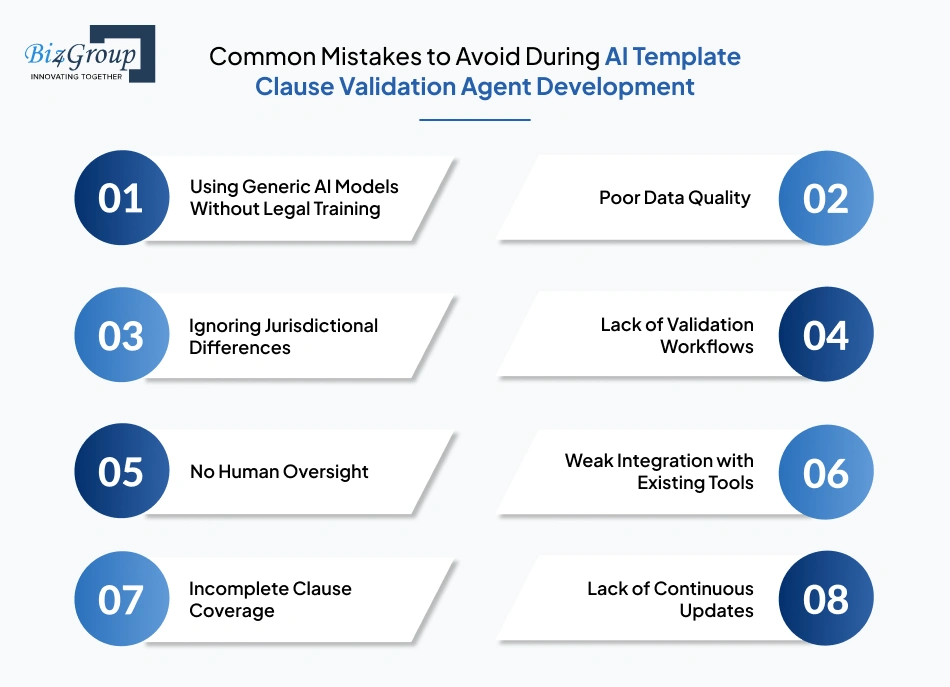
Small missteps during early stages can lead to long-term issues in validation accuracy and reliability. When teams create AI powered clause validation agent for legal teams, these mistakes often appear during planning, data preparation, or integration, and can slow down progress if not addressed early.
Below are the key mistakes along with practical solutions to help you avoid these issues from the start.
1. Using Generic AI Models Without Legal Training
Models trained on general data fail to understand legal language correctly, which leads to incorrect clause interpretation and unreliable validation outputs during AI clause validation agent development for legal tech.
Solution: Train the agent using legal-specific clause datasets and real contract examples. Focus on clause-level training, so the agent understands context and intent instead of relying on general language patterns.
2. Poor Data Quality
Unstructured or inconsistent data creates confusion during training. This results in frequent validation errors and reduces the accuracy of clause detection and interpretation.
Solution: Clean and standardize all clause data before training. Organize clauses by type and purpose, so the agent learns from structured and reliable inputs that reflect real legal templates.
3. Ignoring Jurisdictional Differences
Validation logic that does not consider regional variations produces incorrect results when templates are reused across locations. This creates gaps in validation accuracy.
Solution: Define separate validation rules for each jurisdiction. Map clauses to region-specific requirements so the agent can apply the correct validation logic based on location.
4. Lack of Validation Workflows
Without a structured validation flow, clause checks become inconsistent and difficult to track. This affects how decisions are made and reduces output reliability.
Solution: Define a clear validation sequence from input to output. Ensure each clause follows the same review path, so validation remains consistent across all templates.
5. No Human Oversight
Fully automated validation increases the chances of approving incorrect clauses, especially in complex scenarios that require judgment.
Solution: Introduce controlled review checkpoints where legal teams can verify flagged clauses. This ensures that final decisions are validated before approval.
6. Weak Integration with Existing Tools
Poor integration disrupts existing workflows and makes adoption difficult. Even accurate validation may not be used effectively if it does not fit into daily operations.
Solution: Connect validation with existing tools using structured AI integration services, so the agent works within current legal processes instead of creating additional steps.
7. Incomplete Clause Coverage
Limiting validation to a small set of clauses creates gaps across different contract types. This reduces the overall usefulness of the agent.
Solution: Start with critical clauses and expand coverage gradually. Use real usage patterns to identify which clauses should be added next for better validation coverage.
8. Lack of Continuous Updates
Static validation logic becomes outdated as legal standards change. This reduces accuracy over time and creates inconsistencies in results.
Solution: Regularly update clause datasets and validation rules. Keep the agent aligned with current legal requirements, so validation remains accurate. Work closely with an experienced AI development company that understands legal workflows and ensures the agent aligns with how teams handle templates.
Addressing these automation pitfalls early helps avoid rework and keeps development aligned with real legal needs. A structured approach to AI template clause validation agent development for legal tech ensures the agent remains accurate, usable, and easier to scale over time.
Streamline How Legal Templates Are Managed
Create a more structured way to handle templates, so validation becomes part of your regular workflow, not an extra step.
Optimize My Template WorkflowWhat does the Future Holds for AI Template Clause Validation in Legal Sector?
Legal validation is extending beyond reviewing templates after they are created. The direction is shifting toward continuous validation that adapts as contracts evolve. As AI template clause validation agent development progresses, the focus is moving toward making validation more responsive, connected, and aligned with real-time legal needs.
1. Real-Time Clause Validation
- Validation is expected to happen instantly as clauses are written or modified, rather than after the document is completed. This reduces delays and ensures issues are addressed at the earliest stage.
- Teams that make AI agent for legal clause validation will increasingly rely on real-time checks to maintain consistency while drafting, instead of correcting errors later in the process.
2. Self-Updating Compliance Systems
- Legal requirements change frequently, and static validation rules struggle to keep up. Future validation models will adapt automatically by incorporating updated regulations and internal policies without requiring manual reconfiguration.
- This shift will allow validation to remain updated without constant intervention, especially when handling templates across different regulatory environments.
3. Integration with Contract Lifecycle Management
- Clause validation will no longer operate in isolation. It will be embedded across the entire contract lifecycle, from drafting to renewal and updates.
- This ensures that validation continues beyond initial creation and supports ongoing contract management, making it easier to maintain consistency throughout the lifecycle of an agreement.
4. Predictive Legal Risk Analysis
- Validation will move beyond identifying current issues and start predicting potential risks based on clause patterns and historical data through predictive analysis.
- This approach allows legal teams to anticipate problems before they occur and take corrective action earlier, improving decision-making during contract preparation.
5. Context-Aware Clause Adaptation
- Future validation will not only check clauses but also adjust them based on context such as industry, contract type, or business scenario.
- This helps ensure that templates remain relevant and tailored to specific use cases, rather than relying on fixed clause structures that may not fit every situation.
These changes reflect a shift toward more adaptive and connected validation processes. As AI template clause validation agent development for legal tech continues to evolve, validation will become a continuous layer within legal workflows rather than a separate review step.
Why You Should Choose Biz4Group LLC for AI Template Clause Validation Agent Development for Law Firms?
When legal teams look for reliable solutions to build clause validation AI agents for contracts, the focus is not just on development but on how well the agent fits real legal workflows. At Biz4Group LLC, the approach stays grounded in practical execution, with a strong understanding of how legal teams handle templates, compliance requirements, and clause-level reviews in day-to-day operations.
As an AI agent development company, we focus on building agents that go beyond surface-level automation. The goal is to create AI clause validation agent for contracts that aligns with legal drafting standards, handles structured clause data, and adapts to evolving regulatory and contractual needs without disrupting existing workflows.
With multiple projects in the domain, we bring experience with legal document structures, clause libraries, and compliance-driven workflows to the table. Take a look:
1. Desc Legal- Quotation Platform Development

Desc Legal is a legal compliance management platform that helps teams manage regulatory updates, assign tasks, and maintain control over legal documents within a structured workflow. It enables better tracking of compliance activities while keeping processes organized. This approach reflects how legal operations become more manageable when tasks, communication, and documentation are handled within a centralized and well-defined system.
2. Court Calendar- Judiciary Platform for Attorneys and Law Firms
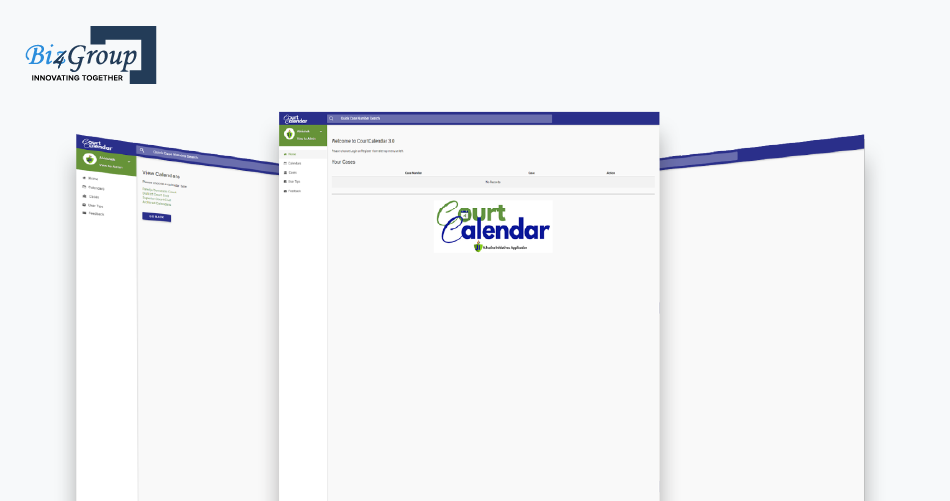
Court Calendar is a legal scheduling platform that helps attorneys manage hearings, filings, and deadlines across multiple cases. It centralizes case timelines and provides clear visibility into upcoming activities. Legal teams can track obligations, coordinate schedules across jurisdictions, and stay aligned without relying on fragmented or manual tracking methods.
3. TrialProofer- Litigation Preparation Platform
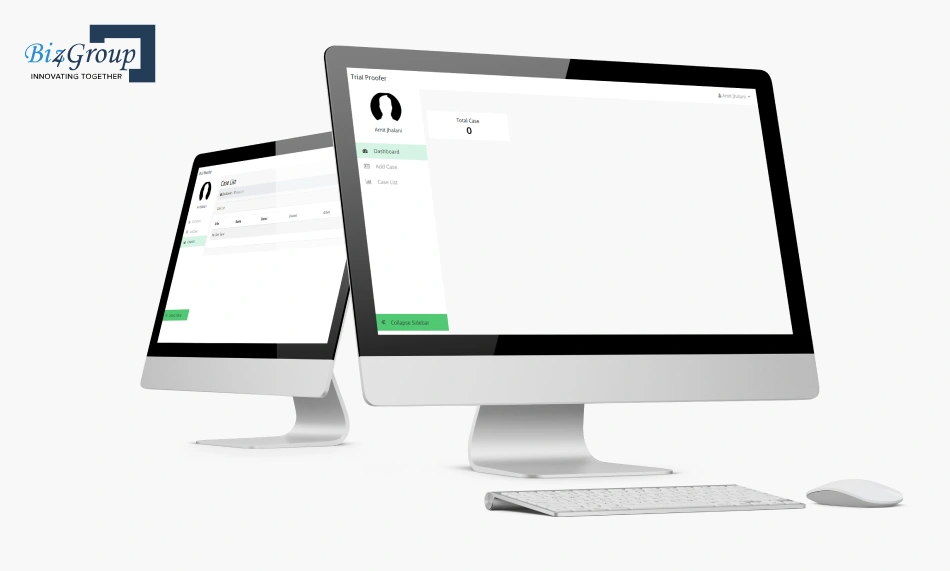
TrialProofer is a litigation preparation platform that enables legal teams to organize case materials, evidence, and witness information in a structured manner. It helps map timelines, connect key case elements, and maintain clarity during preparation. The platform supports collaboration across teams while ensuring all trial-related documents remain organized and easily accessible.
These implementations reflect how legal systems are handled at scale, where structured workflows and document consistency shape how validation logic is applied in real environments. Here something more you should know about us:
- Our experienced AI developers work closely with clause-level datasets to ensure accuracy and consistency in validation, aligning it with existing legal review practices instead of redefining workflows
- Our AI consulting services align validation logic with real legal requirements instead of generic automation approaches with emphasis on integration with legal tools, so that it becomes part of ongoing processes
Therefore, our goal is to build what creates measurable impact, not what sounds fancy in a pitch deck, and our AI portfolio vouches for that. So, if you want a partner who blends strategic clarity with hands-on execution, Biz4Group is built for that kind of collaboration.
Build a Validation Approach That Fits Your Legal Workflow
Bring clarity into how templates are handled across teams with a setup designed around real legal processes.
Plan My Validation StrategyConclusion
Legal teams have been managing clause validation through manual checks for years, but that approach does not scale well with growing contract volumes and evolving compliance needs. This is where structured validation becomes necessary, especially when supported by focused product development services that align with how legal workflows actually operate.
AI-driven validation brings consistency into how templates are reviewed and maintained. It reduces dependency on repeated manual effort and helps ensure that clauses stay aligned with defined standards over time. This makes it easier for teams to develop AI clause validation agent for legal teams that fits naturally into their existing processes.
At Biz4Group LLC, the focus remains on keeping this transition practical and aligned with real legal requirements. If you are evaluating how this can fit into your current setup, let us discuss.
FAQ’s
1. How accurate can an AI clause validation agent be when handling complex legal templates?
Accuracy depends on how well the agent is trained on clause-level legal data and real contract variations. With structured datasets and continuous refinement, it can handle complex templates with high consistency, especially in identifying deviations and missing clauses.
2. What type of legal data is required to build AI template clause validation agent solutions effectively?
Well-structured clause libraries, historical contract templates, and labeled clause datasets are essential. The quality and organization of this data directly influence how accurately the agent can interpret and validate clauses in different scenarios.
3. How long does it take to develop AI clause validation agent for legal teams?
The timeline typically ranges from 8 to 20 weeks, depending on scope, data readiness, and integration needs. Initial versions can be built faster, while more advanced implementations require additional time for refinement and testing.
4. What is the typical cost to develop AI template clause validation agent for legal tech?
The cost generally ranges between $30,000 to $200,000+, depending on complexity, data preparation, and integration requirements. Simpler versions cost less, while enterprise-grade solutions with broader coverage require higher investment.
5. Can an AI agent handle custom clause variations across different clients and industries?
Yes, if trained properly. The agent can recognize variations in clause wording and intent, allowing it to validate templates across different industries while maintaining consistency with predefined standards.
6. How do enterprises ensure long-term performance after they create AI clause validation agent for contracts?
Long-term performance depends on regular updates to clause data, validation rules, and model refinement. Continuous monitoring and feedback from legal teams help maintain accuracy as templates and compliance requirements evolve.
