 Location :
Orlando, FL, USA
Location :
Orlando, FL, USA +1 (407) 714-1616
 info@biz4group.com

- Cost to build a mental health app like Youper depends on AI depth, personalization, compliance planning, and long-term scalability.
- The realistic cost of building a mental health app like Youper typically falls between $80,000 and $250,000+, based on scope, AI maturity, and post launch ownership.
- Teams that plan early for architecture and phasing tend to control the mental health app development cost like Youper more effectively and avoid expensive rebuilds later.
- The global mental health app market is projected to cross $17 billion by 2030, driven by AI powered conversational care and self-guided therapy tools.
- Monetization choices, AI training needs, and compliance requirements directly influence the cost to develop a mental health app like Youper over time.
- Apps designed with clear phases, realistic budgets, and measurable outcomes are more likely to turn AI driven mental health products into sustainable business assets.
Every serious conversation about building a mental health product eventually hits the same wall. You can validate demand, sketch features, even map user journeys, but sooner or later the budget question takes over. For founders and tech leaders evaluating the cost to build a mental health app like Youper, the real challenge is separating optimistic estimates from what it actually takes to ship, scale, and stay compliant.
In most practical scenarios, the investment starts around USD 80,000 and can easily stretch to USD 250,000+, especially once AI, data security, and long-term scalability enter the mix. That is usually when a familiar set of questions starts looping in your head:
- cost to build a mental health app like Youper
- how much to develop an AI mental health app
- budget for creating a therapy support app
- is building a mental wellness app expensive
- pricing breakdown for mental health app development
Apparently, you’re not the only one looking for the right answers to these questions. The market dynamics force them into the open:
- The global mental health apps market valuation is projected to reach USD 17+ billion by the end of this decade.
Together, these forces reshape the mental health app development cost like Youper in ways that basic feature lists never capture.
Behind the scenes, the concerns are deeply practical. Founders think about runway and investor patience. CTOs worry about whether early technical shortcuts become expensive rewrites later. Product leaders question whether outcomes justify the spend. These internal debates quietly shape every serious decision around AI mental health app development, long before timelines or vendors are finalized.
This guide is built for those moments. We unpack the real cost to develop a mental health app like Youper by showing where the money goes, which choices matter most, and how teams can approach budgeting with confidence instead of assumptions.
Practical Formula to Calculate the Cost to Build a Mental Health App Like Youper
Estimating the cost to build a mental health app like Youper is less about chasing a fixed number and more about understanding how effort turns into spend. Teams rarely struggle with the idea itself. The real friction begins when they try to balance clinical credibility, AI driven conversations, and a product experience users trust. That balance quietly shapes the budget long before design polish or feature lists enter the discussion.
General Cost Estimation Formula for Mental Health App Development Like Youper
Total Development Cost = (Total Development Hours × Hourly Rate) + Mental Health Specific Expenses
On paper, this formula looks simple. In reality, every component hides layers of technical and regulatory decisions that influence mental health app software development pricing like Youper in meaningful ways.
How to Use the Formula to Estimate the Cost to Build a Mental Health App Like Youper
Start by defining the total development hours. These hours go well beyond screens and basic flows. They usually include:
- Designing therapeutic conversation logic
- Building secure backend systems
- Implementing AI logic that supports emotional context
- Testing for stability, safety, and reliability
- Iteration cycles to refine tone, accuracy, and user trust
Once the total hours are clear, they are multiplied by the hourly rate of your development team or partner. This gives you the baseline number most teams anchor their planning around.
That baseline, however, is rarely the final figure.
Additional expenses are where budgets tend to shift. When you build a mental health app like Youper, it often introduce costs related to:
- Compliance reviews and documentation
- Secure data storage and access controls
- Continuous AI model development and tuning
- Post launch monitoring and infrastructure upkeep
Many teams rely on AI automation services to streamline conversational workflows and data handling. Early architectural input from a custom software development company also helps avoid expensive rework as the app scales.
Looking at these elements together leads to a more realistic understanding of the AI mental health app development cost like Youper, rather than an optimistic estimate that unravels later.
Still Estimating in Your Head?
Get a realistic view of the cost to build a mental health app like Youper based on scope, AI depth, and real world constraints.
Calculate My App CostAlso Read: Best Practices Mental Health App Design
Detailed Breakdown of Mental Health App Development Cost Like Youper
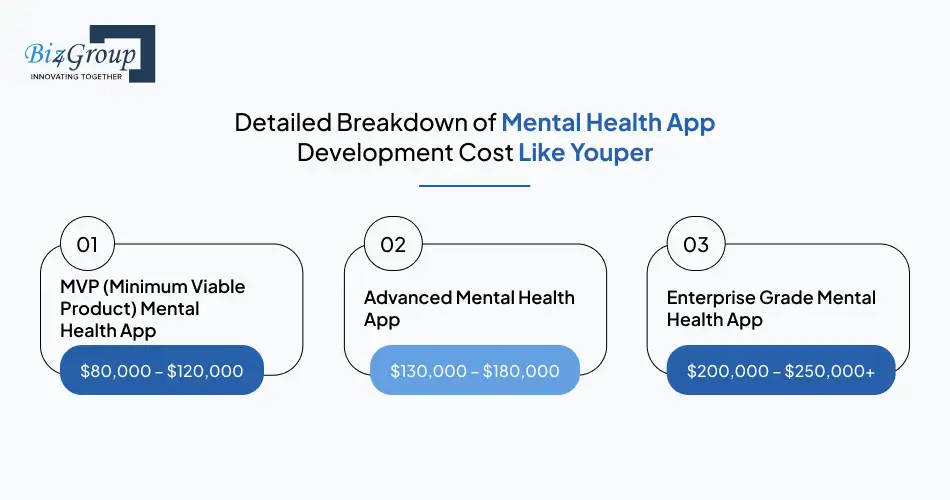
Building a digital mental health product is not a one-line budget decision. The cost to build a mental health app like Youper typically falls between USD 80,000 and 250,000+, depending on how deep the therapeutic logic goes, how personalized the experience needs to be, and how seriously the product treats long term scalability and data protection.
Apps that focus on guided self-help and limited AI interactions usually stay toward the lower end. Platforms designed to support continuous engagement, personalization, and clinical grade workflows move quickly toward the higher range, which directly affects the custom mental health app development cost like Youper.
Here is a snapshot of how these costs usually distribute across product stages.
|
Build Level |
Scope |
Estimated Cost Range |
|
MVP (Minimum Viable Product) Mental Health App |
Core AI conversations, mood tracking, limited user flows |
$80,000 – $120,000 |
|
Advanced Mental Health App |
Expanded AI logic, personalization, secure data handling |
$130,000 – $180,000 |
|
Enterprise Grade Mental Health App |
Advanced AI, scalability, compliance, integrations |
$200,000 – $250,000+ |
What often gets overlooked is how quickly decisions made in early stages compound later. Choices around data structure, conversational logic, and system architecture determine whether the app can evolve smoothly or requires expensive rework. Teams that aim to create a mental health chatbot app like Youper often discover that conversational quality and reliability demand more investment than originally expected, especially as usage grows.
Below is a more detailed view of where the investment typically goes once development begins.
|
Development Stages |
Typical Range |
Notes |
|
Discovery and Planning |
$4,000 – $10,000 |
Product scope definition, therapeutic flow mapping, risk analysis |
|
UI and UX Design |
$6,000 – $15,000 |
Emotionally sensitive flows, accessibility, and trust driven design |
|
AI Logic and Model Work |
$15,000 – $70,000 |
Conversation intelligence, personalization, and continuous learning |
|
Backend and Database |
$8,000 – $30,000 |
Secure data handling, user management, and system logic |
|
Integrations |
$6,000 – $25,000 |
Third party tools, analytics, and service connections |
|
Security and Compliance |
$10,000 – $40,000 |
Data protection, access controls, and audit readiness |
|
Infrastructure and Cloud |
$3,000 – $10,000 |
Hosting, performance monitoring, and scalability setup |
|
Testing and Quality Assurance |
$4,000 – $12,000 |
Functional testing, security validation, and reliability checks |
|
Post Launch Support |
15% – 25% annually |
Updates, monitoring, and system improvements |
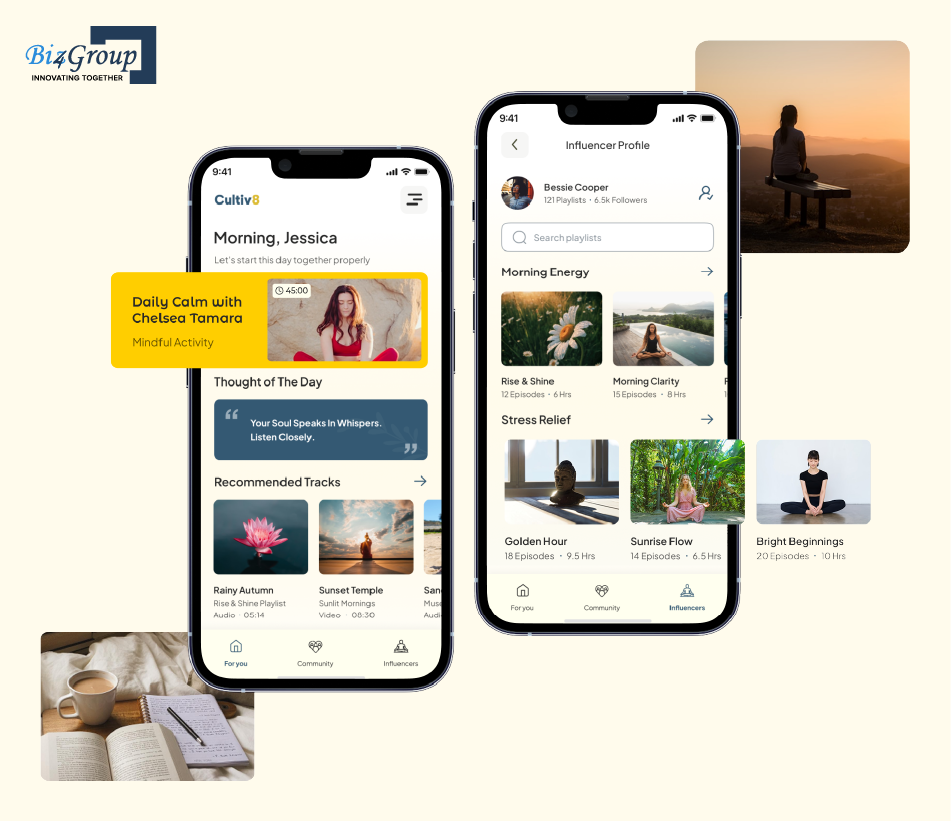
Cultiv8 is an AI powered mental wellness platform focused on guided self-improvement, habit formation, and reflective support through intelligent interactions. The platform highlights how conversational AI, personalization, and user engagement layers come together in real world builds, making it a strong reference point when evaluating the cost to build a mental health app like Youper.
Understanding these layers early helps teams align expectations and make informed decisions around the mental wellness app development cost like Youper without underestimating what it takes to build a product users trust.
This is also where specialized expertise often enters the picture. Some teams engage an AI chatbot development company to refine conversational accuracy, while others invest heavily in AI model development to support personalization and long-term engagement. Both decisions have a direct impact on the mental wellness app development cost like Youper and should be planned intentionally rather than reactively.
Also Read: Developing Effective Mental Health Solutions Tips for Entrepreneurs
What Influences the Cost to Develop a Mental Health App Like Youper?
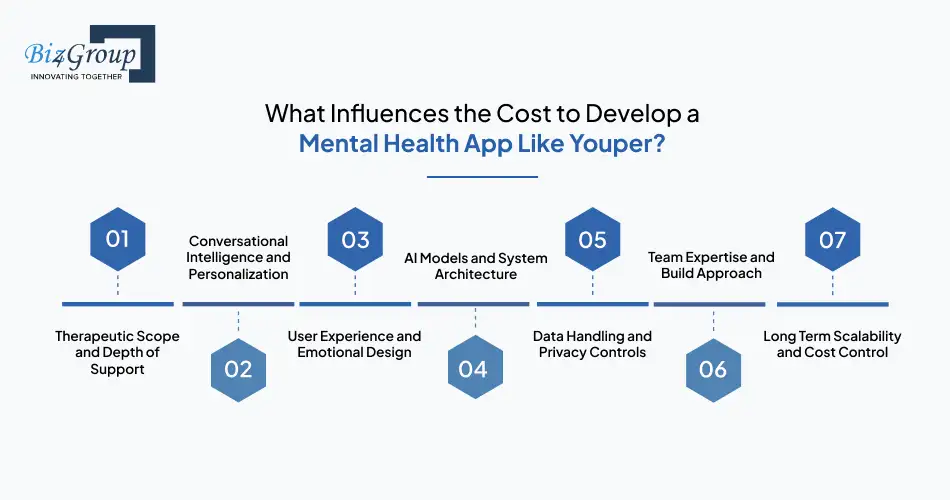
When teams talk about budgets, they often expect a single number. In reality, the cost to build a mental health app like Youper is the outcome of multiple interconnected product, technical, and strategic decisions made early. Each decision subtly shapes timelines, effort, and long term investment requirements.
Below are the key factors that most directly shape the final investment.
1. Therapeutic Scope and Depth of Support
The level of mental health support your app delivers directly impacts complexity. A narrowly focused wellness experience is far simpler to build than an app supporting structured therapy journeys, progress tracking, and ongoing engagement that requires deeper logic and consistent behavioral alignment.
- Example:A light wellness focused product may stay within a controlled range, while expanding into therapy oriented flows can significantly increase the develop mental health therapy app cost like Youper due to added logic, content, and validation.
2. Conversational Intelligence and Personalization
Conversation quality determines whether users trust and continue using the app. Simple scripted responses are easier to build, while adaptive conversations that respond to mood, history, and context require more logic, tuning, and testing across diverse mental health scenarios.
- Example:Basic scripted interactions may be cost effective early on, but building an AI conversation app that adapts tone and suggestions over time adds noticeable complexity and budget impact.
3. User Experience and Emotional Design
Mental health design prioritizes clarity, emotional safety, and ease of use. Designing flows that feel supportive rather than overwhelming takes additional time, iteration, and testing, especially when experiences adapt based on user inputs and emotional states.
- Example:A simple journaling flow may be quick to design, while multi step journeys that respond to user state can add thousands in design and validation effort.
4. AI Models and System Architecture
AI architecture choices influence flexibility, performance, and cost. Using prebuilt components can accelerate development, while custom architectures allow deeper personalization but require more effort to implement, test, and maintain over time.
- Example:Integrating off the shelf models may reduce early spend, but investing in AI mental health assistant development increases control and performance at a higher initial cost.
5. Data Handling and Privacy Controls
Mental health data requires careful handling to maintain trust and compliance. Decisions around storage, access control, encryption, and monitoring directly influence development effort and infrastructure design, especially as user volume and data sensitivity increase.
- Example:Lightweight security may be acceptable for early validation, but scaling the app increases mental health mobile app development expenses like Youper due to encryption, access controls, and monitoring.
6. Team Expertise and Build Approach
The experience level of the team building the app significantly affects cost efficiency. Teams familiar with mental health products tend to make better architectural decisions early, reducing rework and minimizing delays caused by trial and error.
- Example:Some organizations choose to hire AI developers with mental health experience to reduce trial and error during implementation.
7. Long Term Scalability and Cost Control
Early scalability planning determines whether costs stay predictable or escalate later. Apps designed only for launch often require expensive restructuring once usage grows, while scalable foundations support gradual expansion without constant redevelopment.
- Example:Teams that plan how to build a mental health app like Youper on a budget often focus first on core outcomes, then layer advanced features only after validating engagement.
Together, these factors explain why budgets vary so widely. When assessed upfront, they help teams align expectations, reduce risk, and approach the develop mental health therapy app cost like Youper with clarity rather than uncertainty.
Feature Choices Affect the Mental Health App Development Cost Like Youper
Understand how feature choices affect the mental health app development cost like Youper before committing to build.
Review Feature CostsAlso Read: Top Mental Health App Features
Hidden Costs in Mental Health App Development Like Youper
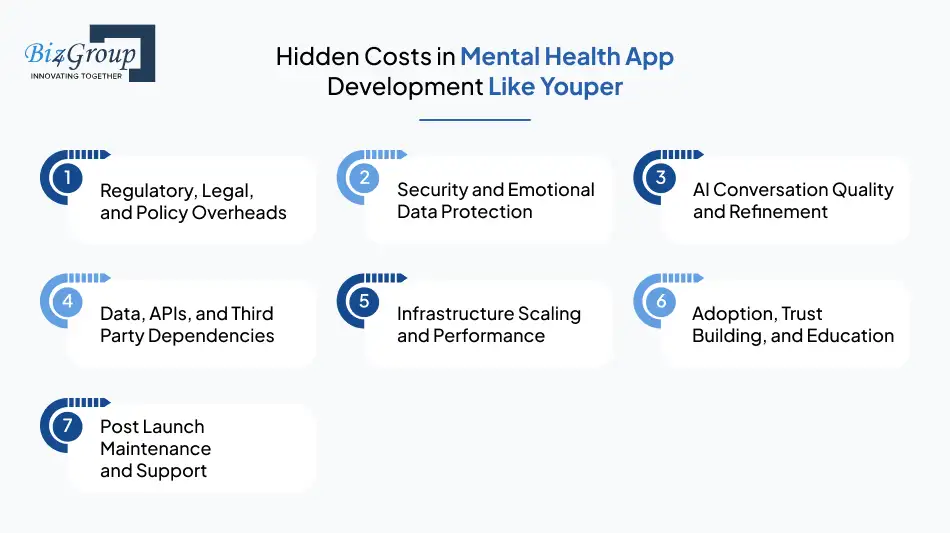
When teams estimate budgets, they usually focus on visible line items like core features and development hours. What quietly shifts projections is everything that follows once the build starts. For anyone evaluating the cost to build a mental health app like Youper, these overlooked expenses often determine whether the budget holds or slowly stretches beyond expectations.
These costs rarely appear on early spreadsheets. They surface as the product matures, user volume grows, and real world constraints kick in.
Below are the most common hidden costs that influence actual builds.
1. Regulatory, Legal, and Policy Overheads
Mental health products operate in a sensitive space. Policies around consent, content boundaries, and user safety evolve as features expand. Legal reviews and documentation updates are not one time tasks and tend to repeat as the app changes, often complicating mental health app development budget planning like Youper when scope evolves.
- Cost range:$6,000 to $18,000 initially, with $5,000 to $12,000 annually
- Impact:Compliance related work can add 10 to 20 percent to total spend over time
2. Security and Emotional Data Protection
Mental health data requires stronger safeguards than standard consumer apps. Beyond encryption, teams implement access controls, monitoring, and response protocols that evolve with usage.
- Cost range:$10,000 to $30,000 upfront, plus $6,000 to $15,000 per year
- Impact:Security often contributes 8 to 14 percent of overall project cost
3. AI Conversation Quality and Refinement
Conversational accuracy is not fixed at launch. Tone, relevance, and response quality require ongoing tuning, especially when products begin to resemble an AI virtual mental health coach rather than a static tool.
- Cost range:$6,000 to $20,000 annually
- Impact:AI refinement typically adds 5 to 9 percent to maintenance budgets
4. Data, APIs, and Third Party Dependencies
Many mental health apps rely on external services for analytics, notifications, or content delivery. These services often scale with usage and become recurring expenses.
- Cost range:$800 to $3,500 per month
- Impact:3rd party dependencies account for 6 to 10 percent of ongoing costs
5. Infrastructure Scaling and Performance
Early hosting costs stay modest. As engagement grows, infrastructure must support concurrency, responsiveness, and uptime. Teams that plan early to integrate AI into an app reduce inefficiencies, but scaling remains unavoidable.
- Cost range:$700 per month early stage, rising to $4,000 or more
- Impact:Infrastructure typically represents 7 to 12 percent of long term spending
6. Adoption, Trust Building, and Education
Mental health apps need careful onboarding, especially when teams aim to make a mental health app like Youper for business use where clarity and responsible usage matter. Users must understand how and when to engage safely through guidance, education, and trust building initiatives.
- Cost range:$5,000 to $18,000 per month during growth phases
- Impact:Adoption efforts can account for 10 to 20 percent of launch stage costs
7. Post Launch Maintenance and Support
After launch, updates never stop. Bug fixes, compliance adjustments, performance tuning, and feature refinements become routine. Many teams lean on AI consulting services or work with an AI product development company to keep pace without internal overload.
- Cost range:15 to 25 percent of initial build cost annually
- Impact:Maintenance costs compound as the product evolves
Quick Reference: Common Hidden Cost Breakdown
|
Category |
Estimated Cost Range |
Notes |
|
Compliance and Legal |
$6K to $18K |
Policy updates and reviews |
|
Security |
$10K to $30K plus annual |
Data protection and monitoring |
|
AI Refinement |
$6K to $20K yearly |
Conversation quality updates |
|
Data and APIs |
$800 to $3.5K monthly |
Third party services |
|
Infrastructure |
$700 to $4K monthly |
Scaling and performance |
|
Adoption |
$5K to $18K monthly |
Education and onboarding |
|
Maintenance |
15 to 25 percent yearly |
Ongoing support |
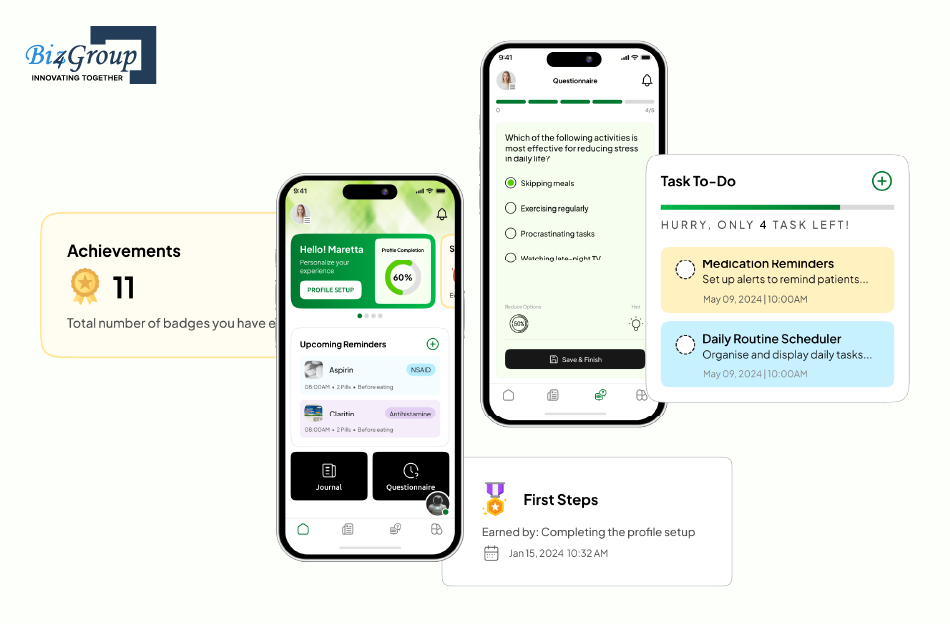
CogniHelp is an AI driven cognitive support platform designed to assist users through structured conversations, monitoring, and personalized guidance. The product demonstrates how sensitive data handling, conversational intelligence, and long term user engagement affect architecture decisions, all of which directly influence budgeting and scalability in mental health app development.
These hidden layers matter most when teams plan long term sustainability and predictability. Accounting for them early brings clarity to the bigger question many founders ask later, is it profitable to develop a mental health app like Youper once real operating costs are fully understood.
Also Read: Developing Effective Mental Health Solutions Tips for Entrepreneurs
Hidden Costs Sneak Up Fast
Avoid budget surprises by planning beyond development hours and uncovering real ownership costs early.
Check out Hidden Cost FactorsHow to Optimize the Cost to Build a Mental Health App Like Youper
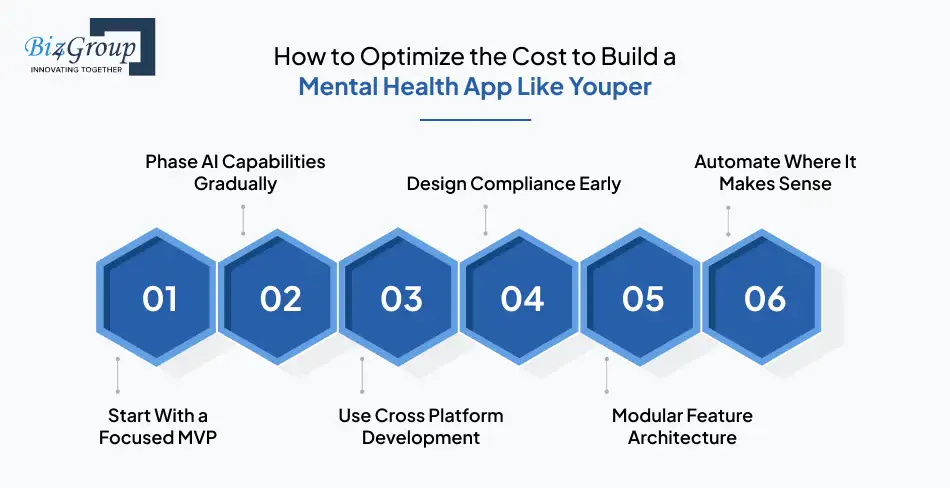
Cost overruns in digital mental health projects are common, but they are rarely inevitable. When teams plan deliberately, the cost to build a mental health app like Youper stays manageable without cutting corners on user safety, trust, or long term scalability. The goal is not to build cheaply. It is to build in the right order so effort and investment stay aligned with real outcomes.
Most successful teams borrow from proven software patterns and adapt them thoughtfully to mental health use cases, where sequencing matters more than speed.
|
Strategy |
How It Controls Cost |
How It Applies to Mental Health Apps |
|
Start With a Focused MVP |
Limits early scope and validation effort |
Teams launch with core mood tracking and guided conversations, postponing advanced personalization until real usage data supports it |
|
Phase AI Capabilities Gradually |
Avoids heavy upfront AI investment |
Rule based guidance comes first, with generative AI introduced later to enhance reflection and insight quality |
|
Use Cross Platform Development |
Reduces build and maintenance effort |
A shared codebase supports iOS and Android together, lowering development time and ongoing updates |
|
Design Compliance Early |
Prevents costly rework later |
Privacy, consent, and data handling rules are addressed during architecture planning instead of being retrofitted |
|
Modular Feature Architecture |
Enables controlled expansion |
Journaling, conversations, and analytics are built as independent modules to support change without rewrites |
|
Automate Where It Makes Sense |
Lowers long term operational costs |
Conversation handling and follow ups rely on AI integration services to reduce manual oversight as usage grows |
Optimizing cost is really about restraint and timing. Teams that delay complexity until it is justified, reuse stable components, and automate selectively tend to preserve both budget and flexibility. This approach allows the product to grow with demand instead of forcing expensive redesigns under pressure.
When these principles are applied consistently, teams are better positioned to evaluate the best company to build a mental health app like Youper in budget, not by chasing the lowest quote, but by choosing partners who understand sequencing, risk, and sustainable growth.
Also Read: Why AI Ethics in Healthcare Should Be a Priority in Mental Health App Development?
A Phase Wise Breakdown of Cost to Build a Mental Health App Like Youper
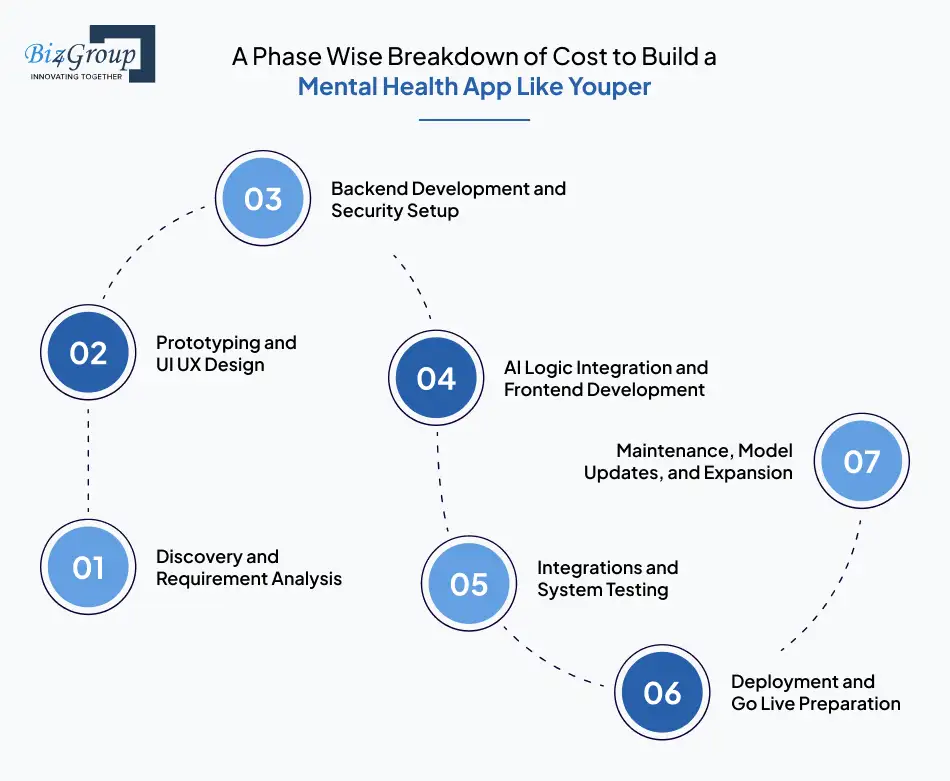
Building a mental health app is rarely linear. It moves in phases, each one adding clarity, complexity, and cost. Looking at the work this way helps teams understand where money is actually spent and why the cost to build a mental health app like Youper feels predictable at some stages and uncertain at others.
1. Discovery and Requirement Analysis
This is where assumptions get challenged early. Teams define the kind of support the app will offer, map user journeys, and decide how AI fits into the experience without overreaching. Safety, consent, and data handling questions surface here.
- Typical cost range:$3,000 to $8,000
This phase often sets the tone for the overall mental health app development cost estimate like Youper, especially when scope is still flexible.
2. Prototyping and UI UX Design
Once direction is clear, ideas turn into flows and prototypes. In mental health apps, design is about emotional clarity and ease of use, not visual flair. Iteration is common as teams test how conversations and prompts actually feel by collaborating with an experienced UI/UX design company.
- Typical cost range:$5,000 to $14,000
Thoughtful AI assistant app design during this phase reduces friction later when real users enter the picture.
Also Read: Top UI/UX Developers in USA
3. Backend Development and Security Setup
This phase is less visible but deeply important. Databases, APIs, authentication, and access controls are built to support sensitive personal data. Decisions made during MVP development services often determine how smoothly the app scales later.
- Typical cost range:$8,000 to $28,000
Teams that plan to build an AI app with long term flexibility usually invest more thought here than anywhere else.
Also Read: Top 12+ MVP Development Companies to Launch Your Startup in 2026
4. AI Logic Integration and Frontend Development
Here, the product starts to feel real. Conversational logic, personalization, and user facing screens come together. The more adaptive and contextual the experience becomes, the easier it is to train AI models, as per the phase demands.
- Typical cost range:$15,000 to $55,000
This is often where founders get a clearer answer to what is the cost to develop a mental health app like Youper, once intelligence becomes central to engagement.
5. Integrations and System Testing
No app lives in isolation. Analytics, messaging tools, and supporting services are connected and tested under real conditions. Features like AI chatbot integration are validated here to ensure conversations remain stable under real user load.
- Typical cost range:$6,000 to $22,000
This stage plays a quiet role in stabilizing the development cost of mental health app like Youper before release.
Also Read: Software Testing Companies in USA
6. Deployment and Go Live Preparation
Deployment is more than pushing code live. Hosting, monitoring, and early performance checks are handled here. Teams that treat this as a planning exercise rather than a checkbox avoid early user frustration.
- Typical cost range:$2,000 to $7,000
Some teams lean on regional partners, including a software development company in Florida, to ensure launch readiness aligns with expected usage patterns.
7. Maintenance, Model Updates, and Expansion
After launch, the product continues to evolve. AI responses are refined, features expand, and compliance expectations change. This phase often surprises teams who underestimate long term ownership.
- Typical cost range:15 to 25 percent of the initial build cost annually
Over time, this ongoing work defines the real cost of building a mental health app like Youper, not just the initial release.
Cost Breakdown by Phase
|
Development Phase |
Key Activities |
Estimated Cost Range |
|
Discovery and Requirements |
Goals, validation, scope definition |
$3K to $8K |
|
Prototyping and UI UX |
Wireframes, flows, usability testing |
$5K to $14K |
|
Backend and Security |
APIs, databases, access controls |
$8K to $28K |
|
AI and Frontend |
Logic integration, user interfaces |
$15K to $55K |
|
Integrations and Testing |
QA, performance, reliability |
$6K to $22K |
|
Deployment |
Hosting, monitoring, release prep |
$2K to $7K |
|
Maintenance and Updates |
Ongoing improvements |
15 to 25 percent yearly |
Looking at the build through phases helps teams stay grounded. It clarifies where flexibility exists, where costs are fixed, and how the development budget of mental health app like Youper evolves as the product matures instead of appearing all at once.
Also Read: How to Choose Top Mental Health App Development Company in USA?
Trying to Build Smart, Not Expensive?
Learn how teams control spend and build a mental health app like Youper on a budget without cutting corners.
Optimize My App BudgetBudgeting Errors That Increase the Cost to Build a Mental Health App Like Youper
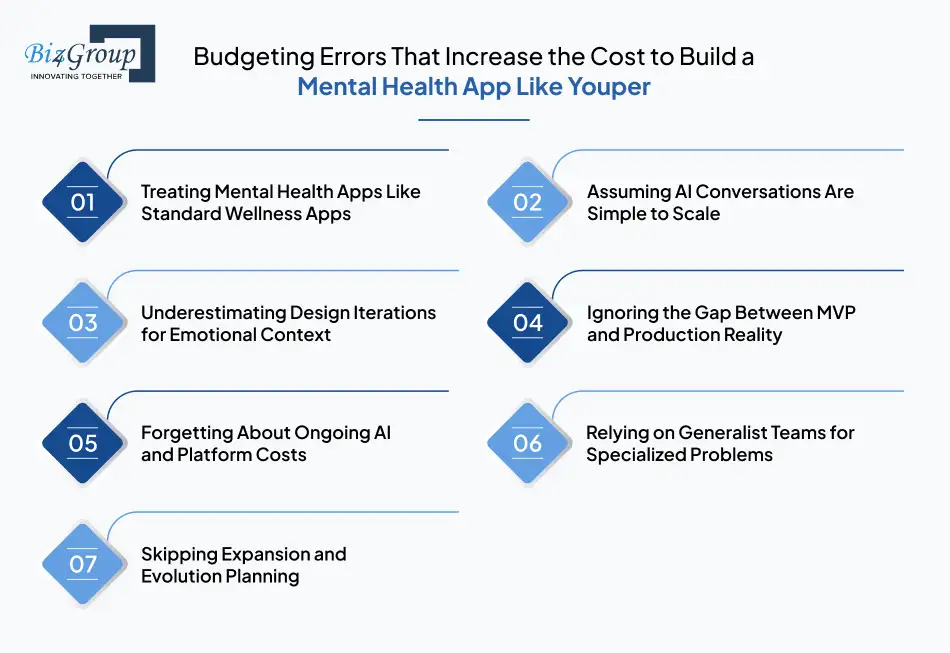
Most budget blowups do not happen because teams are careless. They happen because early assumptions feel reasonable at the time. When planning skips nuance or compresses complexity, the cost to build a mental health app like Youper quietly grows until it shows up as delays, rework, or unplanned spend.
Below are the most common budgeting errors that push costs higher later.
1. Treating Mental Health Apps Like Standard Wellness Apps
A frequent mistake is estimating a mental health product the same way as a habit tracker or content app. Mental health tools carry higher expectations around safety, reliability, and user trust, which directly affects the mental health app development cost like Youper from day one.
2. Assuming AI Conversations Are Simple to Scale
Early demos often work well with limited logic, which can create false confidence. As usage grows, conversation quality, edge cases, and response accuracy require more refinement than expected, especially when AI chatbot integration becomes central to the user experience.
3. Underestimating Design Iterations for Emotional Context
Design in mental health is rarely one and done. Tone, pacing, and interaction flow often change based on user feedback. Teams that budget for minimal design effort usually face additional rounds that increase timelines and cost.
4. Ignoring the Gap Between MVP and Production Reality
An MVP still needs to behave responsibly. Cutting corners on validation or infrastructure often leads to rewrites once real users arrive. This is where assumptions borrowed from business app development using AI tend to fall apart in mental health contexts.
5. Forgetting About Ongoing AI and Platform Costs
Many estimates stop at launch. In reality, model tuning, infrastructure scaling, and monitoring continue long after release. These recurring efforts are often missing when teams ask how much will it cost to build a mental health app like Youper during early planning.
6. Relying on Generalist Teams for Specialized Problems
Mental health products sit at the intersection of psychology, design, and AI. Teams without domain experience may move quickly at first but introduce costly rework later. This often skews expectations around the an average cost to create a mental health app like Youper.
7. Skipping Expansion and Evolution Planning
Mental health apps rarely stay static. New features, improved guidance, and changing user needs arrive sooner than expected. Without planning for evolution, every addition becomes an emergency build instead of a measured extension.
Avoiding these errors does not guarantee a cheap build, but it does create predictable ones. When planning accounts for AI depth, emotional design, and long term ownership, teams get a clearer picture of an average cost to create a mental health app like Youper before budgets drift out of control.
Also Read: 50+ Questions to Ask Before AI Adoption in Healthcare
How Monetization Choices Impact the Cost to Develop a Mental Health App Like Youper
Monetization is not something you bolt on later. It shapes architecture, data flow, access control, and compliance decisions from day one. For teams planning the cost to build a mental health app like Youper, the chosen revenue model often determines how complex the system becomes and how much engineering effort is required over time.
When monetization is defined early, billing logic, permissions, and reporting are designed into the product instead of retrofitted. That approach keeps the cost to develop a mental health app like Youper predictable and avoids late stage rebuilds.
Below is a breakdown of common monetization models and how each one influences development cost:
|
Monetization Model |
How It Works |
Best Suited For |
Development Cost Impact |
|
Subscription Based |
Users pay monthly or annually for access to guided support, insights, and conversations |
Consumer focused mental health apps |
Adds $10K to $25K for billing systems, user tiers, and account controls |
|
Freemium With Premium Features |
Core support is free, advanced guidance or personalization is paid |
Early stage products testing engagement |
Adds $6K to $18K for feature gating, upgrade flows, and usage tracking |
|
Pay Per Session |
Users pay for individual sessions or structured programs |
Therapy aligned experiences |
Adds $5K to $15K for session tracking, payments, and secure records |
|
Employer or B2B Licensing |
Platform is licensed to organizations or providers |
Workplace wellness or care programs |
Adds $15K to $40K for multi-tenant architecture and reporting |
|
Data or API Access |
Insights or models are exposed to partners via controlled access |
Platforms building partnerships |
Adds $20K to $45K for APIs, monitoring, and governance |
Each model introduces different technical requirements:
- Subscription and freemium products require reliable billing and access logic.
- Session based models add complexity around tracking and records.
- B2B licensing pushes architecture toward scalability and isolation, often resembling enterprise AI solutionsin structure.
Monetization also affects conversational depth. When access is metered or session based, conversation handling and logging become more complex. Teams evaluating mental health AI chatbot development cost often discover that monetization rules influence how conversations are stored, limited, or extended across plans.
This is why experienced teams usually align monetization with system design early. Whether working with an AI development company or planning internal builds, clarity here prevents unexpected spikes in the AI mental health app development cost like Youper as the product scales.
In practice, the right revenue model is the one that supports growth without forcing architectural shortcuts. When monetization strategy and product design evolve together, teams can build a mental health app like Youper with clearer expectations.
Also Read: Why 75% of Enterprises Are Investing in AI-Powered Solutions?
Your Revenue Model Shapes Your Tech
See how monetization decisions influence architecture and long term AI mental health app development cost like Youper.
Map Monetization ImpactIs It Profitable to Develop a Mental Health App Like Youper for Business Use?
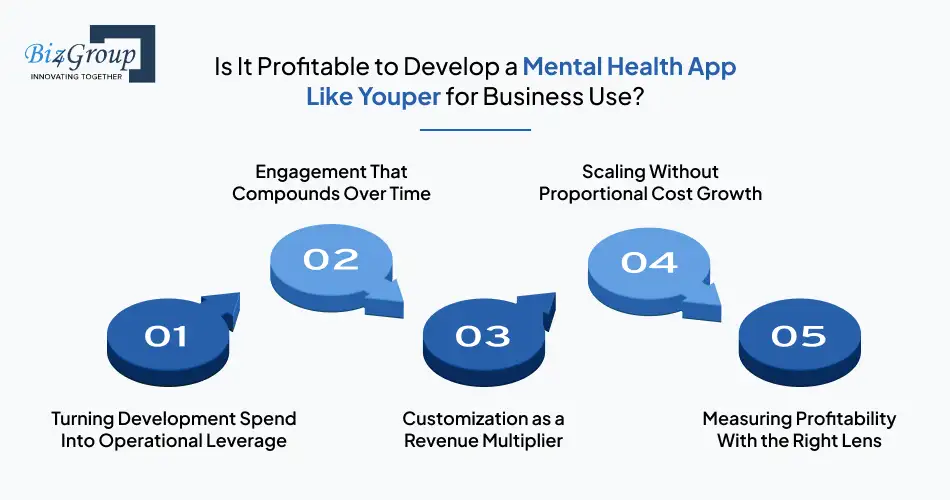
At first glance, the numbers can feel heavy. Between engineering, compliance, and AI work, the cost to build a mental health app like Youper is not trivial. Profitability, however, is less about the upfront spend and more about how that investment converts into efficiency, engagement, and scalable value once the product is live.
Below are the core ways teams typically evaluate whether the investment makes business sense:
1. Turning Development Spend Into Operational Leverage
Mental health apps reduce reliance on manual support by automating conversations, check-ins, and guidance. Once the system is stable, the same platform can support more users without a matching increase in operational cost.
This is where teams that build AI software intentionally begin to see leverage rather than linear expense growth.
2. Engagement That Compounds Over Time
Profitability depends heavily on retention. Apps that deliver consistent, empathetic interactions tend to see repeat usage and longer lifecycles. When teams create a mental health chatbot app like Youper, conversational quality often becomes the difference between short term trials and sustained engagement.
Higher engagement lowers acquisition pressure and improves lifetime value, which directly offsets the AI mental health app development cost like Youper.
3. Customization as a Revenue Multiplier
Off the shelf solutions limit differentiation. Products built around specific populations or use cases often unlock stronger monetization paths. This is where the custom mental health app development cost like Youper starts to justify itself by enabling tailored programs, pricing models, and partnerships.
Customization also makes it easier to evolve the product without rebuilding core systems.
4. Scaling Without Proportional Cost Growth
A well-designed platform can expand features, programs, or user segments without major rework. As usage increases, infrastructure and AI costs rise more slowly than revenue potential, improving margins over time.
This dynamic is often strongest when teams plan early and hire mental health AI app developers who understand both technical scale and product nuance.
5. Measuring Profitability With the Right Lens
Returns rarely show up immediately. Most teams track profitability through reduced support effort, improved retention, and gradual revenue expansion rather than early break even points. When these signals trend in the right direction, the business case strengthens quickly.
In practice, profitability is not guaranteed, but it is achievable. When the product is designed for engagement, automation, and scale, the long term returns often outweigh the initial AI mental health app development cost like Youper, turning what looks expensive upfront into a sustainable business asset.
How Biz4Group Helps Control the Cost to Build a Mental Health App Like Youper
The biggest cost risks in mental health apps usually come from early decisions that feel harmless at the time. Biz4Group focuses on controlling those moments so the cost to build a mental health app like Youper stays predictable as the product evolves.
Here is how that works:
1. Tight scope before development starts
We align on therapeutic intent and user boundaries early, cutting features that add complexity without real value. This helps keep the mental wellness app development cost like Youper under control from the first release.
2. Phase development instead of overloading the MVP
Validation comes first, advanced AI later. Clear phases allow teams to reassess spend before committing to deeper personalization or scale.
3. Design systems that can evolve cleanly
Modular architecture and clean data flows reduce rework as usage grows or requirements change.
4. Build compliance in from day one
Privacy, consent, and safety are treated as foundations, not add-ons, avoiding late-stage budget shocks.
As a team recognized among the top AI development companies in Florida, Biz4Group helps founders and product leaders make deliberate tradeoffs. The result is a product that grows steadily and maintains a sustainable mental wellness app development cost like Youper without reacting to budget pressure after launch.
Wondering If the Investment Pays Off?
Evaluate ROI, scalability, and whether the cost to develop a mental health app like Youper makes business sense.
Assess Profit PotentialClosing Insights on Mental Health App Development Cost Like Youper
Building a mental health app like Youper is not just a pricing exercise. It is a series of decisions that stack up over time. From early scope choices to AI depth, compliance, monetization, and long term maintenance, every layer shapes the final outcome. When teams understand where money actually goes, the cost to build a mental health app like Youper stops feeling unpredictable and starts feeling manageable.
The most successful products are rarely the cheapest or the most complex. They are the ones built with intent. Clear phases. Realistic expectations. Smart tradeoffs. Whether you are working with an experienced AI app development company or building internally, the goal is the same. Align investment with outcomes, not assumptions. When done right, AI in mental health becomes a scalable business asset rather than a cost center that keeps expanding.
Get a realistic cost breakdown based on your goals, not averages - Get on a Strategy Call.
Frequently Asked Questions about Cost to Build a Mental Health App Like Youper
1. How long does it take to build a mental health app like Youper?
A mental health app like Youper usually takes 4 to 7 months to develop, depending on feature scope and AI depth. Teams planning the build a mental health app like Youper timeline should factor in testing, iteration, and safety validation beyond core development.
2. What factors make AI mental health apps cost more than basic wellness apps?
AI mental health apps require conversational logic, emotional context handling, and ongoing refinement. These layers increase complexity and directly influence the mental health app software development pricing like Youper, especially as personalization and user engagement scale.
3. What is the cost to build a mental health app like Youper?
The cost of building a mental health app like Youper typically ranges between $80,000 and $250,000+. The final figure depends on AI sophistication, compliance needs, and long term scalability rather than just the number of features included.
4. Can a mental health app like Youper be built without clinical integrations?
Yes, many products focus on guided self support rather than direct clinical care. However, even without integrations, teams must plan carefully for content safety and user trust, which affects the custom mental health app development cost like Youper.
5. Is it possible to control costs while building an AI driven therapy app?
Cost control is possible by phasing features and validating engagement early. Teams that plan how to build a mental health app like Youper on a budget often start with core conversations and expand AI depth only after user behavior is understood.
6. Why do mental health apps require ongoing investment after launch?
Mental health apps evolve continuously as user needs and AI behavior change. Ongoing tuning, monitoring, and improvement contribute to the AI mental health app development cost like Youper, making post launch planning just as important as initial development.
