 Location :
Orlando, FL, USA
Location :
Orlando, FL, USA +1 (407) 714-1616
 info@biz4group.com
- Legacy workers compensation platforms slow down claims processing, increase operational costs, and limit AI-driven insurance capabilities.
- Organizations modernize legacy workers compensation insurance systems through phased rollout models that reduce disruption across active claims environments.
- A strong workers compensation system migration strategy starts with operational KPIs, compliance validation, and controlled modernization planning.
- Legacy workers compensation software modernization improves adjuster productivity, fraud visibility, reporting speed, and employer communication workflows.
- Workers compensation insurance technology upgrade initiatives depend heavily on clean claims data and stable integration readiness.
- Biz4Group LLC helps insurers modernize aging claims infrastructure while improving operational scalability and modernization execution stability.
What happens when a workers compensation system keeps the business running, yet slows every move the business tries to make? In many insurance teams, that is the daily reality.
Insurance Business reports that over 70% of insurers still run on legacy platforms, while 54% of IT budgets in insurance go into maintaining existing systems instead of building new capabilities. That pressure shows up fast when teams try to launch new products. Manual setup across connected systems can stretch a development cycle to 6-9 months and push each product launch into the US $400,000-900,000 range.
In practice, that means:
- claims teams spend more time fixing process gaps than improving service
- product changes move through too many manual steps
- IT leaders keep funding maintenance instead of progress
- compliance teams face more friction when regulations shift
- innovation stalls before it reaches the market
That is why many insurers are now rethinking how they can modernize legacy workers compensation insurance systems. The goal is not just to patch old software. The real shift is transforming a legacy workers compensation insurance system into an AI powered intelligent claims management platform that can support faster work, cleaner data, and safer change.
In this blog, we will walk through how to modernize legacy workers compensation insurance systems without disrupting ongoing claims operations or risking regulatory compliance failures. But before diving let’s start by understanding the basics.
What Are Legacy Workers Compensation Insurance Systems?
Legacy workers compensation insurance systems are older software platforms used by insurers and TPAs to manage claims processing, policy administration, billing, compliance reporting, and related insurance operations. Most of these systems were built 15-30 years ago using technologies such as COBOL-based mainframes, on-premise applications, and batch-processing infrastructure.
These systems were originally designed for stable insurance workflows, not for modern requirements like AI-driven claims processing, real-time analytics, cloud scalability, or API-based integrations.
A legacy workers compensation insurance system typically includes:
- claims management platforms with manual workflows
- policy administration systems with hardcoded business rules
- disconnected billing and reporting systems
- spreadsheet-dependent compliance processes
- limited integration capability with modern applications
- outdated user interfaces for adjusters and operations teams
- siloed databases across claims, finance, and reporting functions
Many insurers still rely on these platforms because they continue handling core operations. However, maintaining them becomes increasingly difficult as regulatory requirements, customer expectations, and technology demands evolve.
These limitations are one of the main reasons insurers are trying to modernize legacy workers compensation insurance systems and move toward more connected, intelligent, and scalable insurance operations.
Why Legacy Workers Compensation Insurance Systems Are Becoming a Competitive Liability?
Workers compensation insurers are operating in a market where speed, operational visibility, and technology adaptability directly affect client retention and long-term growth. At the same time, claim costs continue rising.
As operational pressure grows, legacy systems are making it harder for insurers and TPAs to compete with faster and more technology-enabled organizations.
1. Slow Claims Operations Are Creating a Competitive Speed Gap
Legacy claims systems often depend on batch processing, manual assignment workflows, and disconnected communication channels. This slows the movement of claims from FNOL intake to adjuster action.
Common speed limitations include:
- delayed FNOL intake processing
- manual claim assignment workflows
- slower employer communication
- fragmented adjuster coordination
- limited real-time claim visibility
That operational delay affects claimant responsiveness, employer experience, and overall claims efficiency.
2. Integration Limitations Are Slowing Connected Insurance Operations
Workers compensation operations rely on constant coordination across vendors, providers, and reporting systems. Older platforms were not designed for modern API connectivity, which makes enterprise AI integrations difficult and expensive to maintain.
This creates operational bottlenecks with systems such as:
- medical bill review platforms
- pharmacy benefit managers (PBMs)
- state EDI reporting systems
- employer payroll platforms
- fraud detection tools
As competitors build connected digital ecosystems, legacy infrastructure slows operational coordination and data exchange.
3. Lack of Predictive Analytics Reduces Decision-Making Speed
Many legacy workers compensation systems collect large amounts of claims data but cannot turn that information into actionable operational insights. Adjusters often identify high-severity claims only after costs escalate.
This limits the ability to:
- flag high-risk claims early
- predict reserve exposure accurately
- identify abnormal claim behavior
- prioritize claims proactively
Insurers gain limited visibility into claim severity trends, while teams react after financial impact increases.
4. Compliance Delays Increase Operational and Financial Risk
Workers compensation regulations change frequently across states and jurisdictions. Legacy systems often require manual configuration updates for fee schedules, NCCI filings, and jurisdiction-specific reporting rules.
That creates:
- slower compliance adaptation
- higher reporting error risk
- increased operational workload
- delayed regulatory response
As regulatory complexity grows, manual compliance management becomes harder to sustain at scale.
5. Rising Maintenance Costs Are Reducing Innovation Capacity
Many insurers continue investing large portions of their IT budgets into maintaining aging infrastructure instead of building new operational capabilities. Legacy platforms require specialized support, constant maintenance, and expensive system upkeep.
According to the Workers Compensation Research Institute (WCRI), total workers’ compensation claim costs increased by an average of 6% annually between 2022 and 2025 across the median study states.
That slows investments in:
- AI-driven claims automation
- predictive analytics initiatives
- digital claimant experiences
- workflow modernization
- cloud-based infrastructure
While competitors introduce faster and more intelligent insurance operations, legacy-dependent organizations remain focused on keeping outdated systems running.
6. Outdated Systems Are Creating Workforce Friction
Older workers compensation platforms often rely on outdated interfaces and heavily manual workflows. Adjusters and underwriting teams spend more time navigating system limitations than improving operational performance.
This contributes to:
- lower productivity
- longer onboarding cycles
- workforce frustration
- higher talent attrition
Modern operational teams increasingly expect connected and user-friendly systems that support faster decision-making.
Legacy workers compensation systems are no longer just an infrastructure issue. They directly affect claims speed, compliance agility, operational cost control, workforce efficiency, and long-term competitive positioning.
Still Funding Systems Instead of Growth?
Your competitors are accelerating claims operations while legacy infrastructure keeps consuming operational momentum
Rework My Claims InfrastructureSigns Your Workers Compensation Insurance System Needs Modernization
Many insurers continue operating on aging platforms because core workflows still function day-to-day. The bigger problem usually appears gradually through slower claims operations, rising maintenance costs, integration failures, and growing operational friction.
If these issues are becoming part of daily operations, it may be time to start planning for legacy workers compensation system modernization.
1. Claims Processing Takes Too Long
Manual FNOL intake, delayed assignment workflows, and disconnected systems slow claim movement and reduce operational responsiveness.
2. System Maintenance Costs Keep Increasing
A growing portion of the IT budget goes into maintaining outdated infrastructure instead of funding innovation or operational improvements.
3. Third-Party Integrations Are Difficult
Connecting with PBMs, medical bill review vendors, payroll systems, or EDI platforms requires excessive customization and long deployment cycles.
4. Compliance Updates Require Manual Work
State fee schedule changes, NCCI updates, and jurisdiction-specific reporting rules take too long to configure and validate.
5. Adjusters Lack Real-Time Claim Visibility
Claims teams struggle to identify high-severity cases early because the system cannot support predictive analytics or intelligent alerts.
6. Employees Avoid Using Core Systems
Outdated interfaces and fragmented workflows create frustration for adjusters, underwriters, and operations teams.
7. Launching New Capabilities Feels Slow
Adding AI automation tools or digital workflows becomes difficult because the existing platform cannot support modern operational requirements.
These signs usually appear long before a system completely fails. Identifying them early helps insurers build a more structured workers compensation insurance system modernization strategy before operational risks become harder and more expensive to manage.
Now that we have identified where operational gaps exist and the signs that indicate modernization is necessary, the next step is understanding how insurers can upgrade aging infrastructure while keeping claims processing stable and regulatory workflows uninterrupted.
How to Modernize Legacy Workers Compensation Insurance Systems Without Disrupting Claims Operations or Compliance
You can keep modern fraud detection out of the big-bang trap by breaking the work into controlled moves. If you’re someone stuck with:
We have been trying to add AI fraud detection capabilities to our workers compensation claims system for two years. But our legacy platform architecture simply cannot support modern AI integration, and every attempt has failed. So, we need a modernization approach that enables AI capabilities without requiring us to replace our entire claims system in a single risky big bang project?
Here’s how you can do it.
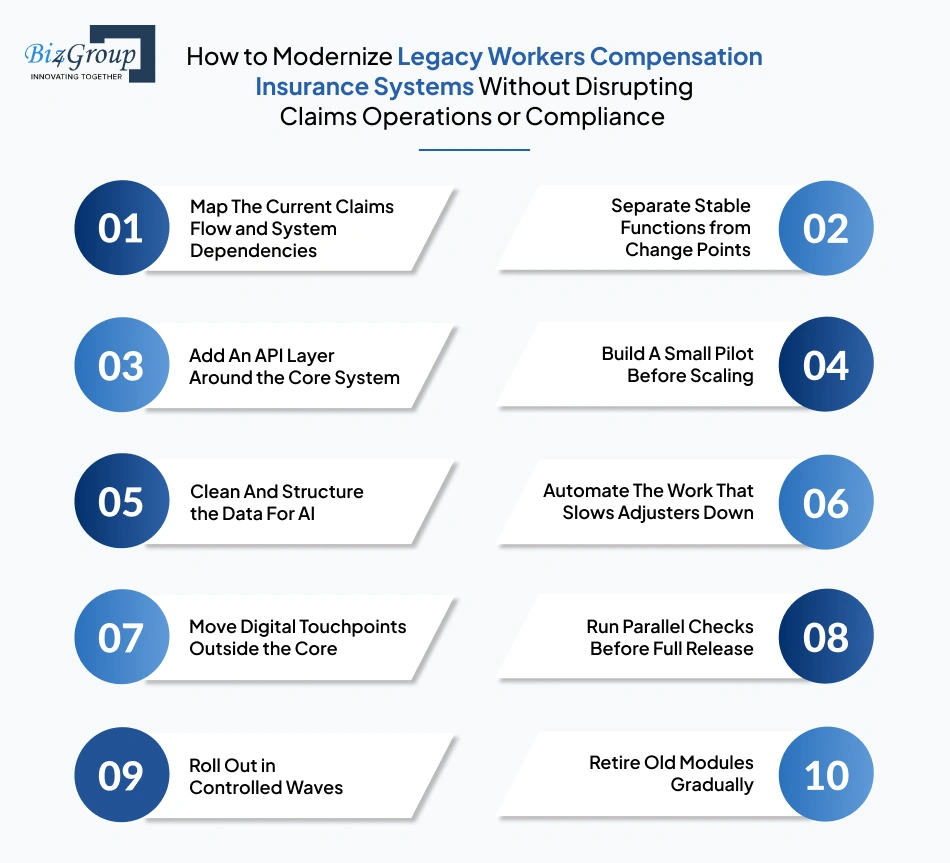
1. Map The Current Claims Flow and System Dependencies
Start with a clean inventory of how claims move today. Look at FNOL intake, assignment, document handling, payments, compliance updates, and every system tied to those steps. For legacy workers compensation software modernization, this gives you the base map before any change begins.
- list every core system and its owner
- note every manual handoff and delayed approval
- identify where claims data gets copied more than once
2. Separate Stable Functions from Change Points
Not every part of the platform needs to move at once. Keep the stable core visible, then mark the areas where workflow changes can happen first. This is the safest way to approach modernizing legacy workers compensation insurance platform work without breaking the operating model.
- keep core claim records and legal history protected
- isolate workflows that can be updated without core replacement
- define which changes need business approval before release
3. Add An API Layer Around the Core System
This is where the platform starts becoming usable for modern tools. An API layer lets the old system share data without exposing the entire core to risk. It also creates room for AI integration services without forcing a full rebuild.
This layer should also support secure connectivity with the external systems workers compensation operations depend on every day.
- connect claims status, documents, and payment data through secure APIs
- expose only the functions needed for new digital tools
- Support AI integration with EHR systems, medical bill review vendors, PBMs, and state EDI reporting platforms
- reduce dependency on manual file transfers and disconnected reporting workflows
- use AI consulting services to define the first integration points
Also Read: A Complete Guide to AI EMR/EHR Software Development
4. Build A Small Pilot Before Scaling
Do not start with the hardest workflow. Pick one narrow use case, such as fraud flagging or claim triage, and test it first. That is where MVP development services are useful, because you can prove value before asking the business to trust a larger rollout.
- choose one claim type or one fraud trigger set
- test the pilot with a limited user group
- measure cycle time, error rate, and adoption before expanding
Also Read: Top MVP Development Companies in USA
5. Clean And Structure the Data For AI
AI cannot help much when claim records are inconsistent or scattered. Prepare the data so the model can read it clearly and the team can trust the output. This is a core part of modernizing legacy workers compensation insurance systems for analytics and intelligent decision support.
- standardize claim fields, notes, and document labels
- remove duplicate records and inconsistent status codes
- set rules for what data should feed predictive models
6. Automate The Work That Slows Adjusters Down
Focus on tasks that consume time and create repetitive work. This is where AI automation services can remove friction without changing the entire claims model. Use automation for sorting, tagging, routing, and alerting, not for replacing the full adjuster role.
- auto-tag incoming documents and route them to the right team
- flag suspicious billing patterns for review
- summarize claim updates so adjusters spend less time searching
Also Read: Top 10 AI Automation Companies in USA (2026 Edition)
7. Move Digital Touchpoints Outside the Core
Let employer portals, adjuster screens, and reporting views sit on top of the old system instead of inside it. That reduces disruption and creates a smoother path for AI workers compensation software to improve daily work without destabilizing the legacy core.
- build modern front ends for users who need speed and clarity
- keep the old core focused on record storage and processing
- use the new layer to deliver better visibility and faster action
Also Read: How Much Does It Cost to Build AI Workers Compensation Claims Management Software?
8. Run Parallel Checks Before Full Release
Every change needs proof. Run the old and new process side by side for a controlled period. This helps you catch data gaps, workflow mismatches, and compliance issues before they reach live operations.
- compare claim outcomes across both paths
- test payment, reporting, and assignment accuracy
- review exception cases with claims, IT, and compliance teams
9. Roll Out in Controlled Waves
Do not release everything at once. Move one workflow, one region, or one claim segment at a time. That is how legacy workers compensation insurance platform changes stay manageable for business teams and safer for compliance review.
- sequence releases by business impact and risk level
- keep rollback options ready for each wave
- train teams before each release reaches production
10. Retire Old Modules Gradually
Once a new workflow proves stable, remove the old piece it replaced. This keeps the environment cleaner over time and prevents duplicate maintenance. It also helps the business see real progress instead of carrying two systems for the same job.
- turn off only the modules that are fully covered
- archive historical data before shutdown
- document what changed so future updates stay simple
Modernization works best when it protects claims continuity and gives the business room to grow. When you modernize legacy workers compensation insurance systems in controlled steps, you reduce risk, keep compliance intact, and make AI adoption practical instead of disruptive.
Modernization Shouldn’t Break Claims Operations
Plan a phased transformation roadmap that keeps adjusters productive and compliance workflows stable
Map My Modernization StrategyHow Is AI Transforming Workers Compensation Insurance Systems in 2026?
AI is changing workers compensation operations by moving routine claim work out of manual queues and into faster, data-led workflows. For teams trying to modernize legacy workers compensation insurance systems, the shift matters because AI is now helping claims teams work with less delay, less rekeying, and better visibility across active files.
- AI sorts incoming FNOL files and routes them faster, so adjusters spend less time on intake bottlenecks and more time on active claim handling.
- It reads medical notes, bills, and claim documents faster than manual review, which makes tools like AI medical billing software useful for reducing review delays.
- AI flags unusual billing patterns and claim behavior earlier, helping teams spot fraud signals before the file becomes more expensive to manage.
- It supports smarter claim triage by separating routine files from higher-risk cases that need faster attention.
- It helps adjusters summarize notes, track claim progress, and find key information without digging through long file histories.
- AI in insurance systems improves medical coordination by making treatment data easier to organize and review across claim files.
- It gives compliance teams faster access to structured data, which helps them handle reporting work with fewer manual steps.
In 2026, AI is not just adding convenience. It is becoming part of the operating layer for claims, medical review, and decision support. That is why insurance core system modernization for workers compensation is increasingly tied to AI readiness, not just system upgrades.
What Capabilities Must Modern Workers Compensation Insurance Systems Have Today?
Workers compensation operations depend on fast coordination between claims teams, employers, providers, compliance staff, and external systems. Older platforms were not designed for that level of operational connectivity.
That is why many insurers are trying to modernize legacy workers compensation insurance systems around capabilities that improve claims speed, operational visibility, compliance response, and long-term scalability.
Here are the capabilities needed in order to do so:
|
Capability Needed Today |
Why It Matters in Workers Compensation Operations |
|---|---|
|
Real-Time FNOL And Claim Assignment |
Helps claims teams receive and assign claims faster so adjusters can act before delays increase operational risk. |
|
Integration With EHRs, PBMs, And Medical Bill Review Systems |
Improves coordination with healthcare providers and reduces manual document exchange across medical workflows. |
|
Jurisdiction-Specific Compliance Management |
Supports faster updates for fee schedules, state reporting rules, NCCI filings, and jurisdictional changes. |
|
Predictive Claim Severity Detection |
Helps adjusters identify high-risk claims early before medical costs and reserve exposure escalate. |
|
Automated Claims Workflow Routing |
Reduces dependency on manual claim assignments, repetitive approvals, and disconnected communication. |
|
Centralized Claim and Medical Data Visibility |
Gives adjusters and operations teams a unified view of claim history, documents, payments, and medical activity. |
|
Flags suspicious billing behavior, duplicate claims activity, and abnormal treatment patterns earlier in the process. |
|
|
Employer And Adjuster Self-Service Access |
Improves visibility into claim status, reporting tasks, and operational communication without relying on email chains. |
|
Real-Time Reporting and Operational Dashboards |
Helps leadership teams monitor claim trends, reserve exposure, operational bottlenecks, and compliance activity faster. |
|
Adjuster Workload Balancing |
Prevents uneven claim distribution and helps teams respond faster during high claim volume periods. |
|
Return-To-Work Coordination Support |
Tracks recovery progress, communication timelines, and employer coordination during claim resolution. |
|
Secure API-Based Connectivity |
Allows modern tools and external systems to exchange claims data safely without disrupting core operations. |
Modern workers compensation platforms are expected to support more than basic claims processing. They must improve operational responsiveness, reduce manual dependency, support connected workflows, and create a stronger foundation for legacy insurance system modernization for workers compensation across carriers and TPAs.
What Are the Benefits of Modernizing a Legacy Workers Compensation Insurance System?
Claims operations become easier to manage when adjusters, compliance teams, employers, and reporting systems work through connected and responsive workflows. That is one of the biggest reasons insurers continue to modernize legacy workers compensation insurance systems across claims and policy operations.
Accenture’s 2025 study of 245 insurance companies found that modernization outperformers improved premium revenues by 8.1 percentage points while reducing expense ratios by 2.6 percentage points.
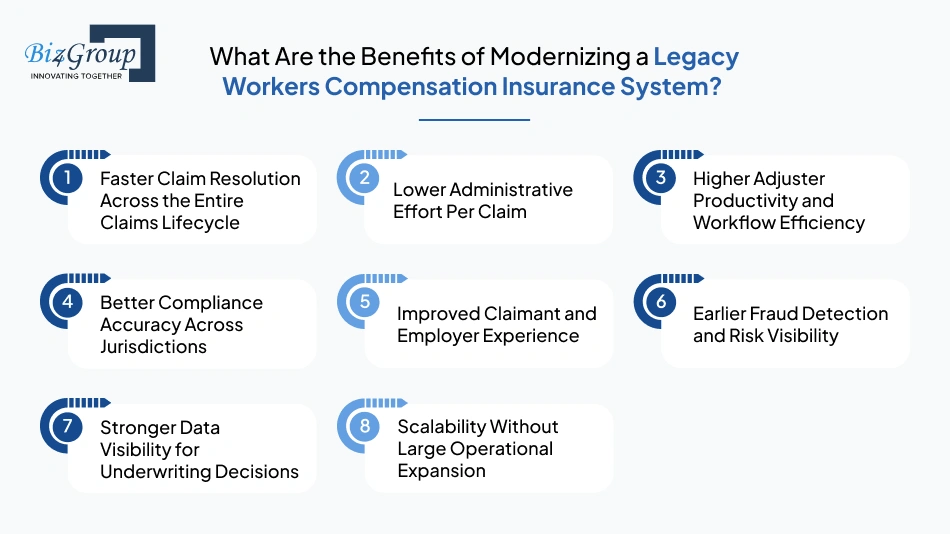
1. Faster Claim Resolution Across the Entire Claims Lifecycle
Modernized workflows help claims move faster from FNOL intake to assignment, medical review, and settlement coordination. Adjusters spend less time waiting on disconnected processes and more time handling active claims, which improves turnaround speed across daily operations.
2. Lower Administrative Effort Per Claim
Automation reduces repetitive operational work tied to document handling, claim routing, reporting tasks, and manual status updates. Claims teams can manage larger workloads with fewer administrative touchpoints, which helps reduce operational costs across high-volume environments.
3. Higher Adjuster Productivity and Workflow Efficiency
Modern claims environments give adjusters centralized claim visibility, dashboard-driven workflows, and faster access to medical and reporting data. That reduces time spent switching between systems and improves overall handling capacity across claims teams.
4. Better Compliance Accuracy Across Jurisdictions
Real-time regulatory update management improves reporting consistency across states and jurisdictions. Compliance teams can respond faster to fee schedule changes, audit requirements, and reporting updates while reducing the risk of manual processing errors.
5. Improved Claimant and Employer Experience
Self-service access, faster communication workflows, and better claim visibility improve operational responsiveness for both employers and injured workers. Claims teams spend less time handling repetitive status inquiries and more time resolving active cases.
6. Earlier Fraud Detection and Risk Visibility
Modernized systems improve the ability to identify suspicious billing behavior, abnormal treatment patterns, and high-risk claims earlier in the claims lifecycle. Faster visibility helps teams investigate issues before claim costs escalate further.
7. Stronger Data Visibility for Underwriting Decisions
Connected claims and operational data improve visibility into claim trends, loss patterns, and risk behavior. That information supports more informed underwriting decisions and helps insurers respond faster to changing risk conditions.
Also Read: AI Insurance Underwriting Software Development
8. Scalability Without Large Operational Expansion
Modern platforms support higher claim volumes without forcing proportional increases in staffing or operational overhead. Claims teams can scale workflows more efficiently during growth periods, catastrophic events, or regional claim spikes.
Modernization improves more than technology performance. It strengthens operational speed, workforce efficiency, claims visibility, compliance responsiveness, and long-term scalability. Those operational gains continue driving legacy workers compensation platform modernization across carriers, TPAs, and claims organizations.
Claims Efficiency Starts with Better Systems
Reduce operational friction and improve claims responsiveness without forcing disruptive platform replacement
Improve Claims PerformanceWhy Big Bang Core Replacement Often Fails in Workers Compensation Insurance Modernization
Replacing an entire workers compensation platform in one large transition may sound faster on paper, but it creates major operational risk once real claims activity, compliance workflows, and external integrations enter the picture.
Workers compensation systems are deeply tied to claims handling, medical coordination, billing, reporting, and jurisdiction-specific processes. A single disruption inside that environment can affect multiple operational teams at the same time.
- large-scale migrations often move decades of claims history at once, which increases the risk of incomplete or inconsistent data transfer
- claims teams struggle when adjusters are forced to learn entirely new workflows during active claim handling periods
- integrations with EHR systems, PBMs, payroll platforms, and state EDI reporting systems frequently break during full-system transitions
- compliance workflows become harder to validate when multiple reporting and jurisdictional processes change simultaneously
- operational downtime creates delays across FNOL intake, claim assignment, payments, and medical coordination
- older business rules embedded inside legacy systems are often undocumented, making full replacement projects harder to stabilize
- testing becomes difficult because every claims workflow, integration, and reporting process changes at the same time
- large deployments usually require longer freeze periods, which slows operational adaptability during rollout
Instead of replacing every system together, organizations modernize claims workflows, integrations, reporting environments, and AI capabilities step by step while keeping core operations active.
How to Build a Workers Compensation Modernization Strategy for Competitive Transformation
When your legacy claims system is losing ground, the answer is not another isolated fix. If you are asking:
“I am the CTO of a large workers compensation TPA and our legacy claims management system is costing us clients. Our competitors have modern AI enabled platforms that offer capabilities we simply cannot match our outdated infrastructure. I need to present our board with a credible modernization strategy that shows a clear path to competitive parity within 18 to 24 months?”
Here’s how you can approach it:
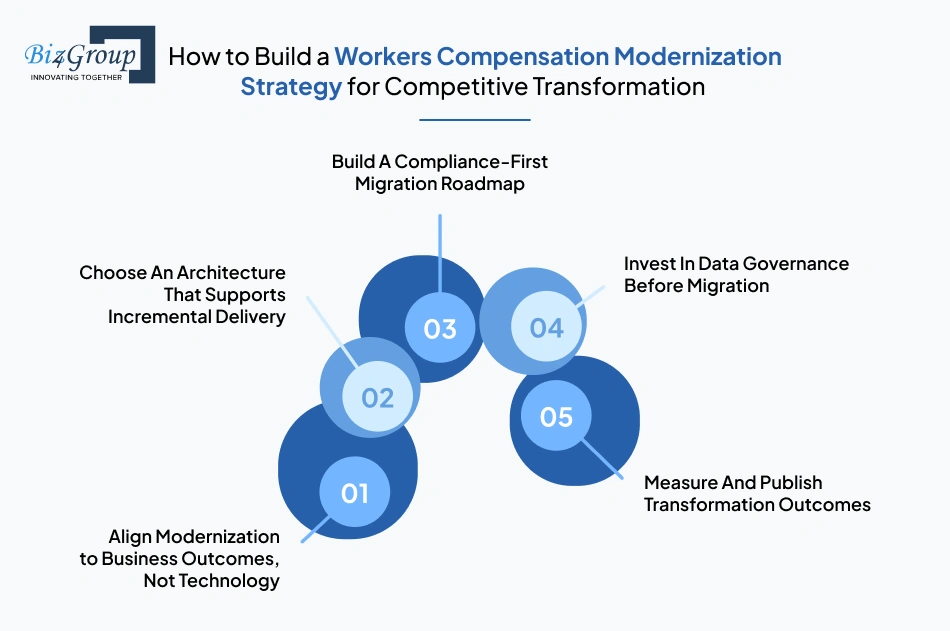
1. Align Modernization to Business Outcomes, Not Technology
A strong modernization strategy starts with the business results you want to improve. Before you talk about platforms or vendors, define success in operational terms such as claims cycle time, adjuster ratio, compliance error rate, document fraud detection speed, and client retention.
This keeps the program grounded in outcomes the board can measure, and the operations team can feel. When the target is clear, every technology choice becomes easier to justify.
2. Choose An Architecture That Supports Incremental Delivery
A workers compensation system migration strategy should avoid locking the business into a risky all-at-once change. API-first, microservices, or composable architecture gives you room to deliver value in stages while keeping the core claims function stable.
That matters because competitive transformation depends on steady progress, not a single release that tries to do everything at once. Incremental delivery also makes it easier to test, correct, and expand without disrupting active claims work.
3. Build A Compliance-First Migration Roadmap
In workers compensation, compliance cannot be an afterthought. State EDI feeds, NCCI reporting, jurisdiction-specific fee schedules, and audit requirements must be validated before old components are retired.
The migration roadmap should show exactly how compliance checks will happen at each stage and who signs off on them. This keeps legal and operational teams aligned and reduces the chance of a technical change creating a reporting problem later.
4. Invest In Data Governance Before Migration
Data quality is usually where modernization efforts get into trouble. Claim records, medical notes, payment data, and reporting fields need to be cleaned, standardized, and validated before they move into a new environment.
If the data is messy, the new platform will only move the mess faster. Good governance makes the transition safer and gives leadership more confidence in the results. It also improves the value of analytics and AI once the new system is live.
5. Measure And Publish Transformation Outcomes
Modernization stays credible when people can see progress. Set quarterly reviews against pre-modernization baselines and publish the results to the people who need them. That can include improvements in claim cycle time, compliance accuracy, adjuster productivity, or operating cost per claim.
When leaders see steady gains, the program gains momentum, but when teams see the numbers, they trust the direction of the work.
A solid strategy gives your board a clear path, your operations team a realistic sequence, and your technology leaders a way to move with control. Thus, becomes the best strategy for modernizing a legacy workers compensation insurance platform that has been running on COBOL mainframe architecture for over 20 years.
Is Your Modernization Roadmap Actually Scalable?
Build a transformation strategy aligned with operational KPIs, compliance readiness, and long-term AI adoption
Review My Transformation PlanWhat Challenges Arise During Legacy Workers Compensation System Modernization (and How to Overcome Them)?
Modernization projects become difficult when operational dependencies, compliance workflows, historical claims data, and external integrations all move at the same pace. That is why many organizations approaching a workers compensation insurance technology upgrade focus heavily on risk control, phased rollout planning, and operational continuity before large-scale transformation begins.
|
Challenge |
Solution |
|---|---|
|
Historical claims data is inconsistent or incomplete |
Clean, standardize, and validate claims data before migration begins to reduce reporting and operational errors later. |
|
Claims operations cannot tolerate downtime |
Use phased rollout models and parallel testing environments to keep claims workflows active during modernization. |
|
Legacy business rules are poorly documented |
Map workflows early and involve claims, compliance, and operations teams before replacing critical processes. |
|
Compliance workflows are harder during migration |
Validate state EDI reporting, NCCI filings, fee schedule updates, and audit processes before retiring older systems. |
|
Integration failures disrupt connected workflows |
Test integrations with EHRs, PBMs, payroll systems, and third-party vendors before production deployment. |
|
Adjusters resist workflow changes |
Introduce changes gradually and provide role-specific training tied directly to daily operational tasks. |
|
AI initiatives fail due to fragmented data |
Improve data consistency and integration readiness before expanding automation initiatives. Many insurers hire AI developers after preparing operational data environments properly. |
|
Modernization costs become difficult to control |
Break the program into measurable phases with operational KPIs tied to each deployment stage. Early planning around AI integrations cost also helps leadership teams avoid budget overruns later. |
|
Reporting visibility decreases during transition |
Maintain centralized reporting validation throughout rollout to keep leadership teams informed during migration. |
|
Departments operating on conflicting priorities |
Align claims, compliance, IT, and executive leadership around shared modernization goals and timelines. |
Also Read: Cost to Hire an AI Software Developer in 2026
Modernization challenges become easier to manage when organizations treat transformation of legacy workers compensation insurance systems as an operational program instead of a single deployment event.
How Does Biz4Group LLC Helps in Modernizing Legacy Workers Compensation Insurance Systems?
Many insurance leaders reach a point where the legacy core keeps the business running, but it also keeps every new idea stuck in place. They start asking:
“Our workers compensation insurance system is 28 years old running on COBOL mainframe architecture. Our IT team spends 75 percent of their budget just keeping it running with almost nothing left for new capabilities. We desperately need a modernization partner that can help us transform this aging infrastructure into a modern platform without destroying our claims operations in the process?”
Well, Biz4Group LLC is the answer you’re looking for.
Biz4Group LLC is an AI development company that works with insurers and TPAs facing operational pressure from aging workers compensation systems. The team helps insurers with modernizing workers compensation insurance system data architecture to support AI machine learning and predictive analytics capabilities by improving claims data structure, integration readiness, and reporting visibility.
Not only this, with hands-on experience in building AI insurance automation software solutions, we bring strong technical and operational understanding of modern insurance platforms. Take a look:
1. Transforming Insurance Training with AI: Meet Insurance AI
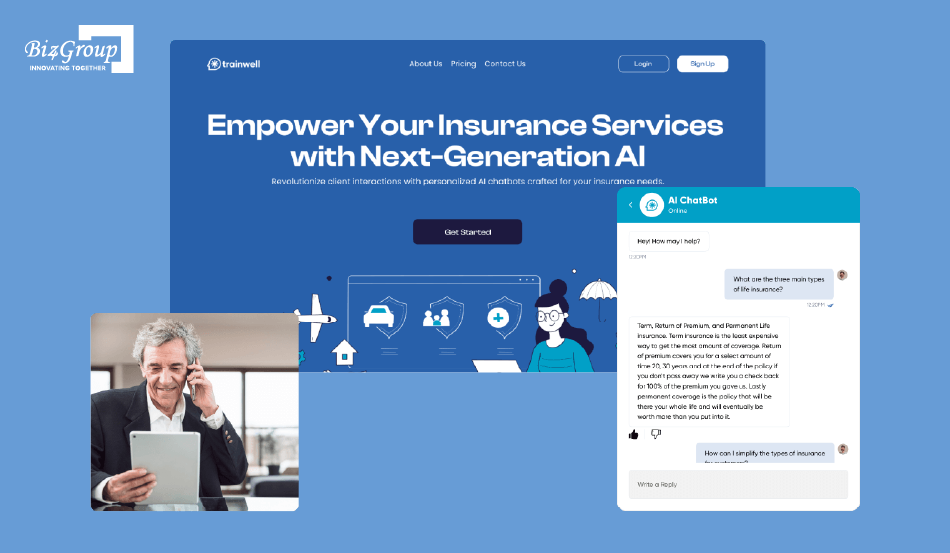
Insurance AI is an AI chatbot built for insurance training and support. It gives agents instant, accurate answers to common questions, reducing repeated live training sessions, and long document-based onboarding.
The system uses custom LLMs powered by GPT-4o and GPT-3.5, includes feedback-based model improvement, and integrates easily into an existing web interface so teams can keep knowledge current and accessible.
2. AI IVR Platform for Medical Claim
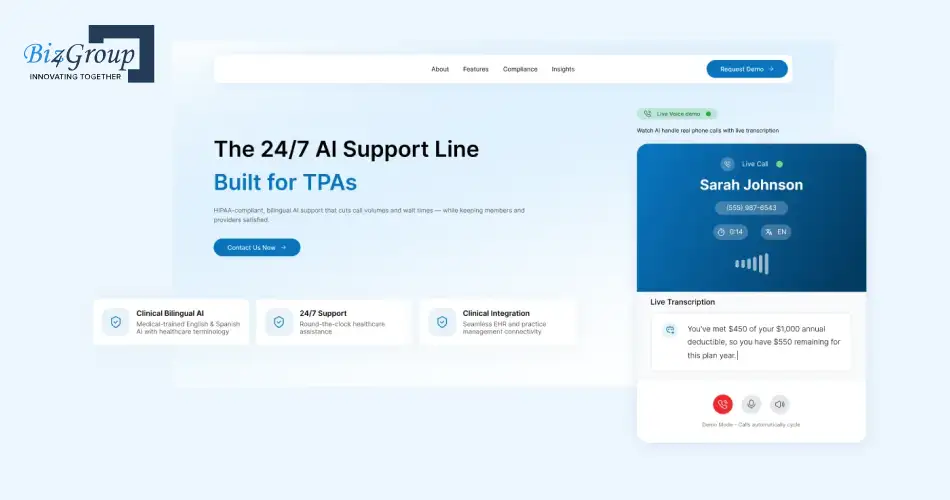
An AI-driven IVR and support platform designed for healthcare administrators to manage high volumes of patient and insurance-related calls through automated voice interactions. The platform supports real-time responses, smart call escalation, bilingual voice support, and secure handling of sensitive healthcare information.
It helps reduce manual call handling while improving response speed, operational efficiency, and communication workflows across healthcare support environments.
Beyond our domain expertise, here’s what we bring more to the table:
- We let insurers move away from tightly coupled legacy workflows through phased modernization plans that keep claims operations active during transition.
- Our team supports modernization projects where claims systems must continue handling active files, compliance reporting, and external integrations without operational disruption.
- We develop AI TPA software that helps insurers improve claims visibility, workflow coordination, and operational responsiveness across adjuster teams.
- AI experts in our team focus on reducing modernization risk by validating integrations, claims workflows, and reporting dependencies before large-scale rollout decisions are made.
With that being said, Biz4Group LLC gives insurers a practical way to modernize without turning the project into a disruption event. For organizations that need to modernize legacy workers compensation insurance systems and still protect daily claims operations, we bring the right mix of AI integration and execution discipline. Connect with us today!]
Conclusion
Workers compensation insurers are reaching a point where maintaining aging infrastructure costs more than improving it. The pressure is not limited to system maintenance alone. It now affects claims speed, compliance responsiveness, operational visibility, and the ability to introduce modern capabilities through AI product development services and connected workflows.
That is why many organizations are reassessing how they can upgrade legacy workers compensation system environments without disrupting active operations. At the same time, workers compensation core system replacement does not always need to happen through a risky all-at-once transition. Phased modernization strategies are giving insurers more control over claims continuity, integrations, compliance workflows, and long-term scalability.
With the right execution partner like Biz4Group LLC, organizations can modernize legacy workers compensation insurance systems while keeping operational stability intact. Teams working through these transformation decisions can connect with us to discuss a modernization roadmap aligned with their operational and technology priorities.
FAQ’s
1. How long does legacy workers compensation system modernization usually take for large insurers or TPAs?
Most modernization programs take place in phases instead of one full replacement cycle. Timelines depend on claims volume, integration complexity, compliance workflows, and data readiness. Many insurers prioritize claims intake, reporting, and integrations first before expanding modernization across the full platform.
2. What is the safest approach for modernizing a legacy workers comp insurance platform without disrupting active claims?
Phased rollout strategies are usually safer than full replacement projects. Many insurers modernize integrations, reporting systems, and claims workflows gradually while keeping the existing core active during transition periods.
3. Why do many workers compensation core system replacement projects fail?
Large replacement projects often fail because claims workflows, integrations, compliance reporting, and historical claims data all change simultaneously. Operational disruption, incomplete migration planning, and undocumented business rules create major implementation risks during large-scale transitions.
4. How does a workers compensation system migration strategy help reduce modernization risk?
A structured migration strategy helps organizations phase modernization across workflows, integrations, and reporting environments instead of changing everything together. This gives claims teams more operational stability during rollout and improves compliance validation throughout modernization.
5. What should insurers prioritize first during a workers compensation insurance technology upgrade?
Most insurers start with claims workflows, integration readiness, compliance reporting, and data standardization before expanding into automation or AI initiatives. Early operational improvements usually create a more stable foundation for broader modernization programs.
6. Can insurers modernize legacy workers compensation insurance systems without replacing the entire core platform?
Yes. Many organizations modernize surrounding workflows, integrations, reporting systems, and operational interfaces while keeping portions of the existing core active. This approach reduces disruption and allows modernization to happen in controlled stages.
