 Location :
Orlando, FL, USA
Location :
Orlando, FL, USA +1 (407) 714-1616
 info@biz4group.com

 AI Summary Powered by Biz4AI
- Real estate RAG platform development combines retrieval-augmented generation with enterprise property data to deliver accurate, context-aware, and up-to-date AI responses.
- A successful platform depends on high-quality data, robust retrieval pipelines, seamless integrations, and scalable architecture rather than just a powerful language model.
- Real estate RAG platforms enable intelligent property search, document analysis, portfolio management, customer support, and personalized property recommendations using real-time business data.
- Cost of development typically ranges from $25,000 for MVP to $300,000+ for enterprise-grade platforms, with the final investment depending on features, integrations, and infrastructure.
- Biz4Group builds custom real estate RAG platforms that unify property data, enterprise systems, and AI into intelligent solutions designed for long-term growth.
Your real estate chatbot can write a property listing in seconds. Ask it which available three-bedroom home offers the best rental yield near top-rated schools, and there's a good chance it won't have enough live business data to answer accurately.
That's the problem real estate RAG platform development is solving. Even the most capable AI model can only answer as well as the data it can access.
Modern real estate businesses don't struggle with a lack of data. They struggle with making that data useful when it matters most. As property portfolios, documents, and customer interactions grow, finding the right information becomes increasingly difficult. Traditional search can locate documents, while standalone LLMs can generate fluent responses. But neither can reliably answer questions using your latest business data on its own. The result is outdated property information, inaccurate recommendations, and answers users can't fully trust.
The industry is already moving in this direction. According to the 2025 National Association of REALTORS® Technology Survey, 68% of realtors used AI tools during the past year, while 20% use them daily. Yet 46% reported no noticeable business impact, which highlights a common challenge, adopting AI is easy, but turning it into measurable business value is much harder.
As a real estate AI software development company, we've observed a common pattern at Biz4Group, many businesses begin their AI journey by focusing on the model, when the real foundation for success is the data.
A powerful LLM alone can't deliver reliable property intelligence. Real estate data is scattered across MLS platforms, CRMs, contracts, valuation reports, and other systems that rarely stay in sync. Without connecting and grounding AI in this data, even the best models produce inconsistent results. That's where a Real Estate RAG platform makes the difference.
Jumping straight into development wouldn't make much sense until we understand what we're actually building. Let's start with the basics and see what makes a real estate RAG platform different.
What Is a Real Estate RAG Platform and How It Works?
A real estate RAG platform is a system that retrieves information from your property data before generating a response. Instead of relying only on what a large language model (LLM) learned during training, it combines AI with live business data to answer questions using the most relevant and up-to-date information available.
Its primary purpose is to help users find trustworthy property information without manually searching through multiple systems or outdated records.
A typical platform connects to the data your business already uses, including:
- MLS listings
- CRM systems
- Lease agreements
- Property valuation reports
- Inspection documents
- Zoning records
- Property images and floor plans
- Internal knowledge bases
Imagine a buyer asks, "Find modern family homes under $800,000 with highly rated schools nearby and less than a 30-minute commute."
Then RAG response would be, "I found four properties that match your requirements. The best match is a four-bedroom home in North Creek listed at $775,000. It's a 12-minute walk from Lincoln Elementary (rated 9/10), approximately a 28-minute commute to downtown, and includes a fenced backyard, a two-car garage, and recent energy-efficient upgrades. Three additional properties also meet your budget and commute preferences, with school ratings ranging from 8/10 to 10/10."
Instead of searching one database or matching a few keywords, the platform can:
- Understand the buyer's intent.
- Retrieve relevant information from multiple business systems.
- Combine property, location, and market data.
- Generate a personalized response backed by current business information.
Think of it like consulting two real estate advisors. One answers entirely from memory. The other reviews the latest listings, contracts, market reports, and property records before responding. A real estate RAG platform works like the second advisor, grounding every response in the latest available information.
Several components work together to make this possible.
|
Component |
Role |
|---|---|
|
Business Data |
Stores listings, customer records, property documents, and market insights. |
|
Retrieval Layer |
Finds the most relevant information for every query. |
|
Vector Database |
Performs semantic search by understanding meaning instead of exact keywords. |
|
Large Language Model (LLM) |
Generates responses using the retrieved business context. |
|
Application Layer |
Delivers answers through websites, mobile apps, chatbots, or internal dashboards. |
Together, these components enable the platform to retrieve relevant business information before generating a response, making AI outputs more accurate, contextual, and reliable.
How Does a Real Estate RAG Platform Work?
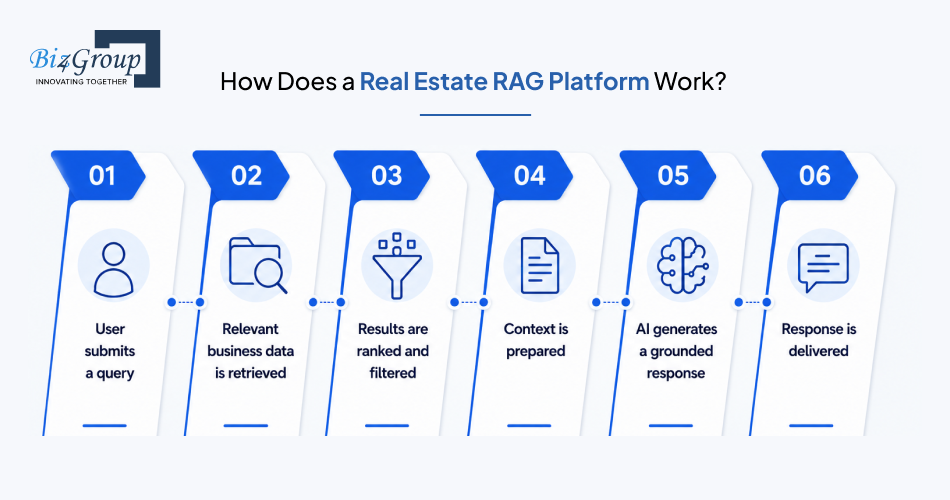
Every query in a real estate RAG platform follows a retrieval pipeline before an AI response is generated. Instead of searching a single database or relying on stored model knowledge, the platform gathers relevant business information, prepares it as context, and then generates a response grounded in that data.
The process typically follows these six steps:
|
Step |
What Happens |
|---|---|
|
User submits a query |
A buyer, agent, investor, or property manager asks a question in natural language. |
|
Relevant business data is retrieved |
The platform searches connected sources such as MLS listings, CRM records, contracts, inspection reports, and market databases. |
|
Results are ranked and filtered |
The most relevant records are selected while duplicate or unrelated information is discarded. |
|
Context is prepared |
The retrieved information is organized into a structured prompt for the language model. |
|
AI generates a grounded response |
The LLM generates an answer using the retrieved business context instead of relying only on pre-trained knowledge. |
|
Response is delivered |
The user receives a contextual answer, often with supporting property details or source references. |
The workflow can be visualized as:
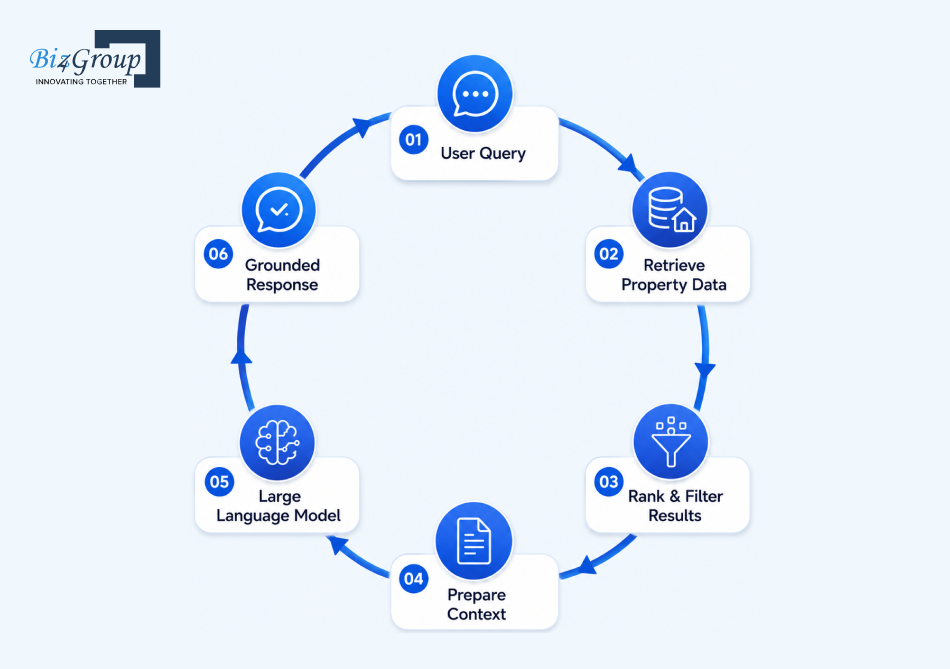
Although the workflow appears straightforward, every stage affects the quality of the final response. Retrieval accuracy, document ranking, and context preparation often have a greater impact on response quality than the language model itself.
Understanding that foundation makes it easier to see why this approach is rapidly replacing traditional property search and standalone AI solutions.
Every Property Has a Story. Can Your AI Tell It?
Build an AI platform that understands listings, contracts, and customer context.
Connect With Our ExpertsHow Real Estate RAG Platform Differs from General Property Search Systems?
A real estate RAG platform shifts the experience from searching for properties to solving property-related questions. Instead of relying only on predefined filters, it combines AI with business knowledge to deliver answers that are more relevant, contextual, and actionable. The difference isn't replacing traditional searches. It's extending what property platforms can do when users need more than a list of listings.
Here is a table exploring the key differences between traditional property search systems and real estate RAG platforms.
|
Capability |
Traditional Property Search |
Real Estate RAG Platform |
|---|---|---|
|
Primary Purpose |
Find matching listings |
Answer questions and recommend relevant properties |
|
Search Method |
Keywords and filters |
Natural language and semantic search |
|
Data Sources |
Property listings |
Listings, MLS, CRM, contracts, reports, knowledge bases, and more |
|
Handles Complex Queries |
Limited |
Yes |
|
Response |
Matching listings |
Context-aware recommendations with supporting information |
|
Document Intelligence |
Not typically supported |
Searches contracts, leases, disclosures, inspection reports, and other documents |
|
Knowledge Freshness |
Depends on listing updates |
Retrieves the latest indexed business data before generating a response |
|
Best For |
Direct property searches |
Property search, customer support, investment analysis, document discovery, and decision support |
For example, if a buyer asks, "Find family homes under $800,000 with good schools nearby, low HOA fees, and less than a 30-minute commute."
A traditional platform returns listings that match the available filters, whereas a RAG platform evaluates the complete request, retrieves relevant information from multiple connected sources, and explains why specific properties satisfy the buyer's priorities.
Let's look into what the platform architecture is used behind a production-ready real estate RAG solution.
What Components Make Up a Real Estate RAG Platform?
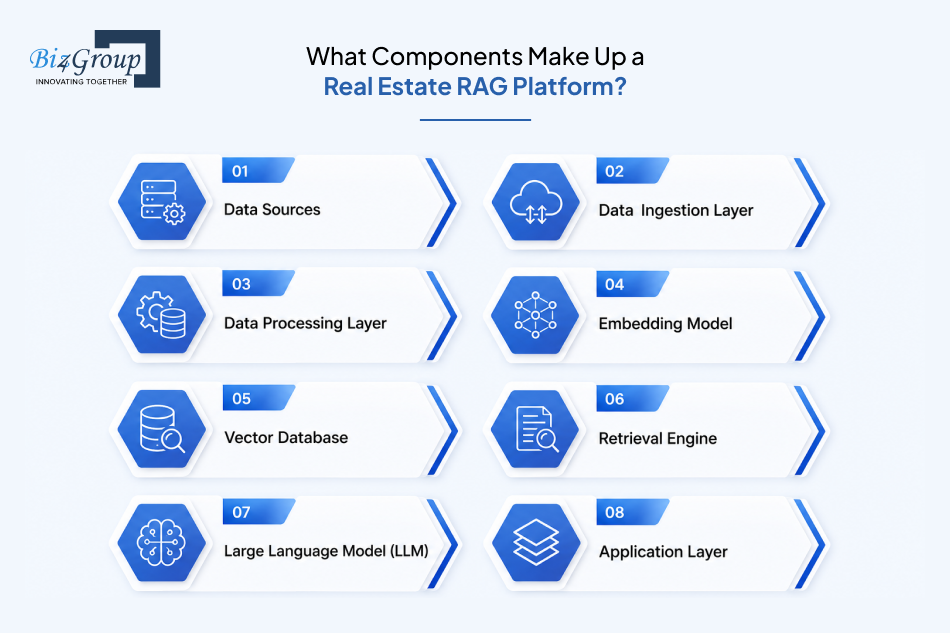
A real estate RAG platform is a collection of components that work together to retrieve, process, and deliver accurate property information. Each component has a specific responsibility, and replacing or upgrading one doesn't eliminate the need for the others.
|
Component |
Responsibility |
Production Consideration |
|---|---|---|
|
Data Sources |
Store MLS listings, CRM records, lease agreements, valuation reports, inspection documents, and other business knowledge. |
Retrieval quality depends on complete, current, and trusted data. |
|
Data Ingestion Layer |
Connects to business systems and continuously imports or synchronizes property data. |
Real-time or scheduled synchronization is essential for frequently changing listings and documents. |
|
Data Processing Layer |
Cleans, validates, structures, enriches metadata, and prepares content for indexing. |
Duplicate records, inconsistent formats, and poor metadata reduce retrieval accuracy. |
|
Embedding Model |
Converts property data into vector embeddings for semantic search. |
Choosing an embedding model that understands real estate terminology improves retrieval quality. |
|
Vector Database |
Stores vector embeddings and performs semantic similarity search. |
Select a database that supports scalability, fast retrieval, and hybrid search capabilities. |
|
Retrieval Engine |
Retrieves, filters, and ranks the most relevant information for each query. |
Combining semantic search with metadata filtering and keyword search typically produces better results. |
|
Large Language Model (LLM) |
Generates responses using the retrieved business context. |
Model selection affects response quality, latency, and operational costs. |
|
Application Layer |
Delivers AI capabilities through websites, chatbots, mobile apps, APIs, or internal dashboards. |
The interface should support conversational interactions while preserving structured search options. |
How these components are deployed depends on your project's scale and complexity. Once they're in place, the real value lies in how they work together to solve practical challenges across the real estate industry.
What Are the Real-World Use Cases of a Real Estate RAG Platform?
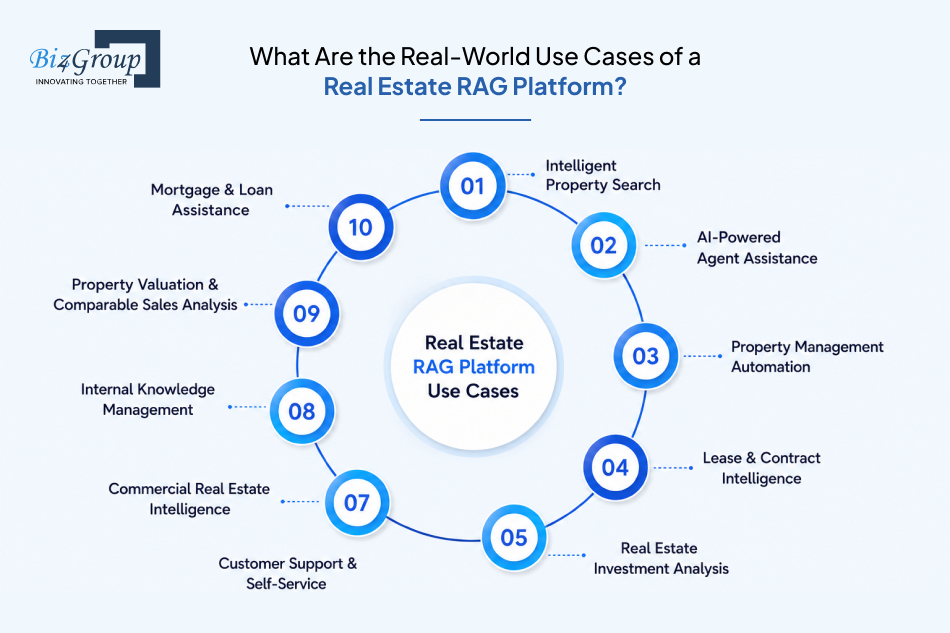
A real estate RAG platform becomes more valuable as it connects with different parts of a real estate business. The same retrieval engine that powers intelligent property search can also assist real estate agents, automate document discovery, support property managers, and help investors make faster decisions. Here are some of the most impactful use cases.
1. Intelligent Property Search
Finding the right property becomes difficult when buyers have specific preferences that go beyond standard filters. They often describe what they want instead of selecting predefined criteria.
A real estate RAG platform interprets conversational queries and retrieves relevant information from property listings, neighborhood data, and supporting documents. It then recommends properties that best match the buyer's requirements.
Example: If a buyer asks, "Show me modern family homes under $800,000 with top-rated schools nearby, low HOA fees, and a commute under 30 minutes."
In such case, instead of displaying hundreds of listings, the platform recommends the most relevant properties and explains why each one fits the buyer's requirements.
Biz4Group developed Homer AI to simplify property discovery through an intelligent, AI-powered real estate platform.
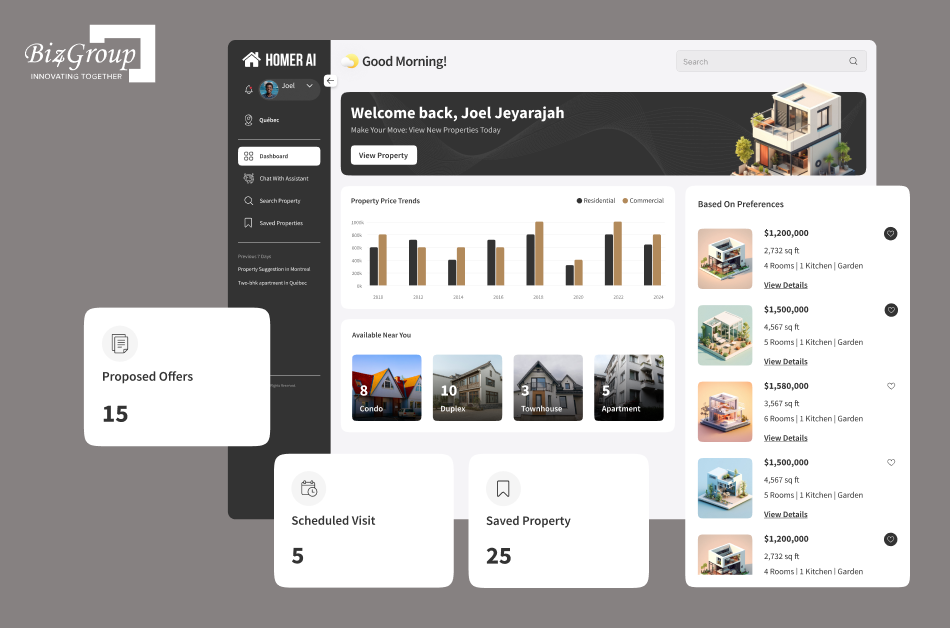
Homer AI combines conversational AI, intelligent property search, AI personalized recommendations, and real estate data into a single experience. This allows buyers to discover properties that match their preferences without relying solely on traditional keyword-based searches.
Key highlights:
- AI-powered conversational property search.
- Personalized property recommendations based on user preferences.
- Natural language interactions instead of traditional filters.
- Intelligent property matching using contextual understanding.
- Interactive user experience for property discovery.
- Scalable AI architecture designed for modern real estate platforms.
This implementation demonstrates how conversational AI can make property discovery more intuitive by understanding user intent instead of relying only on static search filters.
2. AI-Powered Agent Assistance
Real estate agents spend a significant amount of time searching CRMs, emails, listing databases, and market reports before responding to clients. A RAG platform acts as an internal knowledge assistant by retrieving relevant information from connected systems in seconds.
Example: When an agent asks, "Has this client viewed similar waterfront properties in the past six months?"
Then the platform retrieves previous interactions, saved listings, viewing history, and client preferences in a single response.
3. Property Management Automation
Managing multiple properties involves tracking leases, maintenance requests, inspections, tenant communications, and operational records. Instead of navigating separate management systems, property managers can retrieve this information through natural language.
Example: Property manager can directly ask, "Show all unresolved plumbing issues across our Chicago apartment portfolio."
Then the platform returns open maintenance requests, affected properties, contractor updates, and previous repair history.
Biz4Group developed Facilitor to simplify the home-buying journey through an AI-powered real estate platform.
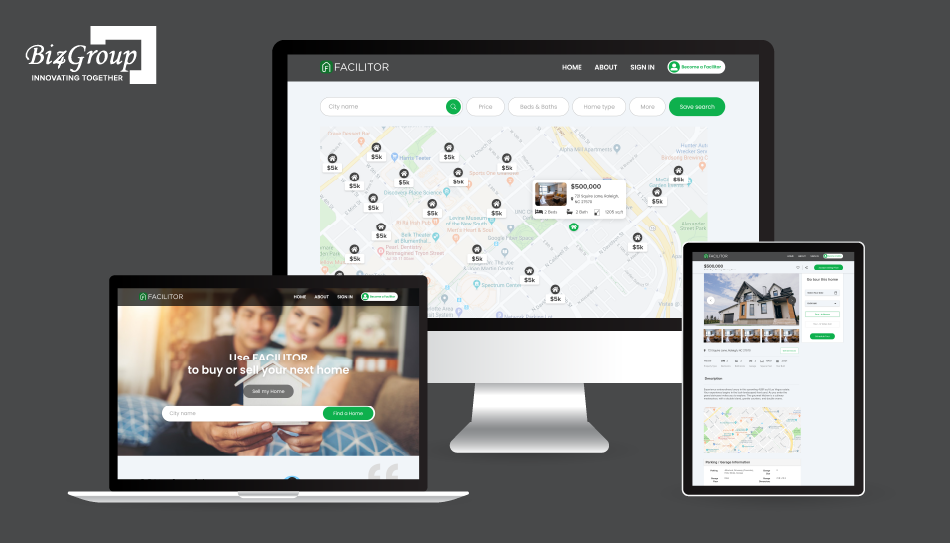
Facilitor combines intelligent property search, AI-powered recommendations, buyer verification, MLS integration, and guided property visits into a single platform, which helps buyers discover and purchase homes with greater confidence.
Key highlights:
- AI-powered property recommendations
- Budget and location-based property search
- Integrated MLS and GPS for accurate listings
- Video and facilitator-assisted property visits
- Buyer's financial verification
- Real-time buyer-seller communication
- Guided experience for first-time homebuyers
This implementation demonstrates how AI can enhance property discovery by combining intelligent recommendations, verified buyer information, and real-time property data within a single platform.
4. Lease & Contract Intelligence
Lease agreements and purchase contracts often contain hundreds of pages of legal language. Finding a single clause can take longer than the review itself. A real estate RAG solution retrieves specific contract terms, summarizes key clauses, and links users to the original document for verification.
Example: When a broker tends to know, "Which office leases include an early termination clause?"
The platform quickly searches through relevant documents to find the answer. It identifies the matching contracts, highlights the clause, and provides direct references to the source documents.
Biz4Group developed Contracks to streamline contract lifecycle management through AI-powered contract intelligence.

Contracks combines contract storage, lifecycle tracking, intelligent search, workflow automation, and centralized document management into a single platform. This enables organizations to locate critical contract information faster, monitor obligations, and manage agreements more efficiently throughout their lifecycle.
Key highlights:
- AI-powered contract search and information retrieval.
- Centralized contract repository with lifecycle tracking.
- Automated approval and renewal workflows.
- Intelligent clause and document lookup.
- Secure enterprise-grade document management.
- Scalable platform for contract operations.
This implementation demonstrates how AI can simplify lease and contract management by making critical information instantly accessible, reducing manual reviews, and improving operational efficiency.
5. Real Estate Investment Analysis
Investment decisions depend on information from multiple sources, including valuation reports, rental trends, occupancy rates, and market research. A RAG platform brings those insights together, reducing the time spent collecting and comparing data manually.
Example: If an investor asks, "Compare multifamily properties in Phoenix with cap rates above 7% and vacancy rates below 5%."
The platform instantly analyzes available data to find relevant opportunities. It retrieves matching properties, summarizes key financial metrics, and highlights the strongest investment candidates.
6. Customer Support & Self-Service
Support teams regularly answer questions about property availability, documentation, transaction status, financing, and application progress. A RAG platform provides accurate answers by retrieving verified business information instead of relying on scripted responses.
Example: When a customer asks, "Has the inspection report for my property been uploaded?"
The platform handles the request in real time. It checks the document repository, confirms the report's status, and provides the right response.
7. Commercial Real Estate Intelligence
Commercial real estate teams work with larger portfolios, complex lease structures, and extensive market data. A RAG platform helps analysts retrieve and compare information across multiple assets without manually reviewing reports.
Example: Analyst asks, "Show retail properties where lease renewals expire within the next 12 months and occupancy exceeds 90%."
Then the platform simplifies the process by finding the right information instantly. It retrieves matching properties, summarizes lease timelines, and highlights assets that require attention.
8. Internal Knowledge Management
Real estate companies maintain operational procedures, compliance guidelines, onboarding documents, and training material across multiple repositories. A RAG platform turns this information into a searchable knowledge base that employees can access instantly.
Example: If a new employee asks, "What's the approval process for updating a commercial listing?"
The platform retrieves the latest internal workflow, approval requirements, and supporting documentation without requiring the employee to search through shared folders.
9. Property Valuation & Comparable Sales Analysis
This is one of the biggest AI opportunities in real estate. Instead of manually reviewing recent sales, appraisal reports, and neighborhood trends, the platform retrieves comparable properties and summarizes the factors influencing a property's estimated value.
Example: When an appraiser needs to identify comparable properties, they can ask, "Find comparable four-bedroom homes sold within the last six months within a three-mile radius."
The platform then retrieves comparable sales, pricing trends, property features, and supporting market data to assist with the valuation process.
10. Mortgage & Loan Assistance
Mortgage advisors and buyers often need information scattered across lender guidelines, financial documents, and loan policies. A RAG platform retrieves relevant eligibility criteria and document requirements while helping users understand the next steps in the lending process.
Example: When a buyer asks, "What documents are required for a conventional mortgage if I'm self-employed?"
The platform quickly finds the relevant information to guide them through the process. It retrieves the lender's documentation requirements, explains the steps involved, and directs the user to the appropriate resources.
These examples show that real estate RAG platform development extends far beyond conversational property search. With the right data foundation, the same platform can support customer-facing experiences, internal operations, and business decision-making across the entire organization.
The next step is understanding the core features that make these use cases possible.
Your Property Data Is Talking. Is Anyone Listening?
Turn scattered business information into intelligent, conversational experiences.
Book a ConsultationWhat Core Features Should Every Real Estate RAG Platform Include?
A production-ready real estate RAG platform should do more than answer questions. It should retrieve the right information, understand user intent, present trustworthy responses, and integrate seamlessly with existing business systems. While feature requirements vary by project, the capabilities below form the foundation of most enterprise-ready platforms.
|
Core Feature |
What It Does |
Business Value |
|---|---|---|
|
Natural Language Search |
Lets users search using conversational language instead of predefined filters. |
Makes property discovery faster and more intuitive. |
|
Semantic Property Retrieval |
Finds relevant listings and documents based on meaning rather than exact keywords. |
Improves search accuracy for complex queries. |
|
Multi-Source Knowledge Retrieval |
Retrieves information from MLS, CRM, contracts, valuation reports, inspection documents, and internal knowledge bases. |
Eliminates data silos and reduces manual research. |
|
Context-Aware Response Generation |
Generates responses using retrieved business context instead of relying solely on the LLM's pre-trained knowledge. |
Produces more accurate and trustworthy answers. |
|
Document Intelligence |
Searches contracts, disclosures, lease agreements, appraisal reports, and other business documents. |
Reduces the time spent reviewing lengthy documents. |
|
Citation & Source References |
Links responses back to the original listings or documents used during retrieval. |
Improves transparency and simplifies verification. |
|
Hybrid Search |
Combines semantic retrieval with keyword search for addresses, MLS IDs, parcel numbers, and other structured fields. |
Delivers better results across both conversational and exact-match searches. |
|
Metadata Filtering |
Narrows search results using structured attributes such as price, location, property type, availability, or square footage. |
Improves search precision without limiting flexibility. |
|
Role-Based Personalization |
Adapts responses based on user roles, permissions, and business context. |
Creates personalized experiences for buyers, agents, managers, and executives. |
|
Performance Monitoring |
Tracks retrieval quality, response latency, failed queries, and user feedback. |
Supports continuous optimization after deployment. |
These features provide the baseline for building intelligent property platforms with AI and vector databases. Once they're in place, businesses can extend the platform with more sophisticated capabilities such as Graph RAG, multimodal search, AI agents, and predictive analytics.
Which Advanced Features Differentiate Enterprise Real Estate RAG Platforms?
The core features make a real estate RAG platform functional. The capabilities below make it scalable, intelligent, and enterprise-ready. Most organizations don't implement them on day one. They become valuable as data volumes, user traffic, and business requirements grow.
|
Advanced Feature |
What It Adds |
Best Suited For |
|---|---|---|
|
Graph RAG |
Connects relationships between properties, owners, neighborhoods, leases, and other entities to improve reasoning across related data. |
Investment analysis, portfolio management, and commercial real estate. |
|
Multimodal Search |
Retrieves information from images, floor plans, scanned documents, videos, and maps in addition to text. |
Property marketplaces, virtual tours, and inspection analysis. |
|
AI Agents & Workflow Automation |
Performs multi-step tasks such as retrieving information, generating reports, scheduling follow-ups, or updating CRM records. |
Brokerages, property management, customer service automation. |
|
Geospatial Intelligence |
Combines retrieval with location-aware analysis, including school zones, commute times, flood risks, and nearby amenities. |
Residential search, investment analysis, and urban planning. |
|
Uses historical and market data to forecast pricing trends, rental demand, occupancy, or investment performance. |
Investors, developers, and commercial real estate firms. |
|
|
Real-Time Data Synchronization |
Keeps listings, documents, and business records continuously updated without requiring full reindexing. |
High-volume marketplaces and enterprise platforms. |
|
Explainable AI |
Shows why a recommendation was generated and references the supporting business data. |
Regulated environments, enterprise decision-making, and customer trust. |
|
Multi-Tenant Architecture |
Supports multiple organizations or business units within a single platform while keeping their data isolated. |
SaaS products, franchise networks, enterprise deployments. |
Not every platform needs every capability. A regional brokerage may prioritize real-time listing synchronization, while a commercial real estate firm handling complex ownership structures may benefit more from Graph RAG.
The right roadmap depends on business goals, not the number of features. Many successful platforms start with strong retrieval, document intelligence, and hybrid search, then expand with advanced capabilities as needs evolve.
The next step is choosing the technologies that bring these capabilities to life, from language models and vector databases to frameworks and cloud infrastructure.
Also Read: Tenant Retention AI Agents Development
Which Technologies Power a Real Estate RAG Platform Development?
A real estate RAG platform combines traditional software engineering with AI infrastructure. Every technology layer has a distinct responsibility. It handles everything from ingesting property data and retrieving relevant information to generating responses and monitoring system performance. Rather than choosing the most popular tools, the goal is to assemble a stack that fits your scalability, security, and operational requirements.
|
Technology Layer |
Purpose |
Popular Technologies |
|---|---|---|
|
Frontend |
Delivers the user interface for buyers, agents, property managers, and administrators. |
React, Next.js development, Angular, Vue.js |
|
Backend & APIs |
Manages business logic, integrations, authentication, and API requests. |
FastAPI, Node.js, Spring Boot, ASP.NET Core |
|
Authentication & Access Control |
Secures the platform through user authentication and role-based permissions. |
Auth0, Keycloak, AWS Cognito, Microsoft Entra ID |
|
Data Storage |
Stores structured business data such as listings, customer records, and transactions. |
PostgreSQL, MySQL, MongoDB |
|
Data Ingestion & ETL |
Imports, cleans, and synchronizes data from MLS, CRM, APIs, and document repositories. |
Apache Airflow, Apache Kafka, Fivetran, Azure Data Factory |
|
Embedding Models |
Converts property data into vector embeddings for semantic retrieval. |
OpenAI, Voyage AI, BAAI BGE, Cohere, Jina AI |
|
Vector Database |
Stores embeddings and retrieves semantically similar information. |
Pinecone, Weaviate, Qdrant, Milvus, pgvector |
|
Retrieval & Orchestration |
Connects data sources, retrieval pipelines, prompts, and language models. |
LlamaIndex, LangChain, Haystack |
|
Reranking Models |
Reorders retrieved results before they reach the language model. |
Cohere Rerank, BGE Reranker, Jina Reranker |
|
Large Language Models (LLMs) |
Generates responses using the retrieved business context. |
GPT-5, Claude, Gemini, Llama |
|
Caching |
Reduces response latency and API costs by storing frequently accessed results. |
Redis, Memcached |
|
Cloud Infrastructure |
Hosts applications, databases, storage, networking, and AI services. |
AWS, Microsoft Azure, Google Cloud |
|
Monitoring & Evaluation |
Tracks latency, retrieval quality, AI hallucinations, usage, and user feedback. |
Langfuse, LangSmith, Arize AI, OpenTelemetry |
|
DevOps & Deployment |
Automates deployment, scaling, and infrastructure management. |
Docker, Kubernetes, GitHub Actions, Azure DevOps, Jenkins |
Technology selection is ultimately a series of trade-offs rather than a search for the "best" tool. The technology stack provides the foundation, but implementation determines how well those technologies work together.
Now, let's walk through the real estate RAG platform development process, from planning and data preparation to deployment and ongoing optimization.
What Does the Real Estate RAG Platform Development Process Look Like?
Building a real estate RAG platform is an iterative process rather than a one-time development project. Most successful implementations move through discovery, validation, product development, and continuous optimization. Each stage reduces risk before the next investment is made.
Step 1. Discovery & Feasibility Assessment
Discovery defines the business problem, validates whether RAG is the right solution, and establishes a clear implementation roadmap before development begins.
Key activities
- Identify business objectives and success criteria.
- Define target users and primary use cases.
- Audit existing systems such as MLS, CRM, ERP, and property management software.
- Assess data quality and availability.
- Evaluate technical feasibility, budget, timeline, and expected ROI.
Why this step matters: Building AI before validating the business problem often leads to expensive features that deliver little value.
Step 2. Proof of Concept (PoC)
A Proof of Concept validates the core AI capabilities using a limited dataset. The objective is to confirm that the retrieval pipeline can produce accurate and useful responses before committing to full-scale development.
Key activities
- Build a basic retrieval pipeline.
- Connect one or two representative data sources.
- Test retrieval accuracy with real business queries.
- Collect stakeholder feedback.
- Identify technical limitations early.
Why this step matters: A PoC answers whether the idea works. It doesn't determine whether the product is ready for customers.
Step 3. MVP Planning
The Minimum Viable Product (MVP) defines the smallest feature set that solves the primary business problem while remaining ready for real users. Businesses can consider MVP development services to build, validate, and refine these core capabilities before scaling further.
Key activities
- Prioritize essential features.
- Define the MVP scope.
- Select initial integrations.
- Create the product roadmap.
- Establish success metrics for the first release.
Why this step matters: A focused MVP reaches the market faster and validates user adoption before expanding the platform.
Also Read: 12+ MVP Development Companies in USA
Step 4. UI/UX Design
UI/UX design determines how users interact with the platform. Even the most accurate AI can struggle with adoption if the experience feels complicated or unpredictable. Businesses can consider partnering with a UI/UX design company to create intuitive interfaces that make AI-powered solutions easier to use.
Key activities
- Map user journeys.
- Design conversational search experiences.
- Create wireframes and interactive prototypes.
- Design dashboards for buyers, agents, and administrators.
- Validate usability through design reviews.
Why this step matters: Good AI improves answers and good UX improves adoption.
Also Read: Top 15 UI/UX Design Companies in USA
Step 5. Data Preparation & Knowledge Base Development
This stage prepares business data for retrieval by cleaning, organizing, and indexing it into a searchable knowledge base.
Key activities
- Import data from MLS, CRM, APIs, and internal systems.
- Remove duplicate and outdated records.
- Normalize property information.
- Process contracts, reports, and other documents.
- Generate metadata and embeddings.
Why this step matters: Clean data has a greater impact on retrieval quality than switching to a larger language model.
Step 6. Platform Development & Integration
This is where the platform is built by combining AI capabilities with backend services, frontend applications, and third-party business systems.
Key activities
- Develop backend services and APIs.
- Build the retrieval pipeline.
- Integrate the language model.
- Develop web and mobile interfaces.
- Connect CRM, MLS, GIS, authentication, and other external systems.
Why this step matters: A production platform depends on reliable integrations as much as AI capabilities.
Step 7. Testing & AI Evaluation
This stage verifies that the platform performs reliably under real-world conditions and produces accurate, trustworthy responses.
Key activities
- Test retrieval accuracy.
- Evaluate AI responses.
- Measure latency and scalability.
- Perform functional and security testing.
- Conduct user acceptance testing (UAT).
Why this step matters: Traditional software testing verifies functionality. AI evaluation verifies response quality.
Step 8. Security & Compliance Validation
Before deployment, the platform should be reviewed to ensure it protects sensitive business and customer information while meeting applicable regulatory requirements.
Key activities
- Validate role-based access controls.
- Encrypt sensitive data.
- Secure APIs and integrations.
- Review compliance requirements.
- Audit data governance policies.
Why this step matters: Security becomes significantly more expensive to fix after deployment.
Step 9. Pilot Deployment
A pilot rollout releases the platform to a limited group of users before expanding to the entire organization.
Key activities
- Deploy to a staging or pilot environment.
- Monitor real user interactions.
- Collect feedback.
- Identify usability issues.
- Optimize retrieval and prompts.
Why this step matters: Pilot programs reduce deployment risks while providing valuable production feedback.
Step 10. Production Launch & Continuous Optimization
Production deployment marks the beginning of ongoing improvements rather than the end of development.
Key activities
- Launch the production environment.
- Monitor platform health.
- Track AI quality and business KPIs.
- Update the knowledge base continuously.
- Expand features based on user feedback and business priorities.
Why this step matters: A RAG platform improves over time as business data, retrieval strategies, and user behavior evolve.
A real estate RAG platform isn't considered "finished" after deployment. New property data, changing market conditions, evolving user expectations, and advances in AI all require continuous refinement to keep the platform accurate, efficient, and valuable.
The next section explores the best practices that help teams build scalable, maintainable, and enterprise-ready RAG platforms from the outset.
Property Data Should Drive Decisions, Not Delays.
Transform scattered records into a searchable AI knowledge layer.
Connect With Biz4GroupHow Do You Secure a Real Estate RAG Platform and Stay Compliant?
A real estate RAG platform retrieves customer information, lease agreements, financial records, inspection reports, and internal business documents. Security isn't limited to protecting the application. Every stage of the retrieval pipeline should enforce the same access controls as the systems supplying the data.
|
Security Area |
Why It Matters |
Recommended Approach |
|---|---|---|
|
Identity & Access Management |
Buyers, agents, administrators, and investors require different levels of access. |
Implement role-based access control (RBAC), single sign-on (SSO), and least-privilege access policies. |
|
Retrieval-Level Permissions |
AI shouldn't retrieve documents a user isn't authorized to view. |
Apply access controls during retrieval, not just after a response is generated. |
|
Data Encryption |
Customer and business information must remain protected during storage and transmission. |
Encrypt data at rest and in transit using industry-standard encryption. |
|
Secure Integrations |
MLS platforms, CRMs, GIS services, and third-party APIs expand the attack surface. |
Use authenticated APIs, secure token management, and rate limiting. |
|
Prompt Injection Protection |
Malicious prompts can attempt to bypass system instructions or expose restricted information. |
Validate user input, isolate system prompts, and restrict retrieval to approved knowledge sources. |
|
Audit & Monitoring |
Security incidents and unauthorized access should be traceable. |
Log retrieval requests, permission checks, and administrative actions for continuous monitoring. |
|
Compliance |
Real estate platforms often process personally identifiable information (PII) and financial records. |
Align data handling, retention, and access policies with applicable privacy regulations. |
Compliance requirements vary by region, but common regulations include GDPR for EU personal data, CCPA/CPRA for California residents' information, and local privacy and housing regulations covering property transactions and customer data.
One often-overlooked security layer in AI projects is retrieval security. Even a secure application can expose sensitive data if the retrieval system ignores document permissions. Access controls should be applied before information reaches the language model, not after generating responses.
Beyond security, successful deployment also depends on performance, scalability, integrations, and evolving business needs. These are the challenges we'll explore next.
Your Real Estate Business Has Outgrown Keyword Search.
Let's build an AI platform that's ready for what's next.
Schedule a Discovery CallWhat Challenges Can You Expect During Real Estate RAG Platform Development?
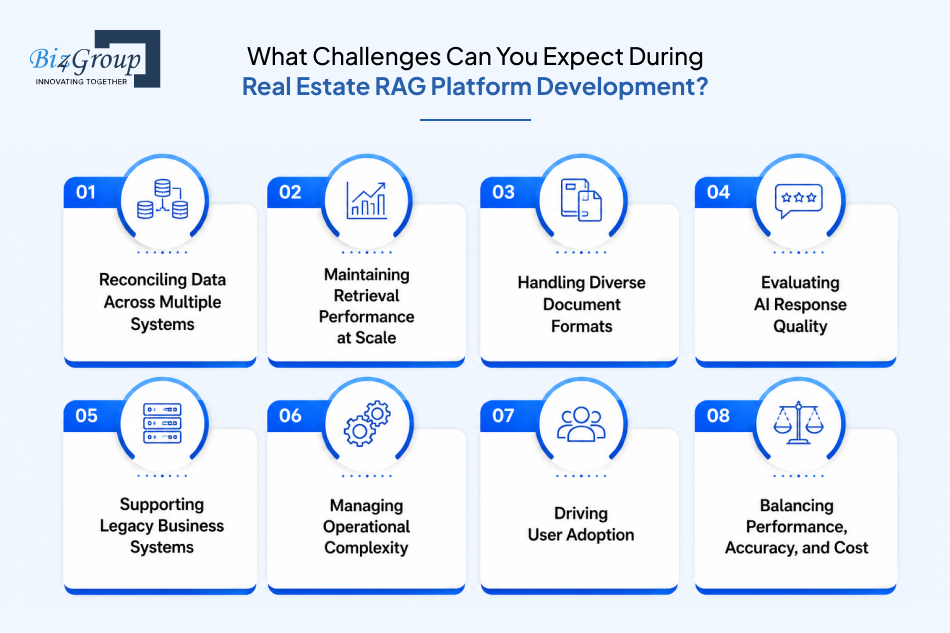
Enterprise real estate RAG platforms introduce challenges that rarely appear during early prototypes. As property data, integrations, and user traffic grow, maintaining retrieval quality and operational reliability becomes increasingly complex.
|
Challenge |
Why It Happens |
Practical Approach |
|---|---|---|
|
Reconciling Data Across Multiple Systems |
MLS platforms, CRMs, ERPs, GIS systems, and internal databases often contain inconsistent information. |
Establish data validation rules and standardized mapping before indexing. |
|
Maintaining Retrieval Performance at Scale |
Larger knowledge bases increase retrieval time and reduce relevance if left unoptimized. |
Optimize indexing, reranking, and caching as datasets grow. |
|
Handling Diverse Document Formats |
Listings, contracts, inspection reports, floor plans, and scanned PDFs require different processing strategies. |
Use document-specific parsing and chunking instead of a single processing pipeline. |
|
Evaluating AI Response Quality |
Traditional software tests don't measure whether retrieved answers are accurate or useful. |
Continuously evaluate retrieval relevance, groundedness, and user feedback. |
|
Supporting Legacy Business Systems |
Many existing real estate platforms weren't designed for AI integration. |
Introduce middleware and APIs instead of replacing core systems immediately. |
|
Managing Operational Complexity |
Monitoring, indexing, deployments, and AI services become harder to coordinate as the platform grows. |
Automate operational workflows and centralize observability. |
|
Driving User Adoption |
Users continue relying on existing workflows if AI doesn't consistently improve productivity. |
Introduce AI gradually within familiar interfaces and refine it using real usage patterns. |
|
Balancing Performance, Accuracy, and Cost |
Faster responses, higher retrieval quality, and lower infrastructure costs often compete with one another. |
Optimize according to business priorities rather than maximizing a single metric. |
Most of these challenges emerge only after the platform begins serving real users. Planning for them early reduces rework and creates a more reliable foundation for long-term growth.
The next consideration is often the deciding factor for many businesses, that is what is the cost of real estate RAG platform development, and what drives that investment?
How Much Does Real Estate RAG Platform Development Cost?
The cost of real estate RAG platform development typically ranges from $25,000 for an MVP to $300,000+ for an enterprise-grade platform. The final investment depends on the platform's complexity, AI capabilities, integrations, security requirements, and long-term scalability. While development is the largest upfront expense, infrastructure, AI usage, and maintenance continue throughout the platform's lifecycle.
|
Project Scope |
Estimated Cost |
Typical Timeline |
|---|---|---|
|
Minimum Viable Product (MVP) |
$25,000 to $80,000 |
2 to 4 weeks |
|
Production Platform |
$80,000 to $150,000+ |
4 to 6 weeks |
|
Enterprise Solution |
$300,000+ |
6 to 8 weeks |
These estimates represent custom real estate RAG platform development. Actual costs vary based on project scope, integrations, deployment architecture, geographic location, and engineering rates.
The biggest cost differences rarely come from the AI model alone. They're usually driven by the number of business systems involved, the complexity of the retrieval pipeline, and the level of customization required.
What Factors Influence Development Cost Real Estate RAG Platform?
The development budget grows as features, integrations, and infrastructure become more sophisticated. Understanding these cost drivers makes it easier to prioritize requirements and estimate the overall investment.
|
Cost Factor |
Estimated Cost Impact |
Why It Increases Cost |
|---|---|---|
|
Feature Complexity |
20% to 40% |
Features like Graph RAG, AI agents, multimodal search, and predictive analytics require additional engineering and testing. |
|
Third-Party Integrations |
15% to 30% |
Integrating MLS, CRM, ERP, GIS, payment gateways, and document management systems increases development effort. |
|
Data Preparation |
10% to 25% |
Cleaning, structuring, normalizing, and indexing large property datasets requires significant upfront work. |
|
UI/UX Design |
10% to 20% |
Custom dashboards, conversational interfaces, and responsive experiences add design and frontend effort. |
|
Security & Compliance |
10% to 25% |
RBAC, audit logging, encryption, and compliance requirements increase implementation complexity. |
|
Infrastructure & Deployment |
10% to 20% |
Cloud architecture, CI/CD pipelines, monitoring, and disaster recovery contribute to development costs. |
|
Testing & AI Evaluation |
10% to 15% |
Retrieval evaluation, performance testing, and user acceptance testing require dedicated effort before launch. |
Every project doesn't require every cost driver. An MVP may only integrate one CRM and an MLS, while an enterprise deployment often connects several business systems simultaneously.
What Hidden Costs Should You Plan for Real Estate RAG Platform?
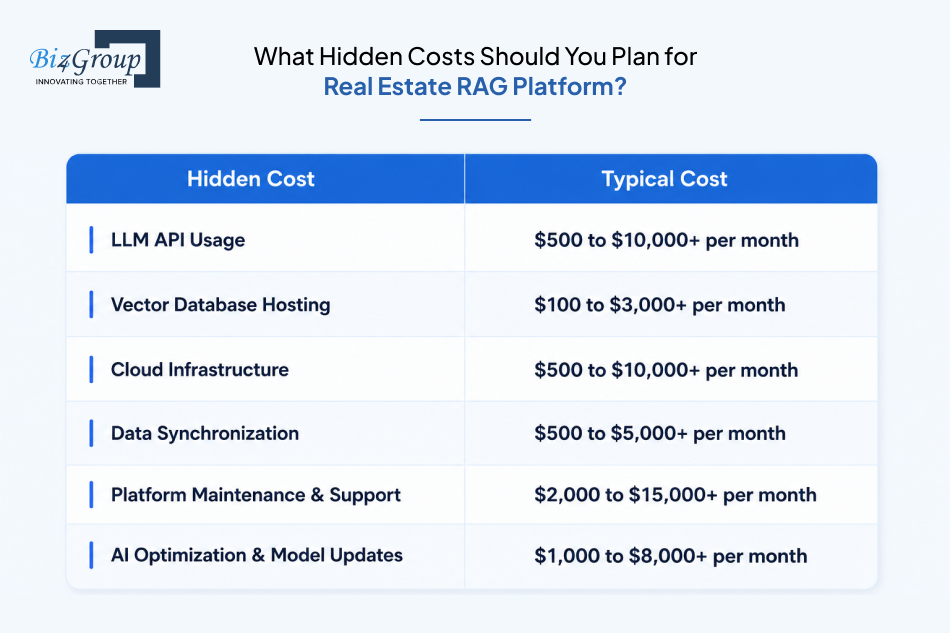
Development is a one-time investment, however, operating a production AI platform introduces recurring expenses that grow alongside users, data, and AI usage.
|
Hidden Cost |
Typical Cost |
Why It Matters |
|---|---|---|
|
LLM API Usage |
$500 to $10,000+ per month |
Costs increase with user traffic, prompt volume, and model selection. |
|
Vector Database Hosting |
$100 to $3,000+ per month |
Storage and retrieval costs grow as property data and documents expand. |
|
Cloud Infrastructure |
$500 to $10,000+ per month |
Compute, storage, networking, and monitoring scale with platform usage. |
|
Data Synchronization |
$500 to $5,000+ per month |
Continuous indexing is required to keep listings and documents current. |
|
Platform Maintenance & Support |
$2,000 to $15,000+ per month |
Covers updates, bug fixes, security patches, and infrastructure maintenance. |
|
AI Optimization & Model Updates |
$1,000 to $8,000+ per month |
Retrieval tuning, prompt optimization, and evaluation help maintain response quality over time. |
These operational expenses are often overlooked during budgeting, yet they have the greatest influence on the platform's long-term total cost of ownership.
How Can You Optimize Development Costs?
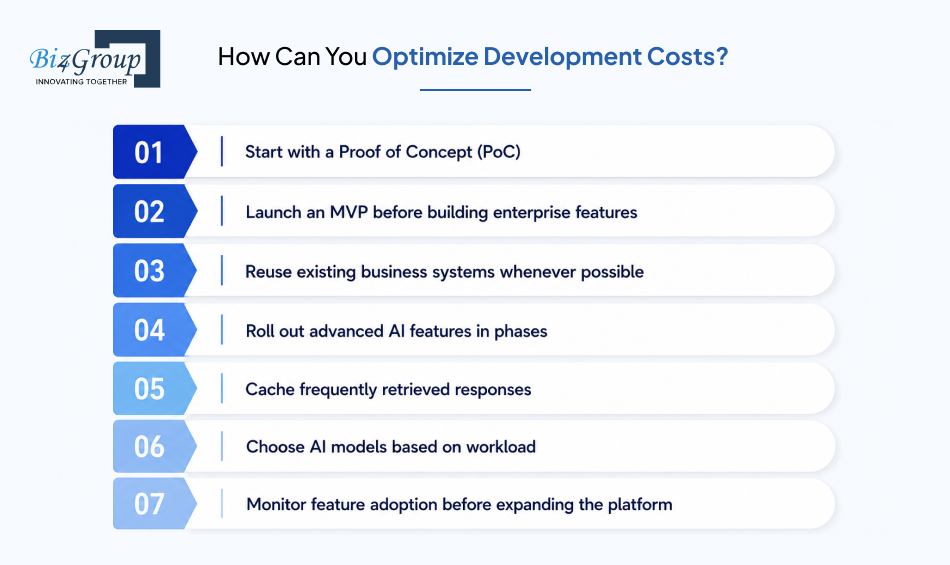
Optimizing the cost of real estate RAG platform development isn't about eliminating features. It's about introducing the right capabilities at the right stage of the project.
- Start with a Proof of Concept (PoC). Validating technical feasibility before full-scale development can reduce overall project costs by 10% to 25% by preventing expensive architectural changes later.
- Launch an MVP before building enterprise features. Prioritizing only essential functionality typically lowers the initial development budget by 20% to 40% while accelerating time to market.
- Reuse existing business systems whenever possible. Integrating with your current CRM, ERP, or property management platform instead of replacing it can reduce integration and development costs by 15% to 30%.
- Roll out advanced AI features in phases. Adding capabilities such as Graph RAG, AI agents, or multimodal search after the MVP can reduce the initial investment by 10% to 25%.
- Cache frequently retrieved responses. Storing common retrieval results and AI responses can lower recurring LLM API expenses by 20% to 50%, especially for high-traffic platforms.
- Choose AI models based on workload instead of using premium models everywhere. Routing simple queries to smaller models can reduce ongoing AI inference costs by 15% to 40% without noticeably affecting user experience.
- Monitor feature adoption before expanding the platform. Investing only in features that demonstrate measurable business value helps avoid spending 10% to 20% of the development budget on low-impact functionality.
The goal is to maximize long-term value by investing where the platform delivers measurable business impact while keeping both development and operational costs under control.
The next step is determining the right approach for your business...to build, buy, or partner for a real estate RAG platform that aligns with your goals and resources.
Don't Let Great Property Data Collect Digital Dust.
Turn your listings, contracts, and documents into an AI-powered knowledge engine.
Connect With Biz4GroupShould You Build, Buy, or Partner for Real Estate RAG Platform Development?
The right approach depends on your business goals, available expertise, budget, and timeline. While building offers maximum flexibility, buying accelerates deployment, and partnering combines technical expertise with custom development.
|
Approach |
Best For |
Why? |
|---|---|---|
|
Build |
Organizations with experienced in-house AI and engineering teams. |
Provides complete ownership, customization, and long-term flexibility, but requires significant investment in development, infrastructure, and ongoing maintenance. |
|
Buy |
Businesses looking for a quick AI solution with standard features. |
Delivers the fastest time to market with minimal development effort, though customization and scalability are often limited by the vendor's platform. |
|
Partner |
Organizations that need a custom solution without building a dedicated AI team. |
Combines the flexibility of custom development with experienced AI engineering, reducing implementation risk and accelerating delivery without the overhead of building an in-house team. |
Why Partner with Biz4Group for Real Estate RAG Platform Development?
Building a real estate RAG platform requires expertise in AI, data engineering, cloud infrastructure, enterprise integrations, and scalable software development. Managing these disciplines in-house can increase project complexity, timelines, and implementation risk.
At Biz4Group, a leading real estate AI software development company in USA, we've helped businesses build AI-powered solutions across the real estate ecosystem. Our work spans platforms like Homer AI, an intelligent property discovery solution, Facilitor, an AI-enabled facility and property management platform, and Contracks, a contract lifecycle management solution.
Backed by 20+ years of AI development experience and a global clientele of 500+ businesses, we help organizations build secure, scalable, and enterprise-ready AI solutions.
By partnering with Biz4Group, you benefit from:
- AI strategy and discovery to validate business goals before development.
- Custom RAG platform development tailored to your workflows and data ecosystem.
- Enterprise integrations with MLS platforms, CRMs, property management systems, and other business tools.
- Scalable, production-ready architecture with built-in security, monitoring, and long-term support.
Instead of coordinating multiple vendors, you can work with a single AI development partner that manages the entire journey, from strategy and development to deployment and continuous optimization.
Connect with us to turn your AI vision into a scalable, production-ready real estate RAG solution.
What's Next for Real Estate RAG Platform Development?
The next generation of real estate RAG platform development will be shaped less by larger AI models and more by intelligent systems that can understand business context, execute workflows, and continuously learn from real-world interactions.
|
Future Trend |
What It Means for Real Estate |
|---|---|
|
Autonomous AI Agents |
Agentic AI will execute multi-step workflows, such as qualifying leads, scheduling property tours, generating investment reports, and updating CRM records with minimal human intervention. |
|
Multimodal RAG |
AI will retrieve and understand information from property images, floor plans, videos, scanned documents, and maps alongside text, enabling richer property search and analysis. |
|
Spatial AI |
Property discovery will evolve beyond maps and keywords by analyzing neighborhood layouts, walkability, traffic patterns, nearby amenities, and other location-based insights. |
|
Self-Optimizing Retrieval |
Retrieval systems will automatically refine indexing, ranking, and retrieval strategies based on user behavior and feedback, reducing the need for manual optimization. |
|
Federated Enterprise Retrieval |
Instead of centralizing every document, AI will securely retrieve information directly from enterprise systems while preserving existing permissions and governance policies. |
|
Built-In AI Governance |
Explainability, permission-aware retrieval, audit trails, and automated compliance checks will become standard capabilities as AI regulations continue to evolve. |
The organizations that gain the greatest competitive advantage won't necessarily be the first to adopt every new AI capability. They'll be the ones with the infrastructure to adopt emerging technologies quickly, securely, and without rebuilding their platforms from scratch.
Final Thoughts
Every major shift in real estate has changed how people find information. Printed listings became online marketplaces, and online marketplaces became mobile apps.
Now, we're entering a stage where people won't search through information at all. They'll expect the information to understand their intent, retrieve the right context, and present answers they can trust. That's the real opportunity behind real estate RAG platform development.
The competitive advantage won't come from having the most advanced language model or the longest feature list. It will come from building a platform that understands your business, works with your proprietary data, and improves every decision made by buyers, agents, investors, and property managers.
The organizations that begin building that foundation today won't just adapt to the next generation of AI. They'll help define how intelligent property experiences evolve over the next decade.
Building a real estate RAG platform requires more than AI expertise. It demands experience across data engineering, cloud architecture, enterprise integrations, and scalable software development. That's where Biz4Group LLC brings value, helping businesses move from AI concepts to production-ready platforms built for long-term growth.
Ready to build a custom real estate RAG platform? Connect with Biz4Group to turn your vision into a production-ready AI solution.
FAQs
1. Does a real estate RAG platform replace general property search?
No. It enhances it. Traditional filters such as price, location, and property type remain valuable for structured searches. RAG adds a conversational layer that understands intent, retrieves relevant business information, and explains results in natural language. The best platforms combine both approaches rather than replacing one with the other.
2. Can a real estate RAG platform analyze contracts, lease agreements, and inspection reports?
Yes. Modern RAG platforms can retrieve information from unstructured documents such as purchase agreements, lease contracts, inspection reports, disclosure forms, and valuation reports. This allows users to ask questions in plain English instead of manually searching through lengthy documents.
3. How often should the knowledge base be updated in real estate RAG platform development?
In real estate RAG platform development, the update frequency depends on how quickly your business data changes. Property listings may require near real-time synchronization, while legal documents or market reports can be updated on a scheduled basis. Many production platforms use incremental indexing so only modified content is refreshed instead of rebuilding the entire knowledge base.
4. Can a real estate RAG platform work with private company data?
Yes. One of RAG's biggest advantages is its ability to retrieve information from private business systems while respecting existing access controls. This allows organizations to use internal documents, CRM records, transaction histories, and proprietary market data without exposing that information to unauthorized users.
5. What's the difference between fine-tuning an AI model and real estate RAG platform development?
Fine-tuning modifies a language model by retraining it on additional datasets, making updates time-consuming and resource-intensive. In real estate RAG platform development, the model remains unchanged. Instead, the platform retrieves the latest property listings, contracts, CRM records, and market data in real time before generating a response. This approach makes it easier to keep AI applications accurate, scalable, and aligned with constantly changing real estate data.
6. Can one RAG platform support multiple real estate businesses?
Yes. A multi-tenant architecture allows a single platform to serve multiple brokerages, agencies, or property management companies while keeping each organization's data isolated. This approach is commonly used for SaaS products serving multiple clients.
7. What property data should you avoid indexing in a real estate RAG platform?
During real estate RAG platform development, not every dataset should be added to the knowledge base. Outdated listings, duplicate property records, draft contracts, temporary files, sensitive credentials, and confidential documents without proper access controls should be excluded. Indexing only verified, business-relevant data improves retrieval accuracy, strengthens security, and helps generate more reliable AI responses.
8. How do you know when a RAG platform is ready for production?
A platform is generally ready when it consistently retrieves accurate information and meets performance targets under expected workloads. It should also integrate reliably with business systems, enforce security policies, and perform well during user acceptance testing. Reaching production readiness is less about adding features and more about proving reliability.
9. Can a real estate RAG platform support future AI technologies without being rebuilt?
Yes, if it's designed with a modular architecture. Separating retrieval, orchestration, language models, and business integrations allows organizations to adopt newer AI models or capabilities without redesigning the entire platform.
10. What is the average cost of developing a custom real estate RAG platform?
A custom real estate RAG platform typically costs $25,000 to $80,000 for an MVP, $80,000 to $150,000+ for a production-ready platform, and $300,000+ for enterprise deployments, depending on features, integrations, AI capabilities, and infrastructure requirements.
