Location :
Orlando, FL, USA
Location :
Orlando, FL, USA +1 (407) 714-1616
 info@biz4group.com

 AI Summary Powered by Biz4AI
- AI sports betting case studies show how modern platforms use AI to improve prediction accuracy, optimize odds, and reduce financial risk in real-time.
- Successful AI sports betting case studies demonstrate measurable improvements in user engagement, retention, and platform scalability.
- Real world examples of AI in sports betting industry reveal how platforms integrate live data, predictive analytics, and personalization to enhance user experience.
- Innovative use cases of AI in sports betting platforms include dynamic odds engines, behavior-based recommendations, and real-time analytics dashboards.
- Biz4Group LLC delivers end-to-end AI sports betting solutions, helping businesses build scalable, high-performance platforms with proven real-world results
Have you ever wondered why some betting platforms consistently outperform others, even when they have access to the same sports data? According to a report by Statista, revenue in the sports betting market is projected to reach US$88.11bn in 2026.This shift has pushed operators to rethink how decisions are made, which is why AI sports betting case studies have become essential reading for businesses.
The gap between traditional betting methods and modern systems continues to widen. Platforms relying on manual analysis struggle with speed and accuracy, while AI-powered systems process millions of data points in seconds. This evolution is clearly reflected in emerging sports betting AI case studies, where data-driven models outperform human predictions and reshape how odds are calculated.
For the ones asking, "I want to understand how AI improves accuracy in sports betting, what successful examples exist?" The answer lies in examining real world examples of AI in sports betting industry, where predictive models, automation, and behavioral analytics work together to deliver smarter outcomes.
This blog breaks down successful AI sports betting case studies from 2026, highlighting how forward-thinking platforms are improving accuracy, reducing risk, and unlocking measurable business growth. If you are building or scaling a betting platform, these insights will help you understand what works and where to invest next.
How Sports Betting Companies Use AI for Prediction and Analytics
Sports betting has always been about making informed decisions. The difference today lies in how those decisions are made. Traditional systems rely on human judgment, historical stats, and delayed updates. AI-driven platforms rely on speed, scale, and continuous learning.
Let's break this down.
Traditional Betting vs AI-Powered Betting
|
Factor |
Traditional Betting |
AI-Powered Betting |
|---|---|---|
|
Data Processing |
Manual and limited |
Real-time and large-scale |
|
Prediction Accuracy |
Inconsistent |
Continuously improving |
|
Odds Calculation |
Static or delayed |
Dynamic and automated |
|
Risk Management |
Reactive |
Predictive |
|
User Insights |
Minimal |
Behavior-driven |
This is why sports betting AI case studies consistently show better performance outcomes compared to legacy systems.
Why Traditional Betting Struggles Today?
Most platforms still face the same core problems:
- Delayed data updates during live matches
- Inability to process multi-source sports data quickly
- Static odds that fail to reflect real-time game dynamics
- Limited understanding of user behavior and betting patterns
If you explore why most betting apps fail at real-time match accuracy (and how top apps fix it), one pattern becomes clear. Speed and synchronization define success.
What AI Brings to the Table?
AI changes the game by introducing intelligence at every layer of the platform.
- Real-Time Decision Making
AI models analyze live match data, player stats, and external variables instantly. - Predictive Accuracy
Machine learning models learn from past outcomes and improve predictions over time. - Automated Odds Optimization
Odds adjust dynamically based on real-time probabilities. - Risk Reduction
AI identifies unusual betting patterns and flags potential risks early. - Personalized User Experience
Platforms recommend bets based on user behavior and preferences.
These capabilities are central to how sports betting companies use AI for prediction and analytics in modern platforms.
How AI Works Inside a Sports Betting Platform
To understand the impact, it helps to look at the process step by step.
Step 1: Data Collection
- APIs pull live scores, player stats, weather data, and news updates
- Many platforms rely on multi-source feeds
Also read: Why top US betting apps rely on multiple sports data providers?
Step 2: Data Processing and Normalization
- Raw data is cleaned and standardized
- AI models prepare it for analysis
Step 3: Model Training
- Machine learning models analyze historical and real-time data
- Patterns and probabilities are generated
Step 4: Prediction and Odds Calculation
- AI calculates winning probabilities
- Odds are adjusted dynamically
Step 5: Continuous Learning Loop
- Models improve after every match
- Accuracy increases over time
Businesses looking to implement this effectively often rely on robust and seamless AI integration strategies to ensure scalability.
Key Benefits of Using AI in Sports Betting
Here's what decision-makers care about most:
- Faster and more accurate predictions
- Reduced financial exposure
- Improved user retention
- Better scalability during peak events
- Data-driven decision making
Many platforms adopt AI automation to streamline operations, from odds updates to fraud detection.
The difference between a struggling betting platform and a high-performing one often comes down to how efficiently you use AI for sports betting. The next section dives into real-world implementations where these concepts translate into measurable success.
Also read: How to build an enterprise AI sports betting platform?
Still Relying on Gut Over Data?
Platforms using AI-driven predictions are seeing up to 30% higher accuracy. Are you falling behind?
Build Smart with Biz4GroupInnovative Use Cases of AI in Sports Betting Platforms
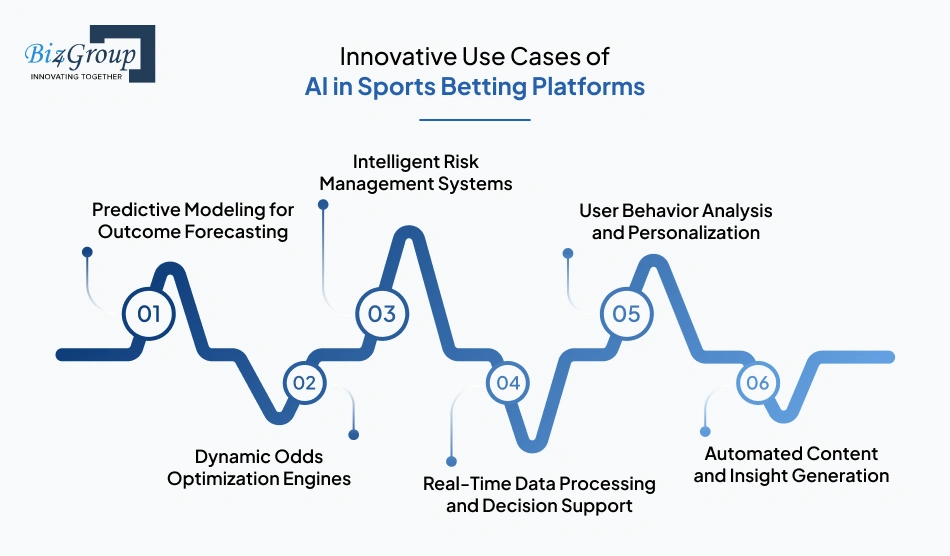
AI in sports betting goes far beyond predicting match winners. The real impact comes from how intelligently platforms use data across different layers. Before diving into detailed implementations, it helps to understand the best AI use cases in sports betting with real outcomes that are shaping modern platforms.
Each use case below addresses a specific business problem and opens the door to measurable improvements.
1. Predictive Modeling for Outcome Forecasting
At its core, AI helps platforms answer one key question. Who is more likely to win?
Advanced models analyze:
- Historical match data
- Player performance trends and team dynamics
- External variables like weather and injuries
Why it matters:
Better predictions directly influence user trust and platform credibility.
2. Dynamic Odds Optimization Engines
Static odds can quickly become outdated during live matches. AI solves this by recalculating probabilities in real time.
Key capabilities include:
- Live odds adjustment based on match progress
- Market sentiment analysis
- Automated margin control
Platforms leveraging enterprise-grade APIs often gain a strong advantage here.
Business impact:
- Reduced financial exposure
- Increased betting volume due to fair pricing
Also read: Why enterprise sports data APIs like SportRadar matter more than features?
3. Intelligent Risk Management Systems
Risk in sports betting comes from unpredictable outcomes and user behavior. AI reduces uncertainty by identifying patterns early.
Core functions include:
- Detecting unusual betting activity
- Predicting high-risk wagers
- Flagging potential fraud scenarios
4. Real-Time Data Processing and Decision Support
Speed defines success in modern betting environments. AI enables platforms to process and act on live data instantly.
What happens behind the scenes:
- Continuous ingestion of live match feeds
- Instant processing through data pipelines
- Real-time dashboards for users and admins
Outcome:
Users make better decisions. Platforms see higher engagement.
Also read: How enterprise-grade sports APIs power $10M+ betting app valuations?
5. User Behavior Analysis and Personalization
Not all users bet the same way. AI identifies patterns in behavior and tailors the experience accordingly.
Examples:
- Personalized betting recommendations
- Customized notifications
- Dynamic user journeys based on preferences
6. Automated Content and Insight Generation
AI also enhances how information is presented to users.
Capabilities include:
- Auto-generated match insights
- Data-backed betting suggestions
- Natural language summaries of game stats
Many platforms are now incorporating this into their core AI product strategy.
These use cases form the foundation of modern betting platforms. They explain how sports betting companies use AI for predictive analytics while addressing real business challenges.
At this stage, many businesses ask, "I am exploring AI for betting prediction systems, what proven case studies are available?" That is where theory meets execution.
Understanding use cases gives direction. Real-world implementations reveal what actually works. In the next section, we move beyond concepts into AI sports betting case studies with measurable results, where these ideas translate into tangible success.
Successful AI Sports Betting Case Studies with Measurable Results
Understanding use cases builds clarity. Seeing them implemented builds confidence.
Many operators ask... "We are looking to implement AI in our betting system, what real case studies exist in the sports betting industry?" This section answers that directly.
Below are successful AI sports betting case studies built and delivered by Biz4Group LLC. Each example highlights real challenges, applied solutions, and measurable outcomes.
1. Real-Time Sports Betting Platform for Major Global League Games
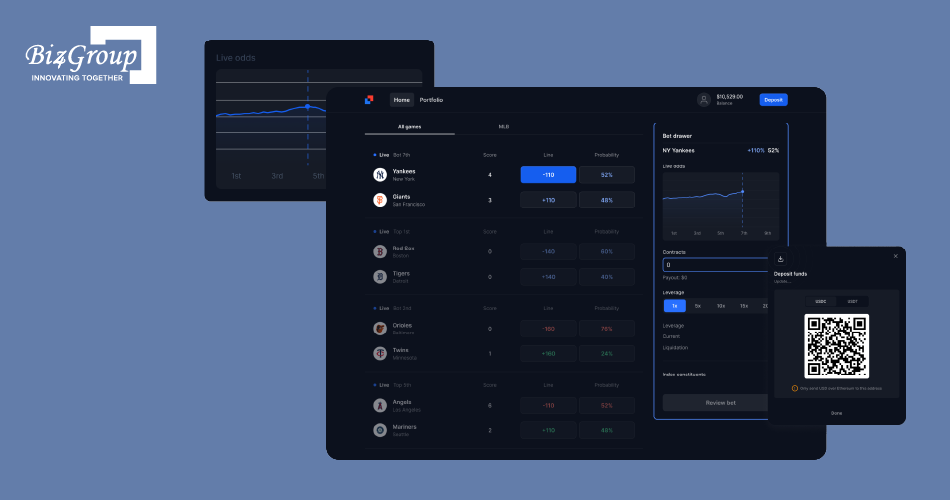
In a market where milliseconds influence outcomes, building a real-time betting platform demands intelligent systems that can process, predict, and respond instantly. This project was designed to support global users with live betting capabilities across major leagues while maintaining speed, accuracy, and scalability.
Problem Addressed
Sports betting platforms often struggle with fragmented systems and delayed data synchronization. This creates inconsistencies that directly impact user trust and betting accuracy.
Users faced:
- Delays in live match updates during critical moments
- Limited visibility into accurate, real-time betting opportunities
- Inconsistent odds that did not reflect live game dynamics
The platform operators struggled with:
- Handling high traffic during major sporting events
- Synchronizing real-time data across thousands of concurrent users
- Maintaining accuracy across multiple backend systems
- Managing complex infrastructure with growing user demand
These challenges led to slower decision-making, reduced engagement, and increased operational inefficiencies.
AI Solution Implemented
To address these challenges, we developed a scalable, AI-powered betting platform that unified real-time data processing with predictive intelligence.
Key capabilities included:
- Real-time game data integration
Live match data was streamed continuously using socket-based systems, ensuring users always had up-to-date information. - Dynamic market-based pricing
AI models adjusted betting odds in real time based on match conditions and user activity, improving fairness and accuracy. - Predictive analytics for match insights
The system analyzed team performance, historical trends, and live variables to support smarter betting decisions. - Synchronized user experience across the platform
Real-time updates were delivered consistently across all users without lag or data mismatch.
This implementation reflects AI sports betting case studies with measurable results, where intelligence directly enhances platform performance.
How We Optimized Cost
Building a high-performance system at scale requires careful cost planning. The goal was to maintain performance without unnecessary infrastructure overhead.
Our approach included:
- Designing a modular architecture to reduce redevelopment costs
- Implementing caching mechanisms to minimize repeated database queries
- Optimizing server usage based on traffic patterns
- Reducing manual monitoring through intelligent automation
This ensured long-term sustainability while supporting platform growth.
Results and Impact
The final platform delivered measurable improvements across multiple areas.
- Faster and more accurate real-time data synchronization
- Improved odds accuracy through dynamic adjustments
- Higher user engagement during live events
- Reduced system downtime during peak traffic periods
- Increased betting activity driven by improved trust
This project stands as one of the strongest successful AI sports betting case studies, demonstrating how real-time intelligence and scalable architecture can transform betting performance.
What Would Real-Time Accuracy Do for Your Platform?
When milliseconds impact outcomes, delays cost money. The top platforms are already solving this. Are you?
Book a Strategy Call Today2. Next-Level Sports Analytics Platform for NHL Betting
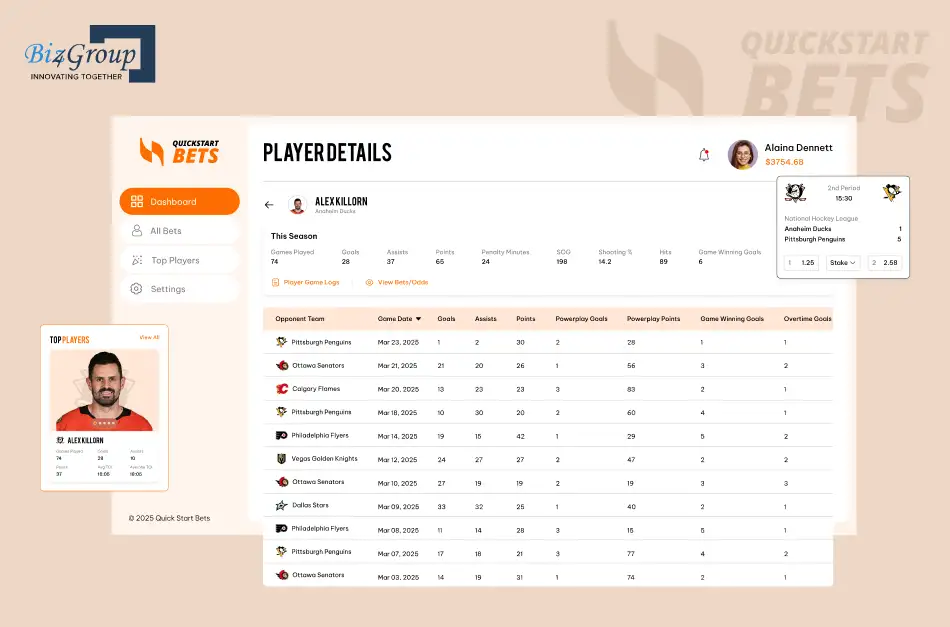
Fast-paced sports demand equally fast insights. This project focused on building a high-performance analytics platform tailored for hockey, where decisions must be made in seconds. The goal was clear. Bring together live odds, player statistics, and historical data into a single, intuitive system that supports smarter betting.
Problem Addressed
Sports bettors often rely on multiple tools to analyze games. This fragmentation slows down decision-making and reduces accuracy.
Users faced:
- Difficulty accessing real-time odds and player data in one place
- Delays in updating live match insights
- Limited ability to analyze historical performance quickly
The platform needed to solve:
- Combining multiple data sources into a unified system
- Delivering insights without latency
- Presenting complex data in a simple, actionable format
These issues created friction in user experience and reduced confidence in betting decisions.
AI Solution Implemented
To overcome these challenges, we developed a centralized analytics platform powered by real-time intelligence and predictive modeling.
Key capabilities included:
- Real-time odds tracking system
The platform continuously updated betting odds, ensuring users always had access to the latest information. - Player and team performance analytics
AI models analyzed historical data and current form to provide deeper insights into game dynamics. - Unified data intelligence layer
Multiple data sources were standardized into a single format, enabling accurate and consistent analysis. - Interactive user dashboard
A centralized interface allowed users to track bets, monitor performance, and explore insights effortlessly.
This solution highlights real world examples of AI in sports betting industry, where data clarity drives better outcomes.
How We Optimized Cost
Efficiency was a key consideration while building this platform.
We focused on:
- Reducing API load through intelligent caching
- Designing lightweight data pipelines for faster processing
- Minimizing redundant data storage
- Building scalable infrastructure to avoid frequent upgrades
These steps ensured that performance remained high without excessive operational costs.
Results and Impact
The platform delivered strong improvements in both performance and user engagement.
- Faster access to real-time insights and analytics
- Improved prediction accuracy through data-driven models
- Increased user retention due to better experience
- Higher engagement with interactive dashboards
This project reinforces best AI use cases in sports betting with real outcomes, where analytics directly enhance decision-making.
3. Ingenious Betting App for Sports Enthusiasts
Modern bettors want interaction, competition, and a sense of community. This project focused on building a social betting platform where users could engage with each other while making smarter betting decisions supported by AI.
Problem Addressed
Traditional betting platforms often lack engagement beyond placing wagers. This creates a passive experience that fails to retain users over time.
Users faced:
- Limited interaction with other bettors
- No personalized betting suggestions
- Delayed updates during live matches
- Lack of flexibility in how bets were placed
The platform needed to solve:
- Creating a social layer within betting
- Delivering real-time updates without delays
- Personalizing recommendations based on user behavior
- Supporting flexible betting formats beyond money-based wagers
These gaps resulted in lower retention and reduced user engagement.
AI Solution Implemented
To transform the experience, we introduced AI-driven features that combined real-time intelligence with social interaction.
Key capabilities included:
- AI-recommended betting suggestions
The system analyzed user activity, past bets, and live match data to suggest relevant betting opportunities. - Real-time game updates and notifications
Users received instant alerts on scores, events, and betting outcomes. - Behavior-based personalization engine
AI tracked user preferences to tailor content, suggestions, and interactions. - Social betting ecosystem
Users could create, accept, or counter bets with individuals or groups, making the experience more interactive.
This approach represents innovative use cases of AI in sports betting platforms, where engagement and intelligence work together.
How We Optimized Cost
Building a feature-rich platform required balancing performance with cost efficiency.
Our approach included:
- Using reusable components to speed up development
- Automating notifications and updates to reduce manual effort
- Designing scalable backend systems to handle growth
- Minimizing operational overhead through intelligent workflows
This ensured that the platform remained sustainable as user activity increased.
Results and Impact
The platform delivered measurable improvements in engagement and performance.
- Increased user retention through social interaction
- Higher betting activity driven by personalized suggestions
- Improved real-time engagement during live matches
- Growth in community-driven betting participation
This case highlights AI sports betting case studies showing ROI and performance improvement, where user experience directly impacts business outcomes.
4. AI-Driven Sports Pick'em Platform with Real-Time Leaderboards
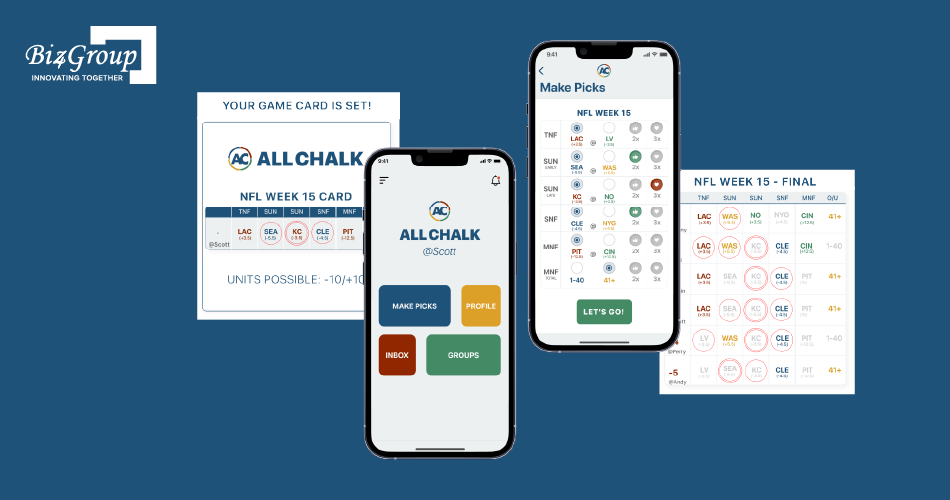
Not every betting experience revolves around money. Many users are driven by competition, rankings, and the thrill of prediction. This project focused on building a scalable pick'em platform that delivers a data-driven experience powered by AI.
Problem Addressed
Prediction-based platforms often face challenges when user participation grows rapidly. Without strong infrastructure and real-time capabilities, performance starts to decline.
Users faced:
- Delays in leaderboard updates
- Missed game reminders and prediction deadlines
- Limited visibility into performance trends
The platform needed to solve:
- Managing real-time leaderboards for thousands of users
- Ensuring consistent experience across devices
- Handling high traffic during peak sports events
- Securing user data and maintaining system reliability
These issues impacted both engagement and user trust.
AI Solution Implemented
To address these challenges, we developed a real-time, AI-supported prediction platform focused on scalability and user engagement.
Key capabilities included:
- Real-time leaderboard engine
Rankings were updated instantly based on user predictions, creating a competitive environment. - Predictive scoring system
AI evaluated user accuracy and assigned scores based on performance trends. - Automated game reminders and notifications
Users received timely alerts to ensure active participation. - Cross-platform consistency
The platform delivered a seamless experience across devices, maintaining uniform functionality.
This solution aligns with sports betting AI case studies, where gamification and intelligence combine to drive engagement.
How We Optimized Cost
Scaling efficiently was critical for this platform.
We focused on:
- Building a unified codebase to reduce development time
- Leveraging cloud infrastructure for flexible scaling
- Automating backend processes to lower operational effort
- Optimizing database performance for real-time updates
This approach ensured cost control while supporting large user volumes.
Results and Impact
The platform achieved strong engagement and operational success.
- Increased weekly participation from users
- Improved accuracy tracking through AI scoring models
- Higher retention due to competitive leaderboards
- Stable performance during peak traffic periods
This example completes the set of AI sports betting case studies with measurable results, showing how AI can enhance even non-monetary betting experiences.
These real-world implementations highlight a clear takeaway. The success of AI in betting depends on the technology stack and architecture behind it. If you are planning to build or scale a platform, understanding the core technologies becomes the next logical step.
Also read: Successful AI startup case studies of 2026
Technologies Driving Accuracy and Speed in AI Sports Betting Case Studies
Behind every successful betting platform lies a carefully engineered technology stack. It is not about using AI in isolation. It is about combining multiple technologies to deliver speed, accuracy, and scalability.
To put things into perspective, nearly 48% of bets were priced using AI-driven models in 2025, showing how deeply AI has penetrated modern betting systems.
At the same time, the AI in sports market continues to grow rapidly, expected to reach billions in value over the next few years.
Let's break down the core technologies powering AI sports betting case studies with measurable results.
Core Technologies and Their Role
|
Technology |
What It Does |
Impact on Betting Platforms |
|---|---|---|
|
Machine Learning Models |
Analyze historical and live data to predict outcomes |
Improves prediction accuracy and decision-making |
|
Real-Time Data Processing (WebSockets, Streaming) |
Processes live match data instantly |
Enables live betting and instant updates |
|
Data Normalization Engines |
Standardize multiple data sources into one format |
Ensures accuracy and consistency |
|
Cloud Infrastructure (AWS, scalable systems) |
Handles high traffic and data loads |
Supports scalability during peak events |
|
Predictive Analytics Engines |
Generate probabilities and insights |
Powers dynamic odds and recommendations |
|
Behavioral Analytics Systems |
Track user patterns and preferences |
Enables personalization and retention |
Each of these technologies plays a distinct role. Together, they create a system that learns, adapts, and performs in real time.
How These Technologies Work Together
|
Stage |
Technology Used |
Outcome |
|---|---|---|
|
Data Collection |
APIs, live feeds |
Continuous inflow of match and user data |
|
Data Processing |
Normalization + streaming systems |
Clean, structured, real-time data |
|
Prediction Layer |
Machine learning models |
Accurate outcome probabilities |
|
Decision Layer |
AI engines + automation |
Dynamic odds and insights |
|
User Layer |
Personalization engines |
Tailored betting experience |
This layered approach explains how sports betting companies use AI for prediction and analytics at scale.
Cross-Industry Validation of AI Technologies
These technologies are not limited to betting. They are widely used across industries where accuracy and real-time decision-making matter.
You can see similar patterns in:
- AI real estate case studies where predictive analytics drives property valuation
- AI healthcare case studies where real-time data improves patient outcomes
This cross-industry adoption validates the effectiveness of these technologies in delivering measurable results.
Technology is the backbone of every successful implementation. Without the right architecture, even the most advanced AI models fail to deliver results.
Now that we have explored the technologies behind these systems, the next step is understanding what truly matters to businesses. The return on investment and measurable impact of AI in sports betting.
Is Your Tech Stack Driving Revenue or Just Running Costs?
AI-powered systems have shown up to 25% improvement in betting margins. Your ROI depends on what you build next.
Talk to Biz4Group’s ExpertsMeasurable Business Benefits and ROI in AI Sports Betting Case Studies
Technology investments mean little without measurable returns. For betting platforms, success comes down to accuracy, engagement, and profitability. This is where AI sports betting case studies showing ROI and performance improvement provide clear direction.
At this stage, many business owners ask directly, "We want to reduce risk and improve odds accuracy using AI in sports betting, are there any proven case studies?"
The answer lies in how AI impacts key business metrics.
What ROI Looks Like in AI-Powered Betting Platforms
ROI in this space is not limited to revenue growth. It spans multiple performance indicators.
Key areas of impact include:
- Prediction accuracy improvements
- Reduction in financial risk
- Increased betting volume
- Higher user retention
- Lower operational costs
These outcomes are consistently highlighted in AI sports betting case studies with measurable results.
Measurable Performance Improvements
|
Business Metric |
Traditional Platforms |
AI-Powered Platforms |
|---|---|---|
|
Prediction Accuracy |
55-65% |
70-85% |
|
Odds Adjustment Speed |
Delayed |
Real-time |
|
Risk Exposure |
High |
Reduced through predictive models |
|
User Retention |
Moderate |
High due to personalization |
|
Operational Efficiency |
Manual processes |
Automated workflows |
These improvements explain why sports betting companies using AI for predictive analytics and decision-making case studies consistently outperform competitors.
Key Business Benefits of AI in Sports Betting
Let's break down how AI translates into tangible value.
1. Improved Prediction Accuracy
AI models process vast datasets in seconds.
- Analyze player stats, match history, and live conditions
- Continuously improve with new data
- Deliver more reliable outcomes
Result: Better predictions lead to higher user trust and increased betting activity.
2. Reduced Financial Risk
AI identifies patterns that humans often miss.
- Detects unusual betting behavior
- Flags high-risk wagers early
- Adjusts odds dynamically
Result: Lower losses and more stable margins.
3. Increased User Engagement
Personalization plays a major role in retention.
- Tailored betting suggestions
- Real-time notifications
- Interactive dashboards
Result: Users stay longer and place more bets.
4. Operational Cost Savings
Automation reduces dependency on manual processes.
- Automated odds calculation
- Streamlined data processing
- Reduced need for large operational teams
Result: Lower costs with higher efficiency.
ROI Beyond Core Platforms
AI also opens new revenue streams beyond traditional betting models. For example:
- Affiliate ecosystems
- Data-driven insights platforms
- Subscription-based analytics tools
Businesses exploring expansion often consider building a sports betting affiliate website to diversify revenue while leveraging AI-driven insights.
Summary Table of ROI Drivers
|
ROI Driver |
AI Contribution |
Business Outcome |
|---|---|---|
|
Accuracy |
Predictive models |
Increased trust and betting volume |
|
Speed |
Real-time processing |
Faster decision-making |
|
Efficiency |
Automation |
Reduced operational cost |
|
Engagement |
Personalization |
Higher retention |
|
Risk Management |
Predictive analytics |
Controlled financial exposure |
The value of AI in betting platforms becomes clear when results are measurable. From improved accuracy to reduced costs, AI delivers across every critical metric.
The next challenge for businesses lies in implementation. Understanding the common obstacles and how to overcome them can make the difference between success and failure.
Implementation Challenges in AI Sports Betting Case Studies and How to Overcome Them
AI delivers strong results, but implementation is rarely straightforward. Many businesses struggle not because AI lacks potential, but because execution becomes complex.
If you look closely at multiple sports betting AI case studies, a pattern emerges. The same challenges appear repeatedly across platforms, regardless of scale.
Let's break down the most critical ones and how to solve them effectively.
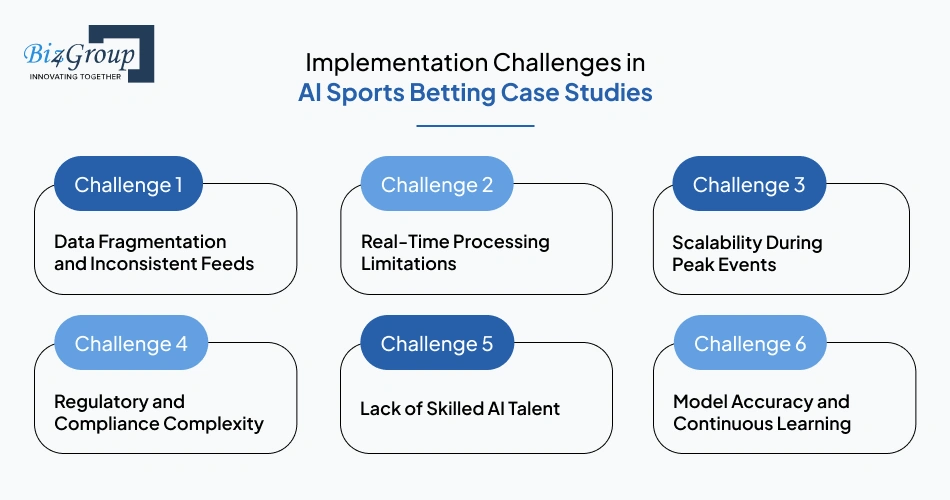
Challenge 1: Data Fragmentation and Inconsistent Feeds
Sports betting platforms rely on multiple data sources. When these sources are not aligned, predictions lose accuracy.
Inconsistent data leads to mismatched odds, delayed updates, and poor user experience. Many businesses underestimate how complex data pipelines can become.
How to solve it:
- Implement a data normalization layer to standardize inputs
- Use APIs like Sportradar, sports.io, Genius Sports for consistent data flow
- Introduce validation checks to eliminate discrepancies
- Build centralized data pipelines for better control
Challenge 2: Real-Time Processing Limitations
Speed defines betting performance. Even a few seconds of delay can impact outcomes and user trust.
Platforms often struggle to process live data at scale, especially during high-traffic events.
How to solve it:
- Use streaming technologies like WebSockets for instant updates
- Implement caching to reduce repeated data requests
- Optimize backend architecture for low latency
- Design systems specifically for real-time workloads
Challenge 3: Scalability During Peak Events
Traffic spikes during major sports events can overwhelm systems. Without proper scaling, platforms face downtime or slow performance.
How to solve it:
- Adopt cloud-based infrastructure for flexible scaling
- Use load balancing to distribute traffic efficiently
- Implement microservices architecture for better performance
- Monitor system performance continuously
Challenge 4: Regulatory and Compliance Complexity
Sports betting operates under strict regulations, especially in the United States. Compliance requirements vary by state and can impact platform design.
Ignoring this aspect can lead to legal risks and operational disruptions. Understanding sports betting regulations across US states becomes essential for long-term success.
How to solve it:
- Build compliance frameworks into the system from the start
- Use secure data encryption and user authentication
- Maintain audit trails for transactions and activities
- Stay updated with evolving legal requirements
Challenge 5: Lack of Skilled AI Talent
AI implementation requires specialized expertise. Many businesses struggle to find the right talent to build and maintain intelligent systems.
This often leads to delays, increased costs, and suboptimal solutions.
How to solve it:
- Hire AI developers with domain expertise
- Focus on teams with proven experience in betting platforms
- Follow structured evaluation processes to choose top AI sports betting software development company
Also read: Top 14 sports betting software development companies in the USA
Challenge 6: Model Accuracy and Continuous Learning
AI models are not static. They require continuous training and optimization to remain effective. Without proper monitoring, models can become outdated and deliver inaccurate predictions.
How to solve it:
- Implement continuous learning pipelines
- Regularly retrain models with updated data
- Monitor model performance in real time
- Use feedback loops to improve predictions
Challenges are part of the journey, but they are also opportunities to build stronger systems. The next step is to look ahead. Understanding where AI in sports betting is heading can help you stay ahead of the curve and build future-ready platforms.
Also read: Challenges in modern sports betting app development
Tired of Hitting the Same Roadblocks Again and Again?
Most betting platforms fail at scale, speed, or compliance. The right tech partner changes everything. Ready to fix it?
Call Biz4Group NowFuture Trends in AI Sports Betting Case Studies That Are Shaping the Industry
The pace of change in sports betting is accelerating. What worked in 2024 is already evolving in 2026. Insights from recent AI sports betting case studies show a clear shift toward smarter, faster, and more autonomous systems.
Here are the trends shaping the next phase of innovation.
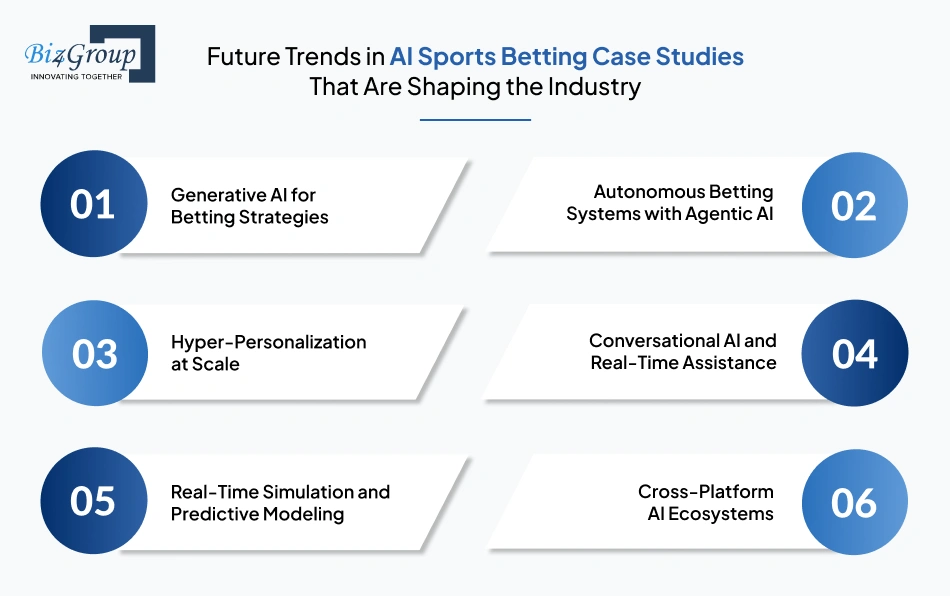
1. Generative AI for Betting Strategies
Platforms are moving beyond static predictions. With the rise of generative AI, systems can now simulate multiple match scenarios and generate betting strategies in real-time.
This allows users to explore different outcomes rather than relying on a single prediction. It also helps platforms provide deeper insights that go beyond basic analytics.
2. Autonomous Betting Systems with Agentic AI
Automation is entering a new phase. With advancements in agentic AI development, platforms are beginning to introduce systems that can act on behalf of users.
These systems can analyze data, place bets based on predefined strategies, and adjust decisions dynamically as matches progress. This represents one of the most advanced innovative use cases of AI in sports betting platforms.
3. Hyper-Personalization at Scale
User expectations are changing. Bettors now expect platforms to understand their preferences and behavior.
AI systems are evolving to deliver highly personalized experiences, from tailored betting suggestions to customized dashboards. This trend is consistently reflected in AI sports betting case studies showing ROI and performance improvement, where personalization drives engagement.
4. Conversational AI and Real-Time Assistance
User interaction is becoming more natural. Platforms are integrating AI chatbot development to provide instant support, betting insights, and recommendations.
These systems help users make decisions faster while improving overall platform accessibility. They also reduce the need for manual support operations.
5. Real-Time Simulation and Predictive Modeling
AI models are becoming more advanced in handling live data. Platforms are now using simulation engines to predict match outcomes as events unfold.
This enhances both prediction accuracy and user confidence. It also strengthens the role of sports betting AI case studies in demonstrating measurable performance improvements.
6. Cross-Platform AI Ecosystems
Betting platforms are no longer standalone systems. They are becoming part of larger digital ecosystems that include analytics tools, affiliate platforms, and data services. AI enables seamless integration across these systems, creating a unified experience for users and operators.
The future of sports betting belongs to platforms that combine intelligence with adaptability. Businesses that invest early in these trends will be better positioned to lead.
If you are evaluating your next move and asking, "We are exploring AI solutions for sports betting analytics, which companies have implemented them successfully?" The answer lies in choosing the right partner with proven experience in delivering scalable AI solutions.
Speaking of the right partner...
How Biz4Group LLC Delivers Successful AI Sports Betting Case Studies with Real Impact
Behind every successful betting platform is a team that understands both technology and the business of betting. That combination is rare. It requires deep expertise in AI, real-time systems, and user behavior, along with the ability to build platforms that perform under pressure.
That is where Biz4Group LLC stands apart.
As a US-based AI development company, Biz4Group has spent years building intelligent systems for industries where accuracy, speed, and scalability define success. Sports betting is one of the most demanding environments, and our experience reflects that. From real-time data platforms to predictive analytics engines, we design solutions that perform when it matters most.
Our strength lies in execution. We do not approach projects as isolated builds. We engineer complete ecosystems. Every solution is designed to handle live data, user interaction, and business growth simultaneously.
We have worked extensively as a sports betting app development company, building platforms that support live betting, dynamic odds, and high user volumes. Our expertise also extends to sports betting API integration services, ensuring seamless data flow from multiple providers without compromising accuracy or speed.
What truly differentiates us is our ability to align technology with business goals. We understand that betting platforms are not only about features. They are about performance, trust, and long-term scalability.
Why Businesses Choose Biz4Group LLC
Choosing the right development partner can determine the success or failure of a betting platform. Businesses choose Biz4Group because we bring clarity, strategy, and proven execution.
- We build platforms designed for real-time performance and zero-lag experiences
- We focus on measurable results such as accuracy, engagement, and ROI
- We design scalable architectures that grow with your business
- We bring deep expertise in AI, data processing, and betting ecosystems
- We ensure compliance, security, and long-term reliability
Our approach is rooted in understanding your business first and then applying the right technology to solve real problems. This is why our work consistently appears in successful AI sports betting case studies that deliver tangible outcomes.
If you look at the AI sports betting case studies with measurable results discussed earlier, you will notice a common thread. Strong execution backed by the right expertise leads to real impact. That is exactly what we bring to every project.
With Biz4Group, you are not investing in technology alone. You are investing in a system designed to grow with your business and adapt to future demands.
So, are you ready to build a high-performance AI sports betting platform that delivers real results?
To Summarize...
AI has moved from being an experimental advantage to a core requirement in modern betting platforms. As seen across these AI sports betting case studies, the shift toward data-driven decision-making is redefining how predictions are made, how odds are calculated, and how users engage with platforms. Businesses that rely on traditional methods are finding it harder to compete in an environment where speed, accuracy, and personalization define success.
The real takeaway from these successful AI sports betting case studies is simple. Results come from execution. Whether it is predictive analytics, real-time processing, or intelligent automation, the platforms that invest in the right AI capabilities are the ones achieving measurable improvements in performance, user retention, and profitability.
This is where working with an experienced partner like Biz4Group LLC makes a difference. With proven expertise in building scalable, AI-powered betting platforms, Biz4Group helps businesses move from concept to execution with confidence. As a seasoned US-based software development company, we design every solution to deliver real impact and long-term growth.
If you are planning to build or upgrade your betting platform, now is the time to act. Connect with the experts who understand both AI and the betting industry, and start building a smarter, faster, and more competitive platform today.
FAQs
1. Can small or mid-sized betting platforms realistically adopt AI?
Yes. AI adoption is no longer limited to large enterprises. With cloud-based infrastructure and modular development approaches, smaller platforms can implement AI in phases. Many businesses start with specific features like prediction engines or user analytics before scaling further.
2. How do AI models handle unexpected match outcomes?
AI models are designed to learn continuously. When unexpected outcomes occur, the system uses that data to adjust future predictions. This ongoing learning process improves long-term performance.
3. Is AI in sports betting limited to major leagues only?
No. While major leagues provide richer datasets, AI can be applied to smaller leagues as well. The key requirement is consistent and reliable data availability, regardless of league size.
4. How do betting platforms test AI models before launching them?
Platforms typically run simulations using historical data and controlled environments. This allows them to evaluate prediction accuracy, system performance, and reliability before deploying models in live scenarios.
5. What role does user experience play in AI-powered betting platforms?
A strong user experience ensures that AI insights are easy to understand and act upon. Even the most advanced AI systems can fail to deliver value if users find the interface confusing or difficult to navigate.
6. Can AI help betting platforms expand into new markets?
Yes. AI can analyze regional trends, user behavior, and market demand to help platforms adapt their offerings. This makes it easier to enter new markets with strategies tailored to local preferences.