 Location :
Orlando, FL, USA
Location :
Orlando, FL, USA +1 (407) 714-1616
 info@biz4group.com

- Custom workers compensation insurance software vs SaaS solutions becomes clearer when carriers evaluate long-term operational control, not only deployment speed.
- SaaS platforms help insurance carriers launch faster, but custom software supports deeper workflow flexibility and multi-state reporting control.
- A strong workers compensation insurance software custom vs SaaS comparison should include integrations, vendor dependency, scalability, and reporting complexity.
- Custom workers compensation platforms usually cost $40,000-$350,000+, while SaaS solutions typically range between $25,000-$200,000+.
- Many carriers now combine SaaS infrastructure with custom workflows to improve claims handling, compliance operations, and future scalability.
- Biz4Group LLC helps insurance carriers modernize systems through scalable platforms, workflow automation, integrations, and long-term operational support.
What happens when a workers compensation carrier expands into new states, adds more claims volume, and still depends on disconnected systems to manage reporting, billing, and adjuster workflows? The issue usually appears slowly at first. Teams spend more time correcting data, handling duplicate entries, and chasing compliance updates instead of improving operational efficiency.
That pressure is one reason carriers are increasing investments in claims technology. The workers compensation claims software market is expected to reach $2.74 billion in 2026 to nearly $10.5 billion in 2028. Growth at that scale reflects a larger industry shift toward platforms that can support faster operations and long-term scalability.
Many carriers entering modernization discussions already frame the challenge this way:
“We are a workers compensation insurance carrier trying to decide between investing in custom software development and subscribing to one of the leading SaaS workers compensation platforms. We need a comprehensive comparison that covers cost scalability features integration capabilities, vendor dependency, and competitive differentiation so we can make the right decision for our organization?”
That question goes far beyond software selection. It affects operational control, claims visibility, and future expansion plans. Therefore, in the next sections we’ll break down custom workers compensation insurance software vs SaaS solutions in practical way. We’ll also show where an AI development company can support automation, workflow intelligence, and system modernization during the development process.
What is the Difference Between Custom Workers Compensation Insurance Software Solution and SaaS Product Solution?
The difference usually comes down to control, flexibility, and operational ownership. Some carriers want software built around their insurance underwriting software rules, claims workflows, and reporting processes.
Others prefer a faster deployment model where the vendor manages infrastructure and platform maintenance. That is why the discussion around Custom Workers Compensation Software vs SaaS Product Solutions matters for long-term operational planning.
What Is Custom Workers Compensation Software?
Custom workers compensation software is built specifically for an insurance carrier’s operational model. The platform may be developed completely from scratch or built on a configurable framework that supports carrier-specific workflows and compliance requirements.
In this model, the carrier controls the codebase, data structure, product roadmap, and integration strategy. That ownership gives insurers more flexibility when handling complex operational requirements tied to a policy administration system (PAS), claims adjudication engine, EDI transactions, and loss runs.
Customization usually focuses on areas such as:
- NCCI state rate table management
- Experience modification calculation workflows
- FROI and SROI EDI filing processes
- Multi-state compliance handling
- Automated loss run generation
Implementation timelines are typically longer because the platform is designed around carrier operations instead of standardized templates. Most deployments take between 6 and 18 weeks followed by continuous internal or vendor-led support.
1. Portfolio Spotlight: Insurance AI
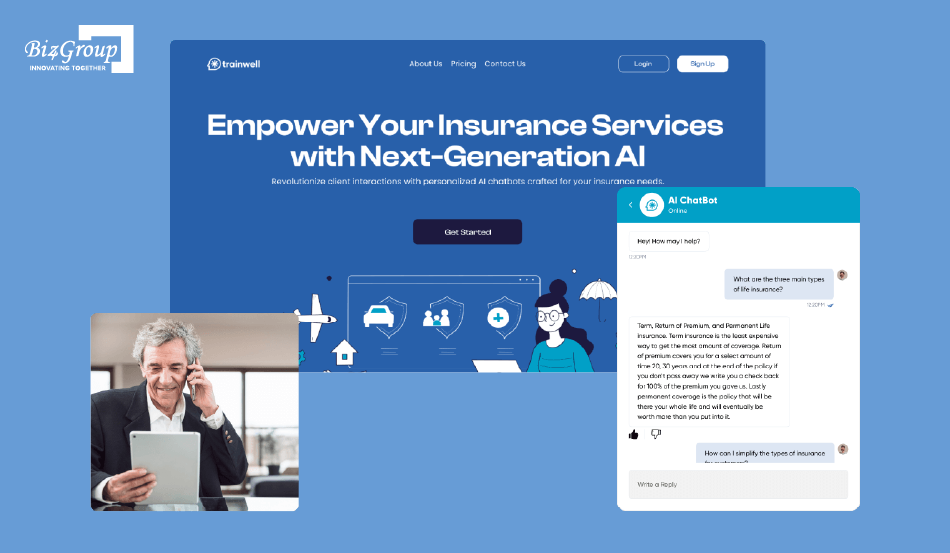
Insurance AI is an AI chatbot built for insurance training and support. It gives agents instant, accurate answers to common questions, reducing repeated live training sessions, and long document-based onboarding.
The system uses custom LLMs powered by GPT-4o and GPT-3.5, includes feedback-based model improvement, and integrates easily into an existing web interface so teams can keep knowledge current and accessible.
2. Portfolio Spotlight: AI IVR Platform for Medical Claim
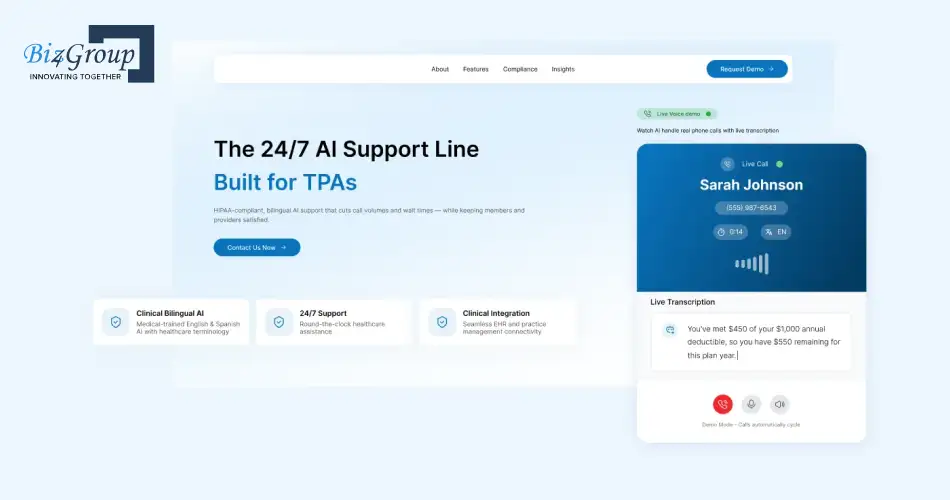
An AI-driven IVR and support platform designed for healthcare administrators to manage high volumes of patient and insurance-related calls through automated voice interactions. The platform supports real-time responses, smart call escalation, bilingual voice support, and secure handling of sensitive healthcare information.
It helps reduce manual call handling while improving response speed, operational efficiency, and communication workflows across healthcare support environments.
Also Read: Top 10 AI Workers Compensation Insurance Software Development Companies in USA
What Is a SaaS Workers Compensation Platform?
A SaaS workers compensation platform is a ready-to-use insurance system delivered through the cloud on a subscription basis. Instead of building and maintaining software internally, the carrier pays the vendor to access the platform along with ongoing updates, infrastructure management, security maintenance, and compliance support.
The software already comes with predefined workflows for claims handling, policy administration, billing operations, reporting, and document management. Carriers can configure screens, approval rules, dashboards, and workflows using low-code configuration tools, but the platform’s core architecture and processing logic remain controlled by the vendor.
A modern API-first platform also makes it easier to connect with external systems such as:
- Claims management tools
- Billing and payment systems
- EDI transactions and compliance filing services
- Third-party underwriting and analytics tools
- Employer and agent self-service portals
This model is commonly used by carriers that want faster implementation timelines and lower internal IT ownership. Most SaaS providers also operate on a multi-tenant architecture where multiple insurance organizations use the same platform environment while keeping their data separated.
Also Read: Step-by-Step Guide to Build an AI SaaS Product
A Quick Glance at Custom Workers Compensation Insurance Software Solution and SaaS Product Solution
|
Dimension |
Custom Workers Compensation Software |
SaaS Workers Compensation Platform |
|---|---|---|
|
Ownership |
Carrier owns the codebase, workflows, and data structure |
Vendor owns and manages the platform |
|
Customization |
Built around carrier-specific operational needs |
Limited to vendor-supported configurations |
|
Compliance Updates |
Managed internally or through a development partner |
Managed by the SaaS vendor |
|
Deployment Time |
Usually takes 6–18 weeks |
Usually deployed within 4–8 weeks |
|
Infrastructure |
Hosted privately or within carrier-controlled environments |
Hosted and maintained by the vendor |
|
Flexibility |
Easier to modify workflows and integrations over time |
Changes depend on vendor capabilities |
|
Exit Control |
Greater control over data portability and migration |
Higher dependency on vendor ecosystem |
The discussion around custom workers compensation insurance software vs SaaS solutions is rarely about software alone. It usually reflects how much speed, control, flexibility, and ownership your organization truly needs. The next sections will break those factors down in detail.
Still Paying for Workflow Workarounds?
Standard platforms solve common problems not carrier-specific operational gaps
Map Your Ideal Platform StrategyWhy Choosing Custom Workers Compensation Software or SaaS Impacts Carrier Growth, Cost Control, and Operational Scalability
The software model a carrier uses shapes more than technology spend. It affects how fast the business expands, how cleanly claims move, and how much control the team keeps over operations. Once growth pressure rises, those differences become hard to ignore.
Before the framework gets deeper, it helps to separate business pressure from software promises. Expansion plans, claims volume, and reporting demands all show up in daily operations. That is why many teams pause and ask: “should insurance carriers build custom workers compensation software or buy a SaaS solution”
Well, the following fits will help your decision framework:
1. State Expansion and Regulatory Fit
State growth is where the gap shows up first. SaaS often gets a carrier live faster because the platform already comes with standard workflows and built-in compliance structure. That helps when the goal is speed.
Custom software asks for more time upfront. It takes longer to shape the filing logic, rate tables, and state rules around the carrier’s own process. That slower start gives the team more room to handle complex reporting needs later.
- SaaS platforms usually work well for standard state setups and common filing paths
- Custom software handles NCCI deviation, state-specific rate rules, and unique underwriting logic with more freedom
- Custom builds can keep that state logic inside the carrier’s own roadmap
2. Cost per Policy and Internal Operating Load
Cost is not just licensing. It is also the cost of manual work, vendor add-ons, and repeated process fixes. SaaS keeps the early spend lighter because hosting and maintenance sit with the vendor. That helps teams move faster without a large internal build.
Custom software asks for a higher upfront commitment. The tradeoff is more control over where the money goes and how the system supports the business over time. Some carriers pair this with AI automation services to cut down repetitive claim intake steps, document handling, and follow-up work.
- SaaS can lower early IT burden but adds recurring subscription and module costs
- Custom software can reduce vendor dependence and support internal efficiency gains
- Custom workflows can be tuned to policy volume and claim handling patterns
- SaaS usually limits how far cost-saving changes can go inside the core platform
3. Claims Cycle Time and Operational Scalability
Claims cycle time depends on how well the system moves data between teams. A SaaS platform can speed up deployment, but the carrier still works inside predefined rules. That can slow deeper workflow changes later.
Custom software gives the carrier more room to shape claim routing, approval steps, and reporting logic around how the operation really works. AI integration services allow teams to connect claims, billing, and document systems without forcing them to switch tools all day. Building AI software around those workflows becomes more useful once the carrier knows where control matters most.
- SaaS works well for standard claim flow and faster rollout
- Custom workers compensation software supports proprietary underwriting and claim-handling logic
- Better workflow fit can shorten review delays and improve cycle time
- Internal control becomes more valuable as policy volume and reporting demand grow
For carriers, the real pressure is not software preference. It is how the platform supports growth without adding friction. That is why custom workers compensation insurance software vs SaaS solutions deserves a close look through cost, control, and operational scale.
Custom Workers Compensation Software vs SaaS: A Long-Term Cost Comparison for Insurance Carriers
The real cost of a workers compensation platform goes beyond the first contract. It includes implementation, support, integrations, upgrades, and the cost of staying aligned with carrier operations over time.
If you’re someone dealing with, “Our SaaS workers compensation platform vendor just announced significant price increases that will add 80000 dollars to our annual technology costs. The vendor told us the custom AI integration that we need with our state reporting systems is not on their product roadmap. So, we are seriously evaluating custom workers compensation software development as a more cost effective and strategically aligned long term solution?”
For most carriers, custom builds land around $40,000-$350,000+, while SaaS product solutions often fall in the $25,000-$200,000+ range depending on scope and support.
Let’s look at where the cost pressure usually shows up before it starts shaping the platform decision.
1) Upfront Build Cost and Go-Live Spend
Custom software usually asks for more money at the start because the carrier is paying for discovery, design, workflow mapping, and platform setup. SaaS usually needs less upfront spend because the base product already exists and the carrier is configuring within vendor limits.
- Custom projects often include requirements workshops, state rule mapping, and testing before launch.
- SaaS usually includes setup fees, configuration, user onboarding, and training.
- Custom AI workers compensation software projects can move toward the higher end of the range when claims automation and reporting logic are part of scope.
- SaaS entry costs stay lower, but extra modules can increase the first-year bill.
2) Ongoing Support and Maintenance Costs
After go-live, the cost pattern changes. Custom software keeps more support responsibility with the carrier or its delivery partner. That means bug fixes, security updates, hosting, and feature changes stay part of the operating budget.
SaaS shifts most of that burden to the vendor. The carrier pays subscription fees while the vendor handles patches, uptime, and version upgrades.
- Custom platforms need internal oversight for updates and system health.
- SaaS platforms reduce infrastructure work, but renewal fees continue each year.
- Custom AI workers compensation software cost should include long-term support, not only the build phase.
- SaaS costs can stay predictable at first, then rise as users and modules increase.
3) Integration and Reporting Costs
Integration work often decides the real budget difference. Carriers rarely run workers compensation operations on one system alone. Claims, billing, PAS, EDI filings, and reporting all need to move together.
Custom software gives more room to connect with legacy systems and state reporting flows. SaaS usually depends on vendor-approved connectors and platform API development That can be enough for simpler environments, but state reporting needs can drive extra charges.
- Custom systems can be shaped around existing PAS and billing tools.
- SaaS often requires paid connectors or extra integration services.
- Reporting logic for state filings can require more custom work in either model.
- AI integrations reduce manual handoffs, but they still need clean data mapping.
Also Read: A Complete Guide to OpenAI API Integration for AI Applications
4) Scaling Costs as the Carrier Grows
Growth changes the cost structure in a different way. A custom build usually absorbs more cost upfront, then gives the carrier more room to control future direction. SaaS often looks lighter early, then becomes more expensive as the carrier adds states, users, transactions, or add-on modules.
That pattern matters for carriers that want AI workers compensation software to support claims routing, document handling, or reporting automation. The platform has to carry those workflows without creating a new cost spike every time the business expands.
- Custom builds can support growth without constant vendor pricing changes.
- SaaS pricing may rise with each new user, state, or feature module.
- Extra compliance modules can make scaling more expensive than expected.
- Building AI software into a custom environment can reduce manual work overtime.
5) 3-Year to 5-Year Total Cost Picture
The first invoice rarely tells the full story. A carrier that only looks at year-one spend may miss the cost of vendor dependency, roadmap gaps, and future migration work. A longer view shows how much each model really costs once operations get busier.
SaaS can still make sense for carriers that need speed and standard workflows. Custom software often becomes stronger when the operation needs more control, more flexibility, and fewer recurring add-on charges.
- SaaS may fit smaller or less complex operations better in the early phase.
- Custom platforms can create better long-term value when workflows are highly specific.
- A 3-year to 5-year model helps carriers compare support, upgrades, and growth costs.
- Vendor price increases can shift SaaS economics faster than many teams expect.
|
Cost Area |
Custom Workers Compensation Insurance Software Solutions |
SaaS Product Solutions |
|---|---|---|
|
Upfront Cost |
Higher initial investment for tailored workflows and integrations |
Lower starting cost with ready-to-use infrastructure |
|
Ongoing Expenses |
Internal maintenance and support costs continue over time |
Recurring subscription and add-on module fees apply |
|
Integration Cost |
Easier to connect with carrier-specific systems and reporting flows |
Vendor-supported integrations may require extra charges |
|
Growth Cost |
More flexibility to scale operations without major pricing shifts |
Costs often rise with more users, states, and features |
|
Long-Term Control |
Greater ownership over future spending and platform direction |
Vendor pricing and roadmap influence long-term costs |
Looking only at the starting price can hide the real budget picture. Once implementation, integration, support, and growth are mapped over time, the workers compensation insurance software custom vs SaaS comparison becomes much clearer for the carrier team.
Subscription Costs Adding Up Faster?
Recurring vendor fees quietly reshape long-term insurance technology budgets over time
Break Down Your Real Platform CostsWhich Option Gives Insurance Carriers More Control Over Compliance, Claims Data, and Multi-State Reporting: Custom Software or SaaS?
Control becomes more important as workers compensation operations expand across states and reporting requirements become harder to manage. Carriers often discover that compliance flexibility, claims visibility, and reporting speed depend heavily on how much control the platform actually allows.
If you’re someone looking for answers for custom workers compensation software vs SaaS, which option gives insurance carriers more control over compliance, technology roadmap, and competitive differentiation from an operational perspective. Let us break down it for you:
1. Compliance Control Across States
Compliance workflows in workers compensation operations rarely stay static. Filing structures, reporting timelines, and state-specific mandates continue changing as carriers expand into new jurisdictions.
Custom software gives carriers more direct control over how compliance logic is handled internally. SaaS platforms usually manage common compliance updates centrally, which reduces administrative burden but also limits flexibility when state-specific changes are needed.
- Custom platforms can manage FROI and SROI filing workflows internally
- Carriers can control EDI 148/271/277/835 transactions based on operational requirements
- NCCI unit stat reporting workflows can be modified without waiting for vendor updates
- SaaS compliance updates depend on vendor release schedules and state support coverage
Operational gaps can appear in monopolistic states such as Washington, Ohio, North Dakota, and Wyoming where some SaaS vendors provide limited workers compensation support.
2. Claims Data Ownership and Access
Claims data influences underwriting decisions, reserve calculations, actuarial analysis, and operational forecasting. Data ownership becomes more valuable once carriers start using advanced reporting and automation workflows.
Custom software keeps claims information inside carrier-controlled environments. SaaS platforms store operational data inside vendor-managed infrastructure where access permissions and export capabilities may vary.
- Custom systems provide direct access to historical claims and operational datasets
- Internal teams can structure analytics workflows around carrier-specific requirements
- Some SaaS vendors charge additional fees for large-scale data exports
- State-level data residency requirements may create additional operational restrictions
- Claims environments handling medical records may also require stronger HIPAA compliance access controls and audit visibility
Also Read: HIPAA-Compliant AI Healthcare Software Development
Many carriers also extend AI workers compensation software capabilities around fraud detection, reserve analysis, and claims prioritization once they gain more direct access to operational data.
3. Multi-State Reporting Flexibility
Reporting requirements vary heavily across workers compensation jurisdictions. Standard templates may support basic operational reporting, but multi-state carriers often need more control over filing structures and output formats.
Custom workers compensation insurance software allows carriers to shape bordereaux reports, loss runs, and regulatory reporting around individual state requirements. SaaS platforms generally rely on predefined templates that may require extra customization work later.
- Custom systems support carrier-specific reporting cadence and formatting needs
- SaaS platforms may require paid customization for non-standard reporting structures
- Internal reporting workflows can adapt faster during operational changes
- Custom AI workers compensation software cost may increase when advanced reporting automation is included
Operational flexibility becomes much easier to manage once reporting workflows align directly with carrier processes instead of vendor-defined limitations.
For carriers managing multi-state operations, reporting flexibility and claims visibility often become larger priorities over time. That operational shift is one reason custom workers compensation insurance software vs SaaS solutions continues to stay central to long-term platform planning.
How Custom Workers Compensation Software and SaaS Platforms Integrate with Claim, Billing, and Legacy Insurance Systems
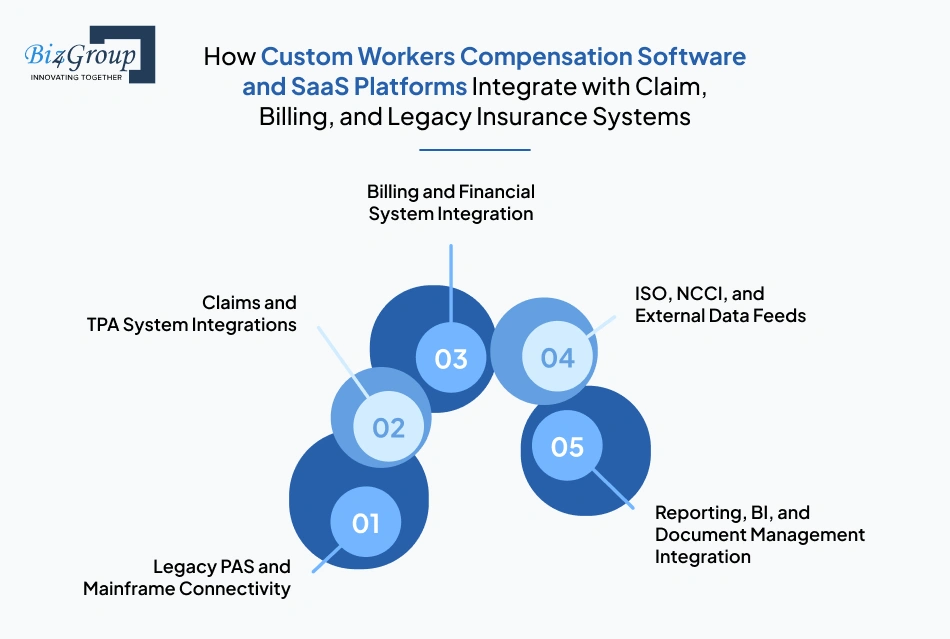
Integration challenges usually appear long before a carrier replaces its core platform. Claims systems, billing tools, reporting workflows, and legacy databases already hold years of operational data. The real difference between custom software and SaaS platforms is not whether integrations are possible. It is how much effort, flexibility, and long-term maintenance those integrations require.
1. Legacy PAS and Mainframe Connectivity
- Custom software can be designed around older PAS environments and mainframe systems already used by the carrier
- Native adapters help carriers connect older workflows without replacing core infrastructure immediately
- SaaS platforms usually rely on APIs and middleware layers to communicate with older systems
- Middleware increases operational cost, adds maintenance overhead, and can slow data synchronization
- Many carriers still operate 10 to 20-year-old systems that do not align easily with modern SaaS architecture
2. Claims and TPA System Integrations
- Custom platforms allow carriers to shape claims workflows around internal operational requirements
- Third-party administrator connections can be configured directly inside carrier-controlled workflows
- SaaS vendors may provide pre-built connectors for selected claims tools and external TPAs
- Integration limitations appear when carriers use highly customized claims handling processes
- Some insurers connect AI TPA software into claims intake and workflow routing environments to reduce manual assignment delays
3. Billing and Financial System Integration
- Custom software supports direct integration with internal accounting workflows and carrier-specific billing logic
- Billing structures can align with existing ERP and payment processing environments
- SaaS integrations depend heavily on vendor-supported billing connectors
- Additional middleware may be required when older accounting systems remain active
- Integration with a medical billing system require extra configuration work depending on the vendor environment
4. ISO, NCCI, and External Data Feeds
- Custom systems allow direct ingestion of ISO and NCCI operational data feeds
- Carriers can structure reporting workflows around internal compliance requirements
- SaaS platforms often depend on vendor-supported ingestion frameworks
- Delays may occur when carriers need custom feed structures or non-standard reporting formats
- Data mapping changes can become harder when carriers depend fully on vendor release cycles
5. Reporting, BI, and Document Management Integration
- Custom software gives carriers direct database access for reporting and analytics workflows
- Internal BI teams can connect dashboards and operational reporting tools more freely
- SaaS platforms usually limit access through APIs or export-based reporting models
- Document management integrations may require add-on licensing within some SaaS environments
- Reporting latency can increase when multiple middleware layers sit between operational systems
|
Integration Type |
Custom Workers Compensation Software |
SaaS Solutions |
|---|---|---|
|
Legacy PAS / Mainframe |
Native adapters and direct workflow mapping |
Middleware and API dependency |
|
Claims / TPA Systems |
Flexible custom integrations |
Pre-built connectors where available |
|
Billing / ERP Systems |
Tailored integration support |
Vendor-supported connectors |
|
ISO / NCCI Data Feeds |
Direct ingestion control |
Vendor-managed ingestion |
|
BI and Reporting Tools |
Direct database access |
API or export-based access |
Operational integration problems rarely come from one system alone. They usually appear when older infrastructure, reporting workflows, and vendor limitations collide during growth. That operational reality keeps custom insurance software vs SaaS workers compensation discussions closely tied to long-term system compatibility and integration flexibility.
Legacy Systems Slowing Claims Operations?
Disconnected platforms create reporting delays billing friction and operational visibility problems
Fix Your Integration BottlenecksHow Insurance Carriers Should Decide Between Custom Workers Compensation Software and SaaS Platforms
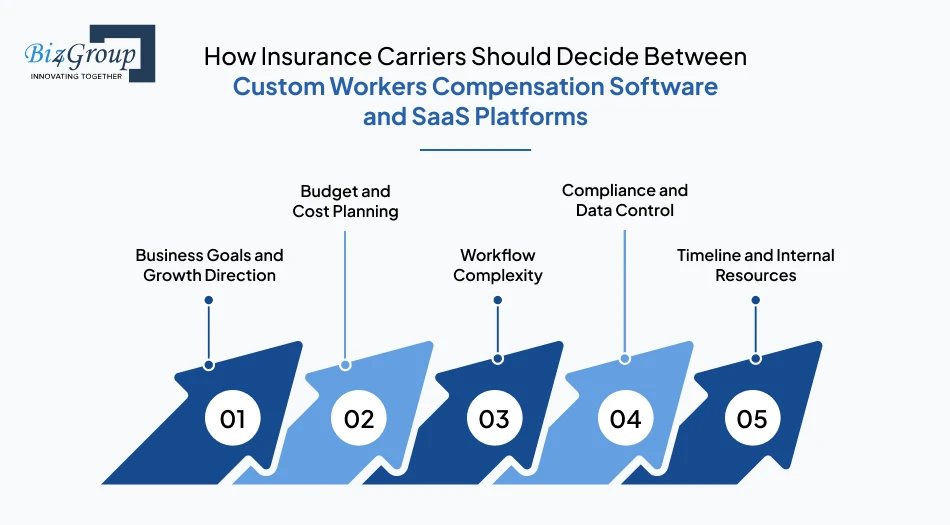
The right choice is not about picking the most popular model. It is about matching the platform to your carrier’s growth plans, workflow complexity, compliance pressure, and internal capacity. When those factors are clear, the decision becomes much easier to make.
The criterias below will help you understand which scales faster for workers compensation insurance carriers custom software development or SaaS product subscription solutions
1. Business Goals and Growth Direction
Start with the outcome you need from the platform. Some carriers are focused on entering new states quickly and keeping operations lean. Others are trying to build a stronger long-term platform for underwriting, claims, and reporting control.
If growth is the main pressure, SaaS can help the team move faster with less setup. If the carrier wants more control over future workflows and product direction, custom workers compensation insurance software usually fits that goal better. The decision should follow the growth plan, not the sales pitch.
2. Budget and Cost Planning
Budget should be viewed as a planning tool, not just a starting number. SaaS usually reduces early spending because the vendor provides the base platform and ongoing support. That helps when a carrier wants to preserve cash flow and keep launch costs lighter.
Custom workers compensation insurance software asks for more upfront investment, but it gives the carrier more control over where that money goes. That matters when the team wants to avoid repeated subscription increases, add-on charges, and roadmap-based pricing changes later. The model should fit the carrier’s expected cost tolerance over time.
3. Workflow Complexity
Some carriers run standard claims and policy processes. Others deal with more layered approval paths, state-specific filing logic, and specialized reporting routines. The more complex the workflow, the more important it becomes to look beyond a basic out-of-the-box platform.
SaaS works well when the operation can stay inside predefined process limits. Custom workers compensation insurance software becomes the better fit when the carrier needs the system to follow how the business actually works. The choice here depends on how often your team needs to bend the process to fit the platform.
4. Compliance and Data Control
Compliance pressure often changes the decision faster than anything else. A carrier with straightforward reporting needs may be comfortable using vendor-managed controls inside a SaaS environment. A carrier dealing with more state-level variation may need tighter control over filings, data handling, and rule changes.
Custom workers compensation insurance software gives the team more ownership over how compliance logic is built and updated. SaaS gives speed and convenience, but the carrier stays inside the vendor’s framework. The right path depends on how much control your team wants over sensitive data and state reporting workflows.
5. Timeline and Internal Resources
Some carriers need a faster rollout because they do not have enough internal bandwidth to manage a long build. In that case, SaaS can reduce pressure on the IT team and get operations moving sooner. That makes sense when the priority is speed with limited internal lift.
Custom workers compensation insurance software works better when the carrier can invest time in planning, testing, and internal coordination. It usually takes longer to launch, but it can support a more precise operating model. The decision should reflect how much time, attention, and technical support the organization can realistically commit.
|
Decision Factor |
SaaS Platform |
Custom Software |
Best Fit Depends On |
|---|---|---|---|
|
Growth Goals |
Faster operational rollout |
Stronger long-term flexibility |
Expansion strategy |
|
Budget Planning |
Lower upfront spending |
Higher initial investment |
Cost priorities |
|
Workflow Needs |
Standardized processes |
Carrier-specific workflows |
Operational complexity |
|
Compliance Control |
Vendor-managed updates |
Greater internal control |
Reporting requirements |
|
Implementation Timeline |
Faster deployment |
Longer planning and rollout |
Internal resources |
The choice between workers compensation software build or buy models for insurance carriers becomes clearer when you look past the launch stage and into daily operations.
Hybrid Strategy: When Insurance Carriers Should Use Both SaaS Platforms and Custom Workers Compensation Software
Not every insurance carrier needs to commit fully to one model. In many cases, a hybrid setup creates a more practical path. Carriers can use SaaS platforms for standardized operations while introducing custom software in workflows that need more flexibility, control, or long-term strategic value.
This approach helps carriers modernize without forcing every department into the same structure from day one and ease their confusion around custom built vs Off the shelf workers compensation software.
1. Better Cost Control Without Overcommitting Early
A hybrid strategy helps carriers avoid large upfront transformation costs while still improving important workflows. SaaS can support routine operational areas first, while custom software investments stay focused on high-impact business functions.
This structure often helps carriers:
- Reduce initial modernization spending
- Prioritize custom investment where operational gaps are larger
- Spread technology costs across multiple phases
- Avoid overbuilding systems too early
- Maintain more budget flexibility during expansion
2. Faster Rollout with More Operational Flexibility
Some insurance operations need quick deployment because claims teams, billing departments, or compliance units cannot wait through a long implementation cycle. SaaS platforms help carriers move faster in those areas while custom workflows are introduced gradually where more operational precision is required.
This model often works well for:
- Faster deployment of standard claims workflows
- Gradual rollout of custom reporting or underwriting logic
- Easier adoption across operational teams
- Reduced delays during modernization initiatives
- Better alignment with internal business processes
3. Lower Operational and Migration Risk
Large software transitions can create pressure on internal teams. Fully custom projects may require longer testing and coordination, while fully standardized systems may create limitations later as operations expand. A hybrid model reduces that pressure by allowing carriers to modernize in stages.
Insurance carriers often benefit through:
- Lower disruption during implementation
- More controlled workflow testing
- Gradual operational transition across departments
- Reduced dependency on one platform model
- Easier adaptation during growth phases
4. Stronger Scalability Across Multi-State Operations
Operational needs change as carriers expand into more states, add policy volume, or introduce new reporting requirements. A hybrid structure allows carriers to keep standardized workflows inside SaaS while using custom software for state-specific processes and specialized operational logic.
This often supports:
- Easier expansion across multiple jurisdictions
- Better handling of state-specific compliance workflows
- More flexibility for future operational changes
- Phased scaling based on business priorities
- Long-term adaptability without full system replacement
5. More Balanced Long-Term Value
Many carriers want immediate operational improvement while also preparing for future growth. A hybrid strategy helps organizations gain early efficiency from SaaS platforms while building long-term operational control through custom capabilities.
This approach often improves:
- Faster operational stabilization
- Reduced manual claims workload
- Better internal process alignment
- Greater flexibility for future enhancements
- More balanced long-term technology investment
A hybrid model gives carriers room to modernize at a practical pace while keeping operational flexibility intact. For many insurers, build vs buy workers compensation insurance software becomes less about picking one side and more about deciding where each model creates the strongest business value.
One Platform Model Rarely Fits All
Hybrid modernization gives carriers more flexibility without forcing large operational disruption
Design Your Hybrid Modernization PlanWhat Common Mistakes Do Insurance Carriers Make When Choosing Between Custom Workers Compensation Software and SaaS Platforms
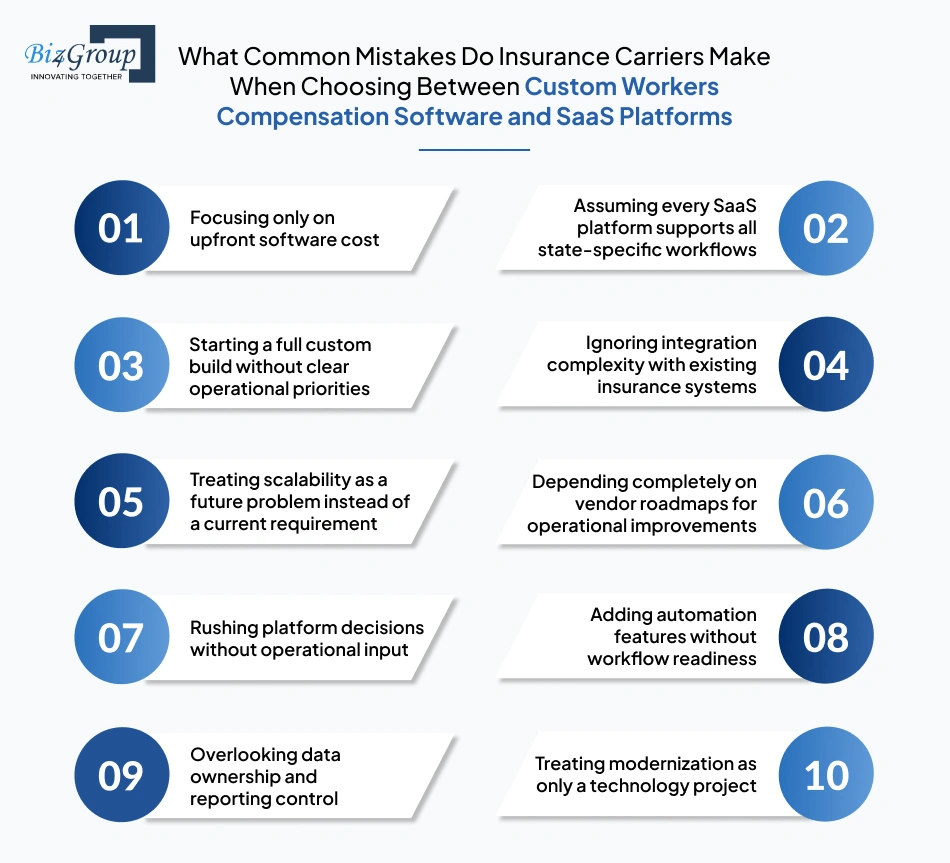
Many carriers run into problems when comparing custom workers compensation insurance software vs SaaS solutions as decisions are made around immediate needs only. A more practical evaluation process helps carriers avoid expensive adjustments after implementation.
|
Common Mistake |
How to Avoid It |
|---|---|
|
Focusing only on upfront software cost |
Evaluate long-term expenses such as integrations, add-on modules, vendor dependency, support, and future migration costs |
|
Assuming every SaaS platform supports all state-specific workflows |
Review how the platform handles state filings, reporting variations, and compliance changes before signing contracts |
|
Starting a full custom build without clear operational priorities |
Define claims workflows, reporting requirements, and internal goals before development begins |
|
Ignoring integration complexity with existing insurance systems |
Map current PAS, billing, claims, and reporting systems early during planning |
|
Treating scalability as a future problem instead of a current requirement |
Assess how the platform will support additional states, policy growth, and operational expansion over the next few years |
|
Depending completely on vendor roadmaps for operational improvements |
Clarify which workflows can be customized internally and which depend on vendor release cycles |
|
Rushing platform decisions without operational input |
Involve adjusters, compliance staff, reporting teams, and operations leaders during evaluation |
|
Adding automation features without workflow readiness |
Align operational processes before investing in AI product development services or automation initiatives |
|
Overlooking data ownership and reporting control |
Review portability, reporting access, and governance requirements during vendor evaluation |
|
Treating modernization as only a technology project |
Combine operational planning with technical strategy and use AI consulting services where internal expertise is limited |
Most platform problems do not appear during vendor demos or early implementation. They surface later when operations expand, reporting complexity increases, and workflows become harder to manage. Strong planning usually prevents far more problems than software replacement later.
Why Biz4Group LLC Is the Right Technology Partner for Custom Workers Compensation Software Development and SaaS Modernization
Many insurance carriers already know they need platform modernization. The bigger challenge is finding a technology partner that understands claims operations and long-term scalability.
When evaluating custom workers compensation insurance software vs SaaS solutions, the partner should help clarify where customization creates value, where SaaS works efficiently, and how both models fit long-term business goals. That exactly we stand out.
Biz4Group LLC works as a custom software development company focused on enterprise-grade insurance platforms, workflow modernization, and scalable digital transformation. The team supports carriers looking to modernize claims systems, improve operational visibility, streamline reporting, and reduce workflow inefficiencies without disrupting day-to-day insurance operations.
Here’s How Biz4Group Supports Insurance Carriers
- Custom workers compensation platforms aligned with carrier-specific workflows and operational goals
- SaaS modernization support for claims, billing, reporting, and compliance systems
- AI insurance software solutions for workflow automation, claims routing, reporting efficiency, and operational visibility
- Integration support for PAS, billing platforms, document systems, and legacy insurance infrastructure
- Strategic modernization planning for carriers evaluating operational scalability and platform flexibility
- End-to-end support for an AI SaaS product designed around insurance operations and long-term growth requirements
- Long-term enhancement, maintenance, and operational scaling support after deployment
Insurance modernization decisions impact claims handling, reporting accuracy, compliance operations, and future scalability. Biz4Group LLC helps carriers move through those decisions with more operational clarity, making custom workers compensation platform vs SaaS solution discussions become more outcome-focused and easier to evaluate.
Modernization Needs More Than Software Delivery
Operational clarity scalable architecture and insurance workflow understanding shape stronger long-term platform outcomes
Talk Through Your Modernization GoalsConclusion
Platform decisions shape how insurance carriers manage growth, reporting complexity, operational flexibility, and long-term technology control. Some organizations need faster deployment and standardized workflows. Others need deeper customization, stronger ownership, and more control over how claims and compliance operations evolve over time.
The right direction becomes clearer once the focus shifts from software features to operational realities. Growth plans, state expansion, workflow complexity, reporting demands, and internal scalability all play a major role in evaluating custom workers compensation insurance software vs SaaS solutions.
For many carriers, the goal is not simply adopting new technology. It is creating a platform strategy that supports operational stability without slowing future growth. Biz4Group LLC helps insurance carriers modernize operations with scalable and business-focused technology solutions. To discuss your platform strategy connect with us.
FAQ’s
1. How much does custom workers compensation software development cost for insurance carriers?
The cost usually depends on workflow complexity, integrations, reporting requirements, compliance needs, and automation scope. Most custom platforms range between $40,000 and $350,000+ depending on whether the carrier needs claims management, billing integration, underwriting workflows, or advanced reporting capabilities.
2. How long does it take to implement custom vs SaaS workers compensation software for insurance carriers?
SaaS platforms are usually deployed within 4 to 8 weeks because the infrastructure already exists. Custom platforms often take 6 to 18 weeks since workflows, integrations, and compliance logic are developed around carrier-specific operations and long-term scalability goals.
3. What makes custom vs SaaS workers compensation software for insurance carriers difficult to evaluate?
Many carriers focus heavily on deployment speed or starting cost while overlooking operational fit. The larger challenge is understanding how the platform will support state expansion, reporting flexibility, claims workflows, and future business growth several years after implementation.
4. When does a custom workers compensation platform vs SaaS solution become a better long-term investment?
The shift usually happens when carriers outgrow standardized workflows or need more control over underwriting logic, reporting structures, integrations, and operational scalability. Long-term platform flexibility becomes more important as policy volume and compliance complexity increase.
5. Is build vs buy workers compensation insurance software still relevant for mid-size carriers?
Yes. Mid-size carriers often face the same operational challenges as larger organizations once they expand into multiple states or handle growing claims volume. The decision becomes less about company size and more about workflow complexity, reporting demands, and long-term operational control.
6. How is custom built vs off the shelf workers compensation software affecting modernization strategies today?
Many carriers now modernize in phases instead of replacing everything at once. Some use SaaS for standardized workflows while introducing custom systems for claims automation, reporting control, or state-specific operational requirements. This phased approach reduces disruption while supporting long-term scalability.
