 Location :
Orlando, FL, USA
Location :
Orlando, FL, USA +1 (407) 714-1616
 info@biz4group.com

- AI legal app ideas in 2026 will focus on automating contracts, predicting case outcomes, and improving decision-making across legal workflows
- Businesses can build strong legal products by identifying gaps in billing, compliance, and client communication where manual effort still dominates
- The best AI legal app ideas for startups in 2026 include contract analyzers, litigation predictors, billing optimization tools, and client communication platforms
- Entrepreneurs should focus on niche legal problems that deliver measurable ROI, clear workflow improvement, and scalable product expansion
- Legal AI products that integrate with existing systems and simplify daily operations are more likely to gain adoption across firms and enterprises
- 2026 offers strong opportunities to launch AI-driven legal products that improve efficiency, reduce risk, and reshape how legal services are delivered
Why do legal teams still struggle with delays, missed risks, and scattered workflows even after adopting digital tools?
The issue is not the lack of technology. It is the gap between how legal work actually happens and how solutions are designed. Many systems fail to align with real workflows, which creates inefficiencies instead of solving them.
This is where an AI legal app idea starts to make sense. When designed around specific problems, it can streamline tasks, reduce manual effort, and bring clarity to decision-making.
The growing demand for such solutions is also reflected in market movement. The global LegalTech market is expected to be valued at $38.1 billion in 2026 and reach $78.1 billion by 2036, which shows how rapidly adoption is expanding.
As interest increases, businesses and entrepreneurs are actively asking:
- Which AI legal ideas are best for investment and growth in today’s market
- What are the top AI based legal app ideas for entrepreneurs that solve real problems
- How to build AI app solutions that fit into existing legal workflows
Well, the answers depend on how the idea aligns with real use cases and execution. Also, how working with a legal software development company can help you structure the idea, define scope, and estimate the cost of AI app development for legal based on complexity.
In the sections ahead, we will break down practical AI legal app ideas for you and help you understand how they fit int legal operations.
Why AI Legal App Ideas Are Gaining Momentum in 2026
Legal work today goes beyond expertise alone. The real challenge now is managing time, processes, and growing workloads. This shift is exactly why AI legal app ideas 2026 are gaining attention across law firms, enterprises, and legal teams.
1. Rising Non-Billable Workload Across Legal Teams
A large portion of legal effort goes into tasks that do not generate revenue. Lawyers spend close to 69% of time on administrative work, communication, and repetitive processes. This directly impacts productivity and profitability.
- Manual billing and time tracking also create gaps, where firms can lose up to 26% of potential revenue
- Teams struggle to balance high-value work with routine operational tasks
This growing imbalance is pushing teams toward solutions that reduce manual effort and improve time utilization.
2. Inefficiencies in Contract and Document Processes
Contract management continues to be one of the most fragmented areas in legal operations. Many organizations still rely on emails, shared folders, and basic document tools.
- Nearly 49% of teams depend on such fragmented systems, which slows down approvals and tracking
- More than 50% of organizations report losing business due to inefficient contract handling
These gaps highlight why structured systems are becoming essential for managing legal documents at a scale.
3. Shift Toward Mobile-First Legal Workflows
Legal professionals are no longer tied to desks for most of their work. A large majority now depend on mobile devices to stay connected.
- Around 86% of lawyers use smartphones or tablets as their primary device when away from their desk
This shift is driving demand for applications that support real-time access, communication, and decision-making from anywhere.
4. Need for Faster Decision-Making and Turnaround
Legal teams are expected to respond quickly to business needs. Delays in approvals, contract reviews, or case preparation can impact operations.
- Businesses now expect legal functions to move at the same speed as other departments
- Manual processes slow down decision-making and create operational bottlenecks
This is where AI legal AI app development becomes relevant, as it helps streamline workflows and reduce response time.
5. Growing Focus on Operational Efficiency
Legal departments are under pressure to do more without increasing team size. Efficiency is no longer optional.
- Teams are expected to handle higher workloads with the same resources
- Reducing errors and improving consistency has become a priority
This shift is encouraging organizations to adopt solutions that bring structure, visibility, and control to daily operations.
The momentum behind these ideas is not driven by trends alone. It comes from clear operational gaps that legal teams face every day. As we move forward, the next section will explore how you can identify the right AI legal app idea for your law firm.
Is Your Legal Idea Financially Scalable?
The right product fit can unlock stronger returns through efficiency, adoption, and long-term operational value
Contact UsHow to Identify the Right AI Legal App Idea for Enterprises
Not every idea turns into a product that people actually use. The difference comes from how well it fits real legal workflows. If you are exploring examples of AI legal apps for business use, the goal is to focus on problems that demand consistent attention.
1. Start With a Specific Legal Problem
A strong AI legal app idea always begins with a clear problem. Instead of thinking about features, focus on where legal teams face delays or confusion.
- Look at repetitive tasks that consume time daily
- Identify gaps where manual effort leads to errors
- Focus on workflows that directly impact cost or turnaround
This helps narrow down ideas that have practical value.
2. Understand Who Will Use the App
Every idea should align with a defined user group. Without that clarity, the product becomes too broad.
- Law firms may need case-focused solutions
- Enterprises may require AI integrations for internal workflows
- Startups may look for simple, focused applications
User clarity makes the idea easier to shape and position.
3. Validate the Idea with Real Scenarios
Ideas become stronger when tested against real use cases.
- Check if teams already use a workaround
- Compare with examples of AI legal apps for business use
- Evaluate how the app improves speed or accuracy
This step ensures that the idea solves a real need.
4. Think About How the Product Will Be Delivered
How the app is used in daily work matters just as much as what it does. If the format does not fit existing habits, adoption becomes difficult.
- Internal legal teams usually prefer a web application to automate legal services
- Client-facing solutions benefit from mobile app development, especially when users need quick access to updates, documents, or communication
- Integration with existing legal tech systems ensures teams do not have to switch between multiple tools
The right delivery approach should match how users already work, not force them to change their routine.
5. Align With Long-Term Opportunity
An idea should not be limited to one small use case. It should have room to expand.
- Check if the idea can evolve into broader solutions
- Look at trends around best AI legal app ideas for startups in 2026
- Ensure the product can scale as needs grow
This keeps the idea relevant in the legal tech environments over time.
The right idea is not the most complex one. It is the one that fits clearly into real workflows and solves a consistent problem. Once that alignment is clear, it becomes easier to move from idea to execution with confidence.
Key Categories of AI Legal Applications
Legal workflows are not uniform, and that is where categorization becomes useful. When we ask what AI apps can be built for legal services, the answer depends on which part of the workflow we want to improve. Let’s break this down into clear categories.
1. Litigation and Case Intelligence Applications
Legal teams spend a significant amount of time preparing cases, analyzing evidence, and planning strategies. This category focuses on improving how cases are handled from preparation to outcome.
These applications help organize case data, identify patterns, and support better decision-making during litigation. The goal is to reduce uncertainty and improve how teams approach complex cases.
2. Contract and Document Management Applications
Contracts and legal documents form the foundation of most legal operations. The category focuses on managing how documents are created, reviewed, stored, and tracked.
These applications help maintain consistency, reduce manual effort, and ensure that documents are handled in a structured way across teams. It brings clarity to processes that usually involve multiple revisions and stakeholders.
3. Legal Operations and Workflow Applications
Legal work depends heavily on coordination between teams, approvals, and task tracking. This category focuses on improving internal workflows by organizing how tasks move across the system.
These applications reduce delays, improve visibility, and help teams manage increasing workloads without losing control over processes.
4. Risk, Compliance, and Predictive Applications
Legal teams are expected to identify risks before they turn into issues. The category focuses on analyzing data to detect potential risks, predict outcomes, and ensure compliance with regulations.
These applications support proactive decision-making and help teams stay prepared instead of reacting late.
5. Client Facing and Access to Legal Service Applications
Client interaction plays a key role in how legal services are delivered. This category focuses on improving communication, accessibility, and user experience.
These applications make it easier for clients to understand legal processes and stay informed, while also helping teams manage communication more efficiently.
Each category highlights a different layer of legal operations, and understanding this structure makes it easier to identify where real value exists. As you go through the next section, you will see how these categories translate into practical, solution-focused app ideas.
Which Legal Category Fits Your Vision?
The strongest legal apps emerge when the category matches workflow urgency and market demand
Discuss with Us15 AI Legal App Ideas Transforming the Legal Industry
Legal operations are evolving in very specific ways, and each shift opens new opportunities. Instead of broad solutions, the focus is now on targeted applications that solve clear problems.
Let’s walk through top 15 AI legal app ideas that directly address real-world legal challenges.
1. AI Evidence Organizer App
Legal teams often deal with scattered evidence across emails, documents, images, and recordings. This AI legal app idea focuses on bringing all that information into one structured system. It organizes evidence based on case context, timelines, and relevance. Instead of manually sorting files, users can upload data and let the system group it logically.
An integrated OCR system helps extract text from scanned documents and images, making everything searchable. This legal tech AI app idea becomes especially useful when handling large case files where missing a single detail can impact outcomes.
Key Features
- Automated Evidence Categorization: Groups files by type, relevance, and case linkage
- Smart Search and Retrieval: Finds documents using keywords, dates, or context
- Timeline-Based Organization: Arranges evidence in chronological order
- Text Extraction Capability: Converts scanned files into readable and searchable content
- Secure Evidence Storage: Maintains confidentiality with controlled access
Use Cases
- Managing large litigation cases with multiple evidence sources
- Organizing investigation files for internal legal teams
- Preparing case documentation for court submissions
- Structuring evidence for faster legal review
Estimated Cost of Development: $35,000 – $110,000+ depending on storage architecture, AI accuracy, and security layers
Revenue Streams: Subscription-based pricing, enterprise licensing, storage-based pricing tiers, API access for integrations, white-label solutions for law firms, premium plans with advanced search and analytics features
2. AI Legal Expense Tracker App
Legal spending often spreads across invoices, external counsel fees, filings, and internal costs. This AI legal app idea helps bring all expenses into one clear view, so teams can understand where money is going. Instead of tracking bills manually, the app captures expenses, categorizes them, and highlights unusual spending patterns.
It works with specialized budget tracking but tailored for legal operations where costs are harder to predict. Many legal tech companies struggle with visibility into legal spending, especially when multiple vendors and cases are involved. This AI driven legal app idea gives teams the clarity they need to control budgets without slowing down legal work.
Key Features
- Automated Expense Categorization: Organizes costs by case, vendor, or activity
- Real-Time Spend Tracking: Shows updated legal expenses as they occur
- Anomaly Detection: Flags unusual or unexpected charges
- Invoice Data Extraction: Captures details from bills and statements
- Cost Breakdown Dashboard: Visualizes spending across matters and teams
Use Cases
- Tracking external legal counsel fees across multiple cases
- Monitoring litigation costs for budget control
- Managing internal legal department expenses
- Reviewing vendor billing patterns for accuracy
Estimated Cost of Development: $30,000 – $150,000+ depending on integrations, analytics depth, and reporting features
Revenue Streams: Subscription-based pricing, enterprise licensing, usage-based pricing for expense volume, API access for integrations, premium analytics features, white-label solutions for firms, tiered plans based on number of users and cases.
Similar solutions are already used by enterprise teams to improve visibility into legal spending and avoid unexpected costs.
For Example: Apperio- It provides real-time tracking of legal spending, including unbilled work, helping teams monitor costs proactively instead of relying only on finalized invoices.
Also Read: AI Budget Tracking App Development for Enterprises
3. AI Legal Vendor Contract Analyzer App
Vendor contracts often carry hidden risks that are easy to miss during manual reviews. This AI legal app idea focuses on analyzing third-party agreements to highlight terms that may impact cost, liability, or compliance. Instead of reading lengthy contracts line by line, the app scans documents and brings attention to critical clauses for compliance teams.
It also checks whether vendor terms align with internal policies and expectations. This AI-based legal app idea helps standardize how contracts are reviewed and ensures nothing important is ignored. It fits well within workflows where AI-based contract management is already in place and needs deeper analysis at the vendor level.
Also Read: AI Contract Management Software Development
Key Features
- Clause Risk Detection: Identifies clauses that may create financial or legal exposure
- Policy Alignment Check: Matches vendor terms with internal guidelines
- Obligation Extraction: Pulls key responsibilities and deliverables from contracts
- Deviation Highlighting: Flags terms that differ from standard contract templates
- Searchable Contract Insights: Makes it easy to locate important sections quickly
Also Read: AI Template Clause Validation Agent Development in Legal Tech
Use Cases
- Reviewing vendor agreements before onboarding
- Auditing existing contracts for hidden risks
- Supporting procurement during contract negotiations
- Standardizing contract review across departments
Estimated Cost of Development: $20,000 – $150,000+ depending on analysis depth, integrations, and document processing capabilities
Revenue Streams: Subscription-based pricing, enterprise licensing, per-contract analysis fees, API access for integrations, premium compliance monitoring features, white-label solutions for legal teams
Contract analysis tools are already being used to simplify document review and identify risks without manual effort.
For Example: Contract Analyzer AI- It allows users to upload contracts, generate summaries, and detect risky clauses, helping simplify document understanding and quick decision-making for non-legal users.
Also Read: A Guide to Legal Contract Validation AI Agent Platform Development for Modern Legal Teams
4. AI Litigation Outcome Prediction App
Litigation decisions involve uncertainty, especially when outcomes depend on multiple factors such as past rulings, judge behavior, and case specifics. This AI legal app idea focuses on bringing clarity to that uncertainty. The app analyzes historical case data and identifies patterns that can indicate how a case might progress. Instead of relying only on experience or intuition, legal teams can use data-backed insights to plan their approach.
This is one of the more innovative AI legal app concepts because it supports strategic decisions before major costs are committed. When built with proper data pipelines and supported by AI integration services, it becomes a practical solution for firms that want better visibility into legal risks and outcomes.
Key Features
- Outcome Probability Scoring: Estimates the likelihood of different case results
- Case Pattern Analysis: Identifies trends from similar past cases
- Judge Behavior Insights: Highlights decision patterns based on historical rulings
- Scenario Simulation: Tests how changes in arguments may impact outcomes
- Data-Driven Case Summaries: Presents key insights in a structured format
Use Cases
- Evaluating whether to settle or proceed with litigation
- Preparing case strategy before filing or trial
- Advising clients on potential legal risks
- Supporting internal decision-making for high-value disputes
Estimated Cost of Development: $30,000 – $200,000+ depending on data availability, model complexity, and analytics depth
Revenue Streams: Subscription-based pricing, enterprise licensing, pay-per-case analysis, API access for integrations, premium predictive insights features, custom deployments for large law firms
Litigation teams are already using data-driven systems to assess case direction before committing resources.
For Example: Pre/Dicta- It analyzes judge behavior and past case data to predict outcomes, motion success, and expected timelines for ongoing litigation.
5. AI Legal Strategy Simulator App
Legal strategy decisions involve multiple variables, and small changes can impact the final outcome. This AI legal app idea focuses on helping legal teams test different approaches before taking action. The app allows users to simulate case strategies by adjusting factors such as arguments, evidence strength, and timelines. It then shows how these changes may influence outcomes based on past patterns.
This artificial intelligence legal app idea supports more confident decision-making without relying only on experience. When combined with structured workflows and supported by AI automation services, the simulator becomes a practical tool for planning complex legal moves with better clarity.
Key Features
- Strategy Scenario Simulation: Tests multiple legal approaches within a controlled environment
- Outcome Impact Analysis: Shows how each change affects possible results
- Argument Strength Evaluation: Assesses the effectiveness of key legal points
- Timeline Adjustment Simulation: Evaluates how delays or accelerations impact cases
- Structured Strategy Reports: Summarizes insights in a clear format
Use Cases
- Planning litigation strategies before filing a case
- Evaluating different legal approaches during ongoing cases
- Supporting internal discussions for high-risk decisions
- Advising clients with structured scenario-based insights
Estimated Cost of Development: $40,000 – $250,000+ depending on simulation depth, data modeling, and analytics capabilities
Revenue Streams: Subscription-based pricing, enterprise licensing, scenario-based usage pricing, API access for integrations, premium simulation features, custom deployments for legal teams
6. AI Personal Legal Avatar App
Legal teams handle repeated queries, standard explanations, and routine interactions across cases. This AI legal app idea focuses on creating digital avatars of legal professionals that can represent them in controlled scenarios. These avatars are trained on a lawyer’s past cases, communication style, and domain expertise. Once set up, they can respond to common queries, explain legal positions, and assist in early-stage discussions without requiring constant human involvement.
This concept fits well within AI startup app ideas in legal tech because it helps firms extend their availability while maintaining consistency in communication. It also ensures that clients receive structured and accurate responses even outside working hours.
Key Features
- Custom Avatar Training: Builds avatars using past interactions, documents, and expertise areas
- Controlled Response Framework: Ensures replies stay aligned with defined legal boundaries
- Multi-Case Context Handling: Allows avatars to respond based on different case scenarios
- Interaction History Tracking: Records conversations for review and improvement
- Access Control Settings: Limits usage based on user roles and permissions
Use Cases
- Handling initial client queries before lawyer involvement
- Supporting internal teams with quick legal clarifications
- Managing high-volume communication during active cases
- Extending availability for firms without increasing workload
Estimated Cost of Development: $30,000 – $150,000+ depending on training depth, personalization, and interaction complexity
Revenue Streams: Subscription-based pricing, enterprise licensing, per-avatar customization fees, API access for integrations, premium plans for advanced training and analytics, white-label solutions for law firms
Also Read: A Complete Guide to OpenAI API Integration for AI Applications
This concept is not limited to theory. Similar AI avatar systems have already been implemented in real-world environments, showing how digital personas can handle structured interactions with consistency and scale.
Biz4Group LLC in Action: AI Wizard: Avatar-based AI Companion

Biz4Group has developed an advanced AI avatar solution that demonstrates how interactive digital personas can engage users in real time. AI Wizard is designed to simulate human-like communication while maintaining structured and context-aware responses.
Key Highlights
- Real-time conversational avatar with interactive response capability
- Context-aware interaction based on user inputs
- Designed to handle repeated queries without manual intervention
- Scalable architecture adaptable across different industries
This example shows how avatar-based systems can be extended into legal workflows where structured communication and availability play a key role.
Ready To Build Trusted Legal Avatars?
We help turn advanced legal interaction concepts into reliable, user-ready digital products
Talk to Our AI Developers7. AI Legal Settlement Probability Predictor
Settlement decisions are not always straightforward, especially when legal teams need to weigh risks, costs, and timelines. This AI legal app idea focuses on helping teams understand the likelihood of settling a case before going further. The app studies past case outcomes, dispute types, and negotiation patterns to estimate how likely a settlement is under current conditions.
It gives legal teams a clearer picture of when it makes sense to settle and when to proceed. This legal industry AI app concept also supports early discussions during a legal consultation where clients expect realistic expectations about outcomes.
Also Read: Build an AI Legal Consultation Platform for Modern Law
Key Features
- Settlement Probability Score: Estimates chances of settlement based on case inputs
- Dispute Pattern Analysis: Identifies trends from similar past disputes
- Cost vs Outcome Insights: Shows how legal costs relate to settlement chances
- Negotiation Scenario Inputs: Allows users to adjust variables and see impact
- Clear Outcome Summaries: Presents insights in an easy-to-understand format
Use Cases
- Deciding whether to settle or continue litigation
- Advising clients during early-stage case discussions
- Supporting negotiation planning with structured insights
- Evaluating financial risks before legal escalation
Estimated Cost of Development: $40,000 – $180,000+ depending on data modeling, prediction accuracy, and scenario capabilities
Revenue Streams: Subscription-based pricing, enterprise licensing, pay-per-case prediction, API access for integrations, premium analytics features, custom deployment for large legal teams
Legal teams are already using data-backed systems to estimate settlement outcomes before making financial and strategic decisions.
For Example: CaseOdds- It analyzes past case data to predict settlement likelihood, estimate case value, and assess litigation risk before proceeding.
8. AI Legal Client Communication Simplifier App
Legal communication can become complex, especially when clients are not familiar with legal terms or processes. This AI legal app idea focuses on simplifying how legal teams interact with clients without losing accuracy. The app takes detailed legal explanations and converts them into clear, easy-to-understand language. It helps ensure that clients fully understand their situation, decisions, and next steps.
This legal mobile app idea integrating AI also supports consistent communication across different cases, which becomes important when multiple team members are involved. Teams that integrate AI into their communication workflows can reduce misunderstandings and improve overall client experience without increasing workload.
Key Features
- Plain Language Conversion: Transforms complex legal text into simple explanations
- Context-Based Response Generation: Adapts communication based on case details
- Multi-Channel Support: Works across email, chat, and client portals
- Consistency Control: Maintains uniform messaging across different team members
- Communication History Tracking: Keeps records for reference and clarity
Use Cases
- Explaining legal documents to clients in simple terms
- Responding to frequent client queries during active cases
- Supporting client onboarding with clear communication
- Reducing back-and-forth caused by misunderstandings
Estimated Cost of Development: $40,000 – $150,000+ depending on language processing depth and integration requirements
Revenue Streams: Subscription-based pricing, enterprise licensing, usage-based pricing for communication volume, API access for integrations, premium language customization features, white-label solutions for law firms
Law firms already rely on dedicated platforms to keep clients updated throughout active cases.
For Example: Case Status- It delivers real-time case updates, messaging, and document sharing, helping clients stay informed without repeated follow-ups.
Also Read: A Guide to AI Conversation App Development
9. AI Legal Billing and Time Tracking Optimization App
Billing in legal work depends heavily on accurate time tracking, yet manual entries can lead to missed hours or inconsistent records. This AI legal app idea focuses on capturing and organizing time spent on different tasks without relying on constant manual input. The app tracks activities across emails, documents, and case work, then converts them into structured billing entries.
It also highlights gaps where time may not have been recorded. Many firms are already moving toward AI legal billing automation to improve accuracy and transparency in invoicing. Among AI app ideas for legal industry, this stands out because it directly impacts revenue and client trust.
Also Read: AI Wealth Management Software Development Services
Key Features
- Automated Time Capture: Tracks work activity and converts it into billable time
- Smart Billing Suggestions: Recommends entries based on task patterns
- Invoice Structuring: Organizes time logs into ready-to-send invoices
- Gap Detection: Identifies untracked or underreported work
- Client Billing Insights: Provides clear breakdowns for better transparency
Use Cases
- Recording billable hours without manual time entry
- Preparing accurate invoices for clients
- Reviewing time allocation across cases and teams
- Improving billing consistency across legal operations
Estimated Cost of Development: $25,000 – $130,000+ depending on tracking depth, integrations, and reporting capabilities
Revenue Streams: Subscription-based pricing, enterprise licensing, usage-based billing for tracked hours, API access for integrations, premium analytics features, white-label solutions for law firms
Legal teams already rely on systems that track work and manage billing across cases.
For Example: Clio- It combines billing, time tracking, and case management, allowing firms to manage invoices, expenses, and payments within one connected workflow.
10. AI Legal Document Lifecycle App
Legal documents move through multiple stages, from drafting and review to approval and storage. Managing this flow manually creates delays and increases the risk of missing critical updates. This AI legal app idea focuses on handling the entire document lifecycle in one structured system. It tracks where each document stands and ensures that every step is completed on time.
The app also maintains version control, so teams always work on the latest document. Many teams already rely on AI legal document management software, but lifecycle tracking adds control over how those documents move and evolve. Among AI app ideas for legal industry, this stands out because it connects document handling with process visibility.
Key Features
- Lifecycle Stage Tracking: Monitors documents from creation to final storage
- Version Control System: Maintains history of changes across document versions
- Approval Workflow Management: Tracks document approvals across stakeholders
- Access Control Settings: Manages who can view or edit documents
- Change Monitoring: Flags unusual edits or inconsistencies
Use Cases
- Managing contract workflows across legal teams
- Tracking document approvals in enterprise environments
- Maintaining audit trails for compliance requirements
- Ensuring document accuracy before final submission
Estimated Cost of Development: $30,000 – $150,000+ depending on workflow complexity, integrations, and security layers
Revenue Streams: Subscription-based pricing, enterprise licensing, usage-based pricing for document volume, API access for integrations, premium workflow automation features, white-label solutions for legal organizations
Also Read: AI Legal Document Analyzer Tool Development
Real World Implementation: PDF Consultant AI

Biz4Group has built an AI-powered solution designed to work with complex PDF documents by extracting and structuring key information. The PDF Consultant AI allows users to upload documents and interact with the content instead of manually reviewing every page.
Key Highlights:
- Extracts key data points from large and complex PDF files
- Enables users to query documents and retrieve specific information
- Structures unorganized content into readable and usable formats
- Reduces manual review effort across high-volume documents
This example connects directly to document lifecycle workflows where accurate data extraction and structured visibility play an important role in maintaining control over documents.
Can Your Documents Move Smarter?
Lifecycle visibility improves compliance, reduces delays, and keeps legal teams aligned at every stage
Connect with Us11. AI Court Filing Error Detection App
Court filings require strict accuracy, and even small errors can lead to delays or rejection. This AI legal app idea focuses on reviewing documents before submission to ensure they meet required standards. The app scans for filings and checks for missing sections, formatting issues, and incorrect details. It also verifies whether the content aligns with court-specific rules.
Legal teams can run documents through an AI document analysis tool to catch issues early instead of fixing them after rejection. It also supports document fraud detection by identifying inconsistencies that may raise concerns during review. Among AI legal application ideas, this stands out because it directly prevents costly mistakes at a critical stage of the legal process.
Key Features
- Pre-Filing Error Detection: Identifies missing fields and incorrect formatting
- Jurisdiction Rule Validation: Checks compliance with court-specific requirements
- Data Consistency Check: Verifies names, dates, and references across documents
- Submission Readiness Score: Indicates how prepared a filing is for submission
- Anomaly Detection: Flags unusual patterns that may indicate errors or risks
Use Cases
- Reviewing court filings before submission
- Reducing rejection rates in legal documentation
- Supporting paralegals during document preparation
- Ensuring compliance with filing standards across jurisdictions
Estimated Cost of Development: $30,000 – $130,000+ depending on validation rules, integrations, and analysis capabilities
Revenue Streams: Subscription-based pricing, enterprise licensing, pay-per-document analysis, API access for integrations, premium compliance validation features, white-label solutions for legal firms
Enterprise teams already use these solutions to improve visibility into legal spending and avoid unexpected costs.
For Example: Clearbrief- It connects legal writing with underlying documents, verifying citations and linking every statement to source evidence within the same workflow.
12. AI Witness Preparation App
Witness preparation takes time and requires careful guidance to avoid inconsistent or unclear statements. Legal teams usually walk witnesses through possible questions, but this process depends heavily on manual effort. An AI legal app idea like this helps simulate real questioning scenarios, so witnesses can practice before appearing in court or depositions.
The app presents questions based on case context and evaluates responses for clarity, consistency, and risk. It uses trained AI models to mirror realistic questioning patterns and identify weak areas in responses. This makes preparation more structured and repeatable across different cases.
Key Features
- Question Simulation Engine: Generates case-specific questions for practice sessions
- Response Evaluation: Analyzes answers for clarity and consistency
- Risk Flagging: Highlights statements that may create legal exposure
- Session Replay: Allows review of past practice sessions for improvement
- Progress Tracking: Monitors readiness across multiple sessions
Use Cases
- Preparing witnesses for court appearances or depositions
- Supporting legal teams during trial preparation
- Identifying weak responses before formal questioning
- Standardizing witness preparation across cases
Estimated Cost of Development: $30,000 – $150,000+ depending on simulation depth, response analysis, and training capabilities
Revenue Streams: Subscription-based pricing, enterprise licensing, per-session usage pricing, API access for integrations, premium training modules, and white-label solutions for legal firms.
Platforms like this are already being used to simulate questioning and evaluate witness responses in controlled environments.
For Example: TestMyWitness- It runs AI-driven mock sessions that evaluate tone, confidence, and response patterns, helping legal teams prepare witnesses more effectively.
- AI Legal Reputation Management App
Legal reputation is shaped by how cases, disputes, and public records appear across different platforms. Negative mentions, unresolved disputes, or misleading information can impact trust and credibility. An AI legal app idea like this helps track and manage how individuals or firms are represented across digital channels.
AI legal reputation management app monitors public data, legal records, and online mentions, then highlights risks that may affect reputation. It also guides users on actions that can improve visibility and correct inaccurate information. This makes it easier to stay aware of potential issues before they escalate. Many legal app ideas integrating AI focus on operations, but reputation management addresses how legal outcomes are perceived outside the courtroom.
Key Features
- Reputation Monitoring: Tracks mentions across legal records and online sources
- Risk Detection: Identifies content that may impact credibility
- Alert System: Notifies users about new or changing mentions
- Insight Dashboard: Shows reputation trends over time
- Action Recommendations: Suggests steps to manage or improve reputation
Use Cases
- Monitoring public perception for law firms and professionals
- Tracking legal disputes that may affect brand image
- Managing online presence for individuals involved in legal cases
- Identifying inaccurate or outdated information for correction
Estimated Cost of Development: $30,000 – $150,000+ depending on data sources, monitoring coverage, and analytics capabilities
Revenue Streams: Subscription-based pricing, enterprise licensing, usage-based monitoring fees, API access for integrations, premium analytics features, white-label solutions for legal service providers
14. AI Legal Workflow Automation App
Legal work involves multiple steps that depend on timely approvals, document movement, and coordination between teams. When these steps are handled manually, delays become common and tracking progress becomes difficult. An AI legal app idea like this helps structure and automate how tasks move across the legal process. The app routes documents, assigns tasks, and tracks progress without constant manual follow-up.
It brings visibility into who is responsible for each step and where things may be getting delayed. By legal workflow automation legal teams can manage higher workloads without losing control over processes. This AI legal app product idea supports smoother operations by keeping workflows organized and predictable.
Also Read: AI Legal Custom Workflow Management Software Development
Key Features
- Automated Task Routing: Assigns tasks based on predefined workflows
- Approval Flow Management: Tracks approvals across different stakeholders
- Progress Tracking Dashboard: Shows real-time status of ongoing work
- Delay Detection: Identifies bottlenecks in workflow stages
- Notification System: Alerts users about pending actions and updates
Use Cases
- Managing contract approvals across departments
- Tracking internal legal requests from business teams
- Coordinating multi-step legal processes
- Improving visibility into ongoing legal work
Estimated Cost of Development: $30,000 – $200,000+ depending on workflow complexity, integrations, and customization
Revenue Streams: Subscription-based pricing, enterprise licensing, usage-based pricing for workflow volume, API access for integrations, premium automation features, white-label solutions for legal organizations
15. AI Micro-Justice Platform App (Instant Dispute Resolution)
Small disputes often take too long to resolve, especially when the cost of legal action outweighs the issue itself. This AI legal app idea addresses that gap by providing a fast and structured way to resolve minor disputes without going through lengthy legal processes. The platform allows users to submit cases, share evidence, and receive guided resolution options within a defined framework.
It uses integrated AI models trained in the legal process to evaluate inputs and suggest fair outcomes based on similar cases. This approach makes dispute resolution more accessible while reducing the burden on courts. It also opens opportunities for entrepreneurs looking at profitable AI legal app idea that focus on high-volume, low-value disputes.
Key Features
- Dispute Intake System: Collects case details and supporting information
- Automated Case Evaluation: Analyzes inputs to suggest possible outcomes
- Guided Resolution Flow: Walks users through structured resolution steps
- Evidence Submission Support: Allows secure upload and review of documents
- Outcome Recommendation Engine: Provides fair resolution suggestions
Use Cases
- Resolving small business or vendor disputes
- Handling consumer complaints without court involvement
- Managing contract disagreements at an early stage
- Providing quick resolution options for low-value cases
Estimated Cost of Development: $30,000 – $180,000+ depending on case handling logic, user flow complexity, and scalability
Revenue Streams: Transaction-based fees per case, subscription-based pricing, enterprise licensing, commission on resolved disputes, API access for integrations, premium fast-track resolution features
Each idea reflects a specific gap in how legal work is handled today. The real value comes from identifying which one aligns with your business context. Think about where delays, risks, or inefficiencies exist, because that is where the strongest opportunities lie.
Key Challenges That Arise in AI Legal App Development and How to Overcome Them
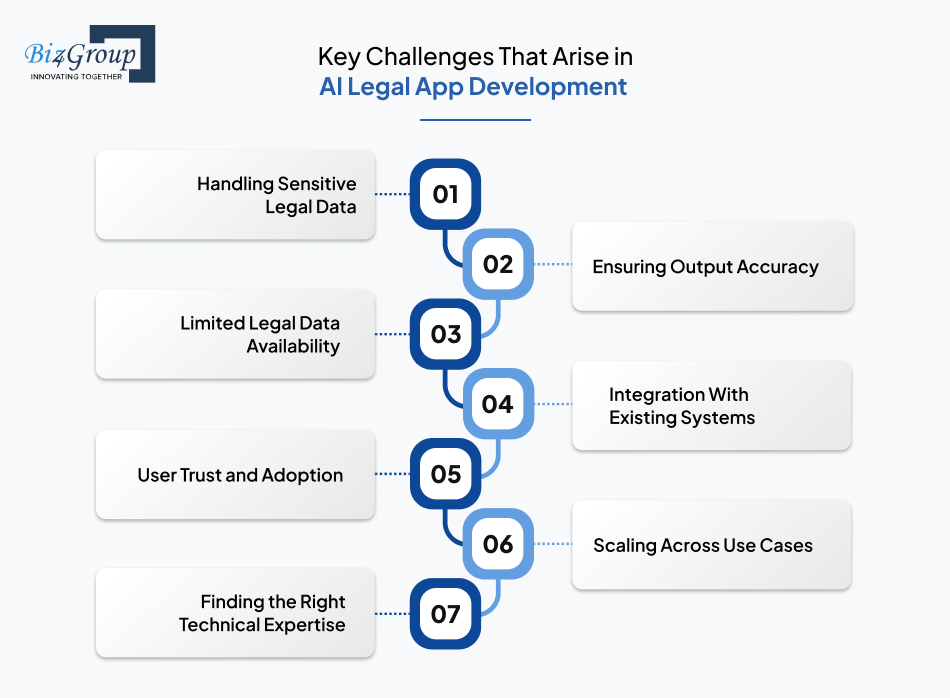
Turning an AI legal app idea into a working product is not just about features. Real challenges start appearing when legal accuracy, data sensitivity, and system reliability come into play. This is where execution matters more than the concept itself.
|
Challenge |
Solution |
|---|---|
|
Handling Sensitive Legal Data |
Legal data requires strict confidentiality. Work with an AI development company that understands secure data handling and builds systems with controlled access and encryption from the start. |
|
Ensuring Output Accuracy |
Inaccurate outputs can lead to serious consequences. Use structured validation layers instead of relying only on generative AI and include human review where needed. |
|
Limited Legal Data Availability |
Many teams lack clean and labeled datasets. Start with focused use cases and gradually train AI models using internal data while improving quality over time. |
|
Integration With Existing Systems |
Legal teams already use multiple tools. Design the app to connect with existing platforms and workflows instead of replacing everything at once. |
|
User Trust and Adoption |
Legal professionals rely on proven methods. Build trust by showing clear outputs, explainable results, and consistent performance across use cases. |
|
Scaling Across Use Cases |
Expanding too quickly can reduce accuracy. Focus on one strong use case first, then scale features gradually while supporting enterprise AI solutions. |
|
Finding the Right Technical Expertise |
AI projects fail without the right team, so hire AI developers with both domain understanding and practical experience in legal workflows. |
Also Read: How to Hire an AI App Developer in USA for Your Business?
Handling these challenges early helps you avoid rework later. Whether you are exploring legal mobile app ideas integrating AI or refining your product strategy, focusing on execution ensures your solution remains reliable, scalable, and aligned with real legal needs.
Avoid Costly Product Mistakes Early
The right technical roadmap helps prevent workflow, compliance, and adoption risks before launch
Talk to Our AI ExpertsWhy Choose Biz4Group LLC for Turning Your AI Legal App Idea into Reality?
Turning an AI legal app idea into a reliable product depends on how well we execute it in real-world conditions. Many emerging AI legal tech app ideas look strong on paper, but they struggle when it comes to usability, accuracy, and scalability. That is where Biz4Group LLC makes a clear difference.
We focus on building solutions that fit into actual legal workflows instead of creating disconnected features. As an AI app development company, our approach is structured around solving practical problems while keeping the product simple to use. Here’s what you should know about us:
- We rely on hands-on experience to avoid trial-and-error during development. Our AI portfolio reflects how different ideas have been turned into working products across industries.
- We approach business app development using AI with a clear focus on outcomes, so your product delivers value from day one and design systems that can grow with your product as requirements evolve.
- From early validation to final deployment, we guide each stage with clarity and consistency through our AI consulting services.
- We deliver cost-effective solutions that maximize the value of your investment, tailored specifically for your business.
Not only this but you also get control over execution by choosing Biz4Group LLC, which ensures that the final product performs as per your expectations in real legal environments.
Conclusion
AI is no longer a future concept. It is already shaping how legal services are delivered and managed. When we look at the best AI legal app ideas for startups in 2026, the real opportunity lies in solving specific problems with clear outcomes. A strong AI legal app idea should focus on practical use, not just innovation.
Across the ideas we explored, one thing stands out. Success depends on how well the product fits into real legal workflows. It is not about adding more features. It is about building something that teams can actually rely on in day-to-day operations.
Working with the right team plays a big role in this journey. An experienced AI product development company helps turn ideas into structured solutions that are scalable and usable. Teams like Biz4Group LLC bring both technical understanding and practical execution, which helps reduce delays and avoid unnecessary rework.
If you are planning to move forward with your idea, this is the right time to take the first step. Start small, focus on one problem, and build from there. That approach will help you create something that delivers real value instead of just another concept.
FAQ’s
1. How do we validate if an AI legal app idea has real market demand before development?
Start by checking how frequently the problem occurs in legal workflows. Talk to legal teams, review internal bottlenecks, and analyze where time or cost is being lost. If users are already solving the problem manually, there is strong demand.
2. What type of legal data is required to build reliable AI legal applications?
You need structured legal documents such as contracts, case records, and compliance data. The key is consistency and quality. Even smaller datasets can work if they are clean and aligned with a specific use case.
3. How do we decide which AI legal app idea fits our business model and target audience?
Start by identifying who will use the app and what problems they face daily. Then map the idea to a clear outcome such as cost reduction, faster turnaround, or risk control. The right fit is where the problem, user, and value align.
4. What are the biggest risks when investing in AI legal application ideas?
The main risks include poor data quality, low user adoption, and unclear product positioning. Many ideas fail because they do not align with real workflows or lack measurable value for users.
5. How do we ensure AI-driven legal apps remain accurate over time?
Accuracy improves with continuous updates. Monitor outputs, collect feedback from users, and retrain models regularly. Keeping the system aligned with real usage is more important than one-time development.
6. Which AI legal app ideas are more suitable for enterprise adoption versus startups?
Enterprises prefer workflow automation, compliance tracking, and risk management solutions. Startups can focus on niche problems such as document simplification or client communication, where faster adoption is possible.
