Location :
Orlando, FL, USA
Location :
Orlando, FL, USA +1 (407) 714-1616
 info@biz4group.com


















Imagine a digital system that doesn’t wait for instructions but instead, understands your business goals, learns from real-time feedback, and takes independent actions to get the job done.
Read More

Have you ever shipped a full print batch only to hear the client say the color looks off?
The global printing industry is now worth over $868 billion, according to Smithers global printing market report, yet even at this scale, print quality issues continue to drain margins and damage client relationships.
That gap between production volume and quality control is exactly why AI color management and quality inspection software development for print shops is gaining serious attention.
Many print businesses today are actively exploring AI print quality inspection software development because manual checks cannot keep up with modern press speeds. Sampling every 50th sheet creates blind spots. By the time a defect is detected, the damage is already done.
At the same time, rising demand for brand consistency across substrates and print runs is pushing companies toward AI color management system development for printing industry.
The expectation is clear. Maintain tight Delta-E tolerances and deliver repeatable accuracy across every job.
If this sounds familiar, you are not alone. Many production managers are asking a similar question, “We are running a print shop and facing issues with color inconsistencies and print defects. Which AI solutions can improve quality and reduce waste?”
The answer lies in combining AI-driven inspection, real-time monitoring, and workflow integration, which we will break down step by step.
For now, let’s begin with the basics.
Color consistency has always been one of the hardest problems in commercial printing. The challenge grows even bigger in packaging, labels, and high-volume production where thousands of sheets move through presses every hour.
Traditional quality control depends heavily on operator experience. Skilled press operators can detect drift visually, but manual inspection becomes unreliable at production speed. That is why many businesses are now investing in AI color management system development for printing industry workflows that can monitor output continuously instead of periodically.
A common question production teams ask is, “I want to implement AI color management system for my printing business but unsure how it works.”
The answer starts with understanding the difference between conventional color management and AI-assisted quality inspection.
|
Process Area |
Traditional Workflow |
AI-Powered Workflow |
|---|---|---|
|
Color checks |
Manual sampling |
Continuous monitoring |
|
Defect detection |
Human inspection |
Machine vision analysis |
|
Drift correction |
Reactive adjustments |
Real-time alerts |
|
Quality logs |
Manual documentation |
Automated audit trails |
|
Scalability |
Operator dependent |
Data driven |
This shift has become increasingly important in the broader landscape of AI in printing industry operations where production speed and color accuracy now directly affect profitability.
AI color management uses machine learning, machine vision, and spectral analysis to maintain consistent print output across jobs, substrates, and production runs.
Instead of relying solely on static ICC profiles, AI systems analyze live production data and identify deviations before they become large-scale print failures.
Here are the core elements involved:
For print shops handling brand-sensitive work, even a small Delta-E shift can trigger rejected batches or expensive reprints.
|
Term |
Meaning |
Why It Matters |
|---|---|---|
|
Delta-E 2000 |
Measurement of color difference |
Determines color accuracy |
|
ICC Profile |
Color mapping standard |
Keeps output consistent |
|
LAB Color Space |
Device-independent color model |
Improves color comparison |
|
Spectrophotometer |
Device that measures color values |
Enables precise calibration |
|
Inline Inspection |
Real-time on-press inspection |
Detects issues instantly |
A traditional workflow checks samples at intervals. AI systems inspect continuously.
That difference changes everything.
Modern AI printing color accuracy software solutions can analyze color density, tonal variation, and substrate behavior in real time using machine vision cameras and spectral sensors.
Instead of detecting drift after thousands of sheets are printed, AI identifies changes almost immediately.
For example:
This approach becomes even more effective when you integrate AI into your printing workflow across prepress, production, and inspection stages.
Print quality problems are not limited to inaccurate colors. Many defects occur even when color values remain technically acceptable.
Modern AI print quality inspection software development projects often include machine vision models trained to identify:
This matters because customers rarely complain using technical language. They simply say the print “looks wrong.”
Many print shops still rely on offline inspection methods. Operators manually review selected sheets under controlled lighting conditions.
That process works for smaller jobs. It struggles at scale.
Here is the difference.
|
Inspection Type |
How It Works |
Limitation |
|---|---|---|
|
Offline Inspection |
Sample checks after printing |
Misses defects between intervals |
|
Inline Inspection |
Real-time monitoring during production |
Requires integration and automation |
This shift toward automation is also driving demand for connected systems like AI prepress automation software and intelligent workflow optimization tools.
Many production managers ask, “We are looking to upgrade our printing workflow with AI-driven color calibration and defect detection systems. How do we begin?”
Now you understand what AI inspection can detect. The next question is what are the realistic limitations of these systems, and where does human expertise still matter?
1 rejected batch can wipe out profits from 10 successful jobs. AI catches issues before clients do.
Build Smart with Biz4Group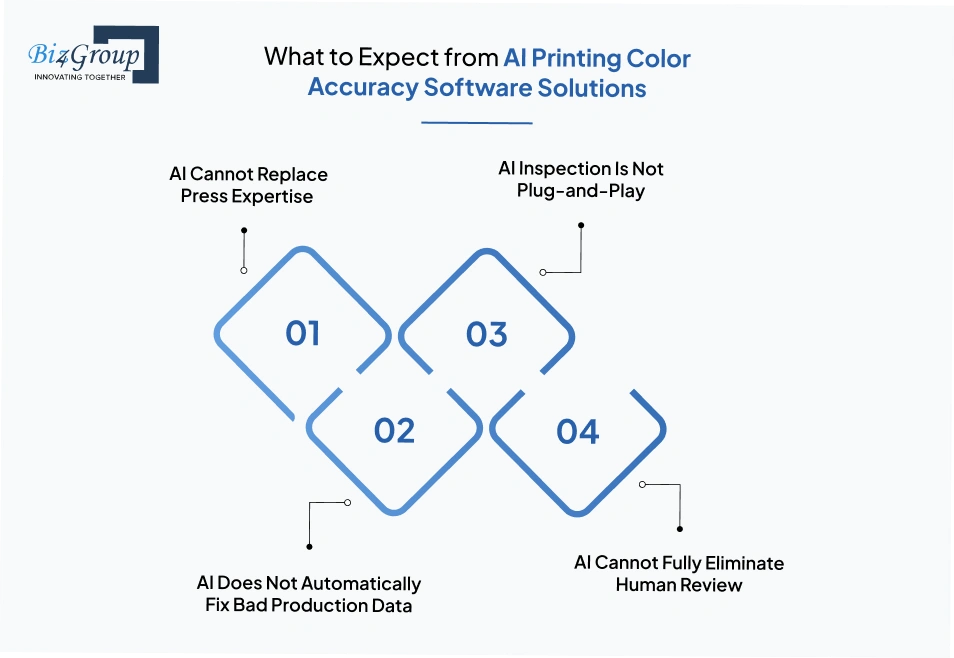
One of the fastest ways to lose trust in a technology investment is overselling what it can achieve. That happens often with automation software in printing. Some vendors present AI as a fully autonomous replacement for operators and press expertise.
Real production environments do not work that way.
The truth is simpler. The best AI-powered print inspection and monitoring system development projects improve visibility, speed, and consistency. They help teams detect problems earlier and respond faster.
They still require calibration, oversight, and workflow alignment. That distinction matters for print businesses evaluating long-term investments.
A common question buyers ask is “We want to implement AI-based color management and quality inspection software to reduce reprints and improve accuracy in our printing operations. Will the system handle everything automatically?”
The short answer is no.
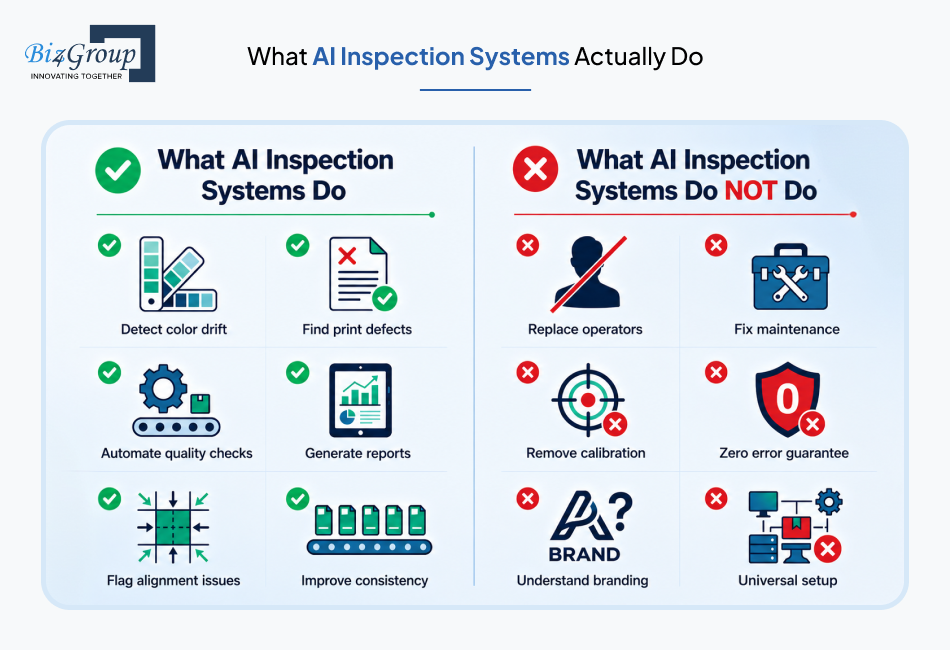
|
What The System Does |
What The System Does Not Do |
|---|---|
|
Detects color drift in real time |
Replace experienced press operators |
|
Identifies print defects faster |
Fix poor press maintenance |
|
Automates quality monitoring |
Eliminate calibration requirements |
|
Generates audit logs and reports |
Guarantee zero print errors |
|
Flags registration and streak issues |
Understand creative brand intent |
|
Improves production consistency |
Work identically across every press without customization |
Understanding this balance helps businesses make smarter implementation decisions instead of chasing unrealistic expectations.
AI systems recognize patterns. Operators understand production behavior.
For example, a machine vision model may detect recurring density fluctuations. An experienced press operator often knows whether the issue comes from substrate inconsistency, ink viscosity, roller wear, or environmental conditions.
That is why successful print shop quality control automation software development projects focus on collaboration between AI monitoring and production teams instead of replacing people entirely.
AI models depend heavily on clean training data and accurate calibration.
If a print shop has inconsistent ICC profiles, poorly maintained spectrophotometers, or unstable workflows, the software will inherit those problems.
Think of AI inspection as a high-performance navigation system. It can detect where things are going wrong quickly, but it still needs reliable inputs.
Every print environment behaves differently.
A packaging printer running flexographic presses faces different quality variables than a wide-format digital print shop. Substrates, inks, lighting conditions, RIP configurations, and production speeds all affect implementation.
That is why many companies searching for AI solutions for reducing waste in printing industry through automated inspection eventually realize customization matters more than generic software licenses.
There are still situations where human judgment matters.
Brand-sensitive jobs often involve subjective approval decisions beyond measurable Delta-E tolerances. Luxury packaging, textile transfers, and premium labels may require visual reviews alongside automated inspection.
This hybrid approach is common across many real-world AI use cases in the printing industry where AI handles repetitive inspection tasks while teams focus on production decisions and client approvals.
Another frequent concern from buyers sounds like this... “I want to reduce reprints and errors in my printing process using AI automation tools, but I do not want production becoming overly dependent on software.”
That concern is valid. The strongest implementations use AI to strengthen workflows, not overcomplicate them.
Now, once the expectations are clear, the next step is understanding how these systems actually operate inside a live print production environment.
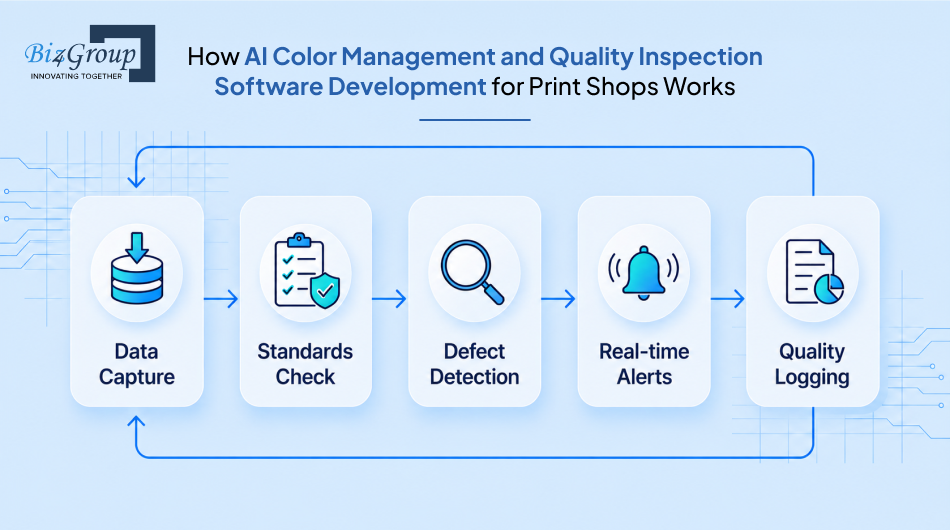
Most print shops already collect production data. The problem is that the data often sits in disconnected systems.
Presses generate output data. Spectrophotometers capture color measurements. Operators log defects manually. RIP systems process print files independently.
None of these systems communicate efficiently in many production environments.
That gap is exactly where modern AI color management and quality inspection software development for print shops changes the workflow. Instead of treating quality control as a separate post-production task, AI systems create a continuous inspection loop across prepress, production, and monitoring.
Businesses say, “I am looking for AI solutions to detect print defects and improve production quality in real time.” The answer starts with understanding the workflow architecture behind these systems.
Every AI inspection system begins with data collection.
Machine vision cameras capture high-speed visual output directly from the press line. Spectrophotometers analyze spectral color values. Sensors monitor density, registration, and substrate behavior.
This process creates a continuous stream of production intelligence instead of periodic manual sampling.
Once the system captures print data, AI models compare live output against predefined references. These references may include:
For example, if a packaging client requires Delta-E 2000 values below 2.0, the software continuously checks live output against that requirement during production.
This is where AI printing color accuracy software solutions become significantly more effective than manual inspection workflows.
Modern inspection systems do far more than compare colors. Computer vision models trained on production samples can identify:
The system analyzes these defects frame by frame at production speed. Operators receive alerts immediately when abnormalities exceed tolerance levels.
This capability has become a major focus area within advanced enterprise AI solutions designed for manufacturing and industrial automation.
Once an issue is detected, the software generates alerts instantly. Depending on system configuration, alerts may appear through:
Some advanced systems also recommend corrective actions based on historical production data. For instance, the software may identify recurring cyan density drift during long-run jobs and suggest recalibration intervals before defects escalate.
Businesses exploring AI automation in print production increasingly prioritize these predictive capabilities because they reduce operator guesswork during high-speed runs.
Every inspection event gets recorded automatically. That includes:
These records create a searchable audit trail for quality assurance and client reporting.
For print businesses handling regulated packaging or brand-sensitive work, this data becomes valuable beyond production itself. It supports compliance reporting, dispute resolution, and long-term process optimization.
|
Component |
Function In the Workflow |
|---|---|
|
Machine Vision Cameras |
Capture live print images |
|
Spectrophotometers |
Measure color accuracy |
|
AI Models |
Detect anomalies and patterns |
|
Integration Layer |
Connect RIPs, presses, and workflows |
|
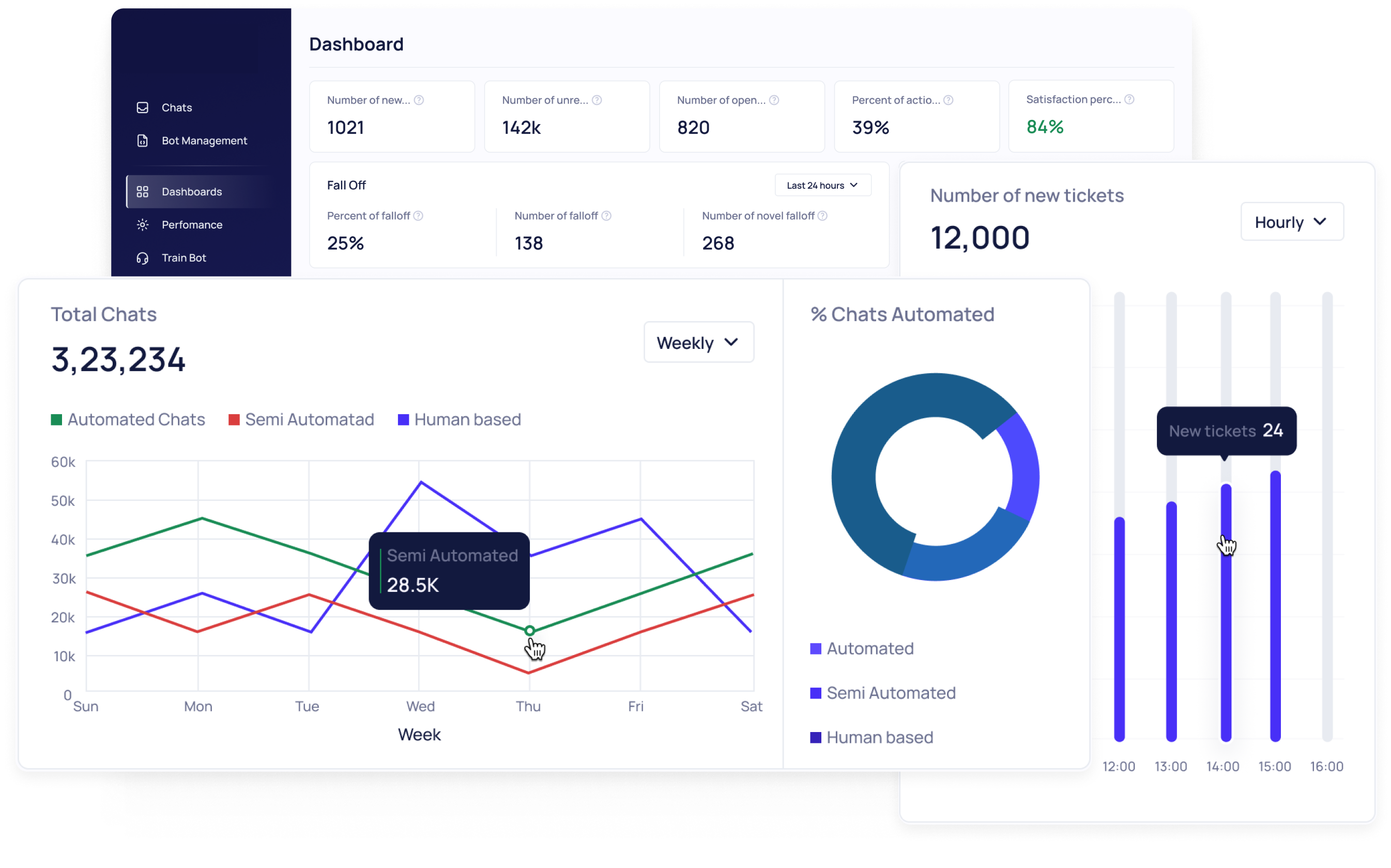
Monitoring Dashboard |
Displays alerts and inspection data |
|
Reporting Engine |
Stores quality logs and analytics |
Many businesses planning to scale inspection workflows also combine these systems with tools like AI print production scheduling & floor optimization software to improve throughput alongside quality consistency.
Another common buyer question is “We are looking to upgrade our printing workflow with AI-driven color calibration and defect detection systems. How difficult is implementation?”
The answer depends on production complexity, existing hardware, and workflow maturity. Before discussing implementation, it is important to understand the measurable operational advantages these systems deliver on the production floor.
Most print shops begin exploring AI after a costly production issue. A rejected packaging batch. Repeated color drift. High material waste. Missed delivery timelines.
What changes their perspective is seeing how much operational friction exists inside everyday workflows.
That is where AI color management and quality inspection software development for print shops creates measurable impact.
Traditional quality checks rely on periodic sampling. AI inspection systems monitor continuously. That difference allows teams to identify problems before defects spread across thousands of sheets.
For print businesses running long production jobs, catching a registration issue within minutes instead of hours can protect both margins and client relationships. This is one reason companies searching for build AI print quality inspection software for reducing waste and errors are prioritizing real-time monitoring over manual inspection methods.
Maintaining accurate brand colors across different materials has become increasingly difficult in modern print environments. Coated stock, flexible packaging films, textured substrates, and fabric transfers all behave differently during production.
Modern AI printing color accuracy software solutions help teams maintain tighter color tolerances by continuously analyzing output behavior instead of relying solely on static calibration settings.
A common production concern comes, “We are a packaging print company and want to improve print accuracy using AI quality control solutions.” AI systems help address this challenge by creating repeatable color control processes across varying production conditions.
Experienced press operators remain essential, but manual inspection slows down under high production loads.
AI systems reduce the pressure on teams by automating repetitive monitoring tasks. Operators can focus more on production decisions and less on physically checking sheets throughout the day.
Commercial print buyers have become more demanding about consistency. Brand managers expect repeatable color accuracy across locations, reorders, and seasonal production cycles. A single rejected job can damage long-term contracts.
Automated inspection systems create stronger quality assurance processes that help print providers build trust with enterprise clients. That matters particularly for businesses competing in packaging, labels, and high-volume retail printing.
Many print operations still rely on fragmented communication between prepress, production, and quality control.
AI inspection platforms centralize inspection data, alerts, and production history into one environment. Teams can identify recurring problems faster and improve decision-making over time.
Waste affects more than material usage. It impacts scheduling, labor allocation, delivery timelines, and profitability forecasting. When defect rates become more predictable, estimating accuracy improves as well.
That is why many print businesses implementing inspection systems also begin evaluating technologies like AI print estimating software to improve quoting accuracy and production planning.
Understanding the benefits explains why adoption is accelerating. The next step is examining the actual features and capabilities modern AI inspection platforms bring into print production workflows.
AI inspection systems can detect defects in under 5 seconds during live production runs.
Call Biz4Group TodayModern print inspection systems are no longer limited to basic defect monitoring. Today’s platforms combine machine vision, workflow automation, analytics, and production intelligence into one connected environment.
That evolution is driving demand for advanced AI print quality inspection software development across packaging, commercial printing, textile transfers, and label production.
Here are the features businesses prioritize most while evaluating intelligent inspection systems.
|
Feature |
What It Does |
Business Impact |
|---|---|---|
|
Real-Time Delta-E Monitoring |
Tracks live color deviations during production |
Improves print consistency |
|
Machine Vision Defect Detection |
Detects streaks, hickeys, and registration issues |
Reduces rejected batches |
|
Automated Quality Alerts |
Sends instant notifications for production issues |
Speeds up operator response |
|
Spectrophotometer Integration |
Connects with color measurement devices |
Improves calibration accuracy |
|
Audit Trail Reporting |
Logs inspection events and corrections |
Supports compliance reporting |
|
Multi-Press Workflow Support |
Centralizes inspection across production lines |
Improves operational visibility |
|
AI-Based Pattern Recognition |
Identifies recurring production defects |
Helps prevent repeat issues |
|
Role-Based Access Controls |
Manages permissions for teams and operators |
Strengthens workflow governance |
|
Dashboard And Analytics |
Displays production quality metrics in real time |
Supports data-driven decisions |
|
Workflow Automation Integration |
Connects inspection with business systems |
Improves production efficiency |
Businesses often say, “I want to implement AI color management system for my printing business but unsure how it works and what features I actually need.”
The answer depends heavily on production scale, workflow complexity, and quality requirements. That is why many print businesses now prioritize modular systems instead of rigid software packages.
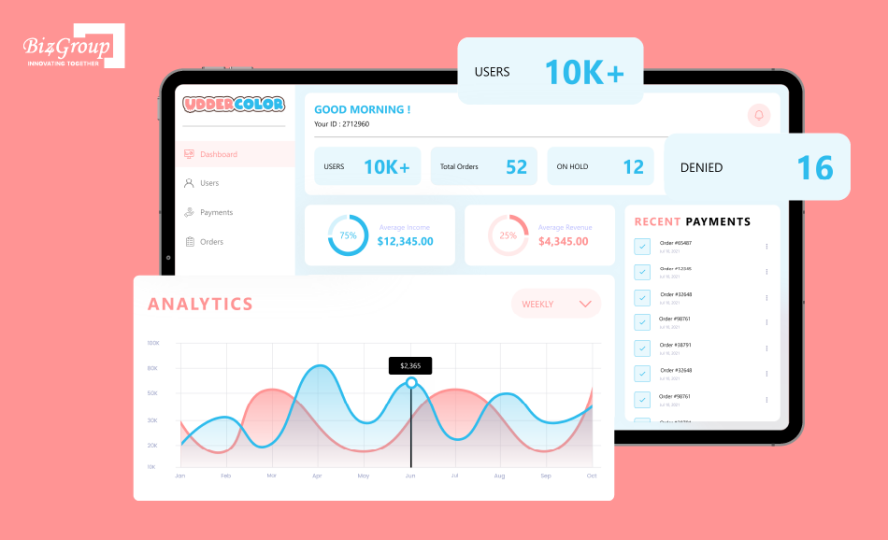
At Biz4Group, we worked with one of the leading printing houses in the United States to modernize and scale their digital printing operations through a custom artwork printing platform.
The client needed a centralized production ecosystem capable of handling thousands of artwork submissions, approvals, revisions, and print orders simultaneously without slowing down operations.
The existing system lacked scalability and operational efficiency. The client wanted a platform that could support:
Our team designed and developed a scalable digital platform focused on workflow efficiency, quality validation, and production coordination.
The platform included:
This project highlighted how custom AI product development can simplify complex print production workflows while improving customer experience and operational control.
Many production bottlenecks begin before printing even starts. Poor artwork validation, inconsistent approval workflows, and disconnected production systems often contribute to downstream quality issues.
That is why businesses planning to build intelligent inspection environments increasingly look for partners who can combine workflow automation, quality control, and scalable platform development under one ecosystem.
The next decision... Should businesses build custom AI inspection systems designed around their workflows, or rely on off-the-shelf software platforms already available in the market?
One of the biggest decisions print businesses face is whether to purchase a prebuilt inspection platform or invest in a customized solution tailored to their workflows.
Both approaches solve different problems.
Businesses ask, “We are comparing companies that offer AI color management and print quality inspection software. Which vendors are best for integrating with our existing RIP workflow, spectrophotometers, and packaging print environment?”
The answer usually depends on operational compatibility.
|
Comparison Area |
Custom AI Inspection System |
Off-The-Shelf Software |
|---|---|---|
|
Workflow Flexibility |
Built around your production process |
Limited to predefined workflows |
|
Hardware Compatibility |
Supports custom integrations |
Often restricted to supported devices |
|
RIP Integration |
Can connect with existing systems |
May require workflow changes |
|
AI Training Models |
Tailored to your print defects and jobs |
Generic defect detection models |
|
Scalability |
Expands with production growth |
Upgrade limitations may apply |
|
Reporting Structure |
Custom dashboards and audit trails |
Fixed reporting templates |
|
Multi-Location Operations |
Easier enterprise customization |
Depends on licensing structure |
|
Initial Cost |
Higher upfront investment |
Lower entry cost |
|
Long-Term Adaptability |
Stronger for evolving workflows |
Limited flexibility over time |
|
Deployment Speed |
Longer implementation timeline |
Faster initial setup |
|
Competitive Differentiation |
Unique operational advantage |
Similar tools used by competitors |
There is no universal answer here. The right choice depends on production goals, integration requirements, growth plans, and how central print quality is to business profitability.
Once businesses decide on the right approach, the next challenge becomes implementation. That includes deployment planning, workflow integration, calibration setup, and minimizing disruption during production rollout.
Also read: AI printing MIS automation software development guide
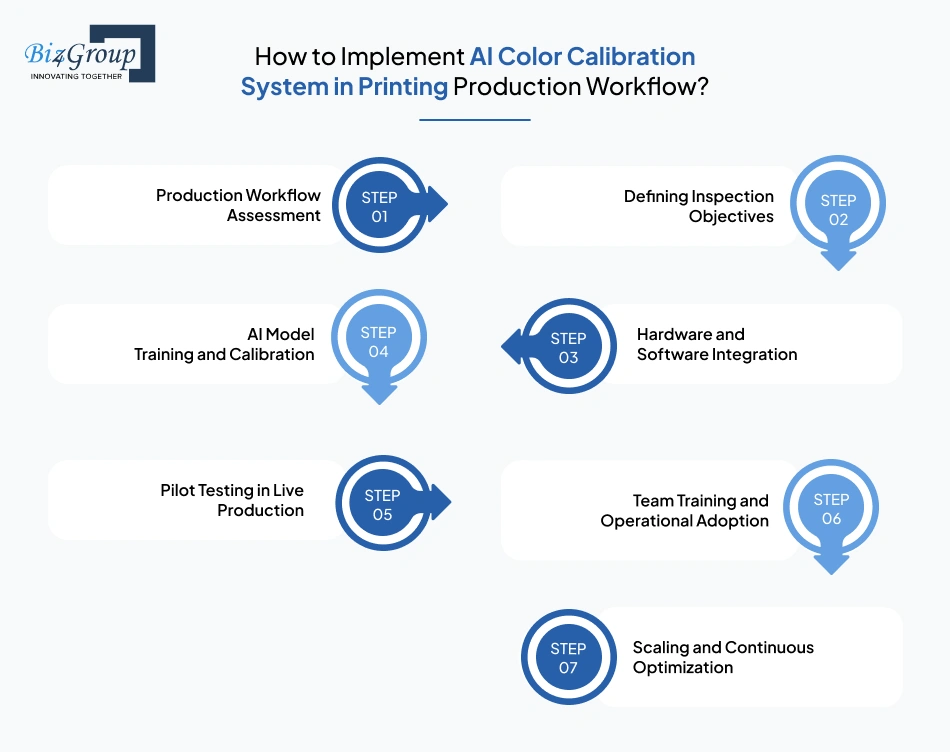
Implementing AI inspection software in a print environment is not a one-day deployment. The process involves production analysis, workflow mapping, hardware integration, calibration planning, and operator adoption.
The good news is that most implementation failures are preventable when the rollout follows a structured process.
A common question production managers ask is “We want to implement AI-based color management and quality inspection software to reduce reprints and improve accuracy in our printing operations. How long does implementation usually take?”
The answer depends on production complexity, existing infrastructure, and customization requirements.
The first stage focuses on understanding the current print environment. This includes:
At this stage, businesses often discover inefficiencies outside inspection itself. In many cases, disconnected workflows and inconsistent approvals create quality issues long before printing begins.
That is why workflow planning and strong UI/UX design play an important role in adoption. Operators and production teams need interfaces that simplify decision-making under production pressure instead of adding operational friction.
Also read: Top 15 UI/UX design companies in USA
Not every print shop needs the same inspection logic.
A packaging printer may prioritize Delta-E compliance and barcode verification. A textile transfer company may focus more on artwork consistency and image distortion detection.
This phase defines:
Businesses pursuing to build AI color management and quality inspection software for printing business operations often make the mistake of overengineering the first deployment phase. A focused rollout usually performs better.
Once objectives are defined, the implementation team connects the inspection platform with production systems.
This may involve:
This is why customization matters. Every production floor has different hardware conditions and operational dependencies.
The AI system now needs production-specific learning. Historical print samples, approved outputs, defect examples, and calibration references are used to train the inspection models.
For example, the system may learn how recurring streak patterns appear on a specific flexographic press under certain substrate conditions.
This phase also includes tolerance calibration to reduce false positives during live production.
A growing number of businesses start with an MVP development approach here instead of deploying enterprise-wide systems immediately. Controlled pilot deployments help validate workflows before scaling further.
Also read: Top 12+ MVP development companies in USA
Before full rollout, the software is tested during real production runs. Teams monitor:
Businesses comparing deployment partners frequently ask, “I want to find a reliable company to implement AI print inspection and quality control system for my print shop. What should I evaluate before deployment?”
The answer usually comes down to workflow understanding, integration expertise, and post-launch support rather than software demos alone.
Technology adoption fails quickly when teams are not comfortable using the system. Operators, QC teams, and managers need training focused on:
This stage often determines whether the system becomes part of daily production or remains underutilized after launch.
Once the platform stabilizes, businesses usually expand into broader automation initiatives. That may include:
The most successful deployments treat implementation as an evolving production strategy rather than a one-time software installation.
Businesses ask, “I am planning to upgrade my print shop with AI quality inspection and color calibration software. How do I scale the system after deployment?”
The answer depends heavily on reporting structure, integration architecture, and how well the platform supports compliance tracking and long-term operational visibility. Those areas become especially important when working with enterprise clients and regulated print standards.
Also read: How to build AI print broker software?
Most print shops wait months to upgrade workflows while waste keeps stacking daily.
Book a Strategy Call NowFor packaging printers, label manufacturers, and enterprise print vendors, quality control is not limited to visual accuracy. Clients increasingly expect documented proof of consistency, traceability, and compliance.
That is why modern AI color management and quality inspection software development for print shops platforms now include automated audit and reporting capabilities as a standard requirement.
A common buyer query sounds like this... “We are a packaging print company and want to improve print accuracy using AI quality control solutions while maintaining brand compliance across production runs.”
Here is how AI inspection systems support compliance workflows:
For businesses handling regulated packaging, retail branding, or enterprise contracts, these audit capabilities often become as important as the inspection process itself.
Once compliance requirements are clear, the next question becomes practical. What does it actually cost to build and implement these AI inspection systems in a real print production environment?
The cost of building an AI inspection platform varies widely based on workflow complexity, hardware integration, production scale, and automation goals.
For most print businesses, the average investment for AI color management and quality inspection software development for print shops falls between $30,000-$350,000+.
Business owners often ask, “How much does it cost to develop a custom AI color inspection system for a mid-size printing company with RIP integration, spectrophotometer support, and real-time defect detection?”
The answer depends on the deployment stage.
|
Development Stage |
Typical Scope |
Estimated Cost |
|---|---|---|
|
MVP System |
Basic defect detection, dashboard, limited integrations |
$30,000-$70,000 |
|
Advanced System |
Real-time monitoring, AI models, reporting, workflow automation |
$70,000-$180,000 |
|
Enterprise Platform |
Multi-location support, predictive analytics, compliance systems, custom integrations |
$180,000-$350,000+ |
Businesses pursuing development of AI color management and quality inspection software for printing business operations often begin with focused deployments before expanding into larger production ecosystems.
Several technical and operational factors directly affect pricing. In most projects, these core development components account for nearly 70-85% of the total implementation budget depending on customization depth and production complexity.
|
Cost Driver |
Why It Impacts Cost |
Estimated Cost Impact |
|---|---|---|
|
Machine Vision Integration |
Camera setup and production image processing complexity |
$8,000-$40,000 |
|
AI Model Development |
Training models for defect detection and color analysis |
$15,000-$80,000 |
|
Spectrophotometer Integration |
Connecting color measurement hardware and calibration systems |
$5,000-$25,000 |
|
RIP and Workflow Integration |
Connecting existing print workflows and production systems |
$10,000-$50,000 |
|
Dashboard and Reporting Systems |
Building real-time monitoring interfaces and audit reporting |
$8,000-$35,000 |
|
Multi-Press Support |
Expanding compatibility across multiple production lines |
$12,000-$60,000 |
|
Compliance and Audit Features |
ISO reporting, Delta-E logging, traceability systems |
$5,000-$30,000 |
|
Cloud Infrastructure and Storage |
Supporting live monitoring and historical production data |
$3,000-$20,000 annually |
Businesses implementing advanced AI print quality inspection software development systems often discover that integration complexity influences pricing more than AI itself.
Beyond core development, hidden operational and deployment expenses can contribute another 15-30% of the total project budget if they are not planned early.
Long-term optimization also matters. Businesses scaling AI color management system development for printing industry workflows usually invest continuously in model retraining and workflow improvements after launch.
Well-planned optimization strategies can reduce overall implementation expenses by nearly 20-40% without compromising inspection quality or production visibility.
Here are the most effective cost optimization strategies:
Many businesses creating an AI color management and quality inspection software for printing industry environments achieve better long-term outcomes when they scale incrementally instead of overbuilding during phase one.
The real question, however, is not what the system costs.
It is whether the investment reduces waste, reprints, labor inefficiencies, and client losses enough to create measurable financial return. That is where ROI becomes the deciding factor for most print businesses evaluating AI inspection systems.
Also read: How much does it cost to integrate AI in printing business?
Many print businesses recover costs faster through lower waste, fewer reprints, and stronger retention.
Let's Talk NumbersMany companies initially evaluate AI color management and quality inspection software development for print shops as a technology investment. In reality, it behaves more like a margin recovery system.
Some production managers ask “We are struggling with high material waste in our print production. How can AI quality inspection systems help optimize output and improve profitability?”
The answer depends on how much hidden production loss already exists inside the workflow.
|
ROI Source |
Operational Impact |
Typical Financial Effect |
|---|---|---|
|
Reduced Reprints |
Fewer rejected jobs and reruns |
20-45% reduction in reprint expenses |
|
Lower Material Waste |
Less paper, ink, and substrate loss |
15-35% lower material waste |
|
Faster Issue Resolution |
Shorter downtime during defects |
Improved production continuity |
|
Reduced Manual Inspection Hours |
Less repetitive QC effort |
Lower operational overhead |
|
Better Client Retention |
Fewer quality complaints |
Higher repeat business value |
|
Stronger Production Forecasting |
More predictable scheduling |
Better resource utilization |
Here is a simplified example for a mid-sized packaging print company.
|
Production Metric |
Before AI Inspection |
After AI Inspection |
|---|---|---|
|
Monthly Reprint Cost |
$18,000 |
$8,500 |
|
Material Waste Rate |
11% |
6% |
|
Average Defect Detection Time |
45 minutes |
6 minutes |
|
Annual Quality Losses |
$216,000 |
$102,000 |
In this scenario, the business recovers over $100,000 annually through waste reduction and operational efficiency improvements.
That is why many companies investing in build AI print quality inspection software for reducing waste and errors focus first on their highest-loss production areas instead of attempting full automation immediately.
The first 6-12 months usually focus on stabilizing workflows and reducing recurring production issues. After that, long-term ROI tends to increase because the system accumulates production intelligence continuously.
That includes:
Businesses implementing AI printing color accuracy software solutions across multiple production lines often see stronger financial returns during year two compared to initial deployment periods.
Many print businesses focus heavily on software cost during evaluation.
The more important metric is production leakage.
If recurring color inconsistencies, rejected batches, delayed deliveries, and quality disputes are already reducing margins, AI inspection systems often recover their investment faster than expected.
The next challenge, however, is understanding where implementation becomes difficult and what operational limitations print businesses should prepare for before deployment.
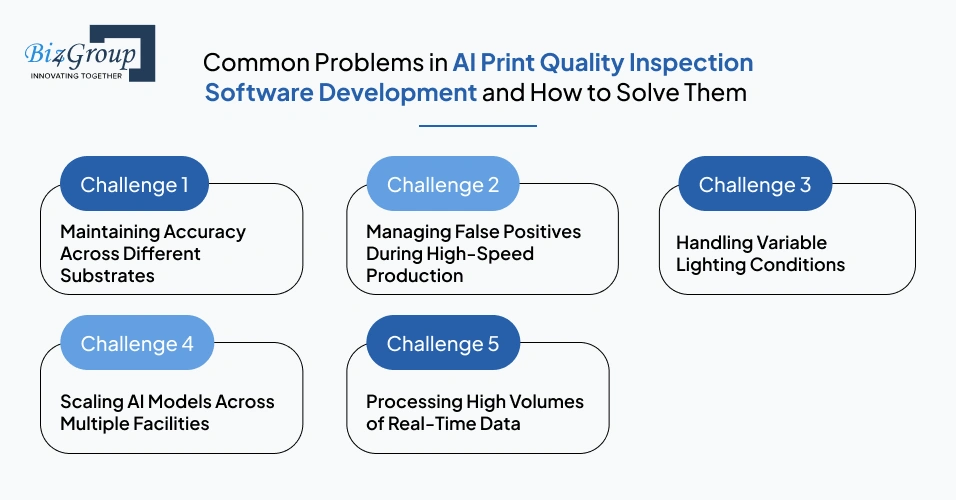
Most businesses ask, “We are evaluating AI solutions for printing quality management. What operational challenges should we expect during implementation and scaling?”
The answer depends on production maturity, workflow complexity, and infrastructure readiness.
Different substrates react differently to ink absorption, lighting, and print density. A model trained on coated paper may behave differently on flexible packaging films or textured materials.
Overly sensitive inspection systems can generate excessive alerts during long production runs. That creates operator fatigue and slows response time.
Lighting inconsistency affects machine vision performance significantly. Ambient production lighting, reflections, and press-side shadows can distort image analysis and impact inspection accuracy.
A system performing well in one plant may require recalibration in another facility due to environmental and production differences. This challenge becomes more noticeable in large-scale AI color management system development for printing industry deployments.
AI inspection systems generate massive amounts of image and production data continuously. Without proper infrastructure, processing delays can reduce real-time responsiveness.
Most of these challenges become manageable once businesses understand that intelligent inspection systems evolve continuously alongside production environments.
The next step is understanding how to evaluate the right development partner and what technical questions print businesses should ask before committing to an AI inspection project.
Minor defects today become major client escalations tomorrow. The faster you react, the less you lose.
Talk to Biz4Group’s ExpertsChoosing the wrong development partner can create long-term workflow problems, integration delays, and unreliable inspection performance.
That is why print businesses evaluating AI color management and quality inspection software development for print shops should focus on technical capability, production understanding, and scalability instead of generic AI claims.
If you’re thinking, “I need a company that can integrate AI-based color calibration and defect detection into my printing workflow without disrupting production”, here are the most important questions worth asking before signing any agreement:
Many print businesses eventually choose to hire AI developers with direct experience in workflow automation, machine vision, and industrial software integration instead of relying on generic software vendors unfamiliar with print production environments.
Also read: Top 12 AI printing software development companies in USA
At this stage, one question naturally follows, “We are evaluating AI solutions for printing quality management. Which company should we consider for custom AI color inspection software that can integrate with our existing production workflow and scale long term?”
Here’s who...
Print businesses today are under pressure from every direction. Faster turnaround expectations. Tighter brand compliance. Rising substrate costs. Increasing client scrutiny around color consistency and production quality.
Most software vendors understand AI. Very few understand printing operations.
Biz4Group LLC has built a strong reputation as a trusted AI development company for businesses looking to solve complex operational challenges through scalable, production-grade technology. Our approach combines AI engineering, workflow automation, machine vision, enterprise software architecture, and deep operational understanding to create systems that perform reliably under real manufacturing conditions.
Our experience with advanced AI printing software solutions allows us to connect quality inspection directly with the broader operational ecosystem instead of treating inspection as an isolated feature.
That difference changes how businesses scale.
Businesses want to know “Which company in the USA can build custom AI color management and print quality inspection software that integrates with our production workflow and supports long-term operational scaling?”
The answer depends on technical depth, integration capability, and the ability to translate operational complexity into practical software systems.
That is where Biz4Group stands apart.
Our development philosophy focuses heavily on long-term usability because production software succeeds only when operators, managers, and quality teams can use it efficiently under pressure.
We also understand that AI inspection systems cannot operate in isolation. They must work alongside RIP workflows, production scheduling, reporting systems, compliance frameworks, and business operations without disrupting throughput.
That operational mindset is built into every system we develop.
Our teams specialize in AI engineering, machine vision systems, automation platforms, enterprise architecture, and intelligent workflow orchestration for operational environments.
We develop platforms tailored to actual print workflows instead of forcing businesses into generic software limitations.
Our systems are designed to work with existing production ecosystems including approval workflows, reporting systems, and operational management tools.
From MVP deployments to enterprise-scale platforms, we build solutions that support long-term operational growth.
Every solution is engineered around production efficiency, waste reduction, process visibility, and operational scalability.
At Biz4Group, the combination of technical expertise and operational thinking is exactly what allows us to build systems that continue delivering value long after deployment.
If your print business is planning to reduce production waste, improve inspection accuracy, modernize workflows, or scale intelligent quality control systems, now is the right time to connect with Biz4Group and explore how custom AI inspection software can transform your print production operations.
Print quality problems rarely begin with one major failure. They build gradually through unnoticed color drift, delayed defect detection, inconsistent approvals, and disconnected workflows. Over time, those small inefficiencies turn into reprints, wasted materials, missed deadlines, and frustrated clients.
That is why more businesses are investing in AI color management and quality inspection software development for print shops. Modern AI inspection systems help production teams detect issues earlier, maintain tighter color accuracy, improve operational visibility, and reduce production waste at scale. For print businesses handling packaging, labels, textile transfers, or commercial printing, intelligent inspection is quickly becoming a competitive necessity rather than an optional upgrade.
The challenge, however, is building a system that fits your actual production environment. Generic platforms often struggle with custom workflows, hardware compatibility, and scalability requirements. Businesses need technology partners capable of combining AI expertise with real operational understanding.
As a USA-based software development company, Biz4Group helps print businesses design and develop scalable AI inspection platforms tailored to their workflows, production goals, and long-term growth plans. From workflow automation to machine vision systems and intelligent quality monitoring, our team builds solutions designed around real production realities.
Want to reduce print waste, improve color consistency, and modernize your production workflow with AI? Talk to Biz4Group and discover how custom AI inspection systems can transform your print operations.
Yes, in many cases they can. Modern AI inspection platforms are often designed with flexible integration layers that allow compatibility with older presses, RIP systems, and production environments. However, the level of integration depends on hardware condition, sensor compatibility, and workflow architecture.
Yes. AI inspection systems can be adapted for offset, flexographic, gravure, digital inkjet, and hybrid print environments. The inspection logic, calibration settings, and defect models are typically customized based on the production method and substrate behavior.
Well-trained systems can achieve very high detection accuracy for recurring print defects such as streaks, banding, registration shifts, missing print elements, and density inconsistencies. Accuracy improves over time as the AI model learns from production-specific data and operational patterns.
Most platforms take several months depending on complexity, integrations, and production requirements. Biz4Group, however, can deliver a functional MVP in as little as 2-4 weeks because our team uses reusable AI and workflow components that significantly reduce both development time and implementation cost.
Yes. One major advantage of AI inspection systems is traceability. Automated logs, inspection history, timestamped defect records, and production reports provide documented evidence of print quality throughout the production cycle. This helps businesses resolve disputes faster and improve accountability.
Not always. Many production environments use edge-based processing where inspection and defect analysis happen locally near the press equipment. Cloud infrastructure may still be used for reporting, analytics, or multi-location monitoring, but real-time inspection itself can often run independently.

with Biz4Group today!
Our website require some cookies to function properly. Read our privacy policy to know more.