 Location :
Orlando, FL, USA
Location :
Orlando, FL, USA +1 (407) 714-1616
 info@biz4group.com

- Build an AI insurance claim take-back detection system to identify silent denials, hidden reversals, and post-payment revenue leakage early.
- Providers aiming to create AI insurance claim fraud and take-back detection system environments use AI monitoring, automation, and anomaly intelligence together.
- Businesses looking to create intelligent insurance claim monitoring system for healthcare operations should evaluate vendors based on scalability and healthcare expertise.
- The average cost to develop AI-driven claim audit and take-back detection platform environments ranges between $40,000-$350,000+ depending on complexity.
- Healthcare enterprises evaluating companies that develop AI insurance claim take-back detection systems in USA increasingly choose Biz4Group for scalable healthcare AI expertise.
Have you ever looked at your reimbursement reports and felt something was off, even though no formal denial appeared on the remittance file? Healthcare providers across the US are losing millions through silent denials, post payment reversals, and payer take-backs that slip through traditional workflows unnoticed.
According to HFMA’s 2026 denials management report, denial rates averaged close to 12% in 2025, with every percentage point representing millions in delayed or lost revenue for hospitals. That growing pressure is why more providers want to build an AI insurance claim take-back detection system capable of spotting hidden reimbursement anomalies before the appeal window closes.
Many post payment adjustments never arrive with a clear denial code. Instead, they appear as contractual changes, offset credits, or silent reductions buried inside ERA transactions. Recent CMS updates also show expanding RAC activity across multiple audit regions in 2025. As a result, healthcare leaders want to develop insurance claim anomaly detection system for revenue protection strategies.
Many executives tell us the same thing. “We are a healthcare organization facing revenue leakage from silent claim take-backs and want to build an AI system to detect and prevent them.” That concern is valid.
Silent revenue erosion builds quietly across thousands of transactions until finance teams discover the damage too late. Healthcare organizations are now actively exploring how to develop AI insurance claim take-back detection system to prevent silent revenue leakage in healthcare environments where every delayed appeal can turn into permanent financial loss.
Understanding the Basics of AI Insurance Claim Take-Back Detection System Development
An AI insurance claim take-back detection system monitors reimbursement activity after claims are paid. Its job is simple on paper and incredibly valuable in practice. It identifies suspicious payer behavior before silent revenue leakage turns into permanent financial loss.
Unlike conventional denial management systems that focus on rejected claims before payment, these platforms analyze post payment transactions, reimbursement patterns, payer adjustments, and remittance behavior across thousands of claims in real time.
That difference matters more than most organizations realize.
Many healthcare finance leaders say, “We are managing insurance billing operations and want to develop an AI-powered claim take-back detection system for real-time monitoring.” That demand is growing because silent denials rarely announce themselves clearly. They hide inside ERA files, bundled adjustments, future offsets, and reimbursement inconsistencies that manual review teams often miss.
What Exactly Does This System Detect?
A modern AI take-back detection platform looks for reimbursement behavior that deviates from expected payer patterns. That includes:
|
Detection Area |
What the System Flags |
|---|---|
|
Silent denials |
Payments reduced without formal denial codes |
|
Post payment take-backs |
Previously paid claims partially or fully reversed |
|
Underpayments |
Reimbursements lower than contracted rates |
|
Offset recoveries |
Future claims adjusted to recover past payments |
|
Payer anomalies |
Unusual payer behavior across DRGs or CPTs |
|
Audit risk patterns |
Claim categories attracting RAC or MAC scrutiny |
|
Appeal urgency |
Claims nearing appeal deadlines |
This approach allows providers to move from reactive recovery to proactive detection, thus, directly impacting net patient revenue.
Why Traditional Denial Management Software Falls Short?
Most denial management platforms were designed for front-end rejection workflows. They work well for:
- Missing modifiers
- Coding edits
- Eligibility issues
- Prior authorization failures
- Claim submission errors
But silent take-backs are a different beast entirely.
Traditional systems typically depend on CARC codes, RARC codes, manual remittance review, and sample-based audits.
The problem?
Not every take-back arrives with a clean adjustment reason code. Some appear weeks later through:
- Reimbursement offsets
- Bundled contract adjustments
- Payer recalculations
- Retrospective audit actions
That creates blind spots.
Here’s a simple comparison.
|
Traditional Denial Management |
AI Take-Back Detection System |
|---|---|
|
Focuses on pre-payment denials |
Focuses on post-payment revenue erosion |
|
Tracks rejected claims |
Tracks hidden reimbursement changes |
|
Relies heavily on codes |
Uses behavioral anomaly detection |
|
Works reactively |
Detects issues in real time |
|
Manual review dependent |
Continuously monitors transactions |
|
Limited payer intelligence |
Learns payer behavior patterns |
This is why many providers evaluating AI claims denial navigator software capabilities are now expanding into intelligent post-payment monitoring.
Where This System Fits in Healthcare Revenue Integrity
Revenue integrity teams are under pressure from every direction.
Margins are tighter. Audit activity is rising. Appeals teams are overwhelmed.
At the same time, payer reimbursement logic keeps changing.
An AI take-back detection platform acts as a financial surveillance layer across the reimbursement lifecycle.
Its role includes:
- Monitoring remittance transactions continuously
- Identifying abnormal payment activity
- Quantifying revenue exposure
- Prioritizing high-risk claims
- Supporting faster appeals
- Improving payer accountability
Organizations investing in enterprise AI solutions are increasingly treating these systems as core financial infrastructure rather than optional analytics tools.
Because once the appeal window closes, the revenue conversation changes from “Can we recover this?” to “Why didn’t we catch this earlier?”
What Makes AI Valuable Here?
Volume.
A large hospital system may process:
- Millions of remittance transactions annually
- Thousands of payer adjustments weekly
- Hundreds of reimbursement variations daily
Humans cannot realistically detect subtle patterns across that scale consistently.
AI can.
A properly designed platform can:
- Compare reimbursement trends across time periods
- Establish baseline payer behavior
- Identify statistically abnormal adjustments
- Prioritize claims by financial impact
- Surface anomalies before losses compound
That capability becomes even more powerful when integrated with systems like EHRs, payer contract databases, ERA pipelines, clearinghouse workflows, and AI medical claim processing software.
A Quick Reality Check Before Moving Forward
AI detection does not eliminate human oversight. That’s important.
Every flagged anomaly still requires:
- Financial review
- Compliance validation
- Payer verification
- Appeal assessment
False positives can happen, especially during early model calibration periods. The goal is not replacing revenue integrity teams. The goal is helping them see what spreadsheets cannot.
Can Your Team Spot A $2M Revenue Leak Early Enough?
Hospitals lose nearly 3%-5% revenue yearly from unnoticed claim reversals and delayed recovery action.
Build Smart with Biz4GroupWhy Healthcare Organizations Develop AI Insurance Claim Take-Back Detection System Beyond Traditional Denial Management
Traditional denial management systems were built for a different era of healthcare reimbursement. Back then, denials were usually visible.
A payer rejected a claim. The billing team corrected it. The claim moved forward.
Today, the game looks very different.
Payers now recover revenue through:
- Post-payment adjustments
- Retrospective audits
- Reimbursement offsets
- Bundled remittance corrections
- Silent reimbursement reductions
And many of these actions never appear as formal denials.
That shift is exactly why healthcare organizations are looking to develop AI insurance claim take-back detection system capabilities that go beyond front-end denial workflows.
The Real Problem Starts After the Claim Gets Paid
This is where most finance teams feel blindsided. The reimbursement lands in the account. Weeks later, part of it disappears.
No clear alert.
No escalation.
No obvious denial notice.
The adjustment often gets buried inside:
- ERA transaction data
- Contractual recalculations
- Payer offsets
- Coordination of benefits corrections
- Retrospective audit activity
That makes silent take-backs significantly harder to detect than standard denials.
Healthcare executives frequently say, “I need a company that can develop an AI system for detecting insurance claim reversals and anomalies.”
And honestly, that concern makes sense.
Most legacy denial tools were never designed for behavioral reimbursement analysis.
Silent Denials vs Post-Payment Take-Backs vs RAC Clawbacks
These terms are often used interchangeably online. That creates confusion. They are not the same thing.
Here’s the distinction healthcare revenue teams actually care about.
|
Revenue Issue |
What Happens |
Typical Trigger |
Why It Gets Missed |
|---|---|---|---|
|
Silent denial |
Payment reduced without formal denial notification |
Payer recalculation or hidden adjustment |
No obvious denial code |
|
Post-payment take-back |
Previously reimbursed amount reversed later |
Audit findings or payment review |
Delayed timing across remittance cycles |
|
RAC clawback |
CMS contractor recovers payment after audit review |
Medicare audit activity |
Audit notices spread across departments |
|
Underpayment |
Payer reimburses below contracted rate |
Contract interpretation differences |
Requires contract-level comparison |
|
Offset recovery |
Payer deducts money from future claims |
Prior overpayment recovery |
Appears disconnected from original claim |
This growing complexity is one of the biggest reasons providers are investing in AI automation services that can monitor reimbursement behavior continuously.
Why Existing Denial Management Systems Keep Missing These Patterns
Traditional platforms operate on rule-based logic. That approach struggles when payer behavior becomes inconsistent, layered, or statistically subtle.
Here’s where most systems break down.
1. They Depend Too Heavily on Adjustment Codes
Many systems rely on:
- CARC codes
- RARC codes
- Explicit denial labels
But silent denials often bypass those pathways entirely. If the payer adjustment lacks a recognizable pattern, the system treats it as normal remittance activity.
2. Manual Review Cannot Scale
Large health systems process:
- Millions of claim transactions
- Thousands of reimbursement updates
- Hundreds of payer adjustments daily
Human review teams typically sample transactions rather than analyze every reimbursement event. That leaves room for low-dollar, high-frequency leakage.
The dangerous part? Those smaller adjustments compound quietly over time.
3. Traditional Tools Look Backward
Most denial workflows focus on claims already denied, claims already escalated, and appeals already opened.
They rarely identify:
- Emerging payer behavior shifts
- Reimbursement anomalies
- Unusual payment trends
That reactive model delays action until revenue has already eroded.
The Payer Technology Gap Is Growing Fast
Healthcare providers are not the only ones using advanced analytics anymore. Major payers are investing aggressively in:
- Reimbursement modeling
- Predictive audit systems
- Automated overpayment detection
- Fraud analytics
- Retrospective review engines
Providers still relying on spreadsheets face a massive disadvantage.
This widening intelligence gap is pushing organizations to build healthcare claim take-back detection software using AI that can respond with the same level of analytical sophistication.
Companies investing in modern AI insurance software strategies are increasingly prioritizing continuous financial monitoring rather than periodic audit review.
What Usually Triggers the Decision to Build This System?
The trigger rarely comes from one catastrophic denial. It usually starts with patterns like:
- Rising unexplained adjustments
- Growing appeal backlogs
- Inconsistent payer reimbursements
- Audit pressure from CMS or commercial payers
- Finance teams unable to quantify exposure
- Declining confidence in denial reporting accuracy
Then leadership realizes something uncomfortable. The organization may not fully understand how much revenue has already slipped away.
That realization often pushes providers toward:
- Intelligent reimbursement monitoring
- Anomaly detection systems
- Automated audit workflows
- Payer behavior intelligence tools
- Advanced AI-powered document validation system capabilities
Some organizations also begin evaluating partnerships with an agentic AI development company capable of building systems that can autonomously monitor claim activity, detect reimbursement drift, and escalate financial risks proactively.
One Small Leak Across Millions of Transactions Becomes a Massive Problem
Here’s the dangerous math. A health system processing 2 million claims annually with an average unnoticed adjustment of only $18 could lose $36 million over time if those patterns continue unchecked.
That’s why many providers are now actively exploring:
- Continuous reimbursement intelligence
- Predictive revenue integrity systems
- Automated claim monitoring
- Intelligent anomaly detection infrastructure
Because by the time finance notices the loss manually, the appeal window may already be gone.
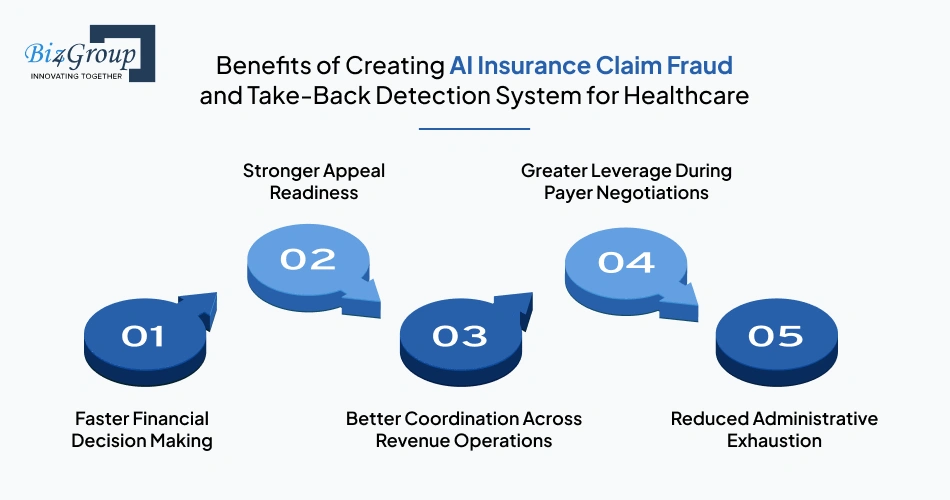
Benefits of Creating AI Insurance Claim Fraud and Take-Back Detection System for Healthcare
Healthcare organizations often realize the value of these systems after seeing how much operational energy goes into chasing reimbursement problems manually.
An AI-powered take-back detection platform changes that equation completely.
Instead of reacting after financial damage spreads across reporting cycles, providers gain earlier visibility into reimbursement disruptions and payer inconsistencies. This creates measurable advantages across finance, compliance, and reimbursement management.
1. Faster Financial Decision Making
Revenue integrity teams spend a significant amount of time reconciling unclear reimbursement activity across different payer systems. An intelligent monitoring environment shortens that cycle and gives finance leaders a clearer understanding of where revenue instability is developing.
Organizations planning to create intelligent insurance claim monitoring system for healthcare operations are increasingly prioritizing proactive financial visibility instead of waiting for retrospective audit reports months later.
This leads to:
- Quicker escalation decisions
- Improved reimbursement forecasting
- Stronger payer accountability
- More reliable revenue reporting
2. Stronger Appeal Readiness
One of the biggest operational problems in healthcare reimbursement is delay. By the time billing teams gather supporting documentation, many claims are already approaching appeal deadlines.
An AI-based monitoring environment helps reimbursement teams organize payment intelligence earlier in the workflow. That gives appeals departments more time to validate claims and respond strategically.
Healthcare executives frequently say, “I want to build a healthcare AI system to detect post-payment claim denials and improve revenue protection.” What they are really looking for is a system that reduces uncertainty and gives their teams time to act before revenue disappears permanently.
3. Better Coordination Across Revenue Operations
Large healthcare organizations often struggle with fragmented reimbursement workflows.
Finance departments monitor revenue reports.
Billing teams manage claim activity.
Compliance teams focus on audit preparedness.
But very few systems connect all three perspectives together.
An intelligent reimbursement monitoring platform creates shared operational visibility across departments. That alignment improves internal communication and allows leadership teams to identify reimbursement risks earlier without depending entirely on manual reporting cycles.
4. Greater Leverage During Payer Negotiations
Payer contract negotiations become difficult when providers cannot quantify reimbursement inconsistencies clearly.
Hospitals may suspect silent revenue leakage exists but struggle to prove:
- Which payer caused it?
- How often it occurs?
- Which service lines are affected?
- How much revenue is actually at risk?
An AI-powered monitoring system creates a stronger analytical foundation for reimbursement discussions and contract renegotiations. That financial visibility can become extremely valuable during payer disputes and renewal conversations.
5. Reduced Administrative Exhaustion
Healthcare reimbursement teams are dealing with growing operational fatigue. Not because they lack expertise. Because too much time is spent manually reviewing payment inconsistencies across massive claim volumes.
A structured monitoring system reduces repetitive investigative work and allows revenue teams to focus on strategic recovery efforts instead of spending entire days searching through reimbursement records manually.
That operational relief improves both efficiency and team stability over time.
Portfolio Spotlight: AI-Driven IVR and Support Platform for Third Party Administrators
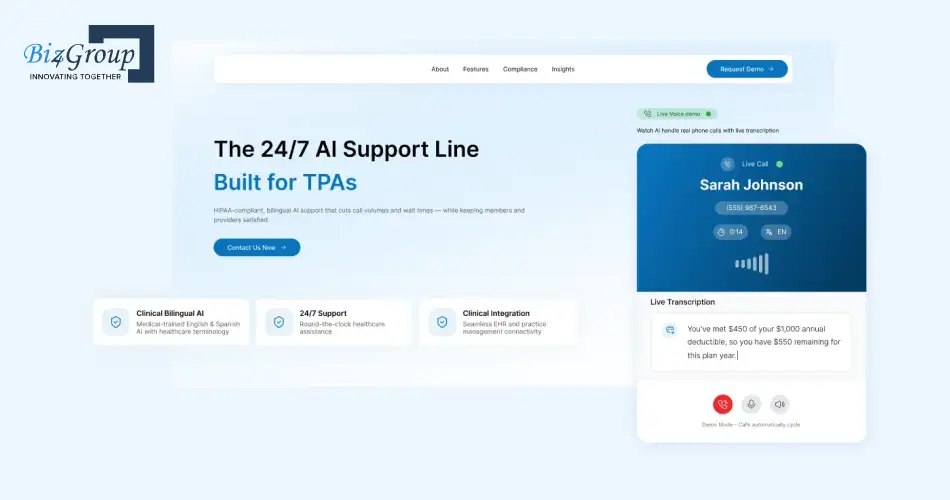
One of the clearest examples of operational transformation comes from Biz4Group’s insurance automation platform for third-party administrators. The organization needed a scalable way to manage rising inquiry volumes related to claim status, eligibility checks, payment guidance, and provider assistance.
The solution was a fully automated, HIPAA-compliant voice support platform built specifically for healthcare insurance workflows.
What the platform delivered:
- Real-time voice-based claims assistance
- AI-powered IVR support for providers and members
- Smart escalation to human agents when required
- English and Spanish language support
- Secure PHI handling with encrypted communication
- 24/7 automated support availability
The platform also improved operational efficiency by reducing repetitive support calls while maintaining faster response times across high-volume insurance interactions.
Organizations evaluating AI IVR system development for insurance claim environments are increasingly combining conversational automation with reimbursement intelligence to create more connected healthcare support ecosystems.
What Happens When 1,000 Tiny Adjustments Go Unnoticed Monthly?
Even $20 unnoticed deductions across high claim volumes can quietly drain millions annually.
Stop Silent Revenue DrainWorkflow Behind AI Insurance Claim Take-Back Detection System Development
Healthcare organizations often ask, “We want end-to-end development of AI insurance analytics system for claim take-back prevention and revenue protection.”
The process usually follows five core stages.
|
Step |
What Happens |
|---|---|
|
Data ingestion |
The platform collects ERA files, payer responses, reimbursement records, and claim transaction data |
|
Payment mapping |
The system connects payments with expected reimbursement logic and historical trends |
|
Anomaly detection |
AI models scan for unusual reversals, reductions, or inconsistent payment behavior |
|
Risk scoring |
Suspicious claim activity receives priority scores based on financial impact and payer behavior |
|
Workflow escalation |
High-risk claims move into review queues for finance or reimbursement teams |
The goal is not to flood teams with alerts. The goal is identifying the reimbursement activity that actually deserves attention.
How AI Detects Suspicious Reimbursement Activity
The platform continuously evaluates:
- Payment timing patterns
- Reimbursement consistency
- Unusual adjustment sequences
- Payer-specific irregularities
- Claim-level financial deviations
Instead of relying only on predefined rules, the system learns how reimbursement behavior normally looks across different payers and service categories.
When activity drifts outside expected patterns, the platform flags it for investigation.
Organizations building advanced reimbursement intelligence platforms often combine these capabilities with tools like AI claim scrubber software to strengthen accuracy earlier in the claim lifecycle as well.
What Happens After Detection?
Once anomalies are identified, the platform routes them into operational workflows for:
- Financial validation
- Reimbursement review
- Compliance verification
- Escalation tracking
- Recovery action planning
At this stage, human expertise becomes critical.
The system highlights the risk but the revenue teams decide the next move.
Key Features to Develop Claim Integrity Monitoring System for Insurance Workflows
Healthcare organizations evaluating reimbursement intelligence platforms want systems that can monitor activity continuously, organize reimbursement intelligence clearly, and support faster financial decisions across teams.
One healthcare executive recently summarized the need perfectly, “We are evaluating vendors for AI insurance claim monitoring systems to prevent post-payment losses.”
This is pushing providers toward platforms with deeper operational capabilities.
|
Feature |
What It Is |
What It Does |
|---|---|---|
|
Reimbursement tracking |
Continuous monitoring of payer transactions and reimbursement activity |
Helps teams identify unusual payment changes quickly |
|
Payer behavior intelligence |
AI analysis of payer-specific reimbursement patterns |
Detects inconsistent or abnormal payment activity |
|
Financial risk scoring |
Automated prioritization of suspicious claim activity |
Helps finance teams focus on high-impact reimbursement issues |
|
Multi-payer visibility |
Unified monitoring across commercial and government payers |
Reduces fragmented reimbursement tracking |
|
Appeal workflow coordination |
Workflow routing for flagged reimbursement events |
Improves operational response speed |
|
Reimbursement trend analytics |
Long-term tracking of adjustment and payment trends |
Supports financial planning and payer negotiations |
|
Audit readiness monitoring |
Detection of reimbursement categories attracting scrutiny |
Helps organizations prepare for external reviews |
|
Conversational reporting layer |
AI-powered query interface for reimbursement analysis |
Makes complex financial data easier to interpret |
|
Intelligent workflow automation |
Automated escalation and review assignment |
Reduces operational bottlenecks |
|
Document intelligence support |
AI-assisted reimbursement document analysis |
Improves validation efficiency across workflows |
Organizations are hiring a trusted AI chatbot development company to increasingly combine conversational interfaces with reimbursement intelligence systems to simplify financial investigations internally.
Portfolio Spotlight: Transforming Insurance Training with AI
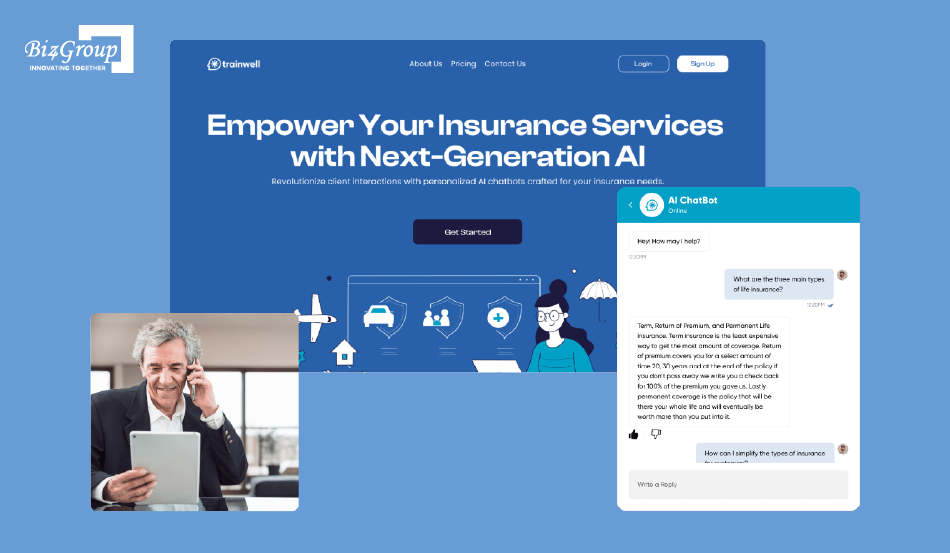
Biz4Group also developed an advanced insurance-focused AI platform responsible for training and operational support. The challenge was straightforward. Insurance teams were spending enormous amounts of time conducting repetitive training sessions and answering the same operational questions repeatedly.
The solution was a domain-trained AI assistant capable of delivering immediate and context-aware insurance guidance at scale.
What the platform delivered:
- Instant AI-powered insurance assistance
- GPT-powered response generation using custom-trained LLMs
- Continuous feedback-driven model improvement
- Simultaneous query handling across teams
- Seamless integration into existing web infrastructure
- Centralized insurance knowledge management
Why this matters for healthcare reimbursement systems
Modern reimbursement intelligence platforms increasingly depend on:
- Conversational AI layers
- Domain-trained language models
- Contextual financial query handling
- Scalable AI interaction environments
That same architecture can support reimbursement analysts, revenue integrity teams, and finance leadership when investigating payer anomalies and claim behavior patterns.
Now that the operational side is clear, the next question becomes more technical. What technologies, integrations, and infrastructure actually power these systems behind the scenes?
Still Trusting Spreadsheets With Multi-Million Dollar Decisions?
AI systems process thousands of transactions faster than manual finance reviews ever realistically can.
Schedule a Strategy Call TodayTechnologies Required to Build Healthcare Claim Take-Back Detection Software Using AI
Healthcare organizations planning advanced reimbursement intelligence systems often ask, “We want a company that can build an AI healthcare revenue leakage detection system for insurance claims.” The answer depends heavily on architecture quality.
These platforms must process large reimbursement datasets, integrate with healthcare systems securely, and support continuous anomaly analysis without slowing operational workflows.
Below is a practical breakdown of the architecture and technology stack commonly used in modern healthcare reimbursement intelligence platforms.
Core System Architecture
A modern AI take-back detection platform usually includes the following layers:
- Data ingestion pipelines for ERA, EDI, payer, and reimbursement transactions
- Integration layer connecting EHRs, clearinghouses, and billing systems
- Data normalization engine for structuring reimbursement records consistently
- AI anomaly detection layer for identifying suspicious financial activity
- Financial intelligence engine for payer trend analysis and reimbursement scoring
- Workflow orchestration layer for routing flagged claims internally
- Reporting and visualization dashboard for finance and revenue integrity teams
- Audit logging and compliance layer for tracking reimbursement investigations
- Conversational AI layer for reimbursement search and operational queries
- API management layer for secure interoperability across systems
Organizations wanting to create healthcare revenue leakage detection system using AI often prioritize modular architecture so additional payer workflows and analytics models can scale over time.
Key Data Sources Used by the Platform
The quality of detection depends heavily on the quality of reimbursement data flowing into the system. Common healthcare data sources include:
|
Data Source |
Purpose |
|---|---|
|
835 ERA files |
Tracks reimbursement activity and payment adjustments |
|
EHR systems |
Provides patient encounter and clinical billing context |
|
Clearinghouse platforms |
Supplies claim submission and transaction data |
|
Payer contract databases |
Validates expected reimbursement structures |
|
Claim lifecycle systems |
Tracks billing and payment progression |
|
Audit records |
Supports reimbursement investigation history |
|
Financial reporting systems |
Measures reimbursement exposure trends |
This is one reason many healthcare enterprises building reimbursement intelligence environments invest in scalable AI product development services with strong healthcare integration expertise.
AI Models Commonly Used in These Systems
Different AI models handle different reimbursement analysis tasks.
|
AI Model Type |
Role in the System |
|---|---|
|
Anomaly detection models |
Identify unusual reimbursement behavior |
|
Time-series forecasting models |
Monitor payment trend deviations over time |
|
Classification models |
Categorize reimbursement risk severity |
|
NLP models |
Interpret remittance notes and reimbursement documentation |
|
Clustering algorithms |
Detect payer-specific reimbursement patterns |
|
Generative AI models |
Support conversational reimbursement analysis |
Organizations working with a generative AI development company are increasingly incorporating NLP and conversational AI layers to simplify reimbursement investigations for operational teams.
Recommended Technology Stack
|
System Layer |
Recommended Tools and Frameworks |
Purpose |
|---|---|---|
|
Frontend |
React, Next.js, Angular |
Dashboard and reporting interface |
|
Backend |
Node.js, Python, .NET |
Business logic and workflow management |
|
AI and ML |
TensorFlow, PyTorch, Scikit-learn |
Reimbursement anomaly analysis |
|
NLP Layer |
OpenAI GPT, Claude API, LangChain |
Conversational financial intelligence |
|
Data Processing |
Apache Kafka, Spark, Airflow |
High-volume reimbursement processing |
|
Database |
PostgreSQL, MongoDB, Snowflake |
Structured reimbursement data storage |
|
Cloud Infrastructure |
AWS, Azure, Google Cloud |
Scalable deployment environment |
|
API Integration |
HL7 FHIR APIs, REST APIs |
Healthcare interoperability |
|
Security |
OAuth 2.0, IAM, AES-256 |
Access control and data protection |
|
Monitoring |
Datadog, Grafana, ELK Stack |
Operational performance monitoring |
The best architecture decisions usually depend on:
- Payer complexity
- Claim volume
- Integration depth
- Reimbursement workflow maturity
- Reporting requirements
Because no two healthcare organizations manage reimbursement operations exactly the same way.
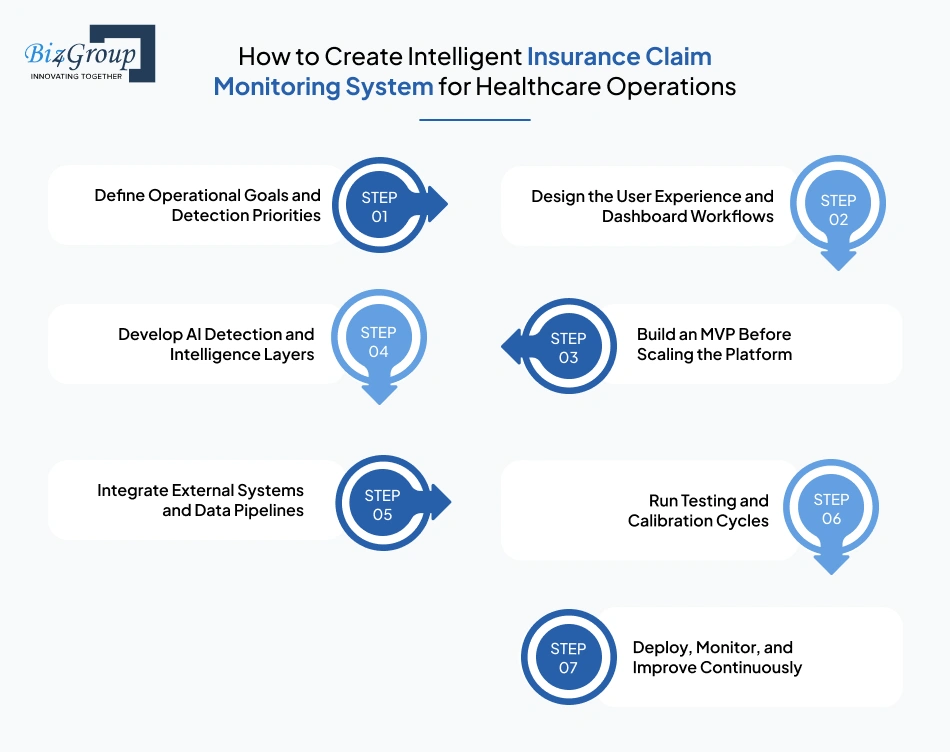
How to Create Intelligent Insurance Claim Monitoring System for Healthcare Operations in 7 Steps?
Healthcare organizations often begin with a simple objective, “We need end-to-end development of AI insurance analytics system for claim take-back prevention and revenue protection.”
Turning that vision into a scalable platform requires a structured development roadmap. Here’s how the process usually works.
Step 1. Define Operational Goals and Detection Priorities
The first step focuses on understanding:
- operational bottlenecks
- transaction workflows
- financial reporting needs
- alert priorities
- escalation requirements
This stage determines what the platform should actually solve instead of overwhelming teams with unnecessary functionality.
Organizations planning to develop claim integrity monitoring system for insurance workflows often underestimate how important early workflow mapping becomes later during deployment.
Step 2. Design the User Experience and Dashboard Workflows
Finance and operations teams interact with large volumes of transactional data daily. If the interface feels cluttered or difficult to navigate, adoption drops quickly. That is why UI planning becomes a critical stage during development.
The focus here includes:
- dashboard hierarchy
- investigation workflows
- alert visibility
- reporting layouts
- mobile accessibility
- workflow simplicity
Many healthcare enterprises collaborate with a specialized UI/UX design company to ensure operational teams can interpret financial intelligence quickly without spending hours navigating complex screens.
Also read: Top 15 UI/UX design companies in USA
Step 3. Build an MVP Before Scaling the Platform
Launching every feature at once increases complexity and slows feedback cycles. Most successful healthcare AI platforms begin with a focused MVP covering:
- anomaly monitoring
- transaction ingestion
- reporting workflows
- alert management
- operational validation
This approach allows teams to validate accuracy, usability, and operational fit early.
Organizations investing in MVP development services often reduce deployment risks significantly by identifying workflow gaps before full-scale implementation.
Also read: Top 12+ MVP development companies in USA
Step 4. Develop AI Detection and Intelligence Layers
Once the core workflows are stable, development teams begin implementing:
- anomaly detection engines
- behavioral analysis models
- transaction intelligence workflows
- NLP capabilities
- operational scoring systems
This stage focuses on improving decision accuracy while reducing unnecessary alert noise.
Step 5. Integrate External Systems and Data Pipelines
A detection platform cannot operate in isolation. The system must connect with:
- EHR environments
- clearinghouse systems
- financial databases
- reporting tools
- operational APIs
This is where scalable AI integration services become essential for maintaining stable interoperability across healthcare infrastructure.
Step 6. Run Testing and Calibration Cycles
Healthcare AI systems require extensive validation before deployment. Testing usually focuses on:
- anomaly accuracy
- workflow stability
- dashboard performance
- integration reliability
- operational responsiveness
Calibration periods are especially important during early deployment stages when models are still adapting to organizational transaction patterns.
Step 7. Deploy, Monitor, and Improve Continuously
Deployment is not the finish line. Once the platform goes live, teams continuously monitor:
- operational performance
- alert quality
- workflow efficiency
- user adoption
- financial visibility outcomes
This continuous optimization cycle helps healthcare organizations improve platform effectiveness over time without disrupting operational continuity.
Now that the development lifecycle is clear, the next question is how do healthcare organizations secure sensitive financial and patient data while keeping these AI systems compliant with industry regulations?
Why Do 68% Of Enterprise AI Projects Fail Operationally?
Most platforms fail from poor execution strategy, weak workflows, and rushed deployment planning.
Talk To Expert AI ArchitectsSecurity and Compliance Requirements to Develop AI Insurance Claim Take-Back Detection System
Healthcare organizations planning to build automated insurance claim recovery and detection system environments must treat security as part of the architecture, not an afterthought added later.
Even the most accurate AI platform can become a liability if compliance gaps exist. Here are the core areas that matter most.
1. HIPAA-Compliant Infrastructure
Any platform handling healthcare transaction data should support:
- Encrypted data storage
- Secure API communication
- Controlled PHI access
- Audit logging
- User activity tracking
This protects sensitive healthcare and operational information across workflows.
Also read: HIPAA-compliant AI healthcare software development guide
2. Role-Based Access Controls
Not every user should access the same level of data. Strong systems typically implement:
- Role-specific permissions
- Multi-factor authentication
- Session monitoring
- Restricted administrative access
This reduces internal exposure risks significantly.
3. Secure AI Model Management
AI models also require protection. That includes:
- Secure model hosting
- Protected training environments
- Controlled dataset access
- Version monitoring
- Validation pipelines
Organizations building healthcare AI platforms often overlook model governance during early development stages.
4. Compliance Monitoring and Audit Readiness
Healthcare enterprises should maintain:
- Activity logs
- Compliance reports
- System access histories
- Investigation tracking records
- Data retention policies
These records become extremely important during audits, investigations, and regulatory reviews.
5. Cloud and Infrastructure Security
Most modern platforms rely on cloud infrastructure. That makes cloud security essential through:
- Encrypted backups
- Network segmentation
- Endpoint monitoring
- Intrusion detection
- Disaster recovery planning
A secure architecture protects operational continuity while reducing long-term compliance risks.
Security creates trust. But healthcare leaders also need to know whether the investment makes financial sense. That brings us to one of the most important questions in the entire decision-making process. What does it cost to build this system, and what kind of ROI can organizations realistically expect?
How Much Does It Cost to Build Healthcare Claim Take-Back Detection Software Using AI?
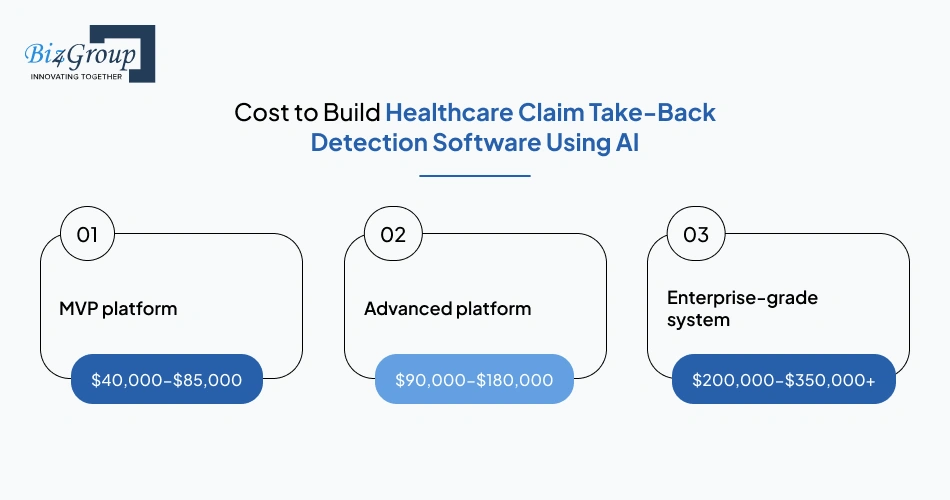
The average cost to develop insurance claim anomaly detection system for revenue protection initiatives usually falls between $40,000-$350,000+ depending on various factors like system complexity, integration depth, AI model sophistication, reporting requirements, among others.
Healthcare organizations often start with a focused MVP and expand gradually into enterprise-grade platforms after operational validation.
Here’s a realistic investment breakdown.
|
Development Level |
Estimated Cost Range |
Typical Scope |
|---|---|---|
|
MVP platform |
$40,000-$85,000 |
Core anomaly monitoring, dashboard, basic reporting |
|
Advanced platform |
$90,000-$180,000 |
AI workflows, integrations, operational automation |
|
Enterprise-grade system |
$200,000-$350,000+ |
Multi-location scalability, advanced analytics, conversational AI, enterprise security |
Organizations frequently say, “We are comparing companies that develop AI insurance claim take-back detection systems and want to choose the best vendor in USA.”
Cost comparisons matter. But architecture quality, scalability, and healthcare workflow expertise matter far more long term.
Major Cost Drivers Behind AI Insurance Claim Take-Back Detection System Development
The overall investment varies based on how sophisticated the platform needs to become. For most mid-to-large healthcare organizations, total spending across infrastructure, integrations, AI workflows, and deployment usually ranges between $75,000-$300,000+.
Here are the biggest cost drivers.
|
Cost Driver |
Estimated Range |
What Impacts the Cost |
|---|---|---|
|
UI and dashboard development |
$8,000-$35,000 |
Reporting complexity, workflow customization, multi-role interfaces |
|
AI model development |
$15,000-$70,000 |
Detection sophistication, NLP layers, scoring systems |
|
System integrations |
$10,000-$60,000 |
EHR connectivity, clearinghouse APIs, operational systems |
|
Data pipeline engineering |
$8,000-$40,000 |
Transaction volume and processing scale |
|
Cloud infrastructure setup |
$5,000-$30,000 |
Hosting environment, scalability requirements |
|
Security and compliance setup |
$7,000-$45,000 |
HIPAA readiness, encryption, audit tracking |
|
Workflow automation |
$10,000-$50,000 |
Escalation logic and operational orchestration |
|
Testing and optimization |
$5,000-$25,000 |
Calibration cycles and workflow refinement |
|
Conversational AI capabilities |
$12,000-$55,000 |
NLP interfaces and query intelligence |
|
Ongoing maintenance |
$2,000-$12,000/month |
Monitoring, updates, infrastructure support |
Organizations planning to build automated insurance claim recovery and detection system environments often underestimate integration and testing complexity during early budgeting discussions.
Hidden Costs Healthcare Organizations Often Miss
Many healthcare leaders focus heavily on development budgets but overlook operational costs that appear later during scaling and adoption. These hidden expenses can add another 15%-35% to the total investment if not planned properly.
One common example is workflow adaptation.
Internal teams often require process restructuring once anomaly intelligence becomes operational. That may involve dashboard retraining, operational restructuring, or additional validation workflows. Depending on organization size, this can add $5,000-$25,000 in onboarding and process alignment expenses.
Another overlooked area is cloud scalability.
As transaction volume grows, infrastructure expenses may increase by $1,500-$8,000/month depending on:
- Storage volume
- API activity
- Model inference load
- Reporting usage
Healthcare organizations also frequently underestimate AI calibration efforts during early deployment stages. Additional tuning cycles and operational refinement can increase costs by another $10,000-$40,000 before the platform stabilizes fully.
This is especially true for enterprises planning to create AI insurance claim fraud and take-back detection system environments across multiple departments or facilities simultaneously.
How Healthcare Organizations Reduce Development Costs Strategically
Smart planning often saves healthcare organizations between $25,000-$90,000+ during development and deployment.
Here are the most effective optimization strategies:
- Start with an MVP before scaling enterprise-wide
- Prioritize high-impact workflows first
- Use modular architecture for phased expansion
- Reuse existing healthcare infrastructure where possible
- Limit custom dashboard complexity initially
- Deploy AI models gradually instead of simultaneously
- Focus early integrations on mission-critical systems only
- Validate workflows with real operational teams before scaling
Organizations exploring how to develop AI insurance claim take-back detection system to prevent silent revenue leakage in healthcare environments often achieve stronger ROI when they phase development strategically instead of attempting enterprise-wide deployment immediately.
Quick ROI Snapshot
The investment becomes easier to justify when organizations compare development cost against ongoing financial exposure.
Here’s a simplified example.
|
Metric |
Example Estimate |
|---|---|
|
Annual operational exposure |
$4M-$8M |
|
Estimated recovery improvement |
20%-45% |
|
Potential annual savings |
$800,000-$3M+ |
|
Typical implementation investment |
$90,000-$250,000 |
|
Average ROI timeline |
8-18 months |
For many healthcare organizations, the bigger financial risk is no longer over-investing in monitoring systems. It is continuing to operate without visibility into where revenue leakage is already happening quietly in the background.
Also read: How much does it cost to build AI workers compensation claims management software?
Could Your ROI Arrive Before Your Next Annual Audit?
Many healthcare organizations recover implementation costs within 8-18 months through earlier anomaly detection.
Estimate My Development CostShould You Buy or Build an AI Insurance Claim Take-Back Detection System?
Healthcare organizations evaluating long-term revenue intelligence strategies often say, “We are comparing companies that develop AI insurance claim take-back detection systems and want to choose the best vendor in USA.”
The answer depends on how flexible, scalable, and organization-specific the platform needs to become.
Here’s a practical comparison.
|
Factor |
Custom AI Platform |
Off-the-Shelf Platform |
|---|---|---|
|
Workflow flexibility |
Fully customized around operational workflows |
Limited to predefined workflows |
|
Integration capabilities |
Built around existing systems and APIs |
May require workflow adjustments |
|
AI model customization |
Tailored anomaly intelligence and scoring |
Shared generic models |
|
Scalability |
Easier to expand across departments and facilities |
Expansion depends on vendor limitations |
|
Dashboard experience |
Custom reporting and operational views |
Standardized interface structure |
|
Ownership and control |
Full ownership of platform logic and workflows |
Vendor-controlled environment |
|
Conversational AI capabilities |
Can include organization-specific intelligence layers |
Usually limited or template-based |
|
Security configuration |
Built around internal compliance policies |
Shared security framework |
|
Deployment timeline |
Longer initial development cycle |
Faster initial launch |
|
Upfront investment |
Higher initial cost |
Lower initial licensing cost |
|
Long-term operational fit |
Better for complex healthcare ecosystems |
Better for simpler workflows |
|
Vendor dependency |
Lower long-term dependency |
Higher reliance on vendor roadmap |
|
Competitive differentiation |
Unique operational advantage |
Similar capabilities across competitors |
When Buying Makes More Sense
An off-the-shelf platform may be the better option when:
- Operational workflows are relatively standardized
- Deployment speed matters most
- Budgets are limited initially
- Internal technical resources are smaller
- Customization requirements are minimal
This path works well for organizations seeking quick operational visibility without major infrastructure changes.
When Building Makes More Sense
A custom platform becomes the stronger choice when:
- Multiple systems need deep integration
- Workflows vary across departments or facilities
- Operational intelligence requirements are advanced
- Scalability is a long-term priority
- Leadership wants ownership of data and AI workflows
Organizations planning to create AI insurance claim fraud and take-back detection system capabilities as long-term infrastructure typically benefit more from custom development.
The decision ultimately comes down to this.
Buy when speed and simplicity matter most.
Build when operational control, scalability, and long-term strategic value matter more.
Now that the build-vs-buy decision is clearer, the next step is evaluating development partners properly. Because the quality of the questions asked early often determines the success of the entire platform later.
Vendor Evaluation Checklist for Creating AI Insurance Claim Take-Back Detection System for Revenue Protection
Healthcare organizations often focus heavily on features and pricing during vendor discussions.
But the smarter approach is evaluating technical depth, healthcare workflow understanding, scalability capability, and long-term operational fit. Especially if uou need a company that can develop an AI system for detecting insurance claim reversals and anomalies.
Here are the questions worth asking before signing any agreement.
Q1. How does the platform detect abnormal transaction behavior?
The answer should explain:
- AI model logic
- Anomaly scoring
- Workflow intelligence
- Operational validation methods
Avoid vendors that rely entirely on generic rule engines.
Q2. What healthcare systems can the platform integrate with?
Look for experience with:
- EHR systems
- Clearinghouses
- APIs
- Financial reporting tools
- Operational workflows
Strong integration capability becomes critical during scaling.
Q3. How are false positives managed?
Every AI platform produces some level of alert noise. The real question is:
- How quickly models improve?
- How workflows reduce unnecessary escalation?
- How is operational feedback incorporated?
Q4. Can the system scale across multiple facilities or departments?
Many platforms work well in pilot environments but struggle at enterprise scale. Ask about:
- Cloud scalability
- Performance optimization
- Transaction handling capacity
- Operational expansion strategy
Q5. How is healthcare compliance handled?
The vendor should clearly explain:
- HIPAA safeguards
- Encryption practices
- Audit logging
- Access controls
- Infrastructure security
Vague answers here are a red flag.
Q6. Who owns the platform workflows and data?
Ownership matters long term. Some vendors limit:
- Workflow customization
- Reporting flexibility
- Data portability
- AI model adaptability
That can create operational dependency later.
Q7. What happens after deployment?
A strong development partner should support:
- Calibration
- Monitoring
- Optimization
- Workflow improvements
- Long-term scaling
Healthcare organizations planning to develop AI insurance claim take-back detection system environments should view deployment as the beginning of the optimization cycle, not the finish line.
Enterprises preparing to scale healthcare AI initiatives also frequently choose to hire AI developers with direct healthcare workflow expertise instead of relying entirely on generic software vendors.
Still Comparing Vendors Who Sound Exactly The Same?
The wrong AI partner can delay deployment, inflate costs, and weaken operational adoption significantly.
Call Biz4Group Experts NowWhy Biz4Group LLC Is the Best Company to Help You Build an AI Insurance Claim Take-Back Detection System
Healthcare organizations are done experimenting with flashy AI demos that look impressive in sales calls and collapse during real operations.
They want systems that work under pressure.
Systems that scale.
Systems that fit how healthcare teams actually operate.
That is exactly where Biz4Group LLC delivers.
As a leading AI development company, Biz4Group builds enterprise AI platforms for organizations that cannot afford operational blind spots. We specialize in transforming complex healthcare and insurance workflows into intelligent, scalable systems designed for real business impact.
Healthcare leaders often approach us with one core challenge... “We need a company that can develop an AI system for detecting insurance claim reversals and anomalies.”
What they discover quickly is that building these platforms takes far more than AI expertise alone.
It requires healthcare workflow understanding, enterprise architecture expertise, operational thinking, secure infrastructure design, and intelligent automation strategy. That combination is rare.
Biz4Group brings all of it together under one roof.
Our experience in AI insurance automation software development allows us to build platforms that connect operational intelligence, automation, conversational AI, analytics, and workflow orchestration into one unified ecosystem.
No bloated systems.
No unnecessary complexity.
No generic AI layers pretending to solve enterprise problems.
We build technology that makes operational teams faster, smarter, and more confident in high-stakes environments.
Why Businesses Choose Biz4Group LLC
- We build custom AI systems around your workflows, not generic templates
- We understand healthcare, insurance, automation, and enterprise operations deeply
- We focus on scalable architecture built for long-term growth
- We prioritize usability so teams actually adopt the platform internally
- We combine AI engineering with strong business and operational thinking
- We deliver AI solutions designed for measurable business outcomes, not vanity features
- We stay involved beyond deployment to optimize and evolve the platform continuously
Healthcare organizations planning to develop AI insurance claim take-back detection system capabilities need strategic AI partners capable of building systems that remain valuable years after deployment.
That is the standard Biz4Group builds toward.
If your organization is ready to stop chasing revenue problems manually and start building intelligent operational visibility at scale, Biz4Group is ready to help architect the system that gets you there.
Talk to Biz4Group today and build an AI insurance claim take-back detection platform designed for the realities of modern healthcare operations.
Final Thoughts
Silent claim denials and post-payment take-backs are no longer isolated revenue cycle issues. They have become a growing operational blind spot across modern healthcare systems. What makes them dangerous is not how loudly they appear, but how quietly they accumulate across thousands of transactions until the financial impact becomes impossible to ignore.
That is why healthcare organizations are rapidly shifting toward intelligent monitoring systems capable of identifying hidden financial risks before they become permanent losses. From anomaly detection and workflow automation to operational intelligence and predictive analytics, AI is changing how healthcare providers protect revenue in an increasingly complex reimbursement environment.
Organizations planning to build these systems need more than technical development support. They need a partner that understands healthcare operations, enterprise AI architecture, compliance expectations, and scalable automation deeply. As a trusted USA-based software development company, Biz4Group helps healthcare enterprises build AI-powered platforms designed around real operational challenges, not generic software templates.
The future of healthcare revenue protection belongs to organizations that can detect financial risks before they escalate quietly in the background. If your organization is ready to build an AI insurance claim take-back detection system tailored to your workflows, integrations, and operational goals, Biz4Group is ready to help you make it happen.
FAQs
1. What types of healthcare organizations benefit most from AI insurance claim take-back detection systems?
These platforms are highly valuable for hospital systems, multi-location healthcare networks, TPAs, specialty care providers, and enterprise billing operations handling large transaction volumes. As operational complexity increases, identifying hidden financial leakage manually becomes significantly harder, which is where AI-powered monitoring systems create the most impact.
2. Can AI detect fraudulent insurance claim reversals automatically?
Yes. Modern AI systems can identify suspicious transaction behavior, abnormal payment activity, and unusual financial adjustments automatically. However, healthcare organizations still require human validation before escalation or recovery actions are finalized. AI improves detection speed and operational visibility while finance teams maintain decision control.
3. What is the difference between claim denial prevention and claim take-back detection?
Claim denial prevention focuses on identifying front-end submission issues before claims are processed. Claim take-back detection focuses on identifying financial reversals, silent adjustments, and post-payment anomalies after transactions move through operational workflows. Both systems protect revenue, but they solve different operational challenges.
4. Can AI claim monitoring platforms integrate with existing healthcare software?
Yes. Most modern systems integrate with EHRs, operational databases, financial reporting systems, clearinghouses, and API-based healthcare infrastructure. Organizations planning to develop insurance claim anomaly detection system for revenue protection environments usually prioritize integration flexibility because disconnected systems reduce operational visibility significantly.
5. How long does it take to build an AI insurance claim take-back detection system?
Most enterprise-grade platforms take between 3-9 months depending on integrations, workflow complexity, and deployment scale. Biz4Group, however, can deliver a functional MVP within 2-4 weeks because we use reusable AI infrastructure components that reduce both development time and project cost significantly.
6. How accurate are AI claim monitoring systems?
Accuracy improves continuously as models learn operational behavior patterns and workflows. Early deployments typically include calibration phases where finance teams validate alerts and refine system intelligence. Well-optimized platforms significantly reduce manual investigation effort while improving financial visibility.
