 Location :
Orlando, FL, USA
Location :
Orlando, FL, USA +1 (407) 714-1616
 info@biz4group.com

- AI HOA dues collection software development helps automate billing, reminders, payment tracking, and delinquency management across HOA communities.
- Businesses choose to develop AI HOA dues collection software to reduce late payments, improve cash flow, and eliminate manual collection work.
- Key features include forecasting dashboards, resident portals, payment automation, and HOA delinquency management software capabilities.
- The cost to build AI-powered HOA payment collection systems usually ranges between $20,000 to $150,000+ based on platform complexity.
- Biz4Group helps businesses build AI HOA financial management platforms with scalable architecture, automation workflows, and long-term operational flexibility.
It’s Monday morning, your finance team is reviewing overdue HOA dues across multiple communities. Several homeowners missed payments again. Vendor invoices are waiting. Board members want updated financial reports before the monthly meeting, and your staff is still manually sending reminder emails one by one.
Now imagine repeating that process every month across dozens of HOA communities.
That’s exactly why many property management companies are investing in AI HOA dues collection software development to reduce late payments, improve collection consistency, and stabilize cash flow across growing portfolios.
And the problem is bigger than most HOA firms realize.
According to report, HOA communities across the U.S. are facing nearly $9 billion in unpaid assessments and collection-related losses.
At the same time, HOA operators are rapidly adopting AI-driven systems to automate collections, improve financial operations, and reduce administrative overhead.
So, here’s the real question: If AI can predict late payments, automate follow-ups, and improve payment consistency, why are so many HOA teams still relying on reactive collection processes?
That shift is pushing more businesses to develop AI HOA dues collection software that can automate reminders, identify delinquent payment patterns early, and improve long-term financial visibility across communities.
For property management companies handling multiple associations, this is becoming less about convenience and more about operational survival.
Delayed payments affect reserve planning, vendor schedules, budgeting accuracy, and overall community operations. That’s why many organizations are now looking to build HOA payment collection automation systems that can reduce manual effort while improving collection timelines.
At the same time, companies are combining collections automation with AI HOA accounting and reporting software to centralize payment tracking, financial reporting, and operational oversight in one connected ecosystem.
The demand to create AI-powered HOA dues management software is growing because traditional billing systems simply cannot provide the predictive insights, automation, and scalability of modern HOA operations now require.
But before investing in a platform like this, one important question needs to be answered first: What exactly makes AI-powered HOA dues collection software different from traditional HOA management systems?
What Exactly Is AI HOA Dues Collection Software and Why Are Property Managers Rushing to Build It?
AI HOA dues collection software development refers to building a centralized platform that helps HOA management companies manage dues collection, delinquency monitoring, payment workflows, and financial operations across multiple communities.
Unlike traditional HOA systems that mainly record transactions, these platforms are designed to streamline collections, improve financial visibility, and reduce dependency on manual processes.
Companies are now choosing to develop AI HOA dues collection software because older collection workflows are becoming difficult to manage as HOA operations grow more complex.
Why Are Companies Building It Now?
Several operational and financial challenges are driving demand for smarter HOA collection systems.
- Growing HOA portfolios are increasing operational pressure
Many property management companies now manage dozens of communities at once. Tracking payments, overdue accounts, and collection follow-ups manually across multiple associations slows down operations quickly. - Manual collection processes consume too much staff time
Accounting teams still spend hours sending reminders, updating spreadsheets, reconciling payments, and preparing reports. Businesses are looking for ways to reduce repetitive administrative work without continuously increasing headcount. - HOA boards expect faster financial reporting
Board members want accurate financial visibility before making budgeting and reserve planning decisions. Delayed or fragmented reporting creates operational bottlenecks. - Homeowners expect modern payment experiences
Residents now prefer online payments, automated reminders, self-service access, and faster communication instead of paper notices and manual payment processes. - Disconnected software creates operational inefficiencies
Many HOA companies still use separate tools for accounting, billing, communication, and reporting. This is pushing businesses toward connected ecosystems supported by AI integration services that centralize financial operations. - Financial planning requires better collection visibility
Property management firms are increasingly looking to build AI-based HOA cash flow management systems that provide clearer forecasting and more predictable collection tracking across communities.
These challenges are no longer affecting only large enterprises. Even mid-sized HOA management companies are now rethinking how they manage collections, reporting, and financial operations at scale.
But understanding why companies are building these systems leads to another important question: How does an AI-powered HOA dues collection platform actually work behind the scenes?
Still Chasing HOA Payments Manually Every Month?
Let’s build a smarter HOA dues collection system that automates reminders, improves cash flow, and reduces delinquent accounts.
Talk to Our ExpertsHow Does an AI HOA Payment Collection Automation System Actually Work Behind the Scenes?
An AI-powered HOA collection platform works by connecting payment data, homeowner activity, billing workflows, and financial reporting into one centralized system. Instead of requiring accounting teams to manually monitor every payment cycle, the platform continuously tracks collection activity, automates repetitive tasks, and highlights accounts that need attention.
This is why many companies now choose to build HOA payment collection automation systems that can manage collections across multiple communities with far less operational effort.
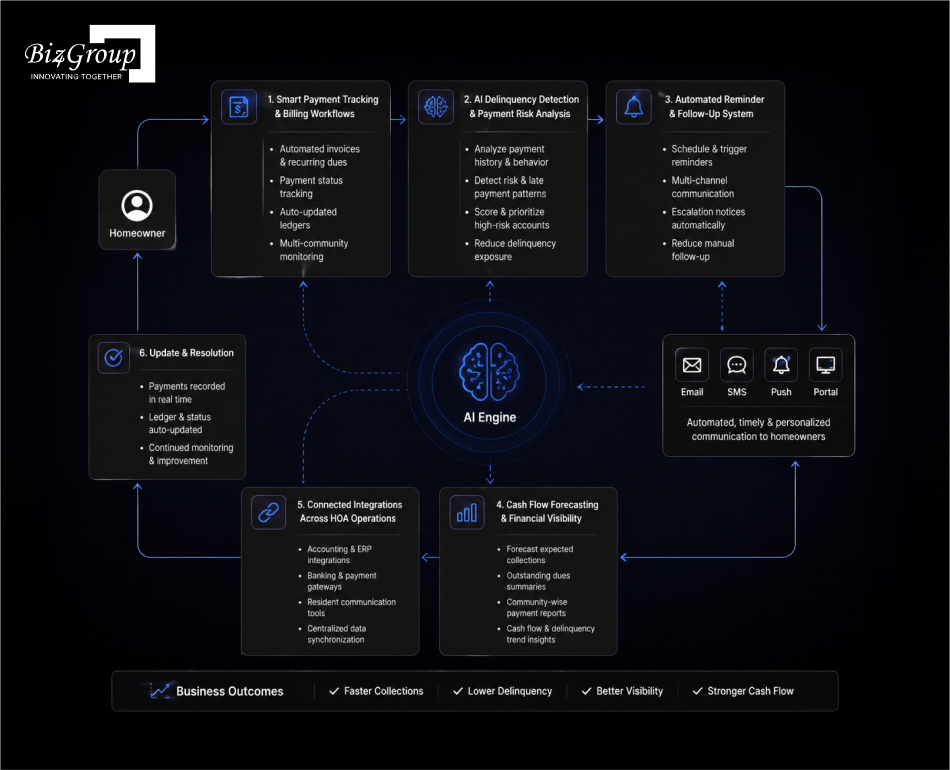
1. Smart Payment Tracking and Billing Workflows
The system automatically manages invoices, recurring dues schedules, payment tracking, and billing updates from a centralized dashboard. Every payment activity is recorded in real time, giving finance teams better visibility into pending, completed, and overdue transactions across communities.
A typical workflow includes:
- Automated invoice generation
- Recurring billing schedules
- Payment status tracking
- Auto-updated resident ledgers
- Multi-community financial monitoring
This helps businesses develop smart HOA billing and payment systems that reduce dependency on spreadsheets and manual reconciliation.
2. AI-Based Delinquency Detection and Payment Risk Analysis
One of the biggest advantages of these platforms is their ability to identify payment risk patterns early. The system analyzes homeowner payment history, frequency of delays, missed dues cycles, and collection trends to flag accounts that are more likely to become delinquent.
This allows property managers to:
- Prioritize high-risk accounts
- Trigger earlier follow-ups
- Monitor repeat late-payment patterns
- Reduce long-term delinquency exposure
That’s why many firms are investing in building AI systems for HOA delinquency detection and financial forecasting instead of relying only on reactive collection methods.
3. Automated Reminder and Follow-Up System
The platform automates communication workflows based on billing schedules, payment status, and homeowner activity. Instead of staff manually sending notices every month, reminders can be triggered automatically through email, SMS, push notifications, or resident portals.
Most companies now want to:
- Schedule recurring reminders
- Customize reminder timing
- Send escalation notices automatically
- Reduce manual follow-up workload
This is a major reason business are choosing to create automated HOA payment reminder systems that improve collection consistency without increasing administrative effort.
4. Cash Flow Forecasting and Financial Visibility
The platform continuously tracks collection performance and generates financial forecasts based on payment trends and outstanding balances. This gives property managers and HOA boards clearer visibility into expected revenue cycles and collection gaps before they affect operations.
Financial dashboards usually include:
- Expected monthly collections
- Outstanding dues summaries
- Community-wise payment reports
- Delinquency trend tracking
- Forecasted cash flow insights
This is why many organizations are now trying to create HOA payment tracking and forecasting systems that support more accurate budgeting and reserve planning.
5. Connected Integrations Across HOA Operations
Modern HOA collection systems rarely operate as standalone software. Most companies integrate collections with accounting systems, resident communication tools, reporting dashboards, banking systems, and operational workflows.
This helps businesses:
- Eliminate duplicate data entry
- Improve reporting accuracy
- Centralize financial operations
- Streamline collection workflows
Companies building larger operational ecosystems also combine collections with AI property management software to manage payments, resident operations, maintenance workflows, and reporting from one connected platform.
Now that the workflow is clear, the next step is understanding where these systems create the biggest operational impact in real-world HOA environments.
Managing Multiple Communities and Drowning in Delinquencies? Here’s Where AI HOA Software Makes the Biggest Impact
The need for AI HOA dues collection software development usually becomes obvious when HOA operations start growing faster than manual processes can handle.
For some companies, it starts with delayed reporting. For others, it’s overdue accounts piling up across multiple communities.
And in many cases, finance teams simply cannot keep up with the amount of manual follow-up required every month.
1. Managing Multiple HOA Communities with Inconsistent Cash Flow
Many property management companies reach a point where collections become difficult to manage across different communities, payment schedules, and resident policies.
That’s when conversations start sounding like this: "we are managing multiple HOA communities and struggling with late payments and inconsistent cash flow, so we want to develop an AI-based dues collection software that can automate reminders, track payments, and improve financial stability"
At this stage, businesses usually need centralized visibility into collections, overdue accounts, and payment activity across all properties instead of relying on disconnected systems and spreadsheets.
Examples
AppFolio and RealPage expanded their financial automation capabilities to help property operators manage payments, accounting workflows, and reporting across large residential portfolios with less manual effort.
2. High Delinquency Rates Across HOA Communities
Some HOA communities struggle with recurring overdue payments even after sending reminders regularly. In these situations, the issue is usually not invoice generation. It’s the lack of visibility into payment behavior patterns and follow-up timing. This is where companies begin exploring ways to develop HOA delinquency management software that helps identify high-risk accounts earlier and improve collection consistency.
The demand often sounds like this: "we are a property management company facing high delinquency rates in HOA dues collection and need to build an AI-powered system that can predict late payments and automate follow-ups"
Examples
Large HOA operators like Associa and FirstService Residential have continued investing in digital financial operations and automated resident communication systems as delinquency management becomes more important across growing HOA portfolios.
3. HOA Financial Planning and Collection Forecasting
Many HOA boards struggle to plan reserves and operational budgets when collections fluctuate every month. Without proper forecasting, budgeting decisions become reactive, especially in communities managing large maintenance and vendor expenses. This is why more businesses are trying to build AI-based HOA cash flow management systems that provide better visibility into expected collections and upcoming financial gaps.
A common business requirement looks like this: "we are looking to develop an AI HOA financial management platform that can handle dues collection, payment tracking, and cash flow forecasting for better operational efficiency"
Examples
Large community management firms increasingly rely on centralized financial dashboards and forecasting systems to improve reserve planning and operational budgeting across multiple HOA communities.
4. Self-Managed HOA Communities with Limited Staff
Self-managed associations often depend on small administrative teams or volunteer board members to handle dues collection and homeowner communication. As communities grow, manual reminders, invoice tracking, and reporting quickly become difficult to manage consistently. That’s when associations begin looking to create AI-powered HOA dues management software that reduces administrative workload while improving payment tracking.
The requirement usually sounds familiar: "we are managing homeowner associations and want to create an automated AI system to reduce manual effort in collecting dues and improving payment consistency"
Examples
Platforms like PayHOA and Buildium became popular among self-managed communities because they simplified online dues collection, homeowner communication, and financial tracking for associations without large operational teams.
5. Property Management Companies Modernizing Financial Operations
Some firms are not only solving collection issues. They are rebuilding their entire operational workflow around automation and centralized financial management. These companies are usually looking to replace disconnected accounting tools, manual reporting processes, and repetitive administrative tasks with a single operational ecosystem.
That’s where conversations shift toward requirements like: "I am running a property management business and want to build an AI-powered HOA payment collection platform to improve cash flow and reduce manual tracking"
Many businesses pursuing this transformation also combine collections platforms with AI automation services to streamline reporting, payment workflows, and operational tasks across departments.
Examples
Vantaca and CINC Systems expanded beyond basic HOA management features by integrating accounting automation, collections management, reporting, and communication workflows into centralized operational platforms.
These real-world scenarios explain why more HOA management companies are investing in smarter collection platforms instead of expanding manual accounting operations.
But once businesses decide to build a system like this, the next question becomes unavoidable: What does it actually cost to develop an AI-powered HOA dues collection platform?
Wondering About the Cost to Build AI-Powered HOA Payment Collection Software? Here’s the Real Breakdown
One of the first questions property management companies ask after deciding to invest in AI HOA dues collection software development is straightforward:
How much will it actually cost to build?
The answer depends on the platform scope, number of integrations, automation complexity, reporting requirements, and whether you’re building a basic MVP or a fully scalable enterprise platform.
On average, the cost to build AI-powered HOA payment collection and delinquency management systems ranges between $20,000 to $150,000+.
A smaller platform focused on payment reminders and collections automation may stay on the lower end. A larger system with forecasting, resident portals, accounting integrations, reporting dashboards, and predictive payment analysis can move significantly higher.
This is why many businesses start conversations with requirements like: "I am planning to develop a smart HOA billing system that uses AI to predict late payments and automate dues collection processes"
The biggest cost driver is usually not the dashboard itself.
It’s the operational complexity behind the platform.
Cost Breakdown for AI HOA Dues Collection Software Development
|
Feature / Module |
Estimated Cost Range |
What Impacts the Cost |
|---|---|---|
|
Automated billing & invoicing |
$5,000 – $12,000 |
Billing logic, recurring schedules, payment workflows |
|
Payment reminder automation |
$4,000 – $10,000 |
SMS/email integrations, reminder customization |
|
Resident payment portal |
$8,000 – $18,000 |
User roles, payment gateways, self-service features |
|
Delinquency detection system |
$10,000 – $25,000 |
Payment behavior analysis and automation logic |
|
Cash flow forecasting dashboard |
$12,000 – $30,000 |
Financial analytics and reporting complexity |
|
HOA accounting integrations |
$5,000 – $15,000 |
ERP/accounting software connectivity |
|
Multi-community management |
$10,000 – $22,000 |
Community segmentation and permissions |
|
Admin dashboard & reporting |
$7,000 – $20,000 |
Real-time reporting and visualization needs |
|
AI-powered communication workflows |
$8,000 – $18,000 |
Notification logic and automation flows |
|
Mobile app support |
$15,000 – $40,000 |
iOS/Android development scope |
Many companies initially begin with an MVP development approach to validate workflows, automate core collection operations, and reduce early development costs before scaling the platform further.
What Factors Affect the Cost of Developing AI HOA Dues Collection Software?
The final development budget depends heavily on platform requirements and long-term scalability goals.
1. Platform Complexity
A basic system focused only on payment reminders will cost significantly less than a platform with forecasting, reporting, analytics, and multi-community management. Businesses planning to develop scalable HOA payment collection software with AI features usually require larger backend infrastructure and more advanced workflow architecture.
2. Number of Integrations
Integrating payment gateways, accounting software, banking APIs, communication systems, and resident portals increases development effort and testing requirements. This is especially true for businesses modernizing older HOA systems through AI HOA software development vs. off-the-shelf solutions strategies where custom integrations become necessary.
3. Reporting and Financial Analytics
Advanced reporting dashboards and collection forecasting systems require more development effort compared to standard payment tracking tools. Companies planning to create HOA payment tracking and forecasting systems typically invest more in analytics architecture and reporting layers.
4. User Roles and Community Scale
Managing multiple HOA communities with separate permissions, workflows, and financial controls increases both development and infrastructure costs.
Hidden Costs Businesses Often Overlook During HOA Software Development
Many companies only calculate development expenses and overlook operational costs that appear later during scaling.
Some of the most common hidden costs include:
- Payment gateway transaction fees
- Cloud hosting and infrastructure scaling
- Third-party API subscriptions
- Ongoing maintenance and security updates
- Reporting storage and backup systems
- Compliance and financial security requirements
- User onboarding and workflow training
This is why businesses working with an experienced AI product development company usually spend more time planning operational scalability before development begins.
How to Reduce AI HOA Dues Collection Software Development Costs Without Sacrificing Quality
The smartest way to control costs is not by removing critical features. It’s by prioritizing development correctly.
Many companies reduce initial investment by:
- Launching with core collection workflows first
- Building reporting and forecasting modules in later phases
- Using cloud infrastructure instead of on-premise systems
- Prioritizing integrations based on operational need
- Starting with web platforms before mobile apps
- Using modular architecture for future scalability
Businesses that want to develop AI HOA dues collection software to reduce late payments and improve cash flow often achieve better ROI by focusing on operational bottlenecks first instead of trying to launch every feature at once.
Custom AI HOA Dues Collection Software vs Off-the-Shelf Platforms
|
Custom AI HOA Platform |
Off-the-Shelf HOA Software |
|---|---|
|
Built around your workflows |
Limited workflow flexibility |
|
Easier multi-community customization |
Generic operational structure |
|
Scalable integrations |
Integration limitations |
|
Full ownership of features and data |
Vendor dependency |
|
Better long-term operational fit |
Faster initial deployment |
|
Higher upfront investment |
Lower starting cost |
|
Easier expansion with automation |
Feature restrictions over time |
Many growing property management companies eventually move toward custom platforms because generic HOA software often becomes restrictive as operational complexity increases.
This is especially true for firms planning to scale collections, financial reporting, and resident operations together through broader enterprise AI solutions strategies.
But cost alone should never drive the development decision.
The real value of an HOA dues collection platform depends on the features and operational capabilities built into the system from the beginning.
Wondering What Your HOA Software Should Actually Cost?
Get a clear roadmap, realistic budget estimate, and feature strategy tailored to your HOA operations and growth plans.
Get Cost EstimationWhich Features Actually Matter in AI HOA Dues Collection Automation Software Development?
The features you choose during AI HOA dues collection software development directly affect how efficiently your teams manage billing, collections, reporting, delinquency tracking, and financial operations across HOA communities.
A platform built only for invoice generation will eventually create operational gaps. That’s why companies planning to develop scalable HOA payment collection software with AI features focus on automation, financial visibility, and centralized management from the beginning.
The table below covers the core features businesses usually prioritize while planning to create AI-powered HOA dues management software and build AI HOA financial management platforms for long-term operational scalability.
|
Feature |
How It Works |
Why It Matters |
|---|---|---|
|
Automated HOA Dues Billing System |
Automatically generates invoices based on monthly, quarterly, or annual HOA billing schedules and updates resident ledgers after payment completion. |
Reduces manual invoice handling and helps accounting teams manage large community portfolios more efficiently. |
|
AI-Powered Payment Reminder Automation |
Sends scheduled reminders through email, SMS, or app notifications based on due dates, overdue status, and payment behavior patterns. |
Helps businesses create automated HOA payment reminder systems that improve collection consistency and reduce manual follow-ups. |
|
HOA Payment Tracking Dashboard |
Tracks paid, unpaid, partial, and overdue dues across multiple communities from one dashboard with real-time updates. |
Gives finance teams better visibility into collection performance and outstanding balances. |
|
AI-Based Delinquency Detection |
Monitors payment history, recurring delays, and overdue patterns to identify accounts with higher delinquency risk. |
Helps companies develop HOA delinquency management software that allows earlier intervention before payment issues escalate. |
|
HOA Cash Flow Forecasting System |
Analyzes historical collection trends and expected payments to estimate upcoming cash flow cycles and revenue gaps. |
Supports businesses planning to build AI-based HOA cash flow management systems for better reserve planning and budgeting visibility. |
|
Multi-Community HOA Management |
Separates data, billing workflows, reports, and permissions for different HOA communities within one platform. |
Simplifies operations for property management firms handling multiple associations simultaneously. |
|
Resident Self-Service Payment Portal |
Allows homeowners to check balances, review invoices, download statements, and complete payments independently through secure login access. |
Reduces administrative dependency while improving payment convenience for residents. Companies often combine this with AI HOA self service resident portal capabilities for better resident experience. |
|
Smart Late Fee Automation |
Automatically applies penalties, late charges, and escalation rules based on HOA payment policies and overdue timelines. |
Maintains consistent policy enforcement without requiring manual calculation or tracking. |
|
HOA Financial Reporting System |
Generates overdue summaries, collection reports, payment histories, financial statements, and community-wise accounting reports automatically. |
Improves financial visibility for property managers and HOA boards while reducing reporting delays. |
|
AI-Powered Collection Prioritization |
Organizes overdue accounts based on payment risk, outstanding balances, and homeowner payment history. |
Helps accounting teams focus on high-priority delinquent accounts first. |
|
HOA Accounting Software Integration |
Connects the platform with accounting systems, banking APIs, and bookkeeping software to sync payment and reporting data automatically. |
Eliminates duplicate data entry and improves financial accuracy across systems. |
|
Payment Gateway Integration |
Supports ACH payments, credit cards, recurring auto-pay, and online payment processing through integrated gateways. |
Makes dues collection faster and more convenient for homeowners. |
|
Workflow Automation System |
Automates collection notices, payment escalations, approval flows, and recurring financial tasks based on predefined workflows. |
Reduces repetitive administrative work across accounting and operations teams. Businesses often extend these workflows using AI automation for larger operational efficiency. |
|
AI Agent for HOA Invoice Processing |
Extracts invoice data, validates payment records, updates accounting entries, and manages invoice workflows automatically. |
Reduces manual invoice processing time and improves financial record accuracy. Many firms integrate AI agent for HOA invoice processing capabilities for faster accounting operations. |
|
Homeowner Communication Management |
Centralizes payment-related communication, reminders, notices, announcements, and support interactions from one interface. |
Improves communication consistency between residents and HOA management teams. |
|
24/7 Homeowner Support Automation |
Handles common resident queries related to dues, invoices, balances, and payment status automatically through chat-based support. |
Reduces support workload while improving resident response times through systems like 24/7 AI homeowner support bot for HOA communities. |
|
Role-Based Access Management |
Controls system permissions for accountants, board members, admins, finance teams, and property managers. |
Improves operational security and prevents unauthorized financial access. |
|
Mobile-Friendly HOA Management Access |
Allows managers and homeowners to access payment records, reminders, and reports from mobile devices. |
Improves accessibility and collection management across distributed teams. |
|
Audit Logs and Financial Activity Tracking |
Records every payment update, reminder action, policy change, and financial transaction within the system. |
Helps maintain transparency, compliance tracking, and operational accountability. |
Many businesses evaluating build AI-powered HOA billing systems for property management companies eventually realize that feature selection directly affects scalability, operational efficiency, and long-term maintenance costs.
That’s why the next step is understanding how these platforms are actually developed from planning to deployment.
Want to Develop AI HOA Dues Collection Software Successfully? Follow These Critical Development Steps
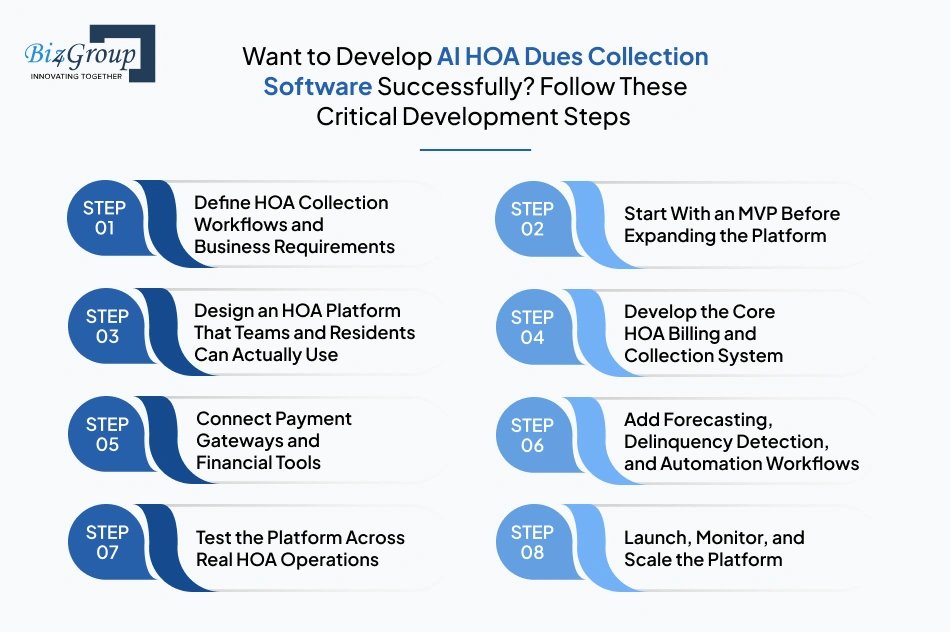
Building a scalable platform during AI HOA dues collection software development requires careful planning across financial workflows, billing systems, reporting architecture, resident operations, and long-term scalability.
This becomes even more important for businesses with requirements like: "I need a company that can build an AI system for HOA payment tracking, reminders, and financial forecasting for our communities"
Or:
"we are evaluating vendors who can develop AI HOA billing and dues automation software for property management businesses"
The most successful companies usually build the platform in structured phases instead of trying to launch every feature at once.
Step 1: Define HOA Collection Workflows and Business Requirements
The first step is understanding how dues collection, billing, delinquency handling, reporting, and homeowner communication currently operate across communities. Without proper workflow mapping, development teams often build features that do not align with actual HOA operations.
This planning stage usually includes:
- HOA billing workflows
- Collection escalation process
- Financial reporting structure
- Resident communication flow
- User roles and permissions
- Multi-community operational requirements
This phase is critical for companies planning to develop scalable HOA payment collection software with AI features because workflow clarity directly affects platform scalability later.
Step 2: Start With an MVP Before Expanding the Platform
Most companies do not begin with a fully developed enterprise platform. Instead, they launch a focused version that handles core workflows like invoicing, payment tracking, reminders, and reporting before expanding into forecasting and automation systems. This approach helps businesses validate operational workflows while controlling development costs.
A typical MVP usually includes:
- Automated dues billing
- HOA payment tracking
- Reminder automation
- Resident payment portal
- Basic financial reporting
This is why many organizations begin with a MVP development strategy before scaling into larger HOA financial systems.
Step 3: Design an HOA Platform That Teams and Residents Can Actually Use
HOA platforms are used by finance teams, property managers, board members, and homeowners every day. If the interface feels complicated, operational adoption becomes difficult regardless of how advanced the backend system is. This stage focuses heavily on usability and workflow accessibility while planning to create AI-powered HOA dues management software.
Key design areas include:
- Dashboard navigation
- Resident payment experience
- Mobile responsiveness
- Reporting accessibility
- Multi-community management flow
- Payment workflow visibility
Many businesses involve specialized UI/UX design teams early to simplify operational workflows before development begins.
Step 4: Develop the Core HOA Billing and Collection System
This is where the platform starts handling real financial operations. The development team builds the billing engine, payment tracking system, reminder workflows, resident ledgers, and financial reporting logic that power daily HOA collection activities.
Core development areas usually include:
- Recurring billing system
- Payment processing workflows
- Reminder automation logic
- Late fee calculations
- Resident account management
- Financial reporting modules
This stage forms the operational backbone for businesses planning to build HOA payment collection automation systems across multiple HOA communities.
Step 5: Connect Payment Gateways and Financial Tools
Modern HOA collection platforms must work alongside external financial systems instead of operating independently. This stage focuses on connecting payment processors, accounting tools, communication systems, and reporting platforms used by finance teams.
Most platforms integrate:
- ACH and card payment systems
- Accounting software
- Banking APIs
- Email and SMS providers
- Reporting platforms
This step becomes especially important for businesses trying to develop smart HOA billing and payment systems that centralize financial operations.
Step 6: Add Forecasting, Delinquency Detection, and Automation Workflows
Once the core billing system is stable, businesses usually expand into forecasting and operational automation. This stage focuses on tracking collection trends, identifying delinquent accounts earlier, and automating repetitive collection actions.
The platform typically expands with:
- Delinquency monitoring
- Collection forecasting
- Automated escalation workflows
- Payment-risk tracking
- Financial trend reporting
This phase supports businesses looking to build AI-based HOA cash flow management systems that improve collection visibility and financial planning.
Step 7: Test the Platform Across Real HOA Operations
Before launch, the system must be tested against real operational workflows across different HOA communities and user roles. The goal is to ensure billing accuracy, reporting consistency, payment reliability, and workflow stability before deployment.
Testing generally includes:
- Payment validation
- Billing workflow testing
- Financial reporting checks
- User permission testing
- Reminder automation testing
- Multi-community workflow simulation
This stage is critical for companies handling sensitive financial and homeowner data at scale.
Step 8: Launch, Monitor, and Scale the Platform
Deployment is only the beginning of long-term platform growth. Most businesses continue improving reporting systems, operational workflows, resident experiences, and financial automation after launch based on real usage data.
Post-launch scaling usually includes:
- Performance monitoring
- Workflow optimization
- Infrastructure scaling
- Security updates
- Additional integrations
- Feature expansion
This long-term approach is especially important for businesses planning to develop AI HOA dues collection software to reduce late payments and improve cash flow across growing HOA portfolios.
Once the development process is clear, the next major decision becomes technical: Which technologies and architecture choices are best suited for building a scalable HOA dues collection platform?
Which Tech Stack Is Best for Building a Scalable AI HOA Dues Collection Platform?
The technology stack used during AI HOA dues collection software development directly affects platform scalability, reporting performance, payment processing, integration flexibility, and long-term maintenance.
A platform handling billing, collections, resident portals, financial reporting, and forecasting across multiple HOA communities requires stable frontend architecture, secure backend systems, and reliable payment infrastructure.
The table below covers the technologies commonly used while building modern HOA dues collection platforms.
|
Technology Layer |
Recommended Technologies |
Why It’s Used in HOA Dues Collection Software |
|---|---|---|
|
Frontend Development |
React.js, Next.js |
Helps build fast, responsive dashboards and resident portals with better user experience and real-time data updates. Many companies work with React JS development services and a specialized Next JS development company for scalable frontend architecture. |
|
Backend Development |
Node.js, Python |
Handles billing workflows, payment processing, reporting logic, automation workflows, and system integrations efficiently. Businesses often partner with a Node JS development company or a Python development company depending on platform complexity and reporting requirements. |
|
Database Management |
PostgreSQL, MySQL, MongoDB |
Stores resident records, payment history, billing cycles, financial reports, and operational data securely across communities. |
|
Payment Gateway Integration |
Stripe, Authorize.Net, PayPal, Plaid |
Enables ACH payments, recurring billing, card payments, auto-pay setup, and secure financial transactions. |
|
Cloud Infrastructure |
AWS, Microsoft Azure, Google Cloud |
Supports platform scalability, data storage, backup systems, and multi-community operational performance. |
|
Reporting & Analytics |
Power BI, Tableau, Metabase |
Generates HOA financial reports, payment tracking dashboards, delinquency reports, and collection forecasting insights. |
|
Automation Workflows |
Cron Jobs, Queue Systems, Workflow Engines |
Automates reminders, escalations, billing schedules, and repetitive operational tasks across communities. |
|
Communication Systems |
Twilio, SendGrid, Firebase Notifications |
Supports payment reminders, alerts, notices, and resident communication workflows through SMS, email, and push notifications. |
|
Resident Portal Development |
React.js, Next.js, Progressive Web Apps |
Creates self-service portals where homeowners can track dues, review invoices, and complete payments online. |
|
Mobile Accessibility |
React Native, Flutter |
Allows property managers and residents to access HOA operations and payment systems from mobile devices. |
|
Financial Security & Compliance |
SSL Encryption, OAuth, MFA Authentication |
Protects sensitive financial and homeowner information while improving platform security and access management. |
|
AI & Forecasting Layer |
Python, TensorFlow, Scikit-learn |
Supports delinquency detection, collection forecasting, payment behavior analysis, and operational prediction systems. |
|
API Integration Layer |
REST APIs, GraphQL |
Connects accounting systems, banking APIs, payment processors, and external operational tools into one platform. |
|
Hosting & Deployment |
Docker, Kubernetes, CI/CD Pipelines |
Helps deploy, manage, scale, and update HOA platforms efficiently across growing user bases. |
|
Audit & Monitoring Systems |
Datadog, Grafana, New Relic |
Tracks platform performance, payment workflows, system errors, and operational activity in real time. |
The tech stack selected during AI HOA dues collection software development directly affects platform scalability, payment processing performance, reporting speed, integration flexibility, and long-term maintenance.
Businesses planning to build AI-powered HOA billing systems for property management companies usually prioritize scalable backend architecture, secure payment infrastructure, and centralized reporting systems from the beginning.
But choosing the right technologies is only part of the process.
Many HOA software projects still run into operational, integration, and scalability challenges during development.
So, the next step is understanding the most common development challenges and how to solve them before they affect the platform later.
Building on the Wrong Tech Stack Can Get Expensive Fast
Our team helps you choose the right architecture, integrations, and scalable technologies before development begins.
Consult Our Tech TeamWhat Challenges Can Break an AI HOA Billing System and How Do Smart Companies Solve Them Early?
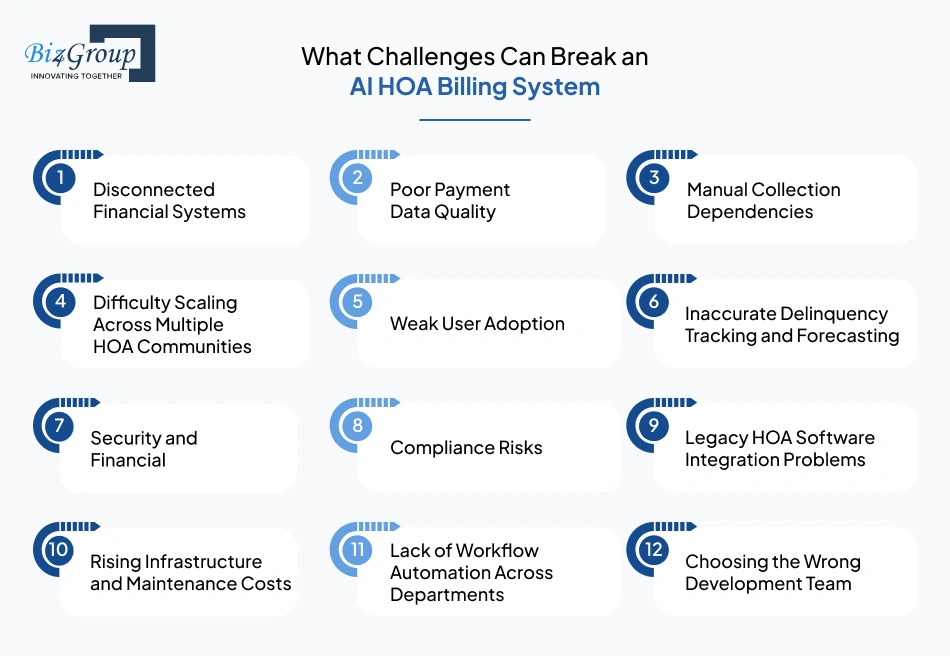
Many companies begin AI HOA dues collection software development with clear operational goals but still face technical, financial, and scalability challenges during implementation.
These issues usually appear when businesses try to develop scalable HOA payment collection software with AI features without properly planning integrations, reporting workflows, forecasting systems, and multi-community operations.
The table below covers the most common problems companies face while trying to build AI HOA financial management platforms and how experienced development teams solve them early.
|
Challenge |
Why It Happens |
How Companies Solve It |
|---|---|---|
|
Disconnected Financial Systems |
Many HOA companies use separate tools for billing, accounting, reporting, communication, and resident management, creating fragmented operations and inconsistent financial records. |
Businesses solve this by centralizing workflows through AI integration services to improve operational visibility and reporting accuracy. |
|
Poor Payment Data Quality |
Historical payment records are often incomplete, inconsistent, or manually maintained across different HOA communities. This affects reporting and forecasting accuracy. |
Companies standardize and clean financial records before implementing automation and forecasting systems. |
|
Manual Collection Dependencies |
Finance teams still spend hours managing reminders, updating spreadsheets, and tracking overdue accounts manually. |
Businesses evaluating developing AI HOA dues collection software to reduce late payments and improve cash flow often first analyze how much is manual HOA management actually costing your company before modernizing workflows. |
|
Difficulty Scaling Across Multiple HOA Communities |
Platforms built for smaller associations often fail once reporting complexity, payment volume, and operational workflows increase across communities. |
Companies planning to build AI-powered HOA billing systems for property management companies usually implement modular architecture and scalable cloud infrastructure from the beginning. |
|
Weak User Adoption |
HOA managers, finance teams, and homeowners avoid systems that feel overly technical or difficult to navigate daily. |
Businesses improve adoption rates by simplifying workflows, dashboards, and resident experiences during platform planning. |
|
Inaccurate Delinquency Tracking and Forecasting |
Forecasting systems become unreliable when there is insufficient payment history or weak financial modeling logic. |
Companies improve forecasting gradually while building AI systems for HOA delinquency detection and financial forecasting using real payment behavior and collection history over time. |
|
Security and Financial Compliance Risks |
HOA systems handle sensitive homeowner and payment information, increasing the risk of security vulnerabilities and compliance issues. |
Teams solve this with encrypted transactions, role-based permissions, audit logs, secure APIs, and compliance-focused infrastructure. |
|
Legacy HOA Software Integration Problems |
Older HOA tools often lack flexible APIs, making data migration and synchronization difficult during modernization projects. |
Businesses usually modernize systems gradually instead of replacing all operational tools simultaneously. |
|
Rising Infrastructure and Maintenance Costs |
Poor backend planning during early development stages creates scalability and maintenance issues later. |
Companies reduce long-term operational costs by planning reusable workflows and scalable infrastructure during platform architecture. |
|
Lack of Workflow Automation Across Departments |
Collections, reporting, accounting, and communication teams often operate separately, slowing down HOA financial operations. |
Businesses solving larger operational inefficiencies increasingly invest in agentic AI development to automate multi-step financial and operational workflows. |
|
Choosing the Wrong Development Team |
Some vendors can build software but lack experience with HOA operations, fintech systems, reporting workflows, and payment infrastructure. |
Many businesses reduce implementation risks by choosing specialized teams or deciding to hire AI developers experienced in automation and financial platforms. |
Most challenges during HOA dues collection automation software development are not caused by the software idea itself.
They happen because operational workflows, scalability planning, integrations, and financial infrastructure are not properly planned before development starts.
That’s why choosing the right technology partner becomes one of the most important decisions during the entire project lifecycle.
Choosing the Wrong Development Partner Could Cost You Thousands. So, What Should You Actually Ask Before Hiring One?
Choosing the right partner during AI HOA dues collection software development affects platform scalability, reporting accuracy, payment workflows, and long-term operational stability.
Many property management companies realize this only after dealing with delayed timelines, weak integrations, reporting limitations, or systems that cannot scale across growing HOA portfolios.
This is why businesses searching for companies that develop AI HOA dues collection software in USA now evaluate operational expertise as carefully as technical capability.
1. Do They Understand HOA Financial Operations or Just Software Development?
Many development companies can build software interfaces but lack experience with HOA collections, billing structures, delinquency handling, and financial reporting workflows.
That’s why businesses often say: "we are looking for US-based companies that can develop AI HOA dues collection software with automation, predictive analytics, and cash flow management features"
A team experienced in AI HOA management software development usually understands operational workflows much better, reducing reporting and automation issues later.
2. Have They Built Financial or Real Estate Platforms Before?
HOA platforms handle recurring payments, financial reporting, resident operations, and sensitive payment data daily. Companies with experience building real estate AI software generally have stronger expertise in payment infrastructure, reporting systems, and operational scalability compared to generic software vendors. This becomes especially important for businesses planning to build AI-powered HOA billing systems for property management companies handling multiple communities.
3. Can They Handle Multi-Community Operations Properly?
Many platforms work well for smaller HOA associations but struggle once multiple communities, permission layers, and financial reporting structures are added. That’s why businesses managing large portfolios often look for partners who understand multi-community architecture before trying to develop scalable HOA payment collection software with AI features.
4. Do They Offer Custom Development or Generic Templates?
Some vendors rely heavily on prebuilt templates that limit integrations, reporting flexibility, and future scalability. This is usually where companies begin comparing custom development with AI HOA software development vs. off-the-shelf solutions before making a technology decision.
5. What Happens After the Platform Goes Live?
Many businesses focus only on development timelines and overlook long-term maintenance, operational scaling, and workflow improvements after launch.
This becomes a major concern for companies saying: "I want to find a company that can build an AI-powered HOA payment collection system to reduce delinquencies and improve financial performance"
That’s why businesses evaluating cost to build AI-powered HOA payment collection and delinquency management systems should also assess long-term support strategy before selecting a development partner.
6. Are They Planning the Platform for Future Scalability?
A platform built only for current operational requirements often becomes expensive to rebuild later as communities, users, and reporting needs grow. Businesses evaluating cost to develop AI HOA management software usually focus heavily on scalability planning because architecture decisions directly affect future operational costs.
7. Can the Platform Support Future Automation Expansion?
Many HOA companies eventually expand beyond collections into reporting automation, resident communication, forecasting, and operational workflows. This is why businesses planning to build AI HOA financial management platforms often choose development partners capable of supporting future platform expansion without major architectural changes later.
Once businesses understand what to look for in a development company, the final question becomes much clearer: Why are more HOA management companies choosing Biz4Group for AI HOA dues collection software development?
Why Are Property Management Companies Choosing Biz4Group for AI HOA Dues Collection Software Development?
Building a successful HOA dues collection platform requires much more than payment automation.
It requires a development team that understands financial workflows, operational scalability, reporting systems, multi-community management, and long-term platform architecture.
That’s where Biz4Group stands out.
As an experienced AI development company, Biz4Group helps businesses develop AI HOA dues collection software that supports automated billing, delinquency tracking, payment forecasting, resident operations, and centralized financial management from one scalable platform.
Many companies approach us with requirements like: "I need a company that can build an AI system for HOA payment tracking, reminders, and financial forecasting for our communities"
Our team focuses on building systems that solve real operational problems instead of delivering generic software templates.
From payment workflows and forecasting systems to resident portals and reporting automation, Biz4Group helps property management companies build platforms designed for long-term operational growth.
Businesses evaluating top AI HOA management software development companies in USA often prioritize vendors with proven experience in automation, financial platforms, and scalable operational systems.
That’s why companies looking to build AI HOA financial management platforms choose Biz4Group for end-to-end strategy, development, integration, and long-term platform scalability.
Ready to Build an HOA Platform That Actually Scales?
From payment automation to forecasting and multi-community management, Biz4Group helps you build HOA software designed for long-term operational growth.
Start Your HOA Software ProjectWrapping Up!
Late payments, inconsistent collections, and manual financial tracking can quietly slow down HOA operations as community portfolios grow.
That’s why more property management companies are investing in AI HOA dues collection software development and looking to build AI-based HOA cash flow management systems that improve collection visibility, automate financial workflows, and reduce operational pressure on accounting teams.
The right platform does more than automate reminders.
It helps you manage collections proactively, improve financial planning, and create a more stable operational structure across every HOA community you manage.
At Biz4Group, we work closely with property management companies to build scalable HOA platforms tailored to real operational challenges, not generic software assumptions. From payment automation and delinquency tracking to forecasting and multi-community management, our focus stays on building systems that support long-term business growth.
If your team is planning to develop AI HOA dues collection software that improves cash flow consistency, reduces manual effort, and scales with your HOA operations, Biz4Group is ready to help you build the right platform from the ground up.
FAQ
1. What is AI HOA dues collection software development?
AI HOA dues collection software development involves building a platform that automates HOA billing, payment reminders, delinquency tracking, financial reporting, and cash flow monitoring for property management companies and HOA communities. Unlike traditional HOA software, these platforms help businesses manage collections, reporting, and financial workflows more efficiently across multiple communities.
2. How much does it cost to build AI-powered HOA payment collection software?
The cost to build AI-powered HOA payment collection and delinquency management systems typically ranges between $20,000 to $150,000+ depending on platform complexity, integrations, reporting requirements, automation workflows, and scalability needs. Smaller MVP platforms cost less, while enterprise systems with forecasting, resident portals, and multi-community management require larger investments.
3. How long does it take to develop AI HOA dues collection software?
The timeline for developing AI HOA dues collection software to reduce late payments and improve cash flow depends on the platform scope and feature complexity. Most MVP platforms with core billing, reminders, and payment tracking features usually take around 2 to 4 weeks. Larger enterprise platforms with forecasting, reporting systems, multi-community management, and advanced automation workflows can take around 6 to 8 weeks.
4. What features should an AI-powered HOA dues management platform include?
Companies planning to create AI-powered HOA dues management software usually prioritize features like automated billing, payment tracking, delinquency monitoring, financial reporting, resident portals, forecasting dashboards, and multi-community management. Modern platforms also integrate payment gateways, accounting systems, and communication workflows into one centralized operational system.
5. Can AI HOA software work for property management companies handling multiple communities?
Yes. Many businesses now build AI-powered HOA billing systems for property management companies specifically to manage collections, reporting, and financial operations across multiple HOA communities from one platform. This becomes especially important for companies struggling with fragmented reporting systems and manual collection workflows across growing portfolios.
6. Should you build custom HOA software or use off-the-shelf platforms?
The answer depends on operational complexity and long-term scalability goals. Smaller HOA communities may use prebuilt software successfully, but businesses managing larger portfolios often choose custom development for better reporting flexibility, integrations, workflow control, and scalability. This is one reason companies compare custom platforms with off-the-shelf solutions before investing in long-term HOA software development.
7. Which company should you choose for AI HOA dues collection software development?
Businesses searching for companies that develop AI HOA dues collection software in USA usually look for teams with experience in financial systems, automation workflows, payment infrastructure, and scalable HOA operations. As an experienced AI development company, Biz4Group helps property management companies build secure, scalable, and operationally efficient HOA dues collection platforms tailored to real-world business workflows.
