 Location :
Orlando, FL, USA
Location :
Orlando, FL, USA +1 (407) 714-1616
 info@biz4group.com
- AI lease agreement generator platforms automate lease drafting using templates and clause logic. Property teams generate accurate contracts faster while reducing manual documentation effort.
- Businesses invest in AI lease agreement generator platform development to streamline leasing workflows, manage contract volume, and maintain consistent agreements across multiple properties.
- Real estate companies and proptech startups use automation to improve efficiency, strengthen compliance control, and scale leasing operations without increasing administrative workload.
- AI lease agreement generator platform development investment ranges between $30,000–$200,000+, depending on platform features, integrations, document automation capabilities, and long-term scalability requirements.
- Companies planning to build AI powered lease agreement software often focus on automated contract generation, clause intelligence, secure document storage, and integrations with property management systems.
- Working with Biz4Group LLC helps businesses design scalable leasing platforms that combine automation, legal workflow accuracy, and modern proptech product architecture.
Property leasing generates a steady stream of agreements that must be accurate, compliant, and easy to manage. Each contract carries details about tenants, payment terms, property clauses, and legal conditions. As the leasing activity grows across multiple properties, preparing these documents manually becomes a repetitive operational task that consumes time across legal and property teams.
If you’re also wondering how real estate leasing teams can generate legally structured agreements faster without increasing administrative workload? Then developing an AI lease agreement generator platform development could be the solution you’re looking for. As this allows lease documents to be generated from structured inputs rather than manual drafting.
Here’s what the market has to say:
- The leasing automation software market is projected to reach $1.94 billion in 2026 to $2.64 billion by 2030, growing at a CAGR of 8.0%.
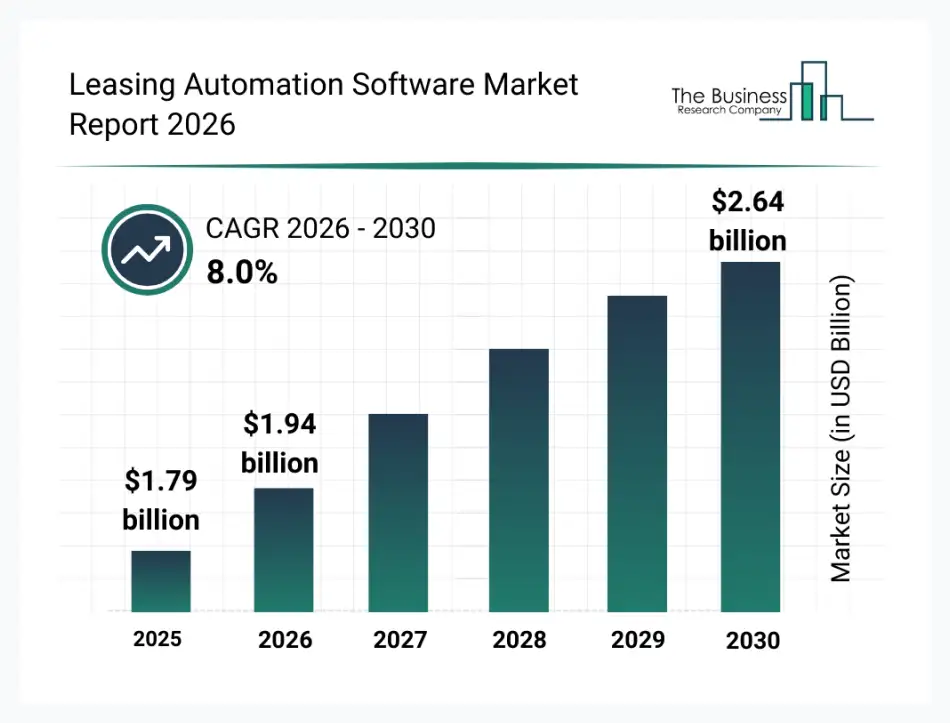
This growth is being driven by expanding commercial leasing portfolios, increasing compliance reporting requirements, and the broader shift toward automated document workflows across property management systems.
Key operational needs driving the need to develop scalable AI lease agreement management platform include:
- Faster lease agreement creation across multiple properties
- Better consistency in contract clauses and document formats
- Automated compliance checks for different lease conditions
- Centralized document workflows powered by AI automation
This blog will walk you through development strategies, platform features, real-world use cases, cost factors, and how a custom software development company support businesses when implementing software in their existing workflows.
What Is AI Powered Lease Agreement Software and How Does It Work?
AI powered lease agreement software is a platform that generates lease contracts using structured information provided by users. Property managers enter tenant details, lease duration, rent terms, and property rules. The platform organizes this data and assembles a complete agreement using predefined clauses and templates.
In many real estate products, generative AI assists with drafting contract language that fits specific lease conditions. This capability often becomes a core part of modern AI lease agreement generator platform development for property platforms.
Also Read: Building Effective Generative AI Solutions
Core Components Behind AI Lease Contract Automation
- NLP for Legal Language: Natural language processing helps the system understand legal terms and contract language. It allows the platform to interpret lease details and map them correctly to relevant clauses within the agreement.
- Clause Recommendation Systems: Clause recommendation systems analyze lease inputs such as tenant type, property category, and lease duration. The system then selects contract clauses that fit those conditions.
- Automated Template Engines: Template engines organize the structure of lease agreements. They place selected clauses, tenant information, and property details into the correct sections, so every generated contract follows a consistent format.
- Compliance Rule Engines: Compliance rule engines verify that lease terms meet required legal conditions. These rules review key details and help ensure generated agreements remain valid for operational and regulatory requirements.
How an AI Lease Agreement Generator Platform Works
- Lease Details Input: Property managers or platform users enter tenant details, lease duration, payment structure, and property information. These inputs form the base data that the platform uses to prepare the agreement.
- Clause Analysis and Selection: The system reviews the entered information and identifies clauses that match lease conditions. This step organizes legal language, so the agreement reflects the correct lease structure.
- Compliance Validation: Compliance rules check the generated contract for missing or conflicting conditions. This step ensures that the lease agreement follows operational policies and required legal requirements.
- Document Generation: After validation, the platform assembles the final agreement using structured templates and selected clauses. Organizations that build secure AI lease agreement generator software often enable deployment through reliable AI integration with property systems.
Why AI Lease Agreement Generator Platforms Are Essential in The Modern Real Estate Ecosystem
Real estate operations are expanding across digital platforms, property marketplaces, and large commercial portfolios. Managing lease agreements within this environment requires faster document preparation and reliable contract workflows. Understanding this shift helps explain why automation is becoming an operational requirement across modern property management systems.
1. Rapid Growth of Digital Real Estate Platforms
Digital property platforms are expanding rapidly as real estate companies move leasing operations online. Property marketplaces, tenant portals, and property management systems now manage leasing activity across multiple locations and asset types through centralized digital workflows.
Industry projections reflect this shift toward technology-driven real estate operations. The global PropTech market is expected to reach about $53.24 billion in 2026 and grow to nearly $120.74 billion by 2031, as digital tools increasingly support property management and leasing activities.
2. Increasing Contract Volume
Commercial property portfolios generate large volumes of lease agreements every year. Legal and operations teams must process these documents while maintaining accuracy. Many companies now create AI lease document generation software for legal teams to manage contracts more efficiently.
3. PropTech Innovation and Automation
PropTech platforms continue to introduce tools that simplify leasing workflows and document management. Tools such as an AI legal document analyzer help organizations review agreements, detect issues, and manage contract data across property management platforms.
4. Need for Faster Tenant Onboarding
Tenant onboarding depends on quick lease preparation and approval workflows. Automated lease systems help property managers generate agreements faster, which allows businesses to complete leasing processes without delays.
As leasing activity expands across digital platforms, businesses continue adopting automated document systems. Many property platforms are building AI powered lease agreement solutions to manage contracts efficiently while supporting growing real estate operations.
Which Organizations Benefit Most from Custom AI Lease Agreement Generator Platform Development
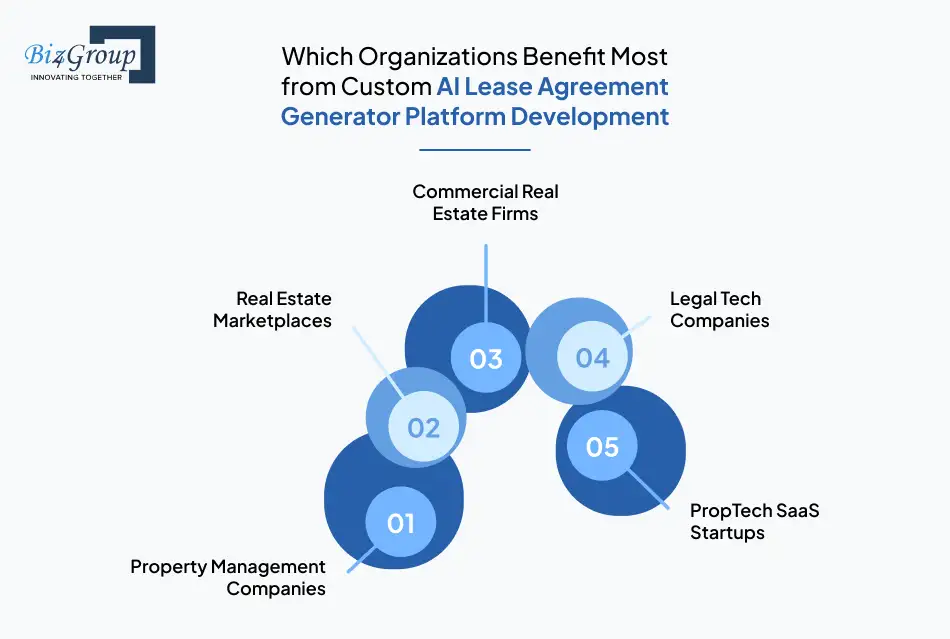
Real estate organizations handle lease agreements across multiple properties, tenants, and legal workflows. As leasing activity expands, many teams look for practical ways to automate contract preparation and keep documents organized. Understanding where automation delivers real value helps businesses evaluate whether AI lease agreement generator platform development fits their operational needs.
1. Property Management Companies
- Property management companies prepare lease agreements for many tenants every month. Automation helps them generate contracts quickly while keeping clauses and document formats consistent across properties.
- Contract data generated through an AI model helps teams track lease terms and property details more efficiently.
2. Real Estate Marketplaces
- Real estate marketplaces manage tenant applications and lease agreements within a single platform. Automated document generation allows agreements to be created immediately after tenant approval.
- Many marketplaces build AI real estate contract generator capabilities so landlords and tenants can finalize lease agreements directly inside the platform.
3. Commercial Real Estate Firms
- Commercial real estate firms manage complex leasing contracts across offices, retail properties, and industrial spaces.
- AI automated lease generation helps their legal teams prepare agreements faster while maintaining accurate contract records for long-term portfolio management.
4. Legal Tech Companies
- Legal technology providers build tools that simplify contract drafting for law firms and property companies.
- Many platforms integrate AI into their legal software so lease agreements can be prepared quickly for real estate clients.
5. PropTech SaaS Startups
- PropTech SaaS startups can embed automated lease generation directly inside property management platforms. This allows landlords or property managers to create lease agreements instantly after tenant details are finalized.
- AI automation also improves product value for customers. Property professionals can manage listings, tenants, and lease agreements within one platform instead of handling contracts separately.
Organizations that manage frequent leasing transactions benefit the most from automated contract generation. These platforms help teams prepare agreements faster, maintain organized lease records, and support growing property portfolios without increasing documentation workload.
Stop Drafting Leases the Old Way
Automate lease creation and simplify contract workflows across your growing property portfolio
Start Your AI Platform PlanWhy Businesses Should Invest in Custom AI Lease Agreement Software Development
Businesses dealing with frequent lease agreements often reach a point where manual drafting slows daily operations. As portfolios expand and contracts increase, companies start looking for systems that can organize lease creation, review, and documentation more efficiently.
1. Improved Operational Control Over Lease Workflows
Custom platforms give businesses better control over how lease agreements are prepared and managed. Instead of relying on scattered templates, companies can structure the entire drafting process within a single system.
- Lease details can be captured in standardized formats before contracts are generated.
- Teams can manage document workflows from one platform without repeating manual drafting steps.
2. Stronger Consistency Across Lease Agreements
Organizations managing multiple properties need every lease agreement to follow consistent clauses and document structures. Custom automation platforms help maintain this consistency across all contracts.
- Standard clause libraries ensure agreements follow the same structure across properties.
- Businesses can maintain uniform contract formats for tenants, landlords, and property managers.
3. Better Integration with Existing Business Systems
Many companies operate property management platforms, real estate CRM systems, or legal tools that handle lease data. Custom development allows businesses to connect contract automation directly with these systems.
- Lease data can move automatically between property platforms and contract generation systems.
- Businesses often introduce these capabilities as part of a broader enterprise AI solution supporting real estate operations.
Also Read: Artificial Intelligence in CRM
4. Scalable Document Automation for Growing Portfolios
As property portfolios grow, contract volumes increase as well. Custom AI lease agreement generator platform development helps businesses design systems that can manage larger leasing workloads.
- Companies can build workflows that handle increasing document volumes without expanding manual effort.
- These platforms along with AI automation tools help organize lease data and generate agreements efficiently.
Organizations investing in lease agreement automation software development using AI gain better control over lease documentation, improve operational workflows, and prepare their platforms to handle growing contract volumes across expanding real estate portfolios.
Real-World Business Use Cases of AI Lease Agreement Generator Platforms
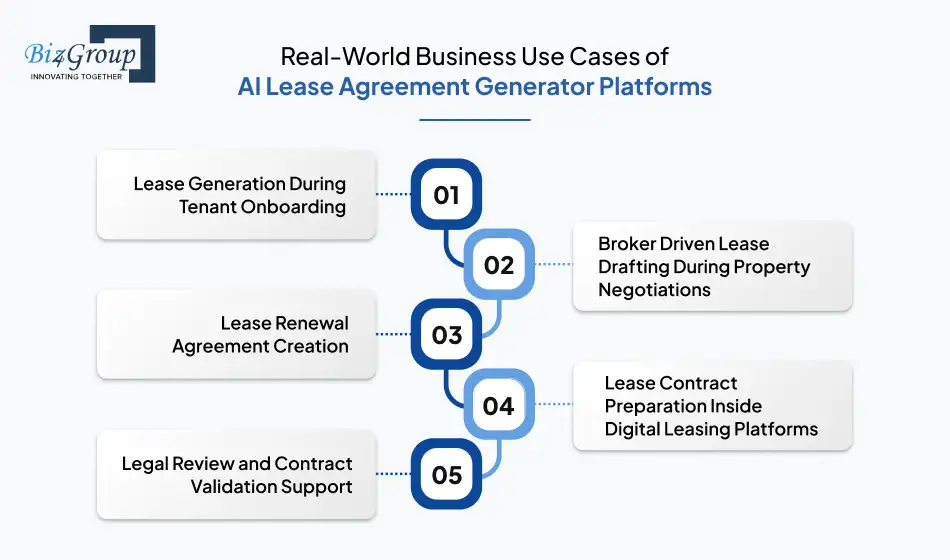
Real estate teams handle lease agreements during several operational moments such as tenant onboarding, property listing activation, renewals, and broker negotiations. Understanding these practical situations helps you see how automated contract generation fits directly into everyday leasing workflows.
1. Lease Generation During Tenant Onboarding
Tenant onboarding often requires preparing lease agreements immediately after application approval. Platforms built through AI lease agreement generator platform development allow property teams to generate contracts instantly using tenant details and property terms already stored in the system.
- Tenant information from application forms automatically fills contract fields.
- Property terms such as rent, duration, and deposit are inserted into the agreement.
- Managers can review and send the document to tenants without manual drafting.
2. Broker Driven Lease Drafting During Property Negotiations
Real estate brokers often finalize lease terms while negotiating between landlords and tenants. AI automated lease generation platforms help brokers prepare agreements quickly once both parties agree on contract terms.
- Brokers enter negotiated lease duration and payment details.
- The system generates a ready lease document for review and signing.
3. Lease Renewal Agreement Creation
Lease renewals occur when tenants continue renting the same property. AI automated lease platforms generate renewal agreements using stored tenant records and existing lease information.
- Tenant data and property terms populate the renewal document automatically.
- Updated rent or duration terms can be inserted before sending the agreement.
4. Lease Contract Preparation Inside Digital Leasing Platforms
Many property platforms include automated document generation as part of leasing workflows. Businesses that create AI based lease management platform solutions often connect contract generation with enterprise AI integration to support document workflows.
- Lease agreements can be generated directly inside leasing dashboards.
- Property teams track contract preparation within the same system used for tenant management.
Similar contract workflow platforms have been developed by Biz4Group LLC to support structured agreement management within digital real estate ecosystem
Real-World Example: ConTracks-Real Estate Contract Management Tool
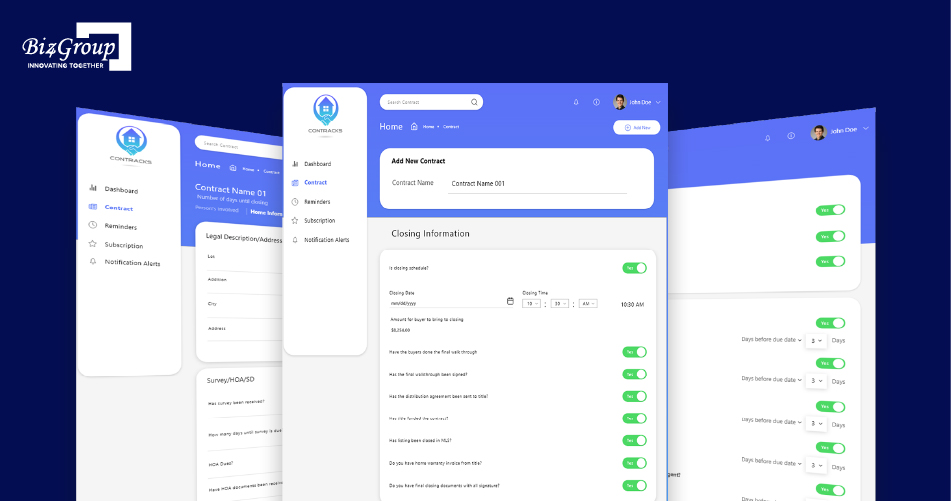
ConTracks is a real estate contract management platform designed to organize transaction documents, track contractual milestones, and maintain visibility across property agreements within a centralized system. Real estate teams use it to monitor contract progress, manage documentation, and coordinate transaction workflows. Platforms built around similar concepts allow leasing systems to manage agreement preparation and contract activity directly within digital property management environments.
5. Legal Review and Contract Validation Support
Legal teams often review lease agreements before they are finalized. AI automated lease platforms support this process by structuring agreements using predefined clauses and contract rules.
- Legal teams can quickly review generated agreements for compliance checks.
- Some systems connect contract preparation workflows with an AI legal consultation platform used for document validation.
These real-world use cases show how automated lease generation supports actual leasing workflows rather than isolated document drafting. Businesses increasingly adopt these systems to streamline lease preparation across operational stages.
Ready To Turn These Use Cases Real
Let's build a platform that generates lease agreements instantly across properties and tenants
Talk to Our ExpertsKey Features Required for AI Lease Agreement Generator Platform Development
Real estate platforms generate lease agreements as part of tenant onboarding, property listings, renewals, and broker transactions. When planning AI lease agreement generator platform development, the platform features determine how efficiently lease documents can be generated, reviewed, and maintained across leasing workflows.
|
Key Feature |
How the Feature Supports AI Lease Agreement Generator Platform |
|---|---|
|
Smart Lease Template Management |
Allows property teams to create reusable lease templates for different property types. Managers can generate contracts quickly using predefined structures without drafting agreements repeatedly. |
|
AI Powered Clause Recommendation Engine |
The system analyzes lease details such as rent terms and property type, then suggests relevant clauses so agreements reflect the correct contract conditions. |
|
Lease Data Input and Validation System |
Structured input forms capture tenant information, lease duration, and payment terms. Validation checks ensure all required data fields are completed before document generation. |
|
Document Version Control |
Lease agreements often require revisions during negotiation or review. Version tracking helps teams monitor contract changes while managing real estate contracts across leasing operations. |
|
Multi Format Lease Document Export |
Generated lease agreements can be exported in multiple formats such as PDF or Word. This allows property teams to share contracts easily with tenants and legal teams. |
|
Digital Signature Integration |
Built-in e-signature capability allows tenants and property managers to sign lease agreements digitally, helping complete leasing documentation within the same platform. |
|
Role Based Access Control |
Access permissions ensure only authorized users can create, edit, or approve lease agreements within the system. |
|
Contract Search and Retrieval |
Lease documents are stored in a searchable repository where teams can find agreements quickly using tenant names, property identifiers, or lease dates. |
|
Compliance Clause Library |
The platform stores commonly used compliance clauses so contracts can include required legal conditions during document generation. |
|
Property Platform Integration |
Lease generation features connect with property management systems. Businesses that build AI software implement this integration to support automated leasing workflows. |
Organizations that create AI powered lease contract automation tool platforms rely on these capabilities to generate contracts accurately while maintaining structured lease documentation across property management operations.
Advanced Features for AI Lease Contract Automation Platforms
Advanced capabilities extend the functionality of lease automation platforms beyond basic document generation. When planning AI lease agreement generator platform development, these features help businesses manage compliance, analyze contract risks, and support large property portfolios more efficiently.
|
Advanced Feature |
How the Feature Enhances Lease Automation Platforms |
|---|---|
|
AI Clause Intelligence Engine |
The platform analyzes lease inputs such as tenant type, property category, and lease duration. It then selects appropriate clauses so agreements reflect correct legal and operational conditions. |
|
Jurisdiction Aware Compliance System |
Lease agreements often follow different rules depending on location. This system applies region specific compliance conditions so contracts generated for different jurisdictions include relevant legal clauses. |
|
Predictive Contract Risk Detection |
The system reviews lease terms and identifies unusual clauses or missing conditions. Some platforms apply predictive analysis to highlight contract risks before the document is finalized. |
|
Automated Lease Renewal and Alerts |
AI lease platforms monitor contract expiry dates and notify property teams before agreements expire. Renewal documents can be generated quickly using stored tenant and lease information. |
|
Multi Property Portfolio Management |
Property companies often manage leases across several buildings or locations. This feature organizes lease records across portfolios so agreements remain accessible and structured. |
|
API Integrations with Real Estate Platforms |
Lease generation systems connect with property management tools, tenant portals, and CRM platforms. These integrations allow lease data to move automatically across real estate systems. |
|
Contract Analytics and Reporting |
Platforms track lease activity such as renewals, contract volumes, and tenant trends. These insights help property teams monitor leasing performance across properties. |
These advanced capabilities support custom AI lease agreement platform development by enabling deeper AI automation and structured contract management. Platforms equipped with these features help organizations manage leasing workflows across growing property portfolios.
Also Read: A Guide to Real Estate AI Predictive Analytics Software
Step-By-Step Process to Develop AI Lease Agreement Generator Platform
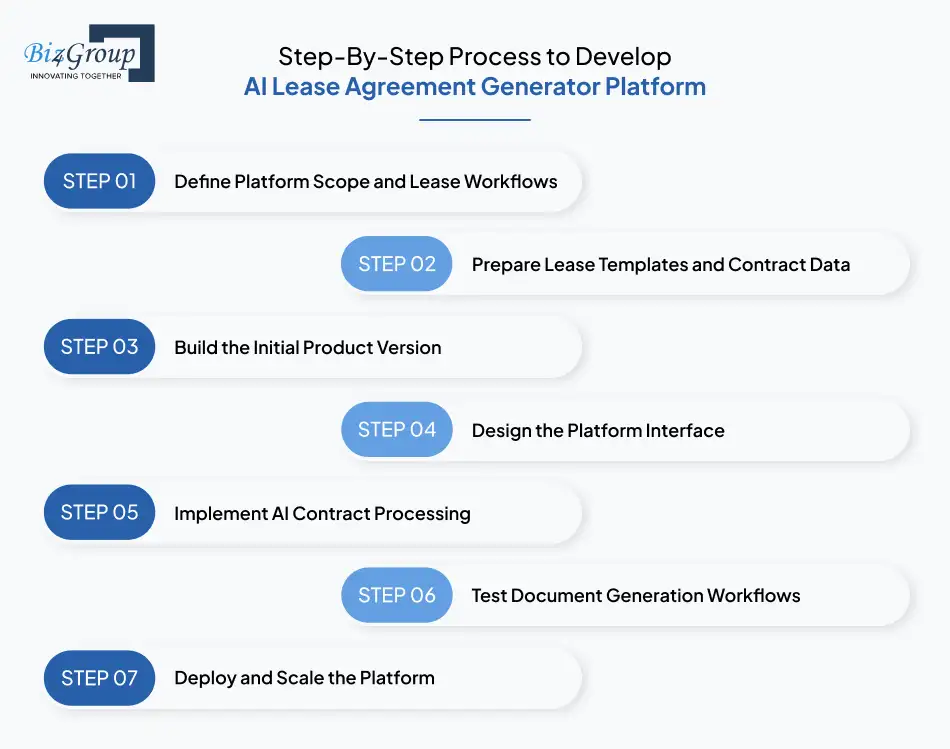
Real estate platforms that generate lease agreements require a structured development roadmap. Each stage focuses on defining contract workflows, preparing lease data, and implementing document automation so the system can support reliable leasing operations.
Step 1: Define Platform Scope and Lease Workflows
The development process begins by defining how lease agreements will move through the platform. Teams identify key workflows such as tenant onboarding, contract preparation, and approval steps.
- Map how users will create lease agreements inside the system.
- Define roles for property managers, legal reviewers, and administrators.
- Document functional requirements for templates, contract storage, and document generation features.
Step 2: Prepare Lease Templates and Contract Data
This stage focuses on building the structure that supports automated contract generation. Teams prepare standardized lease templates and organize the contract data fields used during document creation.
- Create reusable templates for different lease scenarios and property types.
- Build a clause library that supports contract assembly.
- Structure lease data fields such as tenant information, rent terms, deposits, and property conditions.
Step 3: Build the Initial Product Version
The early version of the platform focuses on core document generation capabilities. Create a working basic product that can generate lease agreements using structured templates and clause libraries. Many teams begin with structured development by collaborating with experienced MVP development service providers to validate the concept before expanding features.
- Implement template-based contract generation.
- Test core document workflows with sample lease scenarios.
- Expand functionality through iterative MVP software development
Also Read: Top MVP Development Companies in USA
Step 4: Design the Platform Interface
The platform interface must allow users to generate lease agreements easily. Clear workflows help property teams enter contract details and review documents without confusion. Many teams collaborate with a UI/UX design company to design intuitive contract generation dashboards.
- Build forms for entering tenant details and lease terms.
- Design dashboards for managing templates and generated agreements.
- Ensure the interface supports smooth contract review workflows.
Also Read: Top UI/UX Design Companies in USA
Step 5: Implement AI Contract Processing
This stage introduces intelligent document automation into the platform. Development teams prepare contract datasets and train AI models so the system can recommend clauses based on lease inputs.
- Prepare lease datasets used during AI model training.
- Configure clause recommendation workflows.
- Connect contract generation logic with AI processing modules that integrate AI models within the platform.
Step 6: Test Document Generation Workflows
Testing ensures that lease agreements are generated correctly across different leasing scenarios. Teams validate template behavior, clause selection, and document formatting before the platform is deployed. Many projects involve a specialized software testing company to perform detailed validation.
- Test lease generation using multiple contract conditions.
- Verify clause placement and template accuracy.
- Confirm that generated documents are stored and retrieved correctly.
Step 7: Deploy and Scale the Platform
The final stage focuses on deployment and operational readiness. The platform is launched on stable infrastructure so contract generation workflows remain reliable. Businesses often continue improving features as they develop AI lease agreement generator platform capabilities to support expanding property portfolios.
- Deploy the platform on scalable infrastructure.
- Monitor document generation workflows after launch.
- Expand automation features as leasing operations grow.
A structured roadmap helps organizations manage AI lease agreement generator platform development while maintaining reliable document workflows. Each stage ensures the system supports automated contract generation and scalable lease management.
Have An Idea for Lease Automation
Let's discuss your platform idea and map the right development roadmap together
Discuss Your Platform IdeaTechnology Stack Considerations for AI Lease Agreement Generator Platform Development
AI lease agreement automation platform requires technologies that support document generation, data processing, and contract workflows. Platforms that make AI lease agreement generator with compliance features must also support integrations across modern web development and mobile app development environments.
|
Architecture Layer |
Recommended Technology |
Purpose |
|---|---|---|
|
Frontend Interface |
React |
Builds interactive contract dashboards and lease form interfaces through structured ReactJS development for managing tenant inputs and contract previews. |
|
Server-Side Rendering |
Next.js |
Improves platform performance and routing for contract dashboards using NextJS development so users can access lease workflows quickly. |
|
Backend Services |
Node.js |
Handles document generation logic, contract workflows, and authentication through scalable backend architecture supported by NodeJS development. |
|
AI Processing Layer |
Python |
Processes contract data and clause analysis engines. Platforms rely on Python Development to run AI models that analyze lease templates and contract conditions. |
|
Integration Layer |
REST / GraphQL APIs |
Connects lease automation with tenant portals and property systems through structured API development so lease data flows between platforms. |
|
Document Generation Engine |
Puppeteer / PDFKit |
Generates lease agreements in structured document formats that can be shared, stored, or signed digitally. |
|
Database Layer |
PostgreSQL / MongoDB |
Stores lease templates, clause libraries, tenant data, and generated agreements for easy retrieval and management. |
|
File Storage |
AWS S3 / Azure Blob |
Securely stores generated lease agreements and contract files for long-term document management. |
|
Search & Indexing |
Elasticsearch |
Enables fast searching of lease agreements by tenant name, property ID, or lease period. |
|
Cloud Infrastructure |
AWS / Azure / GCP |
Provides scalable infrastructure to host the platform and manage growing contract volumes. |
A carefully selected stack ensures lease generation workflows remain stable while supporting integrations and document automation. Successful AI lease agreement generator platform development often requires experienced teams capable of delivering reliable systems through strong full stack development expertise.
Also Read: Why to Choose the Full Stack Development for Modern Business
Estimating The Cost to Develop AI Lease Agreement Generator Platform
Building a AI lease agreement generator platform involves several technical components such as document generation engines, clause libraries, AI-driven contract logic, and platform integrations. The typical investment for AI lease agreement generator platform development usually ranges between $30,000 and $200,000+, depending on feature depth and automation capabilities.
|
Development Level |
Scope |
Estimated Cost Range |
|---|---|---|
|
MVP Level AI Lease Agreement Generator Platform |
Basic lease template management, automated document generation, clause library, and export functionality used to validate the platform concept with early users. |
$30,000 – $60,000 |
|
Mid-Level AI Lease Agreement Generator Platform |
Adds clause recommendation logic, lease data validation, contract dashboards, and integrations with property management systems. |
$60,000 – $120,000 |
|
Advanced-Level AI Lease Agreement Generator Platform |
Includes automated compliance validation, portfolio level contract management, AI-driven clause intelligence, and analytics for large leasing platforms. |
$120,000 – $200,000+ |
Understanding the cost range helps, but several development factors influence the final project budget.
Cost Drivers Affecting the Aptos (Body) Development of AI Lease Agreement Generator Platform
- Lease Document Automation Engine: The complexity of the document generation system directly affects development efforts. Platforms designed to develop AI lease document automation software require structured template engines and clause processing logic.
- AI Clause Recommendation Logic: AI modules that analyze lease inputs and suggest contract clauses increase development scope. Preparing datasets and implementing recommendation systems contributes to overall AI integration costs.
- Property Platform Integrations: Connecting lease automation with tenant portals, CRM systems, and property management tools increases engineering effort because multiple systems must exchange contract data.
- Security and Document Access Controls: Lease agreements contain sensitive legal information. Secure storage, role-based access, and audit logs increase the engineering effort that contributes to overall AI software development cost.
- Portfolio Level Contract Management: Platforms managing agreements across hundreds of properties require scalable infrastructure and advanced search capabilities, which increases system complexity.
Now let’s look at a few practical ways to control development investment.
How to Optimize the Cost to Build AI Lease Agreement Generator Platform
- Define the Minimum Feature Scope Early: Start with only the features required for lease generation, clause selection, and document export. Avoid building advanced modules during the first phase to keep initial development costs controlled.
- Use Predefined Lease Templates: Design reusable lease templates instead of generating contracts from scratch for every scenario. This reduces engineering effort because the platform only assembles documents using existing structures.
- Centralize the Clause Library: Maintain a single clause repository used across all lease templates. Updating clauses in one location prevents repeated development work and lowers the cost of maintaining the platform.
- Plan Integrations Before Development Begins: Identify property management systems, CRM tools, and tenant portals that must connect with the platform. Early planning prevents costly integration redesign during later development stages.
A clear development scope and phased roadmap help control costs while building a scalable lease automation platform. Careful planning ensures that the investment supports reliable contract generation and long-term platform growth.
Also Read: AI Real Estate Software Development Cost
Curious What Your Platform Will Cost
Let's estimate the development cost based on your features, integrations, and lease automation goals
Get Your Cost EstimateMonetization and Business Models AI Based Lease Management Platform
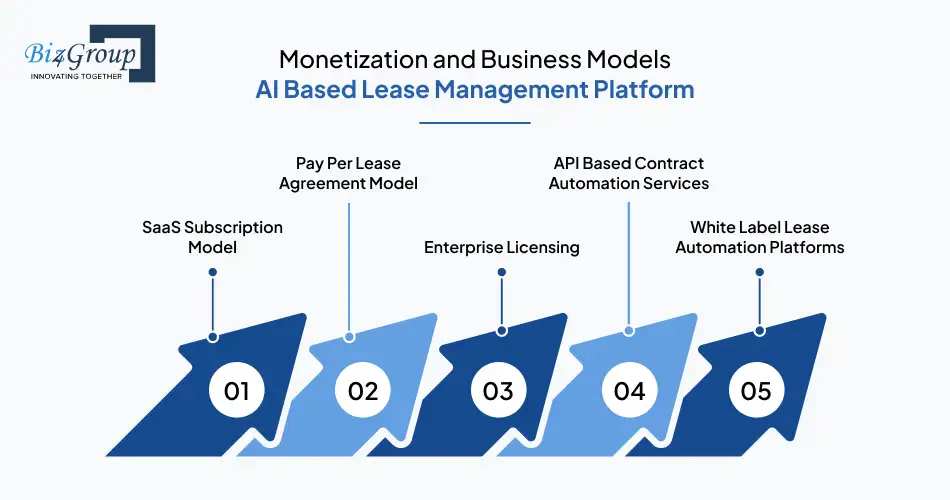
Lease automation platforms generate value not only through document generation but also through flexible revenue models. Businesses that create AI lease contract generator platform solutions often adopt multiple monetization strategies depending on the product scope and customer base.
1. SaaS Subscription Model
Many lease automation platforms operate as subscription-based software products. Property companies, brokers, and legal teams pay a recurring monthly or yearly fee to access the platform.
- Customers subscribe to different pricing tiers based on contract volume or features.
- Higher tiers often include advanced automation capabilities and portfolio management tools.
2. Pay Per Lease Agreement Model
Some platforms charge customers for every lease agreement generated through the system. This model works well for businesses that handle irregular contract volumes.
- Users pay a fixed fee each time a lease document is created.
- Property platforms can control costs because charges scale with actual contract usage.
3. Enterprise Licensing
Large property management companies often prefer enterprise licensing for internal platforms. This model provides full access to lease automation tools across the organization.
- Companies pay a fixed licensing fee for platform access.
- Enterprise plans usually include custom integrations and advanced workflow features.
4. API Based Contract Automation Services
Platforms can expose lease generation capabilities through APIs. Other real estate platforms or property software providers can connect to the system to generate lease documents.
- Real estate platforms integrate lease automation features into their own products.
- Businesses offering AI lease agreement generator platform development often monetize these integrations through usage-based API pricing.
5. White Label Lease Automation Platforms
Some providers allow other businesses to rebrand the lease automation system and offer it as their own product.
- Property software companies launch branded leasing tools using the same automation engine.
- Providers earn revenue through licensing or platform usage fees.
Well-structured monetization models allow lease automation platforms to generate steady revenue while serving different real estate businesses. Selecting the right pricing strategy helps providers scale their product and expand adoption across the leasing ecosystem.
Also Read: 65+ Software Ideas for Entrepreneurs
Key Challenges in AI Lease Agreement Software Development
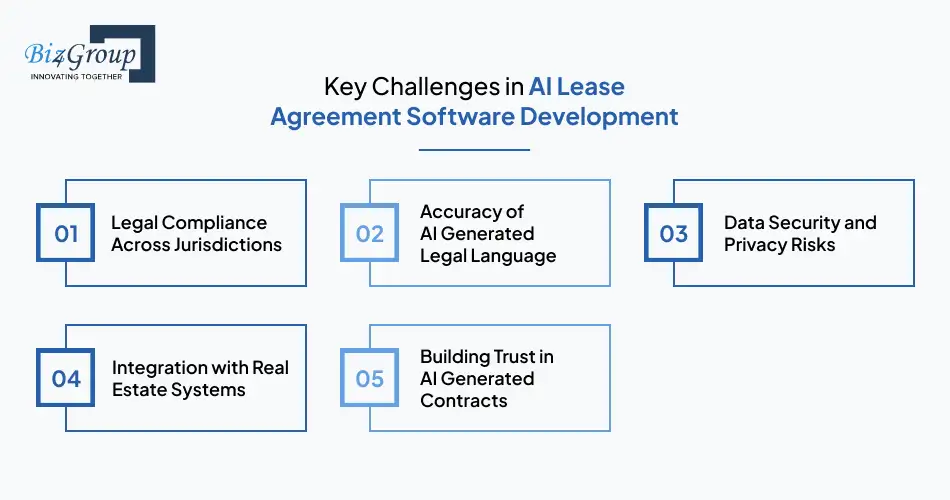
Automating lease agreements introduces several technical and legal challenges that development teams must address carefully. When planning AI lease agreement generator platform development, businesses must ensure contract accuracy, system security, and reliable integration with real estate platforms.
1. Legal Compliance Across Jurisdictions
Challenge: Lease regulations vary across cities, states, and countries. Automated contract systems must account for these differences, so generated agreements include the correct legal clauses for each jurisdiction.
Solution: Development teams design configurable rule engines that apply region specific clauses. Many businesses now work with AI consulting services to define compliance logic before deploying contract automation platforms.
2. Accuracy of AI Generated Legal Language
Challenge: Lease agreements contain detailed legal language. If the system generates inaccurate clauses, the contract may not reflect the correct rental terms or legal requirements.
Solution: Development teams should hire AI developers who train models using structured lease templates and verified clause libraries, so generated contracts follow approved legal formats.
3. Data Security and Privacy Risks
Challenge: Lease platforms store sensitive tenant information such as personal details, financial records, and rental agreements. Weak security controls can expose confidential contract data.
Solution: Platforms must include encryption, secure storage, and role-based access controls so only authorized users can access lease documents and tenant information.
4. Integration with Real Estate Systems
Challenge: Lease automation platforms must connect with property management systems, CRM tools, and tenant portals. Without proper integration, contract data remains fragmented across different platforms.
Solution: Developers should design API-driven integrations, so lease agreements can move between leasing systems and property platforms without manual data entry.
5. Building Trust in AI Generated Contracts
Challenge: Property managers and legal teams may hesitate to rely on automated contracts because they want assurance that generated agreements are accurate and legally valid.
Solution: AI powered lease agreement software should include review workflows and audit logs so teams can verify contract terms before finalizing agreements.
Addressing these challenges early helps development teams create reliable lease automation platforms. Careful system design ensures automated agreements remain secure, compliant, and trusted across real estate leasing operations.
Future Trends in AI Lease Contract Automation Platforms
AI lease agreement generator platforms continue to evolve as real estate operations become more digital. New technologies are expanding in how contracts are drafted, negotiated, and managed. Businesses investing in AI lease agreement generator platform development are beginning to adopt innovations that extend automation beyond basic document generation.
1. Generative AI for Legal Contract Drafting
Future platforms will use generative systems that draft lease agreements from structured property and tenant data. Many solutions will include a legal AI agent that assists with drafting clauses and assembling contracts.
2. AI Assisted Contract Negotiation Tools
Future lease platforms will include tools that review lease terms during negotiations. These systems will identify risky clauses and suggest revisions so landlords and tenants can finalize agreements more efficiently.
3. Blockchain Based Smart Lease Agreements
Blockchain based smart lease contracts will store agreements as secure digital records. These contracts will automatically trigger payments, renewals, or alerts when predefined conditions written in the agreement are met.
4. Voice Driven Lease Document Generation
Future AI lease agreement generator platforms will allow property managers to dictate lease terms through voice commands. The system will convert spoken instructions into structured lease agreements ready for review.
- End to End AI Lease Lifecycle Management
Next generation systems will manage the entire lease lifecycle. Businesses investing in AI lease agreement generator platform development will adopt platforms that handle drafting, approvals, renewals, and contract tracking.
Future innovations will continue transforming lease management platforms. These technologies will support smarter contract creation, automated negotiation workflows, and more reliable management of lease agreements across digital real estate ecosystems.
Why You Should Choose Biz4Group LLC For AI Lease Agreement Generator Platform Development
We understand that building a lease automation platform requires more than just coding features. As a legal software development company, we focus on practical product architecture and reliable automation. At Biz4group LLC, our approach combines domain knowledge, structured engineering, and real experience building platforms used across legal tech and property technology environments.
- Experience Building AI Driven Legal Platforms: Our team has worked on multiple products within legal tech, where contract generation, document workflows, and compliance logic are critical. This experience helps us design platforms that handle lease generation with accuracy and structured automation.
- Strong Expertise in Real Estate AI Solutions: Lease automation systems must align with real estate workflows. Our experience in real estate AI software development allows us to design platforms that connect contract generation with property management operations.
- Understanding of Property Technology Ecosystems: Platforms for lease automation often integrate with tenant portals, listing systems, and CRM tools. Our experience working in real estate tech helps us build systems that connect smoothly with these operational platforms.
- Proven Development Portfolio Across AI Platforms: We bring practical experience from our development portfolio, where we have delivered AI powered platforms that automate business workflows while maintaining system reliability.
- Focused Approach to Custom AI Platforms: Every product we build is designed around the client's operational workflows. When organizations want to build AI powered lease agreement software, we develop systems that align with their leasing processes and platform architecture.
Our team approaches AI lease agreement generator platform development with a clear focus on reliability, integration, and real-world usability. This approach allows us to deliver automation platforms that support legal workflows and modern property management operations.
Let's Build Your Lease Automation Platform
Partner with Biz4Group to turn your leasing workflows into a scalable AI powered platform
Contact Our TeamConclusion
AI Lease agreements sit at the core of real estate operations. As leasing volumes grow, preparing and managing these contracts manually becomes difficult for property teams and legal professionals. This is where automation begins to make a measurable difference. AI lease agreement generator platform development helps organizations generate contracts faster while maintaining structured documentation across leasing workflows.
For real estate companies, proptech startups, and legal organizations, automation simplifies how agreements are drafted, reviewed, and stored. Automated systems reduce repetitive document preparation and help teams manage contracts across larger property portfolios. This is why many organizations are now investing in AI lease agreement software development to modernize how leasing documents are created and maintained.
Working with an experienced AI product development company helps ensure that the platform aligns with real operational workflows and compliance requirements. If your team is planning to a new leasing platform, we would be happy to discuss your idea and help you move the project forward.
FAQ's
1. What is an AI lease agreement generator platform and how does it work in real estate operations?
An AI lease agreement generator platform automatically creates lease contracts using structured property data, tenant details, and predefined legal clauses. The system analyzes inputs such as lease terms, rent value, and property rules, then assembles a legally structured agreement. This allows property managers and legal teams to generate lease documents quickly while maintaining consistent contract formats across different properties.
2. How can real estate companies develop an AI lease agreement generator platform for their property management systems?
To develop an AI lease agreement generator platform, companies typically build a system that includes lease templates, clause libraries, AI-driven clause selection, document generation, and integrations with property management tools. The platform captures lease data from tenant workflows and converts it into structured agreements that can be reviewed, signed, and stored digitally.
3. What is the typical cost of AI lease agreement generator platform development?
The cost of AI lease agreement generator platform development usually ranges between $30,000 and $200,000+ depending on features, AI capabilities, and system integrations. Platforms with basic lease generation features cost less, while advanced systems with clause intelligence, compliance automation, and portfolio management require larger development investment.
4. What features are required to build secure AI powered lease agreement software for property platforms?
To build secure AI powered lease agreement software, platforms typically include lease template management, clause recommendation engines, document generation systems, compliance validation rules, role-based access control, and secure document storage. These features help property teams generate accurate contracts while protecting tenant data and lease documentation.
5. Can AI lease agreement software support compliance across different states or jurisdictions?
Yes. Modern platforms can make AI lease agreement generator with compliance features by using configurable rule engines and clause libraries. These systems insert location-specific legal clauses into lease agreements, so contracts follow the required regulations for each state or region.
6. Who should invest in custom AI lease agreement platform development?
Organizations that manage frequent lease agreements benefit the most from custom AI lease agreement platform development. This includes real estate companies, property management firms, commercial landlords, legal teams handling leasing contracts, and proptech startups building digital leasing platforms.
