 Location :
Orlando, FL, USA
Location :
Orlando, FL, USA +1 (407) 714-1616
 info@biz4group.com

- Building telemedicine AI agent helps automate patient intake, triage, and consultations, reducing manual workload and improving care delivery efficiency.
- A telemedicine AI agent works through NLP, decision workflows, and integrations, enabling real-time interaction and clinical support in virtual care systems.
- Core components include AI models, EHR integration, remote monitoring, and secure data systems to ensure scalable and compliant healthcare solutions.
- Development involves clear steps like MVP planning, workflow design, system integration, testing, and deployment for reliable performance.
- Costs to develop telemedicine AI agent for healthcare typically range from $20,000 to $150,000+, depending on features, compliance, and complexity.
- Partnering with an experienced team like Biz4Group helps accelerate custom telemedicine AI agent development with proven healthcare AI expertise and scalable architecture.
Why does your telemedicine platform still rely so heavily on manual effort, even after investing in digital tools?
You’ve built the system. Patients can book consultations. Maybe you’ve even added automation. But your team is still overloaded. Response times lag. And scaling feels harder than it should be.
That’s where things start to break and it’s exactly why more healthcare leaders are now investing in building telemedicine AI agent systems.
The shift is already happening. According to a report, estimates that up to $250 billion of US healthcare services could be delivered virtually. Another research projects the telemedicine market will reach over $380 billion by 2030, driven largely by AI adoption
This isn’t just growth. It’s a change in how care is delivered and scaled.
So naturally, questions start coming up:
- We want to build a telemedicine AI agent for remote patient consultations, how should we get started
- I want to understand how telemedicine AI agents work and how we can build AI agent for telemedicine platform
- We are looking for companies that can develop telemedicine AI agent for healthcare with EHR integration and compliance
If that sounds like your situation, you’re not alone.
Basic tools can only take you so far. To truly scale, you need systems that can operate intelligently across your workflows.
That’s where building AI agents for telemedicine systems and creating telemedicine AI assistant for healthcare becomes a real advantage.
To understand how automation fits into this shift, this breakdown of an AI-based telehealth automation system shows how intelligent systems are reshaping care delivery.
Here, we’ll walk you through how to develop telemedicine AI agent solutions the right way, from fundamentals to deployment.
What Exactly Is a Telemedicine AI Agent and How Does It Work in Real Clinical Settings?
A telemedicine AI agent is a system that manages patient interactions, processes medical inputs, and executes healthcare workflows with minimal human intervention. It connects patient communication, clinical decision logic, and operational processes into a single system.
When you start building telemedicine AI agent solutions, you are not just automating conversations. You are enabling your platform to handle triage, consultations, and follow-ups in a structured and scalable way.
Many teams begin with telemedicine AI chatbot development, but chatbots are limited to predefined flows. They cannot manage multi-step workflows or make decisions. A clear comparison of AI agents vs. traditional chatbots shows how AI agents go beyond responses and actually execute tasks.
When you build an AI agent for telemedicine platform, the system becomes capable of handling real care delivery workflows instead of just assisting conversations.
How Does a Telemedicine AI Agent Work?
A telemedicine AI agent operates through a structured workflow that connects patient input to decision-making and execution.
1. Patient Interaction Layer
The process begins when a patient interacts through chat, voice, or a telemedicine app. The system collects symptoms, medical history, and contextual inputs. This step ensures that the agent has enough data to move forward without requiring manual intake from staff.
2. Understanding and Interpretation
The system processes patient input using NLP models. It identifies intent, extracts key medical details, and converts unstructured input into structured data. This allows the agent to understand patient concerns beyond basic keyword matching.
3. Decision-Making Engine
The agent evaluates the case using clinical workflows, rules, and AI models. It determines whether the issue can be resolved automatically, requires guidance, or needs escalation to a doctor. This stage is critical when you develop a telemedicine AI agent for healthcare, as accuracy directly impacts clinical outcomes.
4. Action and Workflow Execution
Based on the decision, the agent performs actions such as booking appointments, sending alerts, updating records, or guiding the patient. This reduces dependency on manual coordination and speeds up response times across the system.
5. Continuous Learning and Optimization
The system logs interactions and outcomes to improve over time. With the use of generative AI agents, the system can adapt to new scenarios, improve responses, and handle more complex cases as it evolves.
What Supports This System Behind the Scenes?
To ensure the system works reliably, multiple layers operate together:
- AI models for language understanding and reasoning
- Workflow engines for decision execution
- Integration layers to connect EHRs and external systems
- Communication modules for chat and voice
Understanding different types of AI agents helps in selecting the right architecture based on your use case.
When you focus on building AI agents for telemedicine systems, the goal is to design a system that can handle patient interactions, make decisions, and execute workflows without constant manual input.
Still relying on manual telehealth workflows?
Your platform can do more than just connect patients and doctors. Build intelligence into it.
Talk to an AI ExpertWhat Core Components Do You Need to Develop Telemedicine AI Agent That Actually Works?
When teams start building telemedicine AI agent systems, they often focus only on models or chat interfaces. That approach usually fails in real healthcare environments. To develop telemedicine AI agent for healthcare, you need a system where multiple components work together. If one layer is weak, the entire system becomes unreliable and difficult to scale.
Here are the core components required to build AI agent for telemedicine platform that can actually handle real-world clinical workflows.
1. AI and Intelligence Layer
This is the core of your system where patient inputs are processed and decisions begin. It includes language models, reasoning systems, and clinical logic that interpret symptoms and context. When you create a telemedicine AI assistant for healthcare, this layer ensures the system understands patient intent and responds accurately. Many platforms rely on healthcare conversational AI to improve interaction quality and consistency.
2. Agent Orchestration and Workflow Engine
This layer controls how the system operates across multiple steps. It manages workflows such as triage, escalation, and follow-ups instead of handling isolated requests. When you build scalable telemedicine AI agents for healthcare providers, this component ensures that processes remain structured and reliable. A strong AI agent implementation is critical to avoid workflow breakdowns.
3. Data and Integration Layer (EHR, APIs, Devices)
To develop telemedicine AI agent, access to accurate and real-time data is essential. This layer connects your system with EHR platforms, wearable devices, and external APIs. It ensures patient data flows seamlessly across the system. Without proper AI integration services, your AI agent will operate in silos and fail to deliver meaningful outcomes.
4. Communication Layer (Chat, Voice, Interface)
This is where patients and providers interact with your system. It includes chat interfaces, voice systems, and application UI. When you create a telemedicine AI assistant for healthcare, this layer must be intuitive and responsive. A well-designed AI virtual healthcare assistant improves engagement and ensures patients can communicate without friction.
5. Security and Compliance Layer
Healthcare systems require strict data protection and regulatory compliance. This layer ensures encryption, access control, and audit tracking. When you develop a telemedicine AI agent for healthcare, compliance is not optional. It determines whether your system can be deployed in real clinical environments.
When you focus on building AI agents for telemedicine systems, success depends on how well these components are designed and integrated, not just on the AI model itself.
Where Can You Actually Use AI? High-Impact Use Cases to Build AI Agent for Telemedicine Platform
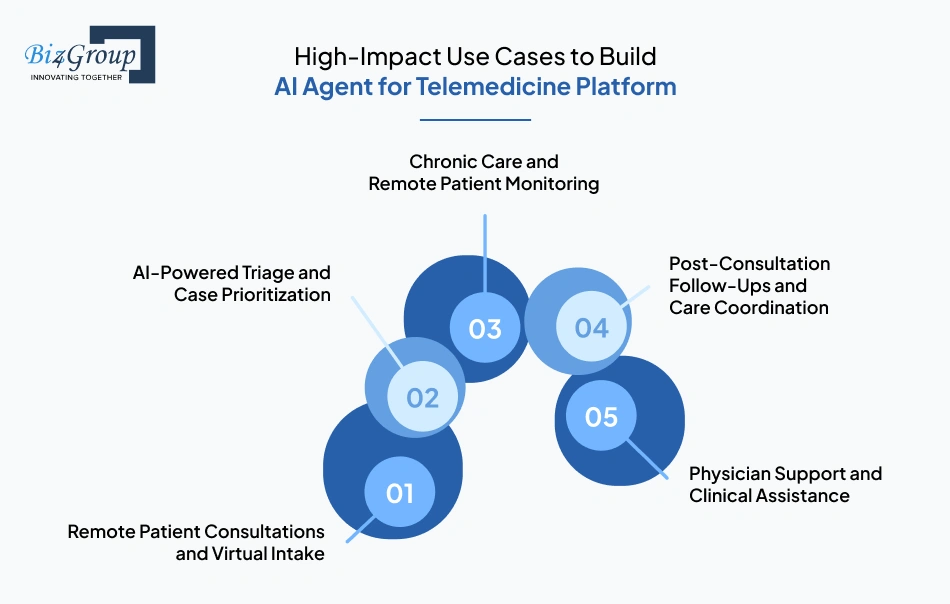
You might understand technology. But the real question is: Where does this actually create value in your system?
Because if you’re planning on building a telemedicine AI agent, the success of your investment depends on choosing the right use cases. Most platforms don’t fail because of poor tech. They fail because they try to automate everything at once, instead of focusing on high-impact areas first.
Let’s break down where AI agents actually make a difference.
1. Remote Patient Consultations and Virtual Intake
If your team is spending too much time collecting patient details before consultations, this is usually the first bottleneck. An AI agent can handle intake by collecting symptoms, medical history, and context before the doctor even joins. This reduces consultation time and improves efficiency. Many platforms building an AI telemedicine app are already using this approach to streamline patient onboarding. This is often the starting point when teams want to build an AI agent for telemedicine platform focused on immediate ROI.
How can an AI avatar handle consultations like a real health companion?
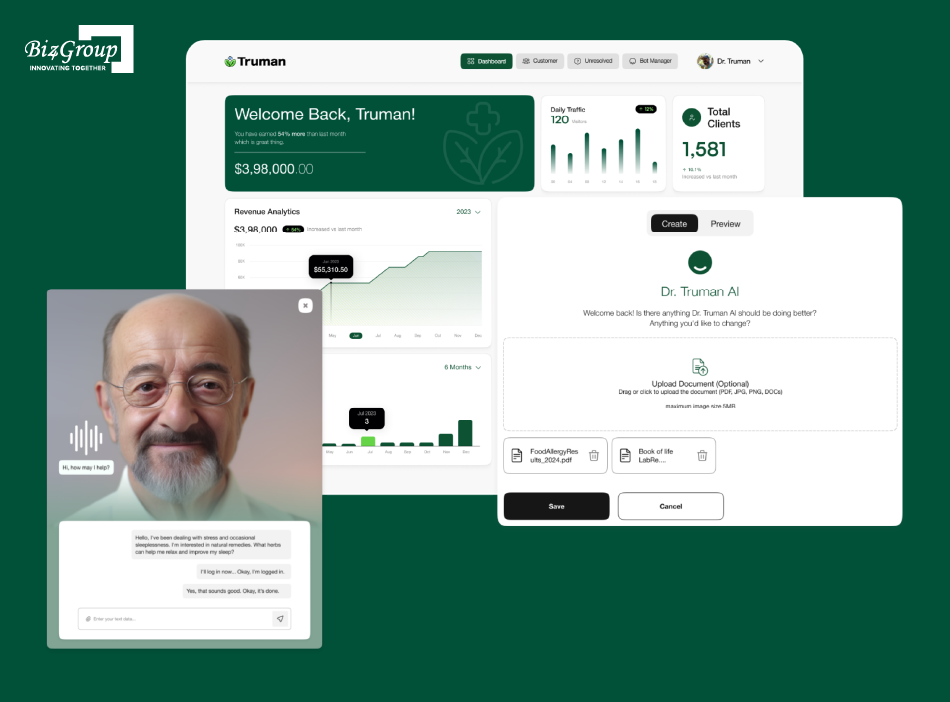
A strong example is Truman, an AI-powered wellness platform built around a virtual health assistant that interacts with users and provides personalized health guidance.
Instead of a basic chatbot, the platform uses an AI avatar combined with conversational AI to simulate real consultation-like interactions, helping users get guidance without waiting for a provider.
Key highlights:
- AI-powered avatar that interacts with users and delivers personalized health guidance
- Conversational system that provides health advice and recommendations based on user input
- Ability for users to upload medical records and track health history within the platform
- Personalized recommendations including supplements, dosage, and treatment duration
This is a practical example of how you can move beyond static intake forms and start building telemedicine AI agent systems that actively engage users during the consultation phase.
2. AI-Powered Triage and Case Prioritization
Not every case needs a doctor immediately. But without proper triage, everything ends up in the same queue. An AI agent can assess urgency based on symptoms and route cases accordingly. Critical cases are escalated, while minor issues are handled automatically or scheduled efficiently. This is a key capability when you develop a telemedicine AI agent for healthcare systems that need to scale. If your doctors are overwhelmed, this is usually where the problem starts.
What does AI-driven triage look like when real health data is involved?

A strong example is Dr. Ara, an AI-powered health platform designed to analyze medical data and provide personalized health insights.
The system processes complex health inputs, such as blood reports, and converts them into actionable recommendations. This reflects how AI can evaluate patient data and prioritize actions based on health conditions.
Key highlights:
- Analyzes blood test reports to identify key health indicators like hydration, cholesterol, and oxygen levels
- Generates personalized health recommendations based on individual data inputs
- Supports consultation-based guidance with tailored health improvement plans
- Enables continuous monitoring and tracking of health progress over time
This is a strong example of how systems built for analysis and recommendation can be extended into triage workflows when you’re building telemedicine AI agent solutions.
3. Chronic Care and Remote Patient Monitoring
Managing chronic conditions requires continuous tracking, not one-time consultations. AI agents can monitor patient data from devices, track trends, and trigger alerts when something looks off. This reduces hospital visits and enables proactive care. Systems focused on AI remote patient monitoring are already using this model to improve long-term outcomes. This is essential if you want to make an AI telemedicine agent with remote monitoring capabilities.
How can AI support patients even when no doctor is involved?
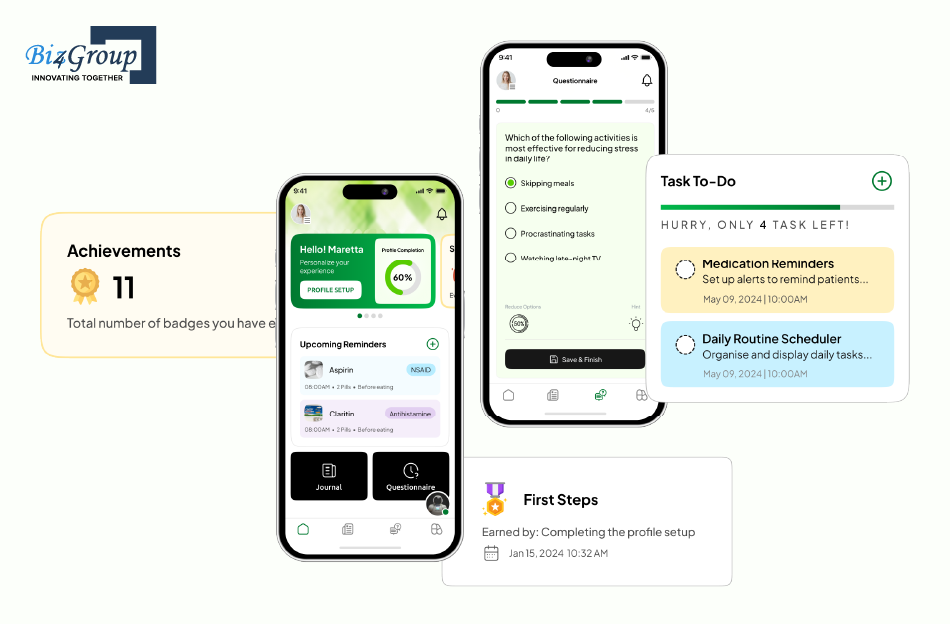
A strong example is CogniHelp, an AI-powered mobile application designed to support dementia patients through continuous monitoring and daily assistance.
Instead of relying on occasional check-ins, the system helps patients stay on track with their routines while capturing data that reflects their cognitive health over time.
Key highlights:
- Tracks cognitive performance over time using AI-based analysis
- Provides daily reminders for medication and routine activities
- Enables voice-to-text journaling to capture patient inputs easily
- Uses conversational AI to monitor emotional state and engagement
- Stores and processes patient data to support long-term care tracking
This is a clear example of how continuous monitoring systems can be built when you develop telemedicine AI agent for healthcare, especially for chronic and long-term conditions.
4. Post-Consultation Follow-Ups and Care Coordination
What happens after the consultation is just as important as the consultation itself. AI agents can send reminders, track medication adherence, and follow up on patient progress. This ensures continuity of care without requiring manual effort from staff. Many healthcare providers are adopting AI automation for healthcare center workflows to manage this stage more efficiently. This is where building AI agents for telemedicine systems starts improving patient outcomes, not just operations.
5. Physician Support and Clinical Assistance
Doctors don’t just need patient data. They need insights. AI agents can summarize patient history, suggest next steps, and assist during consultations. This reduces cognitive load and helps doctors focus on decision-making. Solutions like an AI assistant for physicians are becoming critical in high-volume environments. If your goal is to create a telemedicine AI assistant for healthcare, this is one of the most valuable use cases to consider.
What Should You Focus on First?
If you’re just getting started, don’t try to implement everything at once.
Start with:
- Intake and triage
- Then move to monitoring and follow-ups
- Then expand into physician support
This phased approach makes it easier to develop telemedicine AI agent systems without overwhelming your team or budget.
Are You Compliant? What It Really Takes to Build Telemedicine AI Agent for Healthcare in the US
If you’re planning to build telemedicine AI agent for healthcare, one of the biggest risks is not the technology, it’s compliance. Many teams build functional systems, only to realize later that they cannot deploy them due to regulatory gaps. This leads to delays, rework, and in some cases, complete redesign of the system.
A common concern we hear is: we are looking for companies that can develop telemedicine AI agents with EHR integration and compliance. That concern usually comes up after teams realize how complex healthcare regulations can be when AI is involved.
The key is to design compliance into your system from the beginning while you develop telemedicine AI agent, not after development is complete.
1. HIPAA Compliance and Data Protection
Any system that handles patient data must comply with HIPAA regulations. This includes how your AI agent collects, processes, stores, and shares information. When you build AI agent for telemedicine platform, every interaction must be secure and traceable to avoid legal and operational risks.
- Encrypt patient data both in transit and at rest
- Define strict access controls based on roles
- Maintain detailed audit logs for all interactions
- Ensure Business Associate Agreements (BAAs) are in place
2. Secure Data Handling and Storage
As you develop telemedicine AI agent for healthcare, your system will continuously process sensitive medical data. This makes your infrastructure a critical part of your product, not just backend support. Without a secure foundation, even a well-designed AI system becomes difficult to deploy.
- Use HIPAA-compliant cloud environments
- Separate sensitive patient data across systems
- Apply role-based access control for internal teams
- Perform regular security testing and audits
3. EHR Integration and Interoperability (FHIR/HL7)
To function effectively in real clinical settings, your AI agent must integrate with existing healthcare systems. Without this, your workflows remain disconnected and incomplete. This is why many teams building AI patient software prioritize interoperability early in development.
- Integrate with EHR platforms like Epic and Cerner
- Use FHIR APIs for standardized data exchange
- Enable real-time synchronization of patient data
- Ensure consistency across systems
4. Clinical Safety and FDA Considerations
If your system provides recommendations that influence patient care, it may fall under FDA regulations. This becomes especially important when you create telemedicine AI assistant for healthcare that supports diagnosis or treatment decisions.
- Determine if your solution qualifies as SaMD
- Validate outputs for clinical accuracy
- Maintain proper documentation for audits
- Ensure human oversight for critical decisions
5. Ongoing Monitoring and Compliance Maintenance
Compliance is not a one-time effort. As your system evolves, new integrations, features, and data flows introduce additional risks. When you build scalable telemedicine AI agents for healthcare providers, continuous monitoring becomes essential.
- Track system activity and access logs
- Conduct regular compliance audits
- Update security policies as the system scales
- Train teams on handling sensitive healthcare data
Think your system is ready for healthcare compliance?
Most teams realize gaps only after development starts. Fix it before it becomes expensive.
Check Compliance ReadinessWhat Features Make or Break Your Success When You Create Telemedicine AI Assistant for Healthcare?
Once you move past use cases and compliance, the real question becomes: What should your system actually do to make a measurable impact?
This is where many teams struggle while building telemedicine AI agent systems. Either they build too little and miss value, or they build too much and slow down execution.
A common situation we hear is people need a development partner to create a telemedicine AI agent with real-time chat and voice features.
That sounds straightforward, but once you start to build an AI agent for telemedicine platform, you realize it requires a combination of tightly connected features working together.
|
Feature |
What It Does |
Why It Matters |
|---|---|---|
|
Intelligent Symptom Intake |
The system collects patient symptoms, history, and context through guided conversations. It dynamically adjusts questions based on responses instead of using fixed forms. |
This reduces manual intake effort and ensures doctors receive structured, relevant information before consultations when building telemedicine AI agent |
|
NLP-Based Conversation Engine |
The system processes patient input, understands intent, and maintains context across conversations. It handles variations in language, tone, and incomplete inputs. |
This enables natural interaction and is essential when creating AI agent for telemedicine with NLP and voice support, especially for real-time consultations |
|
Patients can interact using voice, which is converted into structured data for processing. The system can also respond using voice outputs. |
This improves accessibility for elderly users and makes the system more usable in real-world healthcare scenarios |
|
|
The agent evaluates symptoms and determines urgency using predefined clinical logic and AI models. It routes cases accordingly. |
This ensures critical cases are prioritized and reduces unnecessary load on doctors when you develop telemedicine AI agent for healthcare |
|
|
Remote Patient Monitoring Integration |
The system connects with wearable devices and health apps to continuously collect patient data such as vitals and activity levels. |
This enables continuous care and is required if you want to make AI telemedicine agent with remote monitoring capabilities |
|
The agent schedules consultations based on availability, urgency, and patient preferences without manual coordination. |
This reduces administrative overhead and improves operational efficiency across your platform |
|
|
EHR Integration (FHIR/HL7) |
The system connects with electronic health records to access and update patient data in real time using standardized protocols. |
This ensures continuity of care and allows your AI agent to operate within real clinical workflows |
|
The agent provides doctors with summarized patient data, possible conditions, and suggested next steps during consultations. |
This reduces cognitive load and supports faster, more informed decision-making |
|
|
Follow-Up and Care Management |
The system tracks patient recovery, sends reminders, and ensures adherence to treatment plans after consultations. |
This improves long-term outcomes and reduces patient drop-offs |
|
Personalization Engine |
The agent adapts responses and recommendations based on patient history, preferences, and behavior patterns. |
This increases patient engagement and improves overall experience |
|
Multi-Workflow Coordination |
The system manages multiple processes like triage, monitoring, and follow-ups simultaneously without conflicts. |
This is critical when building AI agents for telemedicine systems that need to scale across multiple workflows |
|
Security and Access Control |
The system enforces strict data protection measures, including encryption and role-based access control. |
This ensures compliance and protects sensitive patient information |
|
Analytics and Reporting |
The system tracks performance metrics, patient outcomes, and workflow efficiency. |
This helps you identify bottlenecks and improve your system over time |
|
Scalable Infrastructure |
The system is designed to handle increasing users, data, and integrations without performance issues. |
This is essential to build scalable telemedicine AI agents for healthcare providers as your platform grows |
All these capabilities come together as part of a single system when you design a complete AI agent.
How to Build Telemedicine AI Agent Step by Step Without Wasting Time or Budget
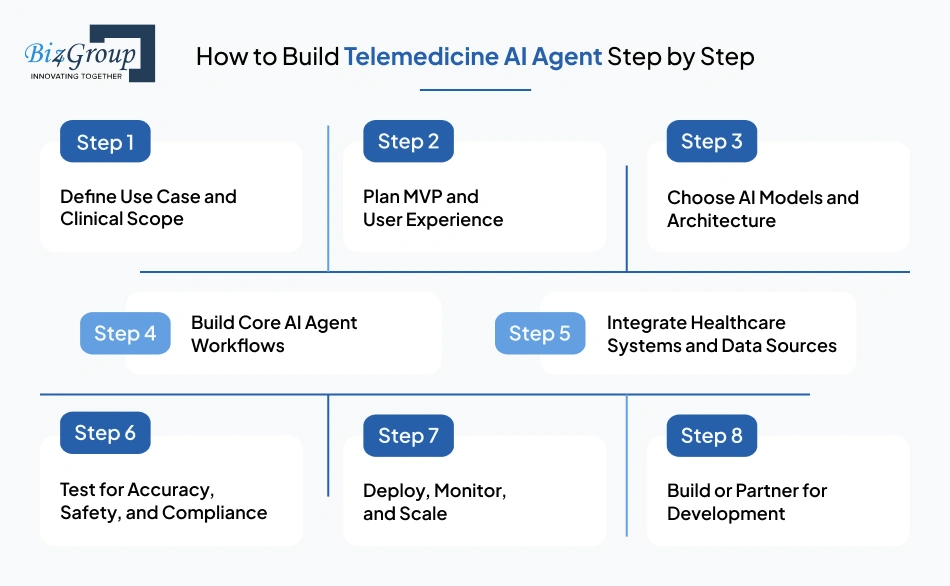
When you start building a telemedicine AI agent, most delays come from unclear scope and poor execution planning. Teams either overbuild too early or miss critical steps needed for real-world deployment.
If you want to develop a telemedicine AI agent for healthcare, the process needs to be structured from day one. Each step should move you closer to a working system, not just a prototype.
Step 1: Define Use Case and Clinical Scope
Start by identifying what problem your system will solve. Focus on one or two high-impact use cases instead of trying to cover everything. This is critical when you build an AI agent for telemedicine platform with limited time and budget.
- Define target users (patients, providers, care teams)
- Identify workflows (intake, triage, monitoring)
- Set measurable outcomes (efficiency, response time)
- Align with clinical requirements
Step 2: Plan MVP and User Experience
Before development, define how users will interact with the system. This includes patient flows, doctor interfaces, and system responses. Most teams start with an MVP development approach to validate quickly while building telemedicine AI agent.
- Design patient journey and interaction flow
- Prioritize essential features for MVP
- Map input-output scenarios
- Create wireframes using UI/UX design
Step 3: Choose AI Models and Architecture
Selecting the right models and architecture determines how your system performs and scales. This step is key when you develop a telemedicine AI agent for healthcare that needs to handle real patient interactions.
- Choose NLP/LLM models for communication
- Define decision-making logic
- Plan scalable architecture
- Identify required APIs and integrations
Step 4: Build Core AI Agent Workflows
This is where you start implementing actual workflows. Focus on intake, triage, and scheduling first before expanding. A structured AI agent implementation ensures your system works reliably when building AI agents for telemedicine systems.
- Develop symptom intake workflows
- Implement triage and routing logic
- Build scheduling and follow-up processes
- Connect workflows with backend systems
Step 5: Integrate Healthcare Systems and Data Sources
Your system needs access to real healthcare data to function properly. Integration ensures your AI agent can operate within clinical workflows when you build AI agent for telemedicine platform.
- Integrate EHR systems (FHIR/HL7)
- Connect wearable devices and monitoring tools
- Enable real-time data synchronization
- Ensure secure data exchange
Step 6: Test for Accuracy, Safety, and Compliance
Testing ensures your system is reliable and safe before deployment. This is critical when you create a telemedicine AI assistant for healthcare that interacts with patients and providers.
- Validate AI responses for accuracy
- Test workflows across multiple scenarios
- Perform compliance and security checks
- Conduct user testing with real stakeholders
Step 7: Deploy, Monitor, and Scale
Deployment should be controlled and monitored closely. Scaling should happen based on actual usage and performance data when you build scalable telemedicine AI agents for healthcare providers.
- Deploy in staging and production environments
- Monitor system performance and usage
- Collect feedback from users
- Optimize and scale infrastructure
Step 8: Build or Partner for Development
Many teams reach a point where they need external expertise. If you lack internal capabilities, it’s practical to hire AI developers or work with an experienced AI development company to accelerate development.
- Evaluate internal vs external capabilities
- Identify skill gaps
- Select the right development partner
- Plan long-term scaling and support
When you follow this structured approach, building a telemedicine AI agent becomes more predictable, cost-efficient, and easier to scale.
What Tech Stack Do You Need for Custom Telemedicine AI Agent Development?
Choosing the right stack is not just a technical decision. It directly affects how fast you can build, how well your system performs, and how easily it scales. When you develop telemedicine AI agent for healthcare, your stack needs to support real-time interactions, secure data handling, and seamless integrations. A fragmented or outdated stack will slow down development and create long-term limitations.
Here’s a practical breakdown of the core technologies required to build AI agents for telemedicine platform.
|
Layer |
Tool / Tech |
Why It Is Used |
|---|---|---|
|
Frontend (Patient & Provider Apps) |
React, Next.js, Flutter |
Builds responsive web and mobile interfaces for patients and doctors with real-time interaction capabilities |
|
UI/UX Layer |
Figma, Adobe XD |
Helps design intuitive user flows for consultations, intake, and monitoring using structured UI/UX design |
|
Backend (Application Layer) |
Handles business logic, API management, and communication between system components |
|
|
AI/LLM Layer |
OpenAI, Azure OpenAI, LLaMA |
Powers natural language understanding, conversation handling, and decision-making in AI agents |
|
Agent Orchestration Layer |
LangChain, Semantic Kernel |
Manages workflows, multi-step reasoning, and task execution across the AI system |
|
Voice Processing Layer |
Whisper, Google Speech-to-Text |
Converts voice input into structured data and enables voice-based interaction |
|
Data Processing Layer |
Python, Pandas, NumPy |
Processes patient data, prepares inputs, and supports analytics workflows |
|
EHR Integration Layer |
FHIR APIs, HL7 Standards |
Enables structured data exchange with healthcare systems like Epic and Cerner |
|
Database Layer |
PostgreSQL, MongoDB |
Stores structured and unstructured patient data securely and efficiently |
|
Cloud Infrastructure |
AWS (HealthLake), Azure Health Data Services |
Provides scalable, HIPAA-compliant infrastructure for deploying healthcare systems |
|
Security Layer |
OAuth 2.0, TLS Encryption |
Ensures secure authentication, data encryption, and controlled access |
|
Analytics & Monitoring |
Power BI, Grafana |
Tracks system performance, patient outcomes, and operational metrics |
|
DevOps & Deployment |
Docker, Kubernetes |
Enables scalable deployment, system reliability, and continuous integration |
When you build an AI agent for telemedicine platform, the focus should be on how these layers work together, not just the individual tools.
A well-structured stack ensures your system can scale, integrate, and operate reliably in real healthcare environments. For organizations looking to build robust systems, aligning this stack with broader enterprise AI solutions ensures long-term scalability and performance.
How Much Does It Cost to Build Scalable Telemedicine AI Agents for Healthcare Providers?
If you’re planning to build a telemedicine AI agent, cost is one of the first questions that comes up.
In most cases, the cost to develop telemedicine AI agent for healthcare ranges between $20,000 to $150,000+, depending on features, integrations, and compliance requirements. This range varies significantly based on how complex your system is and how quickly you want to scale.
A common concern we hear is: I am planning to invest in developing a telemedicine AI agent, what is the estimated cost and who can build it
The answer depends on what exactly you’re building and how you approach development.
Estimated Cost Breakdown by Features When You Build AI Agent for Telemedicine Platform
|
Feature |
Estimated Cost Range |
Why It Impacts Cost |
|---|---|---|
|
Symptom Intake & Chat System |
$5,000 – $15,000 |
Requires NLP setup, conversation design, and backend integration |
|
Voice Interaction (Speech-to-Text) |
$5,000 – $20,000 |
Adds complexity with real-time processing and voice model integration |
|
AI-Powered Triage System |
$10,000 – $25,000 |
Needs clinical logic, decision workflows, and testing for accuracy |
|
Remote Patient Monitoring |
$10,000 – $30,000 |
Involves device integration, real-time data handling, and alerts |
|
Appointment Scheduling Automation |
$3,000 – $10,000 |
Depends on calendar integration and workflow automation |
|
EHR Integration (FHIR/HL7) |
$10,000 – $35,000 |
High complexity due to healthcare system compatibility and data exchange |
|
Clinical Decision Support |
$10,000 – $25,000 |
Requires data modeling, AI logic, and validation |
|
Follow-Up & Care Management |
$5,000 – $15,000 |
Includes reminders, tracking, and workflow automation |
|
Analytics & Reporting Dashboard |
$5,000 – $15,000 |
Needs data pipelines and visualization tools |
Key Factors That Affect Cost When You Develop Telemedicine AI Agent for Healthcare
The cost of custom telemedicine AI agent development is not fixed. It changes based on multiple factors that directly impact complexity and effort.
- Scope of features and workflows
- Level of AI sophistication (basic vs advanced reasoning)
- Number of integrations (EHR, devices, APIs)
- Compliance and security requirements
- Team structure (in-house vs outsourced)
If you are using external partners offering AI automation services, cost can vary based on expertise and delivery speed.
Hidden Costs You Should Plan For When Building Telemedicine AI Agent
Many teams underestimate these costs and face issues later during scaling or deployment.
- Ongoing cloud infrastructure and API usage costs
- AI model usage and token-based pricing
- Maintenance and updates post-deployment
- Compliance audits and security upgrades
- Data storage and scaling costs
These can significantly increase your total investment if not planned early while you build scalable telemedicine AI agents for healthcare providers.
How to Optimize Cost Without Compromising Quality
Cost optimization is not about cutting features. It’s about building in the right order and avoiding unnecessary complexity.
- Start with an MVP and expand gradually
- Prioritize high-impact features (intake, triage)
- Use modular architecture to avoid rework
- Reuse existing APIs and frameworks where possible
When you approach building telemedicine AI agent strategically, you can control costs while still delivering a scalable and compliant system.
Planning your AI telemedicine budget or just guessing it?
Get a realistic estimate based on features, scale, and compliance needs before you commit.
Get Cost EstimateWhat Are the Biggest Challenges in Building Telemedicine AI Agent Systems and How Do You Solve Them?
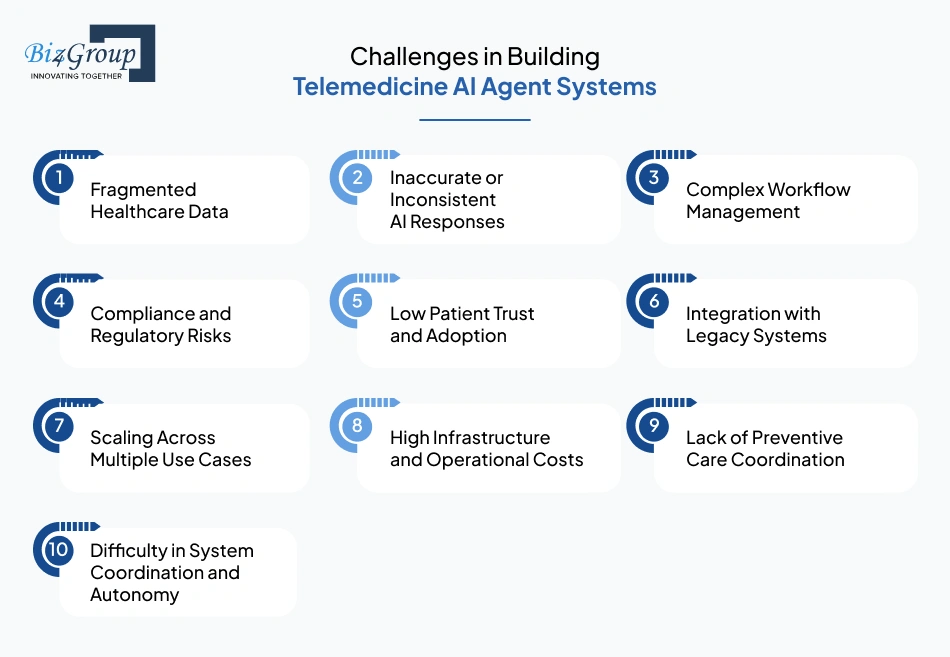
When you start building a telemedicine AI agent, the technical build is only one part of the problem. Most challenges show up when systems interact with real users, real data, and real clinical workflows.
These challenges are predictable. The key is to address them early instead of reacting later.
|
Challenge |
Why It Happens |
How to Solve It |
|---|---|---|
|
Fragmented Healthcare Data |
Patient data is spread across EHRs, devices, and third-party systems, making it hard to unify |
Use strong integration architecture and standardized protocols (FHIR/HL7) to centralize data flow |
|
Inaccurate or Inconsistent AI Responses |
AI models may generate incorrect or vague outputs, especially in medical contexts |
Implement validation layers, structured workflows, and human-in-the-loop review for critical cases |
|
Complex Workflow Management |
Telemedicine involves multi-step processes like intake, triage, consultation, and follow-ups |
Design clear workflow orchestration when building AI agents for telemedicine systems to manage processes reliably |
|
Compliance and Regulatory Risks |
Healthcare systems must meet strict standards (HIPAA, FDA), increasing complexity |
Build compliance into system architecture from day one and conduct regular audits |
|
Low Patient Trust and Adoption |
Patients may hesitate to rely on AI for healthcare interactions |
Improve transparency, provide clear guidance, and combine AI with human oversight |
|
Integration with Legacy Systems |
Older healthcare systems are not designed for modern AI integrations |
Use middleware and APIs to bridge gaps and ensure smooth data exchange |
|
Scaling Across Multiple Use Cases |
Systems become complex when expanding from one use case to multiple workflows |
Start with focused use cases and expand gradually using modular architecture |
|
High Infrastructure and Operational Costs |
AI models, cloud usage, and real-time processing increase ongoing costs |
Optimize usage, monitor resource consumption, and scale infrastructure efficiently |
|
Lack of Preventive Care Coordination |
Most systems focus on reactive care instead of proactive monitoring |
Implement systems aligned with AI multi-agent preventive care to enable proactive health management |
|
Difficulty in System Coordination and Autonomy |
Managing multiple AI processes without conflict is complex |
Adopt principles from agentic AI in healthcare to design systems that can operate with coordinated decision-making |
When you address these challenges early, building telemedicine AI agent becomes more predictable and scalable. Most failures happen not because of technology, but because these challenges are ignored during planning.
Why Choose Biz4Group to Build Telemedicine AI Agent for Healthcare?
When you’re planning building telemedicine AI agent, the biggest decision is not just the technology, it’s choosing the right partner who understands both AI and healthcare workflows.
You might be thinking: we need a reliable partner to develop a telemedicine AI agent from idea to deployment, which companies should we shortlist
That’s exactly where experience matters.
Biz4Group stands among the top AI agent development companies for healthcare industry in USA, with a strong focus on building production-ready healthcare systems. From planning to deployment, the approach is centered around compliance, scalability, and real-world clinical workflows.
Our experience includes building solutions like Truman, Dr. Ara, and CogniHelp, where we’ve delivered AI-driven patient interaction, health data analysis, and continuous monitoring systems. These are the same capabilities required when you develop telemedicine AI agent for healthcare that needs to operate reliably at scale.
If your goal is to build scalable telemedicine AI agents for healthcare providers, the focus should be on getting architecture, workflows, and integrations right from the start. That’s exactly what we help you achieve.
Our experience includes building solutions like Truman, Dr. Ara, and CogniHelp, where we’ve delivered AI-driven patient interaction, health data analysis, and continuous monitoring systems. These are the same capabilities required when you develop telemedicine AI agent for healthcare that needs to operate reliably at scale.
If your goal is to build scalable telemedicine AI agents for healthcare providers, the focus should be on getting architecture, workflows, and integrations right from the start. That’s exactly what we help you achieve.
Looking for a team that actually builds this, not just talks about it?
We help healthcare teams move from idea to production-ready AI systems.
Start Your AI ProjectWrapping Up!
If you’ve made it this far, one thing should be clear. Building telemedicine AI agent is not just about adding AI to your platform. It’s about designing a system that can handle real clinical workflows, integrate with healthcare infrastructure, and scale without increasing operational load.
From defining the right use cases to ensuring compliance, selecting features, and managing development, every step plays a role in whether your system succeeds or becomes another stalled initiative. When you develop telemedicine AI agent for healthcare, the difference comes down to how well your system is planned, not just how it is built.
At Biz4Group, we focus on delivering systems that are built for real-world deployment. With experience across solutions like Truman, Dr. Ara, and CogniHelp, the approach is centered on creating scalable, compliant, and production-ready AI systems that healthcare providers can rely on.
If you're looking to build an AI agent for telemedicine platform that actually delivers results, the focus should be on getting the foundation right from day one.
Build it right once, scale it without limits.
FAQ
1. What is a telemedicine AI agent and how does it work?
A telemedicine AI agent is an AI-powered system that handles patient interactions, collects medical information, supports decision-making, and automates healthcare workflows. When you start building telemedicine AI agent, it works by processing patient input, analyzing symptoms using NLP, and triggering actions like triage, scheduling, or escalation to doctors.
2. How to build telemedicine AI agent step by step?
To develop telemedicine AI agent for healthcare, you start by defining use cases, designing the MVP, selecting AI models, building workflows, integrating EHR systems, testing for compliance, and then deploying the solution. Each step focuses on ensuring the system is scalable, secure, and clinically usable.
3. How much does it cost to build a telemedicine AI agent?
The cost to build scalable telemedicine AI agents for healthcare providers typically ranges from $20,000 to $150,000+. Pricing depends on features like EHR integration, voice support, remote monitoring, compliance requirements, and overall system complexity.
4. What features are required in a telemedicine AI agent?
A strong system should include symptom intake, AI triage, NLP-based conversations, EHR integration, remote patient monitoring, scheduling automation, and clinical decision support. These features are essential when you build an AI agent for telemedicine platform that can operate in real clinical environments.
5. Is telemedicine AI agent development compliant with HIPAA?
Yes, but only if compliance is built into the system architecture. When you develop telemedicine AI agent for healthcare, HIPAA requirements like data encryption, access control, audit logs, and secure cloud infrastructure must be implemented from the start.
6. Which companies can develop telemedicine AI agents in the USA?
Several specialized firms offer telemedicine AI agent development services, but the best choice depends on healthcare experience, AI capability, and compliance expertise. Many organizations prefer working with a top AI healthcare software development company, like BIz4group, that understands clinical workflows and regulatory requirements.
7. Should we build in-house or outsource telemedicine AI agent development?
If you have strong AI and healthcare engineering teams, in-house development can work. However, many companies choose to outsource telemedicine AI agent development to experienced partners to reduce risk, speed up delivery, and ensure compliance while building telemedicine AI agent solutions at scale.
