 Location :
Orlando, FL, USA
Location :
Orlando, FL, USA +1 (407) 714-1616
 info@biz4group.com

- AI workers compensation insurance app development helps carriers and TPAs reduce claim delays, manual reviews, and workflow bottlenecks.
- Core platform features include AI fraud detection, document extraction, claim routing, compliance tracking, and return-to-work monitoring workflows.
- The cost to develop AI workers compensation insurance app typically ranges between $30,000–$200,000+ depending on AI depth, integrations, compliance scope, and operational complexity.
- Strong claims platforms rely on scalable architecture, secure integrations, role-based access, and stable mobile workflows across teams.
- Automated workers compensation insurance app development works best when AI supports real claims operations instead of isolated automation layers.
- Biz4Group LLC helps organizations build workflow-focused insurance platforms with practical AI implementation, scalable infrastructure, and operationally aligned delivery.
What does a workers compensation claim really cost when one file can take 8 to 20 hours of administrative time before the carrier or TPA even gets fully involved?
In a system where 30% to 40% of medical bills carry errors, that is not a small operational leak. It is a direct hit to speed, accuracy, and client confidence. And when only 7% of claims move through straight-through processing, the pressure on claims teams grows fast.
This is where AI-powered system is starting to change the conversation for insurers and TPAs bringing serious attention to AI workers compensation insurance app development. For a decision maker at a mid-sized TPA firm, the goal is not just digitization. It is building an operating layer that reduces manual drag, flags risk earlier, and gives clients a more responsive claims experience.
So, if your thinking sounds close to this, “I am a CTO at a mid-sized TPA firm, and we want to build a proprietary AI workers compensation insurance app that gives our clients a competitive advantage over other TPAs who are still using outdated legacy claim management systems,” then this blog will walk you through it step by step.
Understanding the Core of AI Workers Compensation Insurance App Development
To build AI workers compensation insurance app platforms effectively, decision-makers first need clarity on what they are actually solving. This is not just about digitizing claims workflows. It is about rethinking how workers’ compensation operations are managed, processed, and optimized across the entire claim lifecycle.
What is an AI Workers Compensation Insurance App?
An AI workers compensation insurance app is a digital platform that helps carriers, TPAs, employers, and claims teams manage workers’ compensation claims with greater speed, accuracy, and operational control. It uses AI to automate repetitive tasks, organize claim data, detect irregularities, and support faster claim handling across the entire workflow.
The AI workers compensation insurance app is commonly used by:
- Insurance carriers managing high claim volumes
- TPAs handling claims for multiple employer clients
- Claims adjusters reviewing documents and case activity
- Employers tracking claim progress and workplace incidents
Instead of relying on disconnected systems and manual processing, the AI app centralizes claim operations in one environment. It helps reduce delays, improve visibility, and simplify how teams handle intake, documentation, communication, and claim decisions.
Some of the most common problems solved by AI workers compensation insurance app include:
- Slow claim processing and operational backlogs
- Manual document review and data entry
- Limited fraud visibility during claim evaluation
- Inconsistent communication across stakeholders
- Lack of real-time claim tracking and reporting
Also Read: AI Workers Compensation Claims Management System Development
How AI Workers Compensation Insurance Apps Differ from Traditional Claims Management Systems
Traditional claims systems were designed to store claim records whereas AI-powered workers compensation platforms are built to improve how claims move, how decisions are made, and how operations scale under pressure. Take a look:
|
Operational Aspect |
Traditional Claims Management Systems |
AI Workers Compensation Insurance Apps |
|
Claim Intake Process |
Manual form handling and data entry |
Automated intake with AI-driven data extraction |
|
Workflow Management |
Fixed workflows for every claim |
Dynamic workflows based on claim complexity and risk |
|
Document Handling |
Adjusters review documents manually |
AI classifies, organizes, and prioritizes documents automatically |
|
Fraud Detection |
Relies heavily on manual investigation |
AI identifies unusual claim behavior and fraud indicators early |
|
Claim Visibility |
Limited operational tracking |
Real-time dashboards and claim monitoring |
|
Team Communication |
Dependent on emails and disconnected updates |
Centralized communication and workflow coordination |
|
Claim Assignment |
Manual routing between teams |
Intelligent routing based on workload and claim severity |
|
Risk Management |
Reactive handling after escalation |
Predictive alerts for delays, compliance risks, and escalation |
|
Scalability |
Operational strain increases with claim volume |
Automation supports high-volume claim processing |
|
Reporting and Analytics |
Reports generated manually |
AI-powered reporting with actionable operational insights |
Core Components That Power a Modern Workers Compensation Insurance Platform
A modern workers compensation insurance platform depends on multiple AI-driven components working together to improve claim accuracy, reduce manual workload, strengthen insurance fraud monitoring, and streamline day-to-day operations across the claim lifecycle.
1. Automated FNOL (First Notice of Loss) Processing
- Captures claim details from web portals, mobile apps, emails, and call center submissions in a structured format.
- Reduces manual intake work for adjusters and operations teams.
- Helps carriers and TPAs start claim processing faster with cleaner data collection.
2. ML-Based Fraud Detection Engine
- Analyzes claim behavior against historical fraud patterns and anomaly signals.
- Flags suspicious activities such as duplicate claims, inconsistent injury timelines, or unusual billing activity.
- Helps investigation teams prioritize high-risk claims earlier in the review cycle.
3. NLP Document Analysis
- Extracts structured information from medical reports, legal documents, adjuster notes, and claim forms.
- Reduces time spent reviewing unstructured paperwork manually.
- Improves claim accuracy by organizing key data points automatically.
Also Read: NLP vs LLM: Choosing the Right Approach for Your AI Strategy
- Predictive Return-to-Work (RTW) Analytics
- Uses injury type, diagnosis codes, and historical recovery data to estimate return-to-work timelines.
- Helps employers and claims teams plan rehabilitation and workforce availability more effectively.
- Supports proactive claim management before delays become costly.
5. Integrated Medical Bill Review
- Detects duplicate charges, overbilling, coding inconsistencies, and unbundled services automatically.
- Reduces payment leakage during medical claim processing.
- Improves billing accuracy without increasing manual review workload.
Also Read: AI Medical Claim Processing Software Development Guide
6. Regulatory Compliance Engine
- Maps claim workflows and reporting requirements to state-specific workers’ compensation regulations.
- Helps teams maintain WCIO reporting standards and audit readiness.
- Reduces compliance risk caused by missed deadlines or incomplete claim records.
- Claimant Self-Service Portal
- Allows injured workers to upload documents, track claim status, and manage appointments independently.
- Reduces repetitive communication requests handled by adjusters.
- Improves claim transparency without increasing operational overhead.
Now that you understand what powers these platforms, let’s look at why workers compensation insurance app development integrating AI has become a timely priority for carriers and TPAs.
Claims Chaos Slowing Your Operations?
Turn manual claim handling into faster, AI-driven workflows with better visibility across every stage
Modernize Claim OperationsWhy AI Workers Compensation Insurance Apps Matter More Than Ever
Workers’ compensation teams are facing rising claim complexity, especially as catastrophic “mega claims” exceeding $5 million continue to increase.
That pressure is pushing carriers and TPAs to make a workers compensation insurance app with AI powered adjuster workflow automation for faster and more controlled claim handling.
Operational Benefits of AI Workers Compensation Insurance App Development
Workers compensation operations have never been built for speed, visibility, or seamless coordination. AI workers compensation insurance app development changes that by helping carriers, TPAs, employers, and adjusters handle claims with better control, faster workflows, and fewer operational slowdowns.
Here’s how the AI app creates measurable operational value across every part of the workers’ compensation ecosystem.
1. For Insurance Carriers and TPAs
- Lower operational bottlenecks: Move claims faster without adding heavy administrative workload.
- Better fraud visibility: Detect suspicious claim patterns and billing irregularities earlier in the process.
- Stronger client servicing: Give employers quicker updates, cleaner reporting, and better claim transparency.
- Smarter claim handling: Reduce dependency on disconnected systems, manual reviews, and repetitive follow-ups causing less denials.
Also Read: AI Claims Denial Navigator Software Development for Healthcare Providers
- For Claims Adjusters and Operations Teams
- Less repetitive paperwork: Reduce time spent on manual data entry, document sorting, and routine follow-ups.
- Faster claim authorization: Identify urgent, high-risk, or delayed claims without digging through multiple systems for authorization.
- Cleaner daily workflows: Access claim history, medical records, notes, and updates from one centralized platform.
- Lower backlog pressure: Automate routine tasks so teams can focus more on complex claim decisions and claimant coordination.
Also Read: Develop AI Prior Authorization Software for Mid-Size Clinics
3. For Injured Workers and Employers
- Faster claim communication: Get quicker updates, status visibility, and fewer delays during the claim process.
- Less administrative back-and-forth: Upload documents, track progress, and manage claim-related tasks from one place.
- Better coordination between stakeholders: Keep employers, injured workers, adjusters, and medical teams aligned throughout the claim lifecycle.
- Reduced workplace disruption: Help employers handle claims more efficiently while supporting faster return-to-work planning.
Why Now Is the Right Time to Build an AI Workers Compensation Insurance App
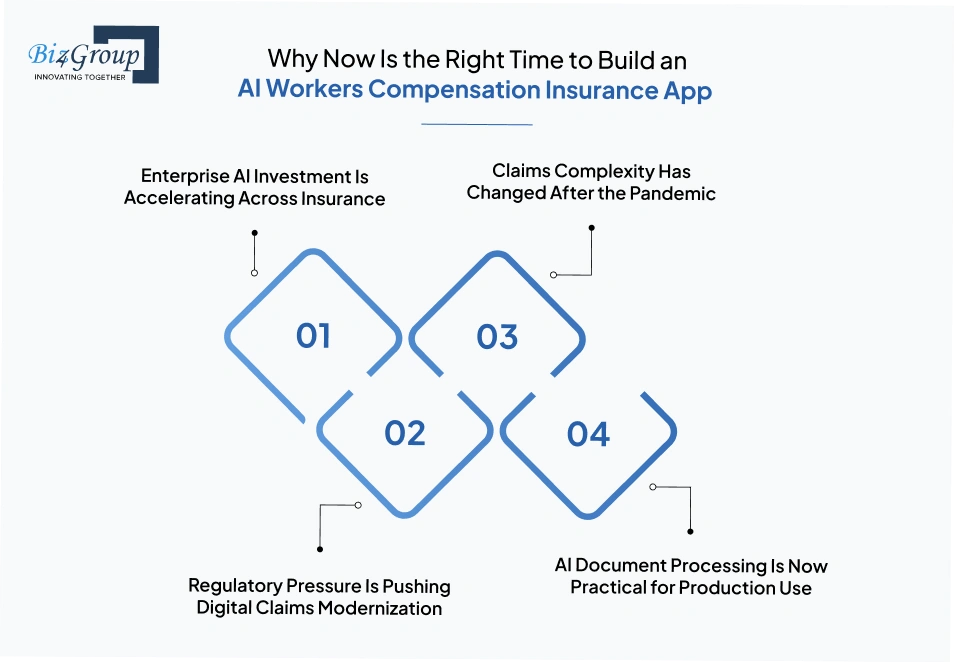
Several operational and market shifts are making AI adoption more practical and more urgent for workers’ compensation organizations. Here are some of the biggest reasons carriers and TPAs are accelerating investment in AI-powered claims platforms.
1. Enterprise AI Investment Is Accelerating Across Insurance
The global AI in the insurance market is projected to grow from USD 13.45 billion in 2026 to USD 154.39 billion by 2034. That signals a clear shift toward AI becoming part of core claims infrastructure, not an experimental add-on.
2. Regulatory Pressure Is Pushing Digital Claims Modernization
State-level reporting demands and digital submission requirements are pushing insurers to modernize legacy workers compensation software. For carriers and TPAs, waiting too long can make compliance harder and operations less efficient.
3. Claims Complexity Has Changed After the Pandemic
Workers’ compensation claims now involve more complex scenarios, including mental health cases, long-COVID, and remote-work incidents. These cases need faster categorization and more support than manual workflows can easily provide.
4. AI Document Processing Is Now Practical for Production Use
LLM-based document analysis tools like GPT-4 and Claude have become more cost-effective for production environments. This makes it easier for carriers and TPAs to process medical records, adjuster notes, and legal documents at scale.
In short, rising claim complexity, growing compliance pressure, and faster AI adoption across insurance are making AI workers compensation insurance app development a strategic move instead of a future consideration. Organizations that delay modernization now risk struggling with slower operations while competitors move toward faster and more scalable claims management.
Legacy Claim Systems Holding You Back?
Bring speed, automation, and operational control into complex workers compensation workflows without disrupting existing processes
Let’s Plan the UpgradeWhat are the Must-Have Features for AI Workers Compensation Insurance App Development
You do not get many chances to fix broken claims experiences once employers and adjusters lose confidence in your platform. That is why workers compensation mobile application development using AI needs the right feature set from day one to keep claims fast, connected, and manageable at scale.
1. AI Automation Features
|
Feature |
Purpose |
|---|---|
|
AI-Powered FNOL Processing |
Captures and structures claim data automatically from digital submissions. |
|
Intelligent Claim Routing |
Assigns claims based on severity, jurisdiction, and adjuster workload. |
|
Fraud Detection Engine |
Flags suspicious claim behavior and billing anomalies early. |
|
NLP-Based Document Analysis |
Extracts key details from medical reports, legal files, and adjuster notes. |
|
Predictive Claim Severity Scoring |
Identifies potentially high-cost or high-risk claims faster through predictive analysis |
2. Core Claims Management Features
|
Feature |
Purpose |
|---|---|
|
Centralized Claim Dashboard |
Gives teams complete visibility into claim activity and progress. |
|
Real-Time Claim Tracking |
Monitors claim movement, pending actions, and processing stages. |
|
Medical Bill Review System |
Detects duplicate billing, overcharges, and coding inconsistencies. |
|
Case Notes and Activity Logs |
Maintains complete operational and audit-ready claim records. |
|
Workflow and Task Management |
Helps teams manage approvals, escalations, and pending claim actions. |
3. Communication and Access Features
|
Feature |
Purpose |
|---|---|
|
Claimant Self-Service Portal |
Allows injured workers to upload documents and track claim status. |
|
Employer Access Portal |
Helps employers monitor incidents and claim progress. |
|
Secure Messaging System |
Centralizes communication between all claim stakeholders. |
|
Automated Alerts and Notifications |
Sends reminders for approvals, deadlines, and missing documents. |
4. Compliance and Reporting Features
|
Feature |
Purpose |
|---|---|
|
State-Specific Compliance Tracking |
Supports workers’ compensation regulations across different states. |
|
WCIO Reporting Support |
Helps maintain standardized reporting accuracy. |
|
Audit Trail Management |
Tracks all claim-related actions and workflow changes. |
|
Role-Based Access Control |
Protects sensitive claim information through permission-based access. |
In the end, strong claims platforms are not built around more screens or more automation alone. The real value comes from building workflows that keep claims moving with fewer delays, better visibility, and smarter coordination. It becomes even more important when developing a workers compensation insurance app with AI powered return to work tracking and monitoring at scale.
How to Build an AI Powered Workers Compensation Insurance App Step-By-Step
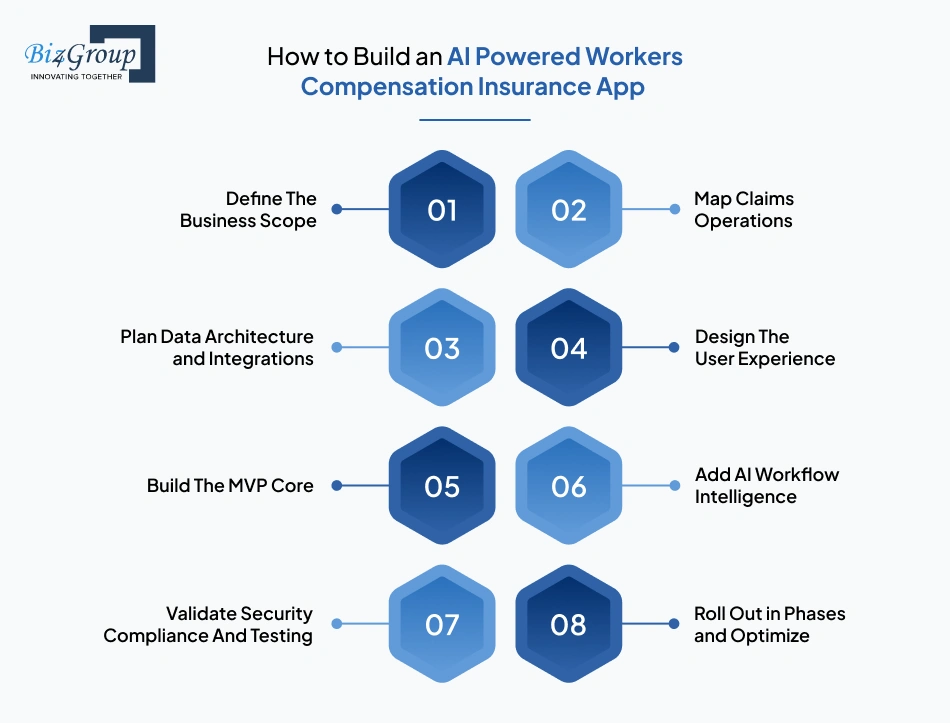
Most organizations do not struggle because they lack claims data. The real challenge starts when medical bills, doctor reports, and claim forms move through disconnected workflows that slow down reviews and increase manual work.
If you are wondering how to build a workers compensation mobile app with an AI powered document scanner that can automatically read extract and verify information from medical bills doctor reports and claim forms submitted by injured workers, the process starts with building the right operational foundation. Not only that it also requires the right development sequence from day one.
Here’s what the AI workers compensation insurance app development process looks like when built for real claims operations.
1. Define The Business Scope
Start by identifying the operational problems the platform needs to solve. This includes claim delays, document handling issues, fraud visibility gaps, or workflow bottlenecks. Teams offering MVP development services usually narrow the first release to the most critical workflows instead of overloading the product with unnecessary functionality.
- Identify primary users such as TPAs, carriers, adjusters, employers, and injured workers.
- Define the claims workflows the first release will support.
- Prioritize features required for daily claim operations.
Outcome: Defined product direction
2. Map Claims Operations
Workers’ compensation systems rely heavily on workflow coordination. Before development starts, the full claim lifecycle should be mapped clearly so the product reflects how claims move in real environments.
- Document FNOL intake, approvals, reviews, escalations, and closure
- Identify where delays, duplicate work, or communication gaps occur.
- Define how different stakeholders interact with claim data.
Outcome: Structured workflow blueprint
3. Plan Data Architecture and Integrations
Claims operations depend on multiple systems working together. The platform architecture should support secure data movement between claim systems, medical records, billing tools, and reporting environments from the beginning.
- Plan integrations for EHRs, medical billing systems, WCIO reporting, and internal claim platforms.
- Define how claim documents, notes, and communication records will be stored.
- Prepare the system for secure API-based connectivity.
Outcome: Connected system architecture
4. Design The User Experience
Claims teams work with large volumes of documents, updates, and pending actions every day. The interface should reduce operational friction instead of adding more complexity. A good UI/UX design company can help you focus on workflow simplicity during this phase.
- Create role-specific dashboards for adjusters, employers, and claimants.
- Keep claim actions accessible with minimal navigation.
- Design layouts that simplify document review and status tracking.
Outcome: Operationally usable interface
Also Read: Top UI/UX Design Companies in USA
5. Build The MVP Core
The first release should focus on the claim workflows that teams use every day. This is where MVP development services matter most, because the goal is to keep the scope lean, stable, and useful before adding deeper automation.
- Build the core claim intake, document handling, status tracking, and task management flows first.
- Keep the MVP focused on the operational paths that reduce manual work fastest.
- Validate the product with a small group of real users before expanding scope.
Outcome: Stable MVP foundation
Also Read: Top MVP Development Companies in USA
6. Add AI Workflow Intelligence
This stage starts with a specific use case, not a broad AI layer. For workers’ compensation, the team usually begins with one or two tasks such as document extraction, claim triage, or fraud flagging. AI model development should stay tied to those workflows so the system solves a real operational problem.
- Define the exact task the AI should handle first.
- Prepare historical claim data and label the examples properly.
- Train AI model on documents, notes, and claim outcomes.
- Validate the model against real claim scenarios.
- Integrate AI model into intake, review, or routing steps.
- Monitor results and retrain when claim patterns change.
Outcome: Working AI layer
Also Read: How to Integrate AI into an App: Process and Cost
7. Validate Security Compliance And Testing
Before rollout, the platform needs full validation across security, access control, workflow accuracy, and claim data handling. Workers’ compensation systems deal with sensitive information, so this phase has to be treated as part of product readiness, not a final checkbox.
- Test role-based access, audit trails, and data protection controls.
- Run workflow tests with real claim scenarios and exception cases.
- Review AI outputs for accuracy, consistency, and operational reliability.
Outcome: Production-ready system
Also Read: Top 15+ Software Testing Companies in USA
8. Roll Out in Phases and Optimize
The platform should go live in stages so teams can adjust without disrupting active claim operations. Phased rollout also makes it easier to catch workflow gaps, train users properly, and improve the product after launch.
- Start with one team, region, or claim line before full release.
- Train users on workflows, actions, and system expectations.
- Monitor adoption, speed, and AI performance after launch.
Outcome: Controlled live deployment
A successful workers’ compensation platform is not shaped by AI alone. The real difference comes from how well the workflows, data handling, claim movement, and rollout strategy fit into day-to-day operations. This balance matters a lot while creating a workers compensation app with AI that automatically assigns claims to the right adjuster across large claim environments.
Still Managing Claims Through Manual Workflows?
Build AI-assisted claims infrastructure that supports adjusters, employers, and injured workers without operational bottlenecks
Start Building Smarter WorkflowsWhat is the Recommended Tech Stack for AI Workers Compensation Insurance App Development
Modern AI workers compensation mobile app development depends on multiple architectural layers working together behind the scenes. From AI-driven claim review to secure document handling and real-time workflow coordination, every layer of the stack plays a role in keeping claims operations stable, scalable, and easier to manage.
|
Architecture Layer |
Technologies Used |
What They’re Used To Build |
|---|---|---|
|
Mobile App Frontend |
React Native, Flutter |
Cross-platform mobile interfaces for adjusters, employers, and injured workers using ReactJS development |
|
Web Dashboard Layer |
Next.js |
Claim dashboards, workflow panels, reporting screens, and employer portals through NextJS development |
|
Backend Services Layer |
Node.js, Express.js |
Claim processing workflows, notification handling, and operational logic with NodeJS development |
|
AI Processing Layer |
Python, TensorFlow, PyTorch |
AI-powered fraud detection, claim scoring, document extraction, and workflow prediction using Python development |
|
LLM Integration Layer |
OpenAI API, Claude API |
Medical note analysis, claim summarization, document classification, and AI-assisted workflow support |
|
API Integration Layer |
REST APIs, GraphQL |
Secure connectivity between EHRs, WCIO systems, billing platforms, and third-party tools through API development |
|
Database Layer |
PostgreSQL, MongoDB |
Storage for claim records, adjuster notes, workflow history, and claimant information |
|
Document Management Layer |
AWS S3, Firebase Storage |
Secure storage and retrieval of medical bills, reports, forms, and legal claim documents |
|
Authentication And Security Layer |
OAuth 2.0, JWT, RBAC |
Secure login, session management, and role-based claim access controls |
|
Real-Time Communication Layer |
Twilio, Socket.io, Firebase |
Live claim notifications, messaging, alerts, and operational communication updates |
|
Cloud Infrastructure Layer |
AWS, Microsoft Azure, Google Cloud |
Scalable hosting environments for claims processing, AI workloads, and system availability |
|
DevOps And Deployment Layer |
Docker, Kubernetes, GitHub Actions |
Containerized deployment, workload scaling, and automated release management |
|
Analytics And Reporting Layer |
Power BI, Tableau, Google Analytics |
Operational dashboards, claim performance reporting, and workflow monitoring |
|
Compliance And Audit Layer |
AES-256 Encryption, Audit Logs |
Protection of sensitive claim data and tracking of workflow activity for compliance review |
The right stack depends on claim volume, compliance requirements, integrations, user roles, and long-term operational scale. What you should always remember is that do not develop workers compensation insurance application around technologies just because they are popular.
A strong approach to full stack development keeps the architecture modular, making it easier to expand workflows, AI capabilities, and claims operations without rebuilding the entire system later.
Also Read: Why to Choose the Full Stack Development for Modern Business
Compliance Essentials for AI Workers Compensation Insurance App Development
When you develop a HIPAA compliant workers compensation insurance mobile app for injured workers, it must cover medical records, claim data, access control, and workflow accountability from the start.
Here are the standards and safeguards that keep the platform secure, reliable, and ready for real claims operations.
1. Regulatory And Industry Compliance Standards
|
Compliance / Standard |
What It Covers |
Why It Matters for AI Workers Compensation Apps |
|---|---|---|
|
WCIO Reporting Standards |
Standardized workers’ compensation claim reporting formats |
Keeps claim reporting structured, consistent, and compatible across carriers and TPAs |
|
HIPAA |
Protection of medical records, PHI, and healthcare-related communication |
important for platforms handling injury records, treatment data, and medical documentation |
|
EDI Compliance |
Electronic claim submission and transaction standards |
Supports faster digital claim exchange with regulators and third-party systems |
|
State Workers’ Compensation Regulations |
Jurisdiction-specific reporting, documentation, and claim handling rules |
Helps carriers and TPAs avoid compliance gaps across different states |
|
GDPR / CCPA |
User consent, data privacy, and information access rights |
Important for platforms handling claimant data across multiple regions |
|
SOC 2 Compliance |
Operational security, system reliability, and access controls |
Strengthens trust around sensitive claim and employer information |
Also Read: HIPAA Compliant AI App Development for Healthcare Providers
2. AI Governance and Claim Accountability
|
AI Governance Measure |
What It Covers |
Why It Matters For AI Workers Compensation App |
|---|---|---|
|
AI Decision Logging |
Tracks AI-generated recommendations and workflow actions |
Helps teams review how claim decisions and risk flags were generated |
|
Human Review Controls |
Allows adjusters to validate AI-assisted outputs |
Prevents overdependence on automated claim decisions |
|
Bias Monitoring |
Reviews claim scoring and workflow logic for unfair patterns |
Reduces operational risk tied to inconsistent AI outputs |
|
Model Retraining Controls |
Updates AI models using new claim data and workflows |
Keeps predictions aligned with changing claim patterns |
|
Audit-Ready AI Records |
Stores AI-generated activity history and claim interactions |
Supports compliance reviews and operational accountability |
3. Security And Access Control Essentials
|
Security Measure |
What It Covers |
Why It Matters for AI Workers Compensation App |
|---|---|---|
|
End-To-End Encryption |
Protects claim data during storage and transfer |
Reduces exposure of sensitive claimant and employer information |
|
Role-Based Access Control |
Restricts system access based on user responsibility |
Prevents unauthorized visibility into claim records |
|
Multi-Factor Authentication |
Adds additional login verification layers |
Improves account security for adjusters, employers, and admins |
|
Audit Logs |
Tracks workflow activity, approvals, and data access |
Helps teams investigate security events and compliance issues |
|
Session Management Controls |
Monitors active sessions and login activity |
Reduces the risk of unauthorized account usage |
4. Data Protection and Infrastructure Standards
|
Infrastructure Control |
What It Covers |
Why It Matters for AI Workers Compensation App |
|---|---|---|
|
Secure Cloud Infrastructure |
Protected hosting environments for claim operations |
Supports scalability while maintaining data protection standards |
|
Backup And Disaster Recovery |
Recovery planning for outages and system failures |
Prevents operational disruption during unexpected incidents |
|
Document Retention Policies |
Long-term storage and management of claim documents |
Helps organizations meet legal and reporting requirements |
|
API Security Controls |
Protection for integrations between claim systems and third-party tools |
Reduces vulnerabilities across connected workflows |
|
Vulnerability Testing |
Regular security scans and infrastructure reviews |
Helps teams identify threats before they affect operations |
Strong compliance planning is not only about avoiding penalties or passing audits. It also helps carriers and TPAs protect claim data, maintain operational trust, and scale AI-driven workflows without creating security or reporting risks later in the product lifecycle.
Compliance Problems Get Expensive Fast
Protect claim data, strengthen audit readiness, and keep workflows aligned with evolving workers compensation regulations
Secure Your Claims PlatformHow Much Does It Cost to Develop AI Workers Compensation Insurance App?
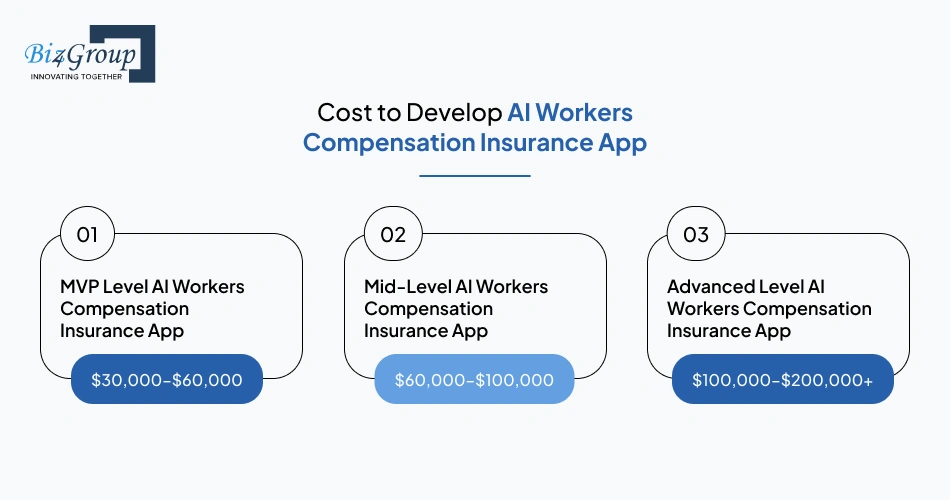
Cost usually becomes a serious discussion once the platform scope starts getting clearer. Features like AI-driven claim workflows, fraud monitoring, document processing, mobile access, and compliance layers directly influence the final budget in AI workers compensation insurance app development. Most platforms typically fall between $30,000 and $200,000+ depending on complexity, integrations, and rollout scale.
The breakdown below explains how development scope, AI capabilities, integrations, and operational requirements affect the overall investment across different platform levels.
|
Development Level |
Estimated Cost Range |
Scope |
|---|---|---|
|
MVP Level AI Workers Compensation Insurance App |
$30,000–$60,000 |
Basic claim intake, document upload, role-based login, simple dashboards, and limited workflow automation |
|
Mid-Level AI Workers Compensation Insurance App |
$60,000–$100,000 |
AI-assisted workflows, adjuster dashboards, mobile support, compliance controls, reporting, and third-party integrations |
|
Advanced Level AI Workers Compensation Insurance App |
$100,000–$200,000+ |
Fraud detection, predictive analytics, advanced automation, scalable infrastructure, AI-driven document processing, and enterprise-grade integrations |
Major Cost Drivers That Affect Development Budget of AI Workers Compensation Insurance App
1. AI Workflow Complexity
AI-powered fraud detection, document extraction, claim prioritization, and workflow automation usually increase development effort significantly. Advanced AI integrations costs can add anywhere between $15,000 and $60,000+ depending on model complexity, automation depth, and training requirements.
2. Mobile And Dashboard Experience
Operational dashboards, claimant workflows, employer portals, and adjuster interfaces all require structured design planning. A detailed UI/UX design cost often falls between $5,000 and $20,000 based on workflow complexity and user roles.
3. Third-Party System Integrations
Connecting AI EHR systems, WCIO reporting tools, billing systems, payroll software, and claim platforms increases both backend complexity and testing requirements. Integration-heavy platforms can add roughly $10,000–$40,000 to the total budget.
4. Compliance And Security Requirements
HIPAA safeguards, audit logging, role-based access control, encryption, and state-specific compliance workflows increase development effort. Security and compliance implementation may contribute an additional $8,000–$30,000 depending on operational requirements.
5. Dedicated Development Resources
Project timelines, feature stability, and AI implementation quality often depend heavily on the delivery team structure. The cost of hiring dedicated AI development team resources may range between $25,000 and $80,000+ based on expertise and project duration.
Hidden Costs That Often Get Overlooked in AI Workers Compensation Insurance App
|
Hidden Costs |
Estimated Cost Impact |
|---|---|
|
AI model retraining and optimization |
$5,000–$25,000 annually |
|
Cloud infrastructure scaling |
$1,000–$8,000/month |
|
Ongoing compliance updates |
$3,000–$15,000 annually |
|
Third-party API usage fees |
$500–$5,000/month |
|
Post-launch workflow refinements |
$5,000–$20,000 |
|
User onboarding and operational training |
$2,000–$10,000 |
Strategies To Optimize Development Cost of AI Workers Compensation Insurance App
- Start with high-impact workflows first instead of automating every operational process immediately. This can reduce initial development cost by nearly 20%–35%.
- Roll out AI capabilities in phases so training, testing, and optimization happen gradually instead of all at once. This may lower early-stage AI spending by 15%–30%.
- Use cross-platform mobile frameworks to reduce separate iOS and Android development effort. Teams often reduce frontend costs by almost 25%–40%.
- Prioritize integrations based on operational importance instead of connecting every third-party system during phase one. This can reduce backend complexity by nearly 15%–25%.
- Keep the first release focused on stable workflows and operational usability before expanding feature depth. Controlled MVP scope often lowers overall delivery cost by 20%–30%.
The total investment depends heavily on workflow complexity, AI depth, integrations, compliance requirements, and long-term operational goals. A structured approach to AI insurance mobile app development for workers compensation usually helps organizations control costs more effectively while keeping the platform scalable for future expansion.
Monetization Strategies for AI Workers Compensation Insurance App Development
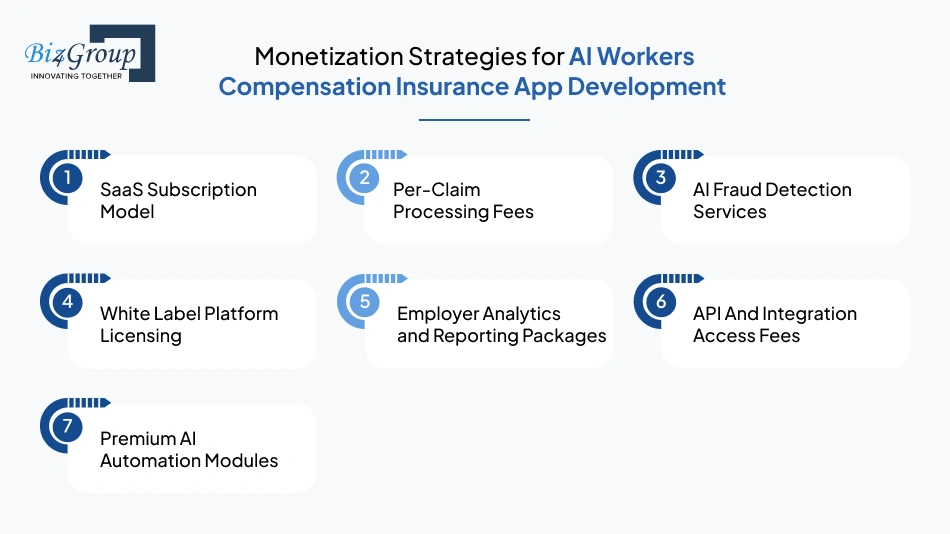
Revenue matters just as much as operational efficiency once the platform goes live. Organizations building an AI workers compensation app that works on both iOS and android platforms are increasingly combining recurring SaaS models, enterprise licensing, and AI-powered service layers to create more scalable long-term revenue streams.
Here are some of the most practical monetization strategies used in AI workers compensation insurance app development today:
1. SaaS Subscription Model
Charge carriers, TPAs, or self-insured employers a recurring monthly or annual platform fee based on usage, claim volume, or user access.
Examples:
- $2,000–$15,000/month for mid-size TPA operations
- Enterprise pricing based on active claims or adjuster seats
Why It Works: Predictable recurring revenue with long-term client retention.
2. Per-Claim Processing Fees
Charge a fixed fee for every claim processed through the platform. This model works well for organizations handling high claim volumes.
Avg Revenue Potential:
- $5–$50 per processed claim
- Higher pricing for AI-assisted fraud review or document analysis
Why It Works: Revenue scales naturally as claim volume increases.
3. AI Fraud Detection Services
Offer AI-powered fraud scoring and anomaly detection as a premium operational service. Many carriers are willing to pay separately for fraud visibility tools that reduce financial leakage.
Examples:
- Monthly fraud monitoring subscriptions
- Additional fees for high-risk claim investigations
Revenue Potential: $10,000–$100,000+ annually for enterprise contracts.
4. White Label Platform Licensing
Companies investing in AI app development can license the platform to carriers, TPAs, or insurance groups under their own branding.
Revenue Model:
- One-time setup fee: $25,000–$150,000+
- Ongoing SaaS licensing: $3,000–$20,000/month
Why It Works: Creates enterprise-level recurring revenue without depending only on direct end users.
Also Read: Top 25 AI App Development Companies in USA in 2026
5. Employer Analytics and Reporting Packages
Offer advanced reporting dashboards and operational analytics as paid add-ons for employer groups and insurance clients.
Examples:
- Return-to-work tracking dashboards
- Injury trend analysis
- Claim performance benchmarking
Avg Revenue Potential: $500–$5,000/month depending on reporting depth and workforce size.
6. API And Integration Access Fees
Charge enterprise clients for custom integrations with EHRs, billing systems, payroll platforms, or internal claim software.
Examples:
- One-time integration setup fees
- Monthly API usage pricing
Revenue Potential: $10,000–$75,000+ per enterprise integration project.
7. Premium AI Automation Modules
Offer advanced AI automation tools as optional upgrades instead of bundling everything into the core platform.
Examples:
- AI-powered medical bill review
- Predictive claim severity scoring
- Automated claim routing
- Return-to-work monitoring tools
Why It Works: Allows organizations to scale platform capabilities gradually without increasing initial adoption resistance.
The strongest monetization models usually combine recurring SaaS revenue with operational add-ons and enterprise licensing. That approach gives workers’ compensation platforms multiple revenue channels while keeping long-term growth more predictable.
Revenue Models Matter After Launch Too
Build scalable monetization layers that support SaaS growth, enterprise licensing, and AI-powered operational services
Discuss Revenue StrategyWhat Challenges Arise in AI Workers Compensation Insurance App Development (And How to Solve Them)
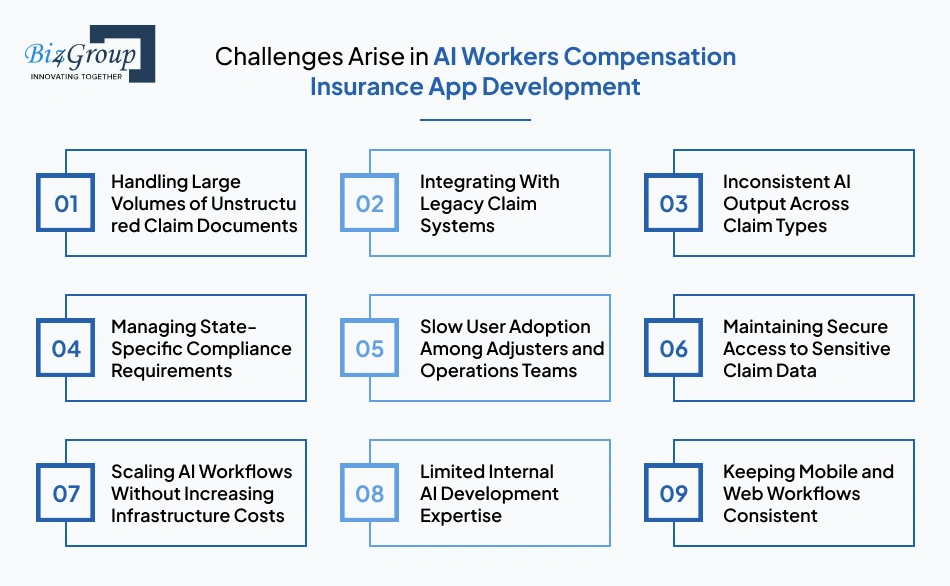
Workflow gaps, poor integrations, and unstable AI outputs can quickly slow down claims operations after deployment. These challenges become harder to manage while building a workers compensation insurance app for self-insured employers in the United States, where operational visibility and compliance consistency matter across every claim workflow.
The table below breaks down some of the most common development challenges teams face during implementation, along with practical ways to solve them before they affect live claims operations.
|
Challenge |
How To Solve It |
|---|---|
|
Handling Large Volumes of Unstructured Claim Documents |
Train the platform on real claim forms, medical bills, and adjuster notes before production rollout. Start document extraction with limited workflows first, so accuracy improves gradually over time. |
|
Integrating With Legacy Claim Systems |
Use modular APIs and phased rollout planning instead of replacing existing infrastructure all at once. This keeps claim operations stable during migration. |
|
Inconsistent AI Output Across Claim Types |
Validate the models against real claim scenarios and regularly fine tune LLM’s using updated claim data, adjuster notes, and operational feedback. |
|
Managing State-Specific Compliance Requirements |
Build configurable workflows that adapt to reporting rules, documentation standards, and claim handling requirements across different jurisdictions. |
|
Slow User Adoption Among Adjusters and Operations Teams |
Keep workflows simple, reduce unnecessary screens, and introduce changes gradually through controlled onboarding and training. |
|
Maintaining Secure Access to Sensitive Claim Data |
Use encrypted storage, role-based access control, audit logs, and multi-factor authentication to protect claimant and employer information. |
|
Scaling AI Workflows Without Increasing Infrastructure Costs |
Prioritize high-impact workflows first instead of automating every operational task during the initial rollout phase. |
|
Limited Internal AI Development Expertise |
Hire AI developers with experience in workflow automation, claims processing, and production-scale AI integration before expanding platform capabilities. |
|
Keeping Mobile and Web Workflows Consistent |
Maintain shared workflow logic and centralized operational rules during AI business app development so users get a consistent claim experience across platforms. |
Also Read: Cost to Hire an AI Software Developer in 2026
Most long-term operational issues are easier to prevent during development than after deployment. A structured approach to AI workers compensation insurance app development helps teams avoid workflow instability, compliance gaps, and scaling problems later.
Why Choose Biz4Group LLC for AI Workers Compensation Insurance App Development
Companies planning to create AI workers compensation insurance app that automates claim filing and processing usually need more than just a development vendor. They need a technology partner that understands claims workflows, AI implementation, and how insurance operations function in real environments.
If you’re someone asking, “I need to find a reliable US based development team that can build our workers compensation insurance mobile app from scratch including the AI backend fraud detection engine and the user facing mobile interface for injured workers and adjusters.” Then this is exactly where your search ends with Biz4Group LLC.
Biz4Group LLC is an AI app development company focused on enterprise platforms, workflow automation, and practical digital products. We build AI apps that support structured operations, smart task handling, and scalable user experiences, which fits naturally with workers’ compensation claims environments.
Insurance platforms also demand strong operational alignment between automation, compliance, reporting, and workflow visibility. This is where our AI insurance automation software solutions become valuable. We understand how workers’ compensation workflows operate in real environments, from claim intake and adjuster coordination to document-heavy reviews and operational tracking across multiple stakeholders. Still not convinces, here’s the proof:
- Transforming Insurance Training with AI: Meet Insurance AI
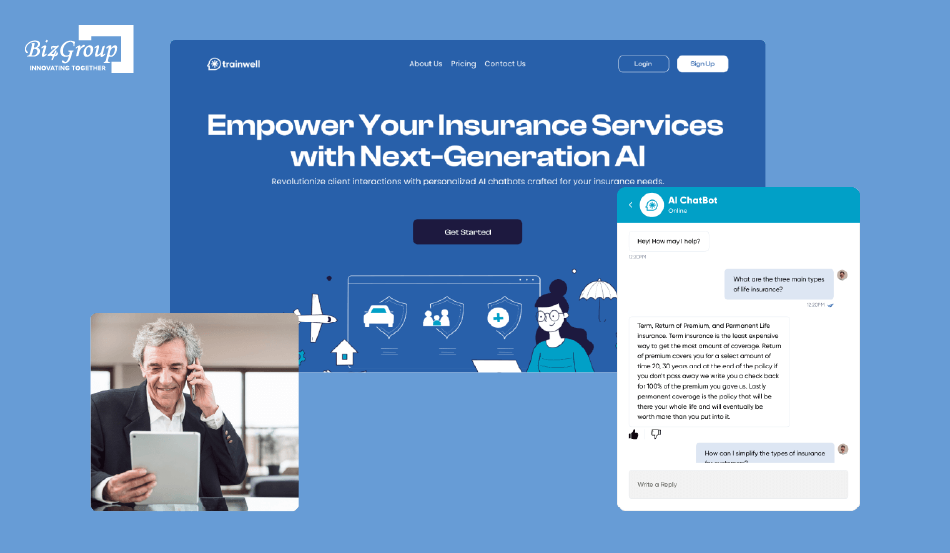
Insurance AI is a smart training and support AI chatbot built for insurance teams. It delivers fast, accurate answers to common queries, helping reduce repetitive onboarding sessions and dependency on lengthy documentation.
Powered by custom GPT-4o and GPT-3.5 LLMs, the system improves through user feedback and integrates smoothly into existing web platforms to keep insurance knowledge accessible, updated, and easy to manage.
2. AI IVR Platform for Medical Claim
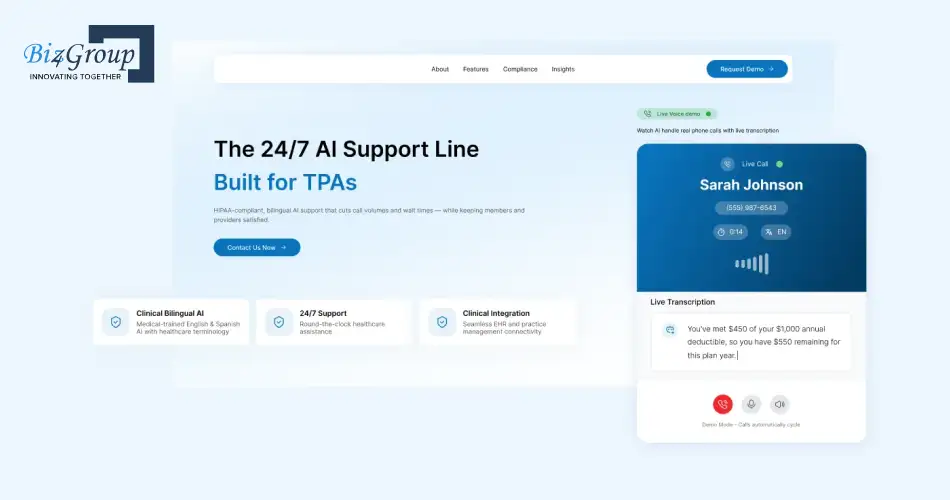
An AI-powered IVR and support solution built for healthcare administrators handling large volumes of patient and insurance calls. The platform automates voice interactions with real-time responses, bilingual support, intelligent call escalation, and secure communication workflows.
By reducing manual call handling, it helps healthcare teams improve response times, streamline support operations, and manage communication more efficiently across high-demand environments.
Want to know what more we bring to the table for workers’ compensation platforms? Take a closer look.
- End-to-end AI automation services for claim intake, document handling, workflow routing, and operational tracking.
- Reliable AI integration services which connect mobile apps, adjuster dashboards, employer portals, and backend claim systems smoothly.
- Role-based workflows built specifically for adjusters, employers, TPAs, and injured workers.
- AI-assisted fraud monitoring and claim prioritization aligned with real operational claim patterns.
- Secure infrastructure with audit logs, controlled access, and compliance-focused data handling.
- Phased delivery support covering planning, MVP rollout, scaling, and post-launch optimization.
Smart workers compensation app development solutions need more than feature delivery alone. The platform has to support operational scale, workflow stability, compliance readiness, and long-term adaptability together. Biz4Group LLC brings those pieces into one execution-focused development approach built for modern insurance operations.
Conclusion
Workers’ compensation teams are already dealing with rising claim complexity, document-heavy workflows, reporting pressure, and growing operational overhead. The goal of AI workers compensation insurance app development is not to replace human decision-making but to remove delays, reduce repetitive work, and give claims teams better visibility across the entire process.
That only works when the platform is built around real operational workflows instead of disconnected automation layers. From claim intake and fraud monitoring to adjuster coordination and compliance tracking, every part of the system must support how teams actually work day to day, and an experienced AI development company can help you achieve it. Automated workers compensation insurance app development becomes far more valuable when the workflows stay practical, scalable, and easy to manage as operations grow.
If you are planning to modernize your claims operations with the right technology strategy and execution approach, schedule a strategy call with us today at Biz4Group LLC.
FAQ’s
1. How accurate can AI fraud detection become in workers compensation claims processing?
AI fraud detection accuracy depends heavily on historical claim quality, workflow design, and model training. Most platforms improve gradually over time as the system learns from adjuster decisions, claim outcomes, billing patterns, and document review history.
2. How long does AI workers compensation insurance app development usually take from planning to launch?
A basic MVP usually takes around 2–4 weeks. Mid-level platforms often require 5–9 weeks, while enterprise-grade systems with AI workflows, integrations, and compliance layers may take 10–14 weeks depending on operational complexity.
3. Can an AI-powered workers compensation platform work with existing claim management systems?
Yes. Most modern platforms use APIs and modular integrations to connect with existing claim software, EHR systems, payroll tools, reporting systems, and internal operational databases without replacing the entire infrastructure immediately.
4. What makes AI-assisted claim routing more effective than manual assignment workflows?
AI-assisted routing helps prioritize claims based on severity, document completeness, injury type, jurisdiction rules, and workload balancing. This reduces delays and helps adjusters focus faster on higher-priority claim cases.
5. What is the typical cost range for enterprise-level workers compensation mobile platform development?
Most enterprise platforms fall between $100,000 and $200,000+ depending on AI capabilities, integrations, compliance requirements, workflow depth, mobile support, reporting infrastructure, and long-term scalability goals.
6. How do workers compensation AI platforms improve adjuster productivity without disrupting operations?
The platform reduces repetitive tasks such as document sorting, claim intake review, status tracking, and manual data extraction. Adjusters spend less time handling administrative work and more time reviewing active claim decisions.
