Location :
Orlando, FL, USA
Location :
Orlando, FL, USA +1 (407) 714-1616
 info@biz4group.com

- Develop an AI auto-betting bot for smarter wagering strategies using real-time data, predictive analytics, and automated execution.
- Build AI auto-betting bots for sports and gaming that analyze live odds and deliver faster decision-making.
- Make intelligent AI bots for online sports betting optimization that adapt to dynamic match conditions, along with advanced features like risk scoring and bankroll management.
- Use AI agent software solutions for real-time odds tracking and automated betting to improve accuracy and efficiency.
- Biz4Group LLC helps you with AI auto-betting bot development services for sports betting businesses, delivering scalable and high-performing solutions.
What if every betting decision you made was backed by real-time data, predictive intelligence, and zero hesitation? Revenue in the sports betting market is expected to show an annual growth rate (CAGR 2026-2030) of 4.79%, resulting in a projected market volume of US$106.22bn by 2030, according to Statista’s latest industry outlook. Businesses today are actively looking to develop an AI auto-betting bot for smarter wagering strategies that can process massive datasets faster than any human team ever could.
For operators and gaming platforms, the challenge goes deeper than placing bets. It is about timing, accuracy, and scale. Manual strategies struggle to keep up with fluctuating odds and live game dynamics. This is where companies are starting to build AI auto-betting bots for sports and gaming, enabling automated decisions that adapt instantly to changing conditions.
Innovation in machine learning and real-time analytics has also opened new doors. Businesses can now create AI betting algorithms for smarter wagering that analyze player stats, historical trends, and even external signals like injuries or weather conditions. The result is a smarter, faster, and more consistent approach to betting decisions that reduces human bias.
So, how can you stay ahead in such a fast-moving landscape? Many operators are now asking, how can I develop an AI auto-betting bot to improve wagering strategies while ensuring scalability and compliance? This guide breaks down the process, technology, and strategy needed to build a system that delivers measurable results.
Let’s begin with the basics.
Understanding the Basics of Building an AI Auto-Betting Bot for Smarter Wagering Strategies
Understanding the foundation of these systems sets the tone for everything that follows. Businesses often jump straight into development without fully grasping what they are building. That leads to inefficient models, poor decision engines, and missed revenue opportunities.
If your goal is to develop AI-powered auto-betting bots for sports betting, you need clarity on how these systems function at a structural level.
What Is an AI Auto-Betting Bot?
An AI auto-betting bot is a software system that uses machine learning, real-time data, and predictive models to place wagers automatically based on calculated probabilities.
In simple terms, it replaces manual decision-making with data-backed execution.
Unlike traditional systems, these bots:
- Analyze large volumes of structured and unstructured data
- Predict outcomes using trained models
- Execute bets instantly through platform integrations
- Continuously learn from outcomes to improve accuracy
This is why many businesses are shifting toward solutions that create intelligent AI betting agents for predictive analytics in gambling, rather than relying on static betting logic.
Traditional Betting Bots Vs AI-Driven Systems
The difference is not incremental. It is foundational.
|
Capability |
Traditional Bots |
AI Auto-Betting Bots |
|---|---|---|
|
Decision Logic |
Predefined rules |
Dynamic learning models |
|
Data Handling |
Limited inputs |
Real-time and historical data |
|
Adaptability |
Fixed |
Continuously evolving |
|
Prediction Accuracy |
Moderate |
Improves with training |
|
Execution Speed |
Trigger-based |
Instant and optimized |
Modern platforms now aim to make intelligent AI bots for online sports betting optimization because static systems cannot keep up with live market fluctuations.
Core Components that Drive the System
Every high-performing betting bot is built on a structured architecture. Each component has a clear responsibility.
- Data Engine
Collects live odds, match statistics, player performance data, and external signals. Reliable data sources such as Sportradar, Genius Sports, and Sports.io are often used at this stage. - Processing Layer
Cleans, filters, and structures incoming data to make it usable for models. - Prediction Engine
Applies machine learning or deep learning models to forecast outcomes and probabilities. - Decision Engine
Evaluates risk, bankroll rules, and probability thresholds to decide whether a bet should be placed. - Execution Layer
Connects with betting platforms via APIs and places wagers automatically. - Learning Loop
Feeds outcomes back into the system to refine future predictions.
Businesses that want to make AI auto-betting bots for data-driven sports betting strategies must ensure each of these layers is tightly integrated.
How the System Works in Practice
The workflow remains continuous and adaptive.
- The system ingests live and historical data
- Models process the data and generate predictions
- The decision engine evaluates risk versus reward
- Bets are placed automatically through APIs
- Results are recorded and fed back into the model
Over time, this creates a self-improving system capable of handling complex betting environments.
This approach aligns closely with modern AI product development practices, where intelligence, scalability, and continuous learning define long-term success.
Why Understanding the Basics Matters
Many businesses focus on features before fundamentals. That often leads to systems that look advanced but fail under real-world conditions.
A strong grasp of these core elements ensures:
- Better model accuracy
- Faster execution
- Scalable infrastructure
- Consistent betting performance
For organizations exploring how to build AI-powered betting agents for automated decision-making in wagering, this foundational clarity reduces development risks and accelerates time to market.
With the fundamentals in place, the next step is understanding why now is the right time to invest in AI-driven betting systems and what market forces are pushing this transformation forward.
Why Develop AI-Powered Auto-Betting Bots for Sports Betting Today?
The betting industry has entered a phase where speed and intelligence define success. Platforms that rely on manual processes struggle to compete with systems that process thousands of data points in seconds.
So why are businesses rushing to invest in AI now? The answer lies in market growth, operational pressure, and rising user expectations.
Market Growth Is Accelerating Rapidly
The numbers tell a clear story. Sports betting and AI adoption are both expanding at a pace that cannot be ignored.
- The global sports betting market is projected to grow at a CAGR of over 10% through 2030, according to Grand View Research report.
- The AI in gaming market is expected to surpass $40 billion by 2028, as highlighted by MarketsandMarkets AI in Gaming report.
What does this mean for businesses?
It means operators who develop AI-powered auto-betting bots for sports betting are positioning themselves in a high-growth, tech-driven ecosystem.
Manual Betting Cannot Keep Up Anymore
Betting platforms today deal with:
- Constantly changing odds
- High-frequency user activity
- Real-time event updates
- Multi-source data dependencies
Manual or rule-based systems cannot process this level of complexity efficiently. This is why many businesses are exploring ways to make AI-powered bots for smarter and faster wagering strategies that can react instantly to live conditions.
Core Pain Points Driving AI Adoption
Let’s break down what operators are dealing with daily.
Operational Challenges
- Delayed decision-making during live betting
- Inconsistent data from multiple providers
- Limited scalability during peak events
Strategic Challenges
- Difficulty identifying profitable patterns
- Human bias affecting wagering decisions
- Lack of predictive insights
These issues explain why platforms are actively learning to use AI for sports betting and automate decision-making processes.
AI Solves What Traditional Systems Cannot
AI does not replace betting logic. It enhances it. Here is how AI changes the game:
|
Challenge |
Traditional Approach |
AI-Driven Approach |
|---|---|---|
|
Odds Analysis |
Manual tracking |
Real-time predictive modeling |
|
Decision Speed |
Seconds to minutes |
Milliseconds |
|
Pattern Recognition |
Limited |
Deep pattern analysis |
|
Scalability |
Restricted |
Highly scalable |
|
Adaptability |
Static |
Continuously learning |
This transformation enables businesses to build AI auto-betting bots for sports and gaming that operate with precision and speed.
Why Data Ecosystems Matter More Than Ever
Modern betting systems rely on multiple data sources. No single provider offers complete coverage. That is why leading platforms integrate feeds from providers like Sportradar, Genius Sports, and Sports.io to ensure accuracy and depth.
Also read: Why top US betting apps rely on multiple sports data providers?
AI Agents are Changing the Way Betting Systems Operate
AI agents take automation a step further. Instead of executing predefined instructions, they act independently based on data and context.
So, how can AI agent help automate sports betting and wagering strategies in real scenarios?
- They monitor multiple games simultaneously
- They adjust strategies mid-game
- They optimize bets based on probability shifts
Businesses exploring advanced solutions are increasingly investing in systems like a sports betting AI agent to keep scaling.
The Shift from Optional to Essential
A few years ago, AI in betting was seen as an innovation. Today, it is becoming a necessity. Platforms that fail to adopt AI risk:
- Slower decision-making
- Lower user engagement
- Reduced profitability
Businesses that create AI betting algorithms for smarter wagering stay ahead in accuracy, scalability, and user trust.
Also read: How to develop a sports betting platform like Outlier.Bet?
Still Waiting While the Market Moves Ahead?
With AI adoption in betting growing over 25% yearly, how many opportunities are you leaving on the table every match day?
Build Smart with Biz4GroupTypes of Betting Strategies AI Bots Can Execute
Not all betting strategies work the same way. Some focus on small margins. Others rely on timing or probability gaps. When businesses make AI auto-betting bots for data-driven sports betting strategies, they are essentially teaching machines how to apply these strategies at scale.
Below are the most widely used approaches that AI systems execute with precision.
1. Arbitrage Betting
Arbitrage betting focuses on exploiting price differences across platforms. The idea is simple. Place bets on all possible outcomes where the combined odds guarantee a profit. AI makes this strategy practical by scanning multiple platforms instantly.
- Identifies odds mismatches across providers
- Calculates stake distribution automatically
- Executes bets before odds change
This strategy is often used in systems built alongside solutions like a white-label sports betting platform where multi-platform integrations are common.
Also read: Migrating from white label to custom sports betting software development
2. Value Betting
Value betting relies on spotting odds that underestimate the true probability of an outcome. AI models analyze:
- Historical match data
- Player performance trends
- Team statistics
If the model detects that a team has a higher probability of winning than what the odds suggest, it places the bet. Businesses aiming to create AI betting algorithms for smarter wagering often prioritize value betting due to its long-term profitability.
3. Live Or In-Play Betting
Live betting requires speed. Odds change within seconds during a match. AI systems monitor:
- Game momentum
- Player substitutions
- Real-time statistics
They adjust decisions instantly. This is where many operators look to build custom AI bots for live betting analysis and automated wagering that can react faster than manual traders.
4. Hedging Strategies
Hedging reduces risk by placing multiple bets to cover different outcomes. AI calculates:
- Risk exposure
- Potential loss scenarios
- Optimal hedge positions
It then adjusts wagers to balance risk and return. This approach is widely used in systems designed for large-scale operations, including platforms similar to AI sports betting exchange software development.
5. Trend-Based Betting
Trend-based strategies rely on patterns across seasons, teams, and players. AI systems evaluate:
- Winning streaks
- Head-to-head records
- Venue-based performance
They identify repeatable patterns that influence outcomes. This method is particularly effective for platforms offering solutions like soccer betting software or football betting app, where historical data plays a major role.
6. Micro-Betting and Event-Based Strategies
Micro-betting focuses on specific moments within a game rather than final outcomes. Examples include:
- Next goal scorer
- Next point or play
- Quarter-based outcomes
AI thrives in this environment because it can process rapid data changes. Businesses building advanced systems often combine these strategies with AI fantasy sports app development to enhance user engagement and predictive depth.
7. Reinforcement Learning-Based Strategies
This is where AI goes beyond predefined logic. Reinforcement learning models:
- Learn from past bets
- Adjust strategies dynamically
- Optimize decisions over time
Instead of following fixed rules, the system evolves. Organizations looking for long-term scalability often explore this approach while working with technologies like generative AI to enhance prediction capabilities.
Why Strategy Selection Matters
Each strategy serves a different purpose. Some focus on consistency. Others aim for high returns. When businesses build AI auto-betting bots for sports and gaming, the real value comes from combining multiple strategies into a unified system.
Important Features to Include When You Build AI Auto-Betting Bots for Sports and Gaming
Before moving into architecture or development, it is important to understand what features truly define a high-performing system. Features are not about adding complexity. They shape how efficiently the bot operates, adapts, and delivers results in real betting environments.
Below are the core and advanced features businesses should prioritize when they develop an AI auto-betting bot for smarter wagering strategies.
|
Feature |
What It Is |
What It Does |
|---|---|---|
|
Real-Time Odds Aggregator |
A system that pulls odds from multiple providers simultaneously |
Ensures accurate and up-to-date pricing for better decision-making |
|
Multi-Source Data Normalization |
A layer that standardizes data from different formats and APIs |
Eliminates inconsistencies and improves model reliability |
|
Predictive Modeling Engine |
Machine learning models trained on historical and live data |
Generates outcome probabilities for smarter betting decisions |
|
Dynamic Bankroll Management |
Automated allocation of betting capital based on risk rules |
Prevents overexposure and optimizes long-term returns |
|
Strategy Switching Engine |
Ability to switch between betting strategies based on conditions |
Maintains performance across different match scenarios |
|
Latency Optimization Module |
System designed to reduce delays in data processing and execution |
Enables faster response to live odds changes |
|
Risk Scoring System |
A mechanism that evaluates each bet’s risk level before execution |
Helps filter low-confidence bets and protect capital |
|
Adaptive Learning Loop |
Continuous feedback system that retrains models based on results |
Improves prediction accuracy over time |
|
Event Detection Engine |
Identifies key match events such as injuries or momentum shifts |
Adjusts betting logic instantly during live games |
|
API Orchestration Layer |
Manages communication between multiple external betting and data APIs |
Ensures smooth and reliable system integration |
|
Scenario Simulation Engine |
Virtual environment to test strategies before live deployment |
Reduces losses by validating models in advance |
|
Portfolio Diversification Logic |
Distributes bets across multiple matches and markets |
Minimizes risk concentration and balances exposure |
|
Alert and Override System |
Allows manual intervention when needed |
Provides control in high-risk or uncertain scenarios |
|
Fraud Detection and Anomaly Monitoring |
Identifies unusual patterns in betting activity |
Protects the platform from misuse and financial risks |
|
Performance Analytics Dashboard |
Visual interface to track outcomes, ROI, and system behavior |
Helps stakeholders make informed business decisions |
These features form the backbone of systems designed to build AI auto-betting bots for sports and gaming at scale. Each capability plays a specific role in improving accuracy, managing risk, and ensuring consistent performance.
With the feature set clearly defined, the next step is to understand the technology stack and architecture required to bring these capabilities to life.
Also read: How to build a sports betting platform like BetDEX?
Features Look Good on Paper, But Do They Perform Live?
The difference between a winning platform and a struggling one often comes down to how these features actually work in real-time.
Book a Strategy Call TodayTechnology and Architecture Required to Develop an AI Auto-Betting Bot for Smarter Wagering Strategies
A strong idea without the right technology fails quickly in betting environments. Speed, accuracy, and scalability depend entirely on the stack you choose. Businesses that develop an AI auto-betting bot for smarter wagering strategies need infrastructure that can process real-time data without delays and support continuous model learning.
Let’s break this down into two parts. The technology stack and the system architecture.
Core AI and Machine Learning Stack
|
Layer |
Tools And Frameworks |
What It Does |
|---|---|---|
|
Machine Learning |
TensorFlow, PyTorch, Scikit-learn |
Builds prediction models for outcomes and probabilities |
|
Deep Learning |
Keras, PyTorch Lightning |
Handles complex pattern recognition in large datasets |
|
Reinforcement Learning |
OpenAI Gym, Ray RLlib |
Enables adaptive betting strategies based on feedback loops |
|
Data Science |
Pandas, NumPy, Jupyter |
Data analysis, preprocessing, and experimentation |
These tools allow businesses to create AI betting algorithms for smarter wagering that evolve with every data cycle.
Data Engineering and Real-Time Processing Stack
|
Layer |
Tools And Frameworks |
What It Does |
|---|---|---|
|
Data Streaming |
Apache Kafka, RabbitMQ |
Handles real-time data ingestion from multiple sources |
|
Data Processing |
Apache Spark, Flink |
Processes large-scale streaming and batch data |
|
Data Storage |
PostgreSQL, MongoDB, Redis |
Stores structured and unstructured data efficiently |
|
API Integrations |
REST, GraphQL |
Connects with betting platforms and data providers |
High-quality data pipelines are critical. Many platforms struggle due to poor synchronization.
Also read: Why enterprise sports data APIs like SportRadar matter more than features?
Backend And Infrastructure Stack
|
Layer |
Tools And Frameworks |
What It Does |
|---|---|---|
|
Backend Development |
Node.js, Python, Go, C# |
Handles business logic and API communication |
|
Cloud Infrastructure |
AWS, Azure, Google Cloud |
Provides scalability and global availability |
|
Containerization |
Docker, Kubernetes |
Ensures smooth deployment and scaling |
|
Security |
OAuth, JWT, SSL |
Protects user data and transactions |
This layer supports businesses looking to build AI auto-betting bots for sports and gaming with high availability and performance.
Frontend And User Interface Stack
|
Layer |
Tools And Frameworks |
What It Does |
|---|---|---|
|
Web Frontend |
React, Next.js |
Builds responsive dashboards and interfaces |
|
Mobile Development |
Flutter, React Native |
Enables cross-platform mobile apps |
|
Visualization |
D3.js, Chart.js |
Displays betting insights and analytics |
User experience still matters. Even the most advanced system needs intuitive dashboards for monitoring and control.
How Biz4Group Brought this Stack to Life: Real-Time Sports Betting Platform
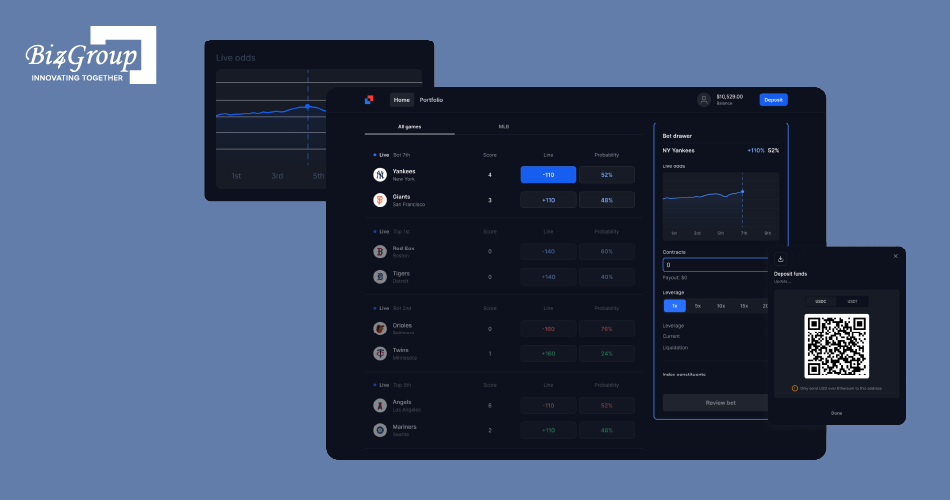
Biz4Group developed a real-time sports betting platform designed to handle global betting scenarios across leagues like MLB, CFB, and NFL.
What Made It Stand Out
- Real-time data ingestion through socket-based architecture
- Multi-language backend using Node.js, Go, Python, and C#
- Predictive analytics for team and match insights
- Frontend built with Next.js for seamless user experience
How It Solved Critical Challenges
- Managed high traffic using load balancing and server clustering
- Reduced latency through optimized socket communication
- Ensured data consistency across multiple services
- Implemented caching and data partitioning for performance
This kind of architecture reflects what businesses need when they aim to build custom AI bots for live betting analysis and automated wagering in real-world environments.
High-Level Architecture of an AI Auto-Betting Bot
A well-designed architecture ensures that every component communicates efficiently and scales without friction.
Key Architectural Layers
- Data ingestion layer that connects with providers like Sportradar, Genius Sports, and Sports.io
- Data processing layer that cleans and structures incoming information
- AI model layer responsible for predictions and probability scoring
- Decision engine that evaluates risk and triggers actions
- Execution layer that integrates with betting platforms via APIs
- Monitoring and analytics layer for performance tracking
Advanced Architectural Considerations
- Microservices architecture for modular scalability
- Event-driven systems for real-time responsiveness
- Multi-tenant setups for platforms serving multiple users or operators
- Low-latency pipelines for live betting scenarios
Also read: How to develop a multi-tenant AI sports betting platform?
Why Architecture Matters More Than Features
Many platforms invest heavily in features but overlook system design. That often leads to performance bottlenecks and delayed execution.
A well-planned architecture ensures:
- Real-time responsiveness
- Scalable performance under high traffic
- Reliable data flow across systems
Businesses aiming to make AI-powered bots for smarter and faster wagering strategies must treat architecture as a priority, not an afterthought.
With the tech stack and architecture in place, the next step is to understand how to actually build and deploy the system step-by-step.
Also read: AI pari-mutuel betting software development guide
How to Build AI-Powered Betting Agents for Automated Decision-Making in Wagering
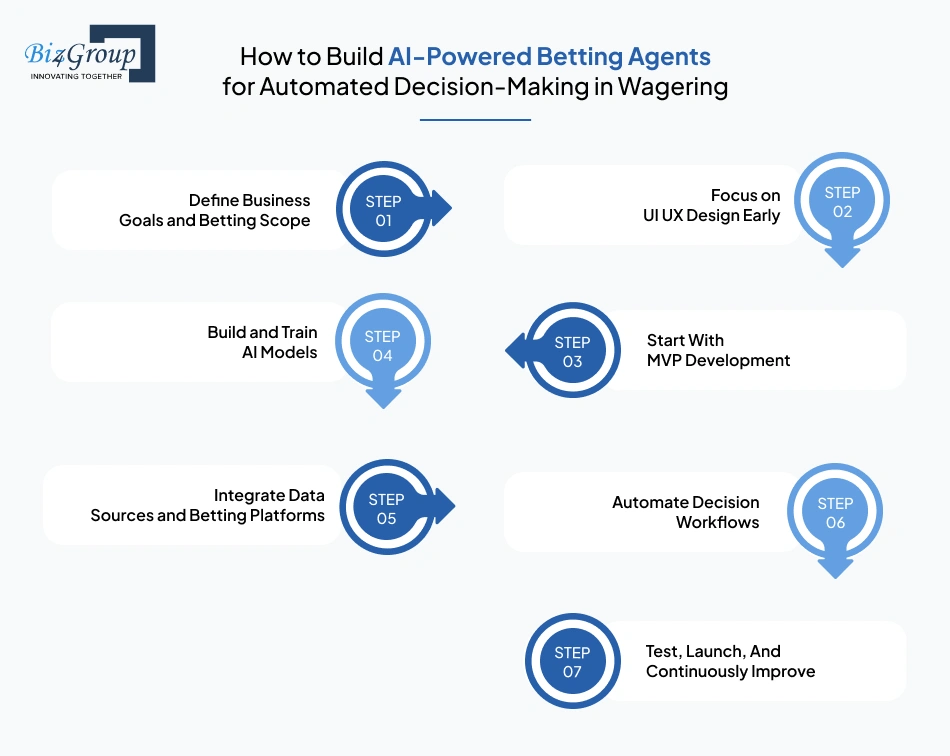
A structured process separates successful betting platforms from those that struggle after launch. Businesses often rush into development without a roadmap. That leads to delays, rework, and missed opportunities.
If you want to build AI auto-betting bots for sports and gaming, follow a phased approach that balances strategy, usability, and performance.
Step 1. Define Business Goals and Betting Scope
Start with clarity. What type of betting platform are you building?
- Sports focus such as football, horse racing, or multi-sport
- Target users such as casual bettors or professional traders
- Revenue model including commissions, subscriptions, or margins
Clear goals help shape how you create AI betting algorithms for smarter wagering later in the process.
Step 2. Focus on UI UX Design Early
A betting platform lives or dies by user experience. Even advanced systems fail if users find them confusing. Strong design should offer:
- Clear betting flows
- Real-time updates without clutter
- Easy navigation across markets
- Visual insights for quick decisions
Investing in professional UI/UX design helps create intuitive interfaces that keep users engaged.
Also read: Top 15 UI/UX design companies in USA
Step 3. Start With MVP Development
Jumping into a full-scale product can be risky. A focused MVP helps validate your idea faster. A typical MVP includes:
- Core betting functionality
- Basic prediction models
- Limited market coverage
- Simple dashboards
Working with an experienced team offering MVP development services ensures faster time to market and early user feedback.
Also read: Top 12+ MVP development companies in USA
Step 4. Build and Train AI Models
Once the foundation is ready, focus on intelligence.
- Train AI models using historical and live data
- Validate predictions using simulations
- Continuously refine based on outcomes
This stage is critical for businesses aiming to develop AI-powered auto-betting bots for sports betting that deliver consistent results.
Step 5. Integrate Data Sources and Betting Platforms
Integration defines how well your system performs in real conditions. You need:
- Reliable sports data providers
- Seamless betting platform connectivity
- Real-time synchronization
Working with experts in AI integration ensures smooth communication between systems and reduces operational friction.
Step 6. Automate Decision Workflows
Automation brings everything together.
- Trigger bets based on model outputs
- Set rules for bankroll allocation
- Enable real-time execution without delays
This is where systems evolve into fully functional solutions capable of making AI-powered bots for smarter and faster wagering strategies. Solutions built with strong AI automation frameworks handle scale and complexity more effectively.
Step 7. Test, Launch, And Continuously Improve
Before going live:
- Run simulations and backtesting
- Monitor early user behavior
- Optimize performance based on feedback
Post-launch, continuous improvement ensures long-term success.
How Biz4Group Demonstrates This Process: Quick Start Bets
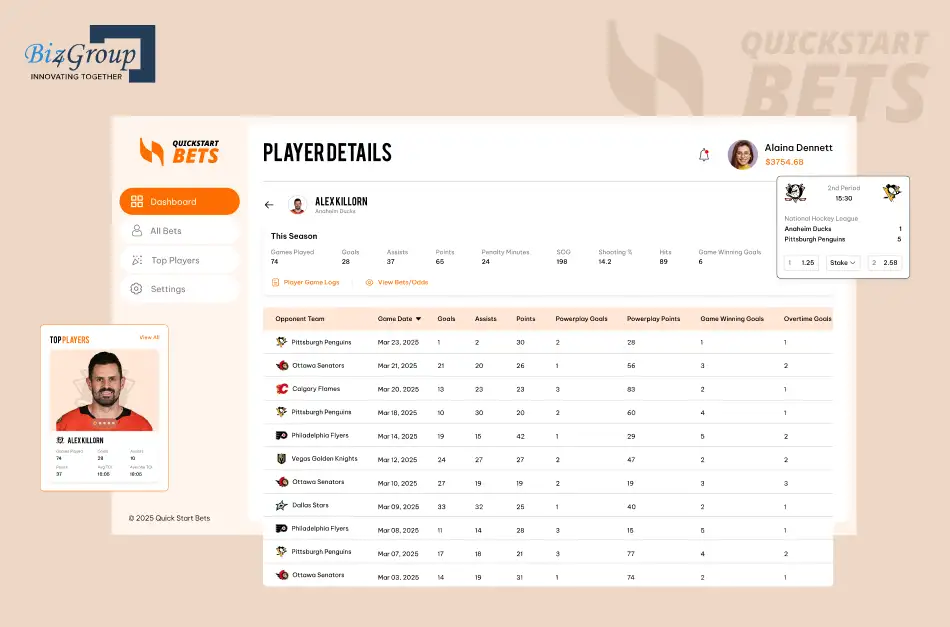
Quick Start Bets is a real-time analytics platform designed for NHL betting scenarios.
What The Platform Achieved
- Delivered live odds with minimal latency
- Provided detailed player and team insights
- Offered a centralized dashboard for tracking bets and performance
Key Development Highlights
- Integrated multiple data sources and normalized them for accuracy
- Built interactive dashboards for better decision visibility
- Enabled real-time tracking of betting outcomes and trends
Challenges Solved During Development
- Managed constant updates in live odds without delays
- Unified data from different providers into a single system
- Improved performance through optimized data pipelines
This example reflects how businesses can successfully build custom AI bots for live betting analysis and automated wagering when they follow a structured development approach.
What This Process Ensures
Following these steps helps businesses:
- Reduce development risks
- Launch faster with validated ideas
- Build scalable and user-friendly platforms
For organizations exploring how to build AI-powered betting agents for automated decision-making in wagering, this roadmap offers a practical path from concept to execution.
Next, it is important to understand how to secure these systems and align them with legal and regulatory requirements.
Also read: How to build an enterprise AI sports betting platform?
Got The Blueprint, But Who’s Building It Right?
Many platforms fail during execution, not planning. Are you working with a team that has already built and scaled betting systems?
Talk to Biz4Group’s ExpertsSecurity and Compliance Essentials When You Develop an AI Auto-Betting Bot for Smarter Wagering Strategies
Security and compliance shape the long-term success of any betting platform. Without them, even the most advanced system faces operational risks and regulatory barriers.
When businesses develop an AI auto-betting bot for smarter wagering strategies, they must account for user protection, data privacy, and jurisdictional laws from the beginning.
1. Understand Regional Regulations First
Betting laws vary across regions. What works in one state or country may not be allowed in another. Key considerations include:
- Licensing requirements for operators
- Restrictions on automated betting systems
- Responsible gambling guidelines
For operators targeting the US market, understanding frameworks like sports betting regulations across US states helps avoid legal complications early.
2. Secure User Data and Transactions
Handling financial transactions and personal data requires strict safeguards. Core security practices:
- End-to-end encryption for data transfers
- Secure authentication mechanisms
- Protection against fraud and unauthorized access
Businesses building solutions under enterprise AI solutions standards often integrate these measures at every layer of the system.
3. Implement Responsible Betting Controls
Automation increases speed. It also increases risk if not managed properly. Responsible betting features should include:
- Betting limits based on user profiles
- Self-exclusion options
- Alerts for unusual betting behavior
These safeguards help platforms maintain trust while scaling operations.
4. Ensure Fairness and Transparency in AI Decisions
Users need confidence in how decisions are made. To maintain transparency:
- Log all betting decisions and model outputs
- Provide audit trails for transactions
- Monitor AI behavior for anomalies
This becomes especially important for platforms that create intelligent AI betting agents for predictive analytics in gambling, where decisions are driven by complex models.
5. Protect System Integrity Against Threats
Betting platforms are frequent targets for cyber threats. Key protections include:
- Real-time monitoring of suspicious activities
- Rate limiting to prevent abuse
- Secure API communication
These measures ensure uninterrupted operations even during high traffic events.
Also read: How enterprise-grade sports APIs power $10M+ betting app valuations?
How Biz4Group Addressed Security and Compliance: Sports-Pick'em App
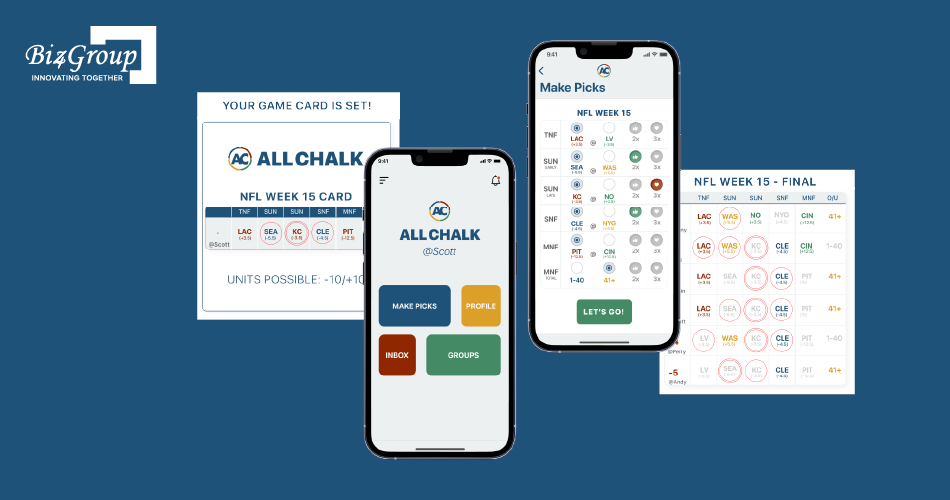
Biz4Group designed a prediction-based sports pick’em app with strong attention to user safety and system reliability.
Security And Compliance Highlights
- Implemented strong encryption protocols for user data
- Used AWS infrastructure to maintain data privacy standards
- Ensured secure handling of user interactions and predictions
Operational Strengths
- Managed high user activity with a scalable backend
- Delivered consistent performance during peak sports events
- Maintained synchronized real-time data across users
User-Focused Safeguards
- Clear leaderboard tracking to ensure transparency
- Controlled betting environment without direct financial risks
- Structured data handling to prevent inconsistencies
This approach reflects how businesses can build custom AI bots for live betting analysis and automated wagering while maintaining security and compliance at scale.
6. Plan for Scalable Compliance as You Grow
Compliance is not a one-time task. It evolves with your platform. As you scale:
- Expand compliance coverage across new regions
- Update policies based on regulatory changes
- Align systems with new betting formats like micro-betting AI app
Ignoring security or compliance can halt growth instantly. Addressing them early builds trust with users, partners, and regulators. For businesses aiming to make AI auto-betting bots for data-driven sports betting strategies, a secure and compliant foundation ensures long-term sustainability.
Up next, we break down the cost of building these systems and what factors influence investment decisions.
How Much Does It Cost to Build AI Auto-Betting Bots for Sports and Gaming?
Understanding the cost is often the deciding factor for businesses entering this space. The investment can vary widely depending on complexity, scale, and feature depth. On average, the cost to develop an AI auto-betting bot for smarter wagering strategies ranges between $20,000-$250,000+.
Here is a quick breakdown based on development stages:
|
Level |
Scope |
Estimated Cost |
|---|---|---|
|
MVP |
Core features, basic AI models, limited integrations |
$20,000-$50,000 |
|
Advanced Level |
Real-time data handling, multiple strategies, improved UI |
$50,000-$120,000 |
|
Enterprise Level |
Full-scale automation, multi-market support, high scalability |
$120,000-$250,000+ |
Businesses that plan to build AI auto-betting bots for sports and gaming should align their budget with long-term goals rather than short-term savings.
Also read: How to build a sports betting website MVP?
Key Cost Drivers You Need to Plan For
The total cost depends on several moving parts. Each component contributes differently based on your product vision.
|
Cost Driver |
What It Involves |
Estimated Cost Impact |
|---|---|---|
|
AI Model Development |
Training, testing, and refining prediction models |
$10,000-$60,000 |
|
Data Acquisition |
Access to real-time and historical sports data APIs |
$5,000-$40,000 annually |
|
Backend Development |
Core system logic, APIs, and workflows |
$15,000-$70,000 |
|
Frontend Development |
Dashboards, user interfaces, and visualization |
$8,000-$40,000 |
|
Integrations |
Connecting with betting platforms and third-party services |
$5,000-$30,000 |
|
Testing And QA |
Simulation, backtesting, and performance validation |
$5,000-$20,000 |
|
Deployment And DevOps |
Cloud setup, scaling, and monitoring |
$5,000-$25,000 |
These elements form the foundation when businesses create AI betting algorithms for smarter wagering and deploy them in real environments.
Hidden Costs That Often Get Overlooked
Beyond development, there are ongoing expenses that many businesses underestimate.
- Data subscriptions can increase over time as you scale into multiple sports or regions. This can range between $2,000-$15,000 per month depending on providers and usage.
- Model retraining is another recurring cost. As betting patterns evolve, AI models need updates. This may require an additional $5,000-$25,000 annually.
- Maintenance and upgrades also add to the budget. Fixing bugs, improving performance, and adapting to platform changes can cost around $1,000-$10,000 per month.
For companies aiming to make AI-powered bots for smarter and faster wagering strategies, these ongoing investments are necessary for sustained performance.
How to Optimize Your Development Cost
Cost control does not mean cutting corners. It means building smart from the start.
- Begin with an MVP to validate your idea before scaling
- Focus on high-impact features instead of overloading the system
- Use modular development to expand capabilities gradually
- Choose scalable infrastructure to avoid rebuilding later
- Work with an experienced AI development company who understands betting ecosystems
Businesses that follow this approach while planning the development of AI auto-betting bot for smarter wagering strategies can reduce unnecessary expenses and improve return on investment.
Also read: Sports betting app MVP development guide
The cost of building an AI betting system depends on how ambitious your vision is. A lean MVP can help you enter the market quickly, while a full-scale platform requires a more significant investment.
For organizations evaluating AI auto-betting bot development services for sports betting businesses, the focus should remain on long-term value rather than upfront cost alone.
Up next, we explore the challenges and risks involved in building and scaling these systems.
Also read: How much does it cost to develop an AI sports betting app like Rithmm?
Spending or Investing, What’s Your Approach?
A well-built AI betting system can improve decision accuracy by up to 40%. Are you ready to turn development cost into measurable ROI?
Call NowChallenges in Building an AI Auto-Betting Bot for Smarter Wagering Strategies and How to Solve Them
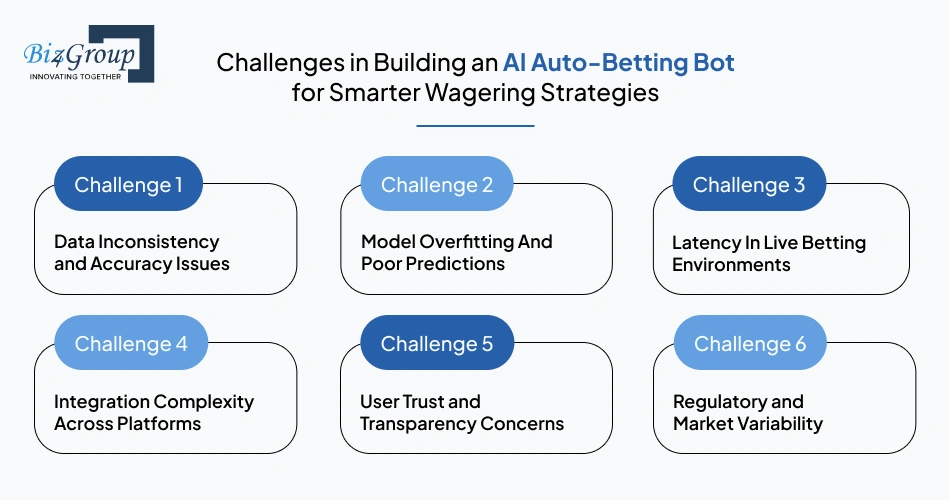
Building an AI betting system sounds promising on paper. In reality, it comes with technical, operational, and strategic challenges that need careful planning. Businesses aiming to create intelligent AI betting agents for predictive analytics in gambling must address these issues early to avoid long-term setbacks.
Challenge 1: Data Inconsistency and Accuracy Issues
Inconsistent or delayed data can lead to poor predictions and incorrect betting decisions.
Solutions
- Integrate multiple verified data providers
- Validate and clean incoming data continuously
Also read: Why most betting apps fail at real-time match accuracy (and how top apps fix it)?
Challenge 2: Model Overfitting And Poor Predictions
AI models may perform well in testing but fail in real-world scenarios due to overfitting.
Solutions
- Use diverse datasets for training
- Regularly retrain models with fresh data
- Monitor real-world performance metrics
Challenge 3: Latency In Live Betting Environments
Even small delays can impact outcomes in live betting scenarios.
Solutions
- Optimize data pipelines for speed
- Use event-driven systems for faster processing
- Reduce dependency on slow external APIs
Challenge 4: Integration Complexity Across Platforms
Connecting multiple systems and APIs can create synchronization issues.
Solutions
- Use standardized API frameworks
- Conduct integration testing across all endpoints
- Hire AI developers experienced in betting platforms
Challenge 5: User Trust and Transparency Concerns
Users often question how automated decisions are made.
Solutions
- Provide clear insights into betting logic
- Offer dashboards showing predictions and outcomes
- Build transparency into the system design
Challenge 6: Regulatory and Market Variability
Different regions have different rules, which can impact operations.
Solutions
- Research local regulations before launch
- Build flexible systems that adapt to regional rules
- Choose the top AI sports betting software development company
Also read: Top 14 sports betting software development companies in the USA
Portfolio Spotlight: Ingenious Betting App for Sports Enthusiasts
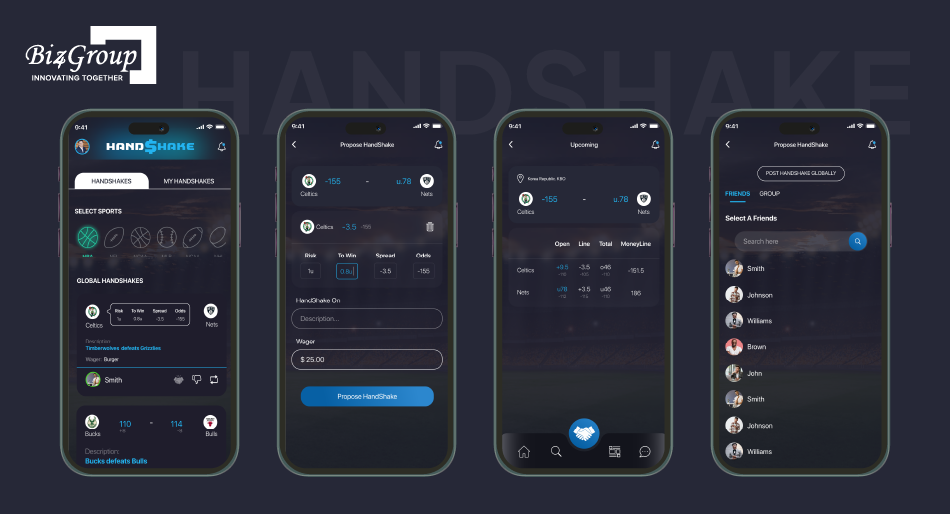
Biz4Group built a social betting platform, where users engage in peer-to-peer wagers. It highlights challenges beyond technology, especially around user interaction and real-time engagement.
Key Challenges Observed
- Managing real-time user interactions during live betting
- Ensuring smooth communication between participants
- Balancing performance with user engagement features
How These Were Addressed
- Built responsive systems to handle simultaneous user actions
- Enabled real-time notifications and updates
- Simplified user flows to reduce friction in betting interactions
This example shows that when businesses build AI auto-betting bots for sports and gaming, they must also focus on user behavior and engagement, not only algorithms.
Every system faces obstacles. The difference lies in how early they are identified and addressed. For organizations exploring the development of AI auto-betting bot for smarter wagering strategies, understanding these risks ensures better planning, smoother execution, and stronger outcomes.
Also read: Challenges in modern sports betting app development
Biz4Group LLC: Trusted USA Based Experts to Build AI Auto-Betting Bots for Sports and Gaming
When it comes to building intelligent betting systems, execution matters more than ideas. Many companies can explain AI. Very few can implement it in high-pressure, real-time environments like sports betting.
Biz4Group LLC is a USA-based AI and software development company known for delivering complex, scalable, and performance-driven solutions. Our work goes beyond development. We partner with businesses to transform ideas into revenue-generating platforms.
We have built advanced systems across sports betting, analytics platforms, and real-time applications that process massive data streams without delays. From predictive modeling to seamless integrations, our team focuses on building systems that perform consistently under real-world conditions.
Our expertise spans across:
- Custom AI development tailored to betting ecosystems
- Real-time data processing and predictive analytics
- End-to-end platform development for gaming businesses
- Scalable architectures that support high user volumes
We also specialize in services like sports betting app development solutions and seamless sports betting API integration services, ensuring that every component of your platform works in sync.
Beyond betting platforms, our capabilities extend into intelligent automation, conversational systems, and advanced integrations, including solutions offered by an experienced AI chatbot development team.
Why Businesses Choose Biz4Group LLC
Businesses do not choose us for development alone. They choose us for reliability, depth, and results.
- Proven experience in building real-time betting and analytics platforms
- Strong understanding of sports data ecosystems and wagering logic
- Ability to handle complex integrations across multiple systems
- Focus on performance, scalability, and long-term sustainability
- Dedicated team of AI engineers, developers, and strategists
We approach every project with a clear objective. Build systems that are not only functional but capable of delivering measurable outcomes.
Choosing the right partner can define the success of your AI betting platform. With Biz4Group, you gain access to a team that has already solved the challenges you are about to face. That experience translates into faster development, fewer risks, and better results.
So, without further ado, contact Biz4Group today to build something phenomenal together.
Final Thoughts
AI-driven betting is no longer a concept reserved for large operators with massive resources. With the right approach, businesses of all sizes can now develop an AI auto-betting bot for smarter wagering strategies that delivers speed, accuracy, and consistency. From understanding core components to selecting the right strategies, features, and architecture, every step plays a role in building a system that performs in real-time environments.
The real value lies in combining data, intelligence, and execution into a single workflow. When done right, these systems can analyze live odds, adapt to changing conditions, and automate decisions without delays. Businesses that build AI auto-betting bots for sports and gaming today are setting themselves up for scalable growth and stronger operational efficiency.
This is where choosing the right technology partner becomes critical. As a trusted software development company in the USA, Biz4Group brings deep expertise in AI, real-time systems, and betting platform development. Our experience ensures that your solution is not only functional but also built to handle real-world complexity with confidence.
If you are ready to take the next step, now is the time to act. Let’s build something that works as fast as the market moves and as smart as the data behind it.
FAQs
1. Can AI auto-betting bots work across multiple sports at the same time?
Yes, modern systems can handle multiple sports simultaneously. They process different data streams in parallel and apply sport-specific models, allowing operators to manage betting across leagues without switching systems.
2. What kind of data is required to train an AI betting bot?
AI betting systems rely on a mix of historical data, live match statistics, player performance metrics, and external factors like weather or injuries. The quality and variety of data directly influence prediction accuracy.
3. Can small businesses or startups afford to build AI betting systems?
Yes, many startups begin with a focused version of the product and expand over time. Starting lean allows businesses to test the market before investing in full-scale development.
4. Do AI betting bots require constant monitoring?
While these systems automate decision-making, periodic monitoring is still important. Businesses need to track performance, update models, and ensure smooth operation during high-traffic events.
5. How do AI betting bots handle unexpected events during live games?
AI systems can adapt to sudden changes by analyzing new data in real time. Events like player injuries or momentum shifts are factored into updated predictions, helping the system adjust its decisions quickly.
6. Is it possible to customize AI betting bots for specific markets or regions?
Yes, AI betting systems can be tailored for specific regions, sports, or user preferences. Customization helps businesses align with local trends, user behavior, and market demands.
7. What makes an AI betting bot more accurate over time?
Accuracy improves as the system processes more data and learns from past outcomes. Continuous refinement, better data inputs, and improved models all contribute to higher prediction reliability.