 Location :
Orlando, FL, USA
Location :
Orlando, FL, USA +1 (407) 714-1616
 info@biz4group.com

 AI Summary Powered by Biz4AI
- AI medical insurance app development helps insurers automate claims, prior authorization, fraud detection, and member services while improving operational efficiency.
- HIPAA-compliant medical insurance app development with AI-powered automation succeeds when secure architecture, quality data, and operational readiness work together.
- Prioritize AI automation where manual work slows your business most. Expanding after measurable results usually delivers better long-term ROI.
- AI medical insurance app development typically requires $40,000–$350,000+, but integrations, compliance, and AI operations often influence budgets more than features.
- Biz4Group LLC builds AI-powered medical insurance platforms that streamline operations, simplify compliance, and create practical solutions designed for long-term business growth.
Why do medical insurance apps still leave customers waiting for answers when AI can verify claims, guide policyholders, and speed up decisions in minutes?
The real challenge isn't offering digital insurance services. It's building a platform that connects medical claims, policies, providers, and customer support into one secure experience. That's exactly where medical insurance app development becomes a strategic investment rather than just another technology initiative.
The opportunity is growing just as quickly. The global InsurTech market is valued at USD 27.6 billion in 2026 and is projected to reach USD 257.8 billion by 2036, growing at a 26.1% CAGR.
As insurers expand their digital capabilities, businesses are looking beyond basic mobile apps and investing in AI-powered platforms that simplify operations, improve customer experiences, and support faster decision-making.
If you're evaluating your next move, you may already be asking questions like:
- I want to develop a custom medical insurance mobile app that includes AI-powered claim verification, chatbot support, digital ID cards, and telemedicine integration. What should the development roadmap look like?
- What are the essential AI features, development costs, technology stack, and timeline required to build a medical insurance app for a health insurance provider in 2026?
- How can an AI development company build a secure medical insurance app that automates claims processing, policy management, and fraud detection while ensuring HIPAA and GDPR compliance?
This guide answers these questions by walking you through every stage of building a HIPAA-compliant AI medical insurance app. From planning essential capabilities to technology decisions, development costs, and partner selection we have got it all covered.
Understanding the Core of AI Medical Insurance App Development
Before getting into medical insurance app development, let's first understand what you're actually building, who relies on it, and why AI has become an important part of the equation.
What is an AI Medical Insurance App?
An AI medical insurance app is a digital platform that helps insurers, policyholders, healthcare providers, and administrators manage the entire insurance journey through a single application.
Instead of simply storing policy details or processing claims, it uses AI to support faster decision-making, reduce routine manual work, and deliver more personalized experiences.
Whether it's assisting customers with policy-related questions or helping insurers handle growing claim volumes, the goal is to make everyday insurance operations more accurate, connected, and efficient without adding unnecessary complexity.
Depending on your business model, different users rely on the platform for different responsibilities:
- Insurance companies: Manage policies, process claims, monitor operations, and improve customer service.
- Policyholders: View policy details, submit claims, track claim status, access digital insurance ID cards, and receive policy support.
- Healthcare providers: Verify insurance coverage, coordinate claims, and exchange information with insurers.
- Third-Party Administrators (TPAs): Handle claims processing, policy servicing, and customer assistance on behalf of insurers.
- Insurance agents and brokers: Manage customer policies, guide policyholders, and streamline sales and renewal activities.
Also Read: Guide to AI TPA Software Development for Insurance Industry
How Does AI Medical Insurance Apps Differ from Traditional Insurance Management Systems
As insurance operations become more complex, the real difference isn't having digital software, it's how intelligently that software supports everyday decisions and workflows.
|
Aspect |
Traditional Insurance Management Systems |
AI Medical Insurance Apps |
|---|---|---|
|
Claims Processing |
Relies heavily on manual reviews, document verification, and predefined workflows. |
Helps validate claims, prioritize cases, and route them for quicker processing with human oversight where needed. |
|
Customer Support |
Customers depend on support teams during business hours for most queries. |
AI-powered assistants provide instant responses to common policy and claims questions at any time. |
|
Fraud Detection |
Suspicious claims are primarily identified through manual reviews or fixed business rules. |
AI detects unusual claim patterns and flags high-risk cases for further investigation. |
|
Policy Management |
Policy updates, renewals, and servicing require significant manual effort. |
AI streamlines routine policy tasks and supports personalized policy recommendations based on customer needs. |
|
Operational Insights |
Reports mainly summarize past activities and performance. |
AI analyzes operational data to identify trends, predict risks, and support better business decisions. |
Core Components That Power a Modern Medical Insurance Platform
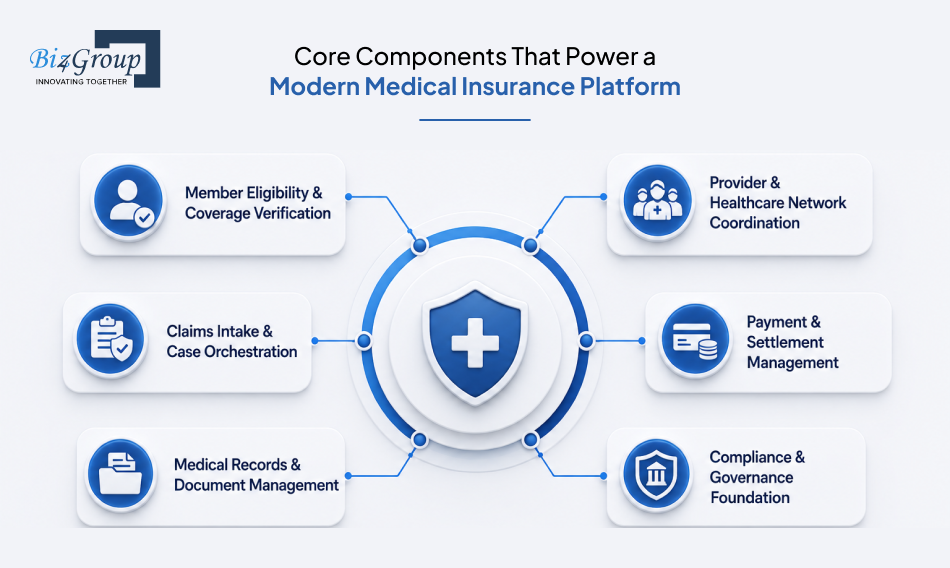
A modern medical insurance platform succeeds because several operational capabilities work together behind the scenes. Each one plays a specific role in managing policies, validating medical information, coordinating claims, and keeping insurers, healthcare providers, and policyholders connected throughout the insurance journey.
1. Member Eligibility & Coverage Verification
- Confirms whether a member's policy is active before medical services or claims move forward.
- Checks coverage limits, deductibles, co-payments, exclusions, and policy benefits against the requested treatment.
- Helps reduce claim disputes by ensuring eligibility is verified at the earliest stage of the process.
2. Claims Intake & Case Orchestration
- Brings claim forms, medical billing system, supporting documents, and customer information into a single structured workflow.
- Assigns each claim to the appropriate review stage based on business rules and claim type.
- Gives claims teams complete visibility into pending actions, document status, and approval progress from one place.
Also Read: AI Medical Claim Processing Software Development Guide
3. Medical Records & Document Management
- Maintains medical reports, prescriptions, invoices, discharge summaries, diagnostic results, and other supporting documents in a secure repository.
- Keeps claim-related records organized, searchable, and readily available whenever additional verification is required.
- Creates a reliable audit trail by linking every document to its corresponding policy and claim.
4. Provider & Healthcare Network Coordination
- Connects insurers with hospitals, clinics, diagnostic laboratories, pharmacies, and third-party administrators through a unified operational workflow.
- Simplifies provider verification, treatment authorization, and information sharing without relying on lengthy manual communication.
- Ensures every stakeholder works with consistent and up-to-date insurance information.
5. Payment & Settlement Management
- Coordinates claim approvals, reimbursement calculations, payment processing, and settlement tracking within a controlled workflow.
- Maintains transparency by recording every payment decision and settlement update throughout the claim lifecycle.
- Helps finance and operations teams monitor outstanding payments and completed settlements more efficiently.
Also Read: How AI in Payments is Changing the Digital Payments Landscape?
6. Compliance & Governance Foundation
- Records every policy update, claim activity, user action, and approval to support regulatory reporting and internal audits.
- Protects sensitive medical and insurance information through controlled access, governance policies, and continuous monitoring.
- Provides the operational foundation required to support regulatory frameworks such as HIPAA and GDPR.
Together, these core components create a connected medical insurance platform where every policy, claim, medical record, provider interaction, and payment follows a structured workflow. This gives insurers greater operational control while delivering a smoother experience for policyholders and healthcare partners.
Know What Your Platform Really Needs
Skip unnecessary features before they become expensive build only what drives measurable insurance outcomes
Plan My AI Insurance AppWhy Is Now the Right Time to Build an AI Medical Insurance App
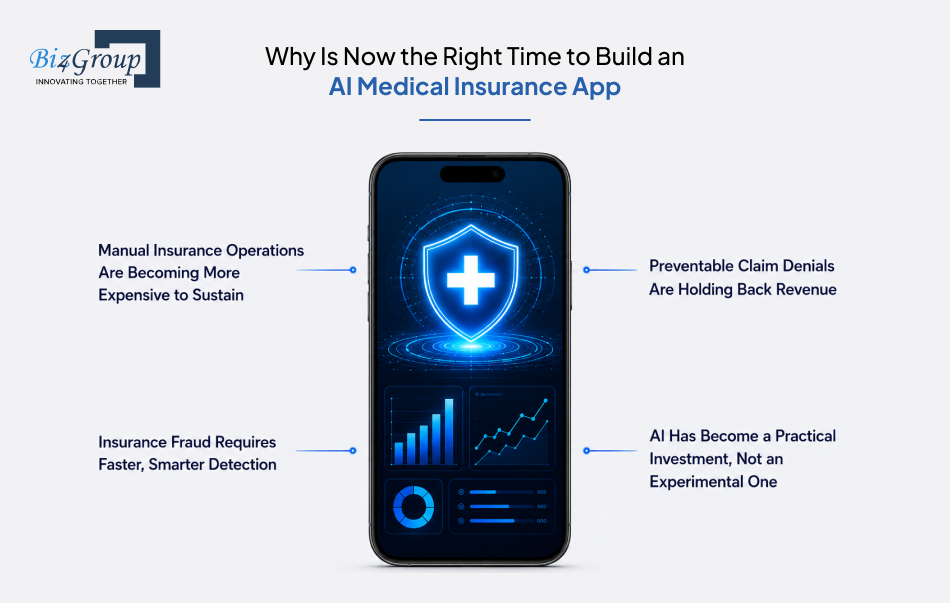
Because the biggest challenges in medical insurance aren't getting smaller, they're getting more expensive. Rising claim volumes, preventable denials, fraud, and legacy systems all add pressure on profitability and customer experience.
Investing now isn't about following an AI trend. It's about fixing the operational gaps that quietly cost your business time, money, and growth opportunities every single day.
1. Manual Insurance Operations Are Becoming More Expensive to Sustain
Most insurers don't struggle because they're processing more policies. They struggle because every new policy brings more manual reviews, document checks, approvals, and customer queries.
Instead of hiring larger operations teams every year, insurers are investing in connected platforms that remove repetitive work and keep every department working from the same information.
A modern platform helps you:
- Reduce time spent on repetitive administrative tasks.
- Eliminate delays caused by disconnected systems and duplicate data entry.
- Scale insurance operations without matching growth with higher staffing costs.
2. Preventable Claim Denials Are Holding Back Revenue
Every denied claim doesn't represent lost revenue, but every avoidable denial creates extra work. Claims need to be reviewed again, providers wait longer for reimbursement, and support teams spend valuable time resolving issues that could have been prevented earlier.
As per industry reports 41% of healthcare providers now report claim denial rates above 10%, while 82% providers consider reducing denials a top business priority. Despite that, AI adoption for this use case remains at only 14%, leaving significant room for improvement.
As more organizations evaluate medical insurance mobile app development, improving claim quality before submission is becoming just as valuable as processing claims faster.
A modern medical insurance app helps you:
- Catch incomplete submissions before they enter the claims workflow.
- Validate policy, member, and authorization details automatically.
- Reduce costly rework caused by preventable administrative errors.
Also Read: AI Claims Denial Navigator Software Development for Healthcare Providers
3. Insurance Fraud Requires Faster, Smarter Detection
Insurance fraud doesn't only result in financial losses. It also slows genuine claims because investigation teams spend time reviewing suspicious cases alongside legitimate ones.
Healthcare insurance fraud already costs consumers an estimated USD 105 billion annually, making it the costliest form of insurance fraud in the United States. That's why insurers are strengthening fraud prevention with intelligent risk monitoring instead of relying solely on manual investigations.
An AI medical insurance app helps you:
- Prioritize high-risk claims without delaying genuine policyholders.
- Detect unusual billing patterns and duplicate submissions earlier.
- Give investigation teams better visibility into suspicious claim activity.
Also Read: How AI Detects and Prevents Insurance Fraud in 2026 to Reduce Claims Losses
4. AI Has Become a Practical Investment, Not an Experimental One
A few years ago, many insurers viewed AI as a technology worth exploring. Today, the conversation has shifted to measurable business outcomes.
The global medical AI apps market is projected to grow from USD 1.4 billion in 2026 to USD 4.8 billion by 2033, expanding at a 19.1% CAGR. North America alone accounted for 38.6% of the market in 2025, showing that adoption is accelerating where healthcare and insurance systems are most mature.
A modern AI medical insurance app helps you:
- Automate high-volume processes without disrupting existing workflows.
- Generate measurable returns across claims, policy servicing, and customer support.
- Modernize operations using proven technology instead of waiting for competitors to move first.
The right time to invest isn't when operational challenges become unmanageable, it's before they begin affecting profitability and customer trust. An AI medical insurance app gives insurers a practical way to reduce costs, improve decision-making, and build a stronger foundation for sustainable growth in an increasingly competitive healthcare insurance market.
How AI-Powered Automation Transforms Medical Insurance Lifecycle in Medical Insurance Apps
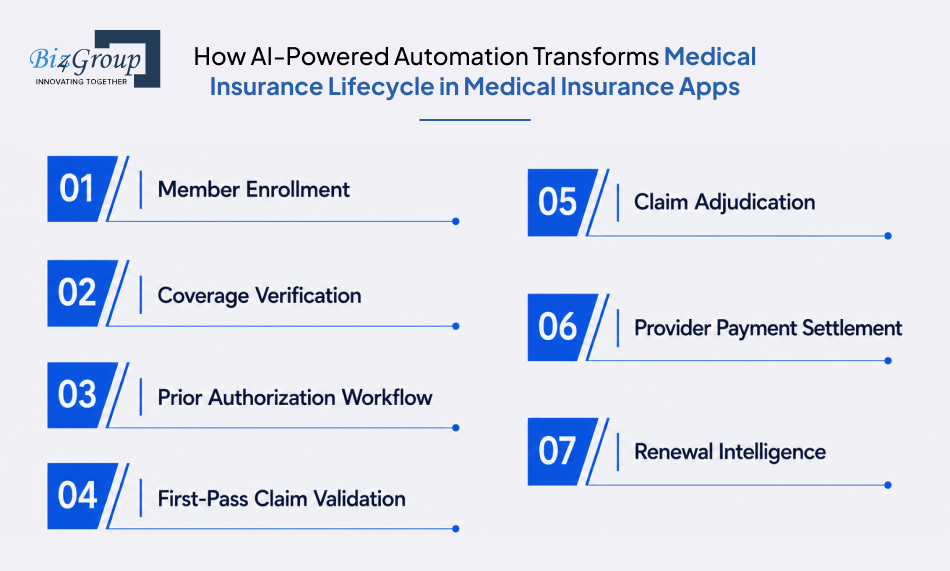
Every medical insurance policy follows a defined operational journey, and delays at one stage often create problems in the next. That raises an important question:
How can AI, machine learning, and predictive analytics improve customer experience, underwriting, and claim settlement in a medical insurance application?
Well, the answer lies in automating the complete lifecycle so information flows accurately, decisions happen faster, and manual intervention is reserved for exceptions instead of routine work.
Here is how AI automation transforms medical insurance lifecycle:
1. Member Enrollment
The lifecycle starts with collecting accurate member information. AI automation helps validate identity, policy applications, dependent details, and KYC records before enrollment is completed.
It also checks eligibility against plan rules and flags missing information early, giving underwriting teams cleaner data to work with.
This creates a stronger starting point for medical insurance app development initiatives focused on long-term operational efficiency.
Also Read: AI Insurance Underwriting Software Development Guide
2. Coverage Verification
Before treatment begins, providers need confirmation that services are covered.
Automation verifies active policy status, benefit limits, co-payment requirements, deductibles, provider network participation, and coverage exclusions in real time.
This reduces back-and-forth communication and gives providers greater confidence before delivering medical services.
3. Prior Authorization Workflow
Certain procedures, diagnostic tests, and specialty medications require approval before care is delivered.
Medical insurance apps with AI automation reviews clinical notes, diagnosis codes, treatment requests, and payer guidelines before supporting AI prior authorization decisions.
Straightforward requests move ahead quickly, while complex cases are routed to medical reviewers with the required documentation already attached.
4. First-Pass Claim Validation
A claim has a much better chance of being paid when errors are identified before submission. AI automation checks for ICD-10 diagnosis codes, CPT and HCPCS procedure codes, billing modifiers, duplicate claims, and supporting attachments.
Many insurers also include AI claim scrubbing within their app to improve clean claim rates and reduce avoidable denials.
5. Claim Adjudication
After validation, claims move through benefit determination and payment calculation.
AI automation in medical insurance apps applies policy terms, deductible balances, co-insurance, out-of-pocket limits, medical necessity rules, and reimbursement schedules before producing a payment decision.
Claims requiring additional investigation are automatically separated from routine cases, allowing adjudication teams to focus where human judgment adds the most value.
6. Provider Payment Settlement
Once a claim is approved, automation calculates the payable amount, generates the Explanation of Benefits (EOB), initiates electronic fund transfers, and reconciles payment records.
Providers receive better visibility into claim status, while finance teams spend less time resolving payment variances, duplicate reimbursements, or settlement discrepancies.
Also Read: AI Payment Fraud Detection Software Development Guide
7. Renewal Intelligence
The final stage focuses on keeping members covered while managing future risk.
Medical insurance app with AI automation reviews utilization trends, claim frequency, policy lapses, renewal eligibility, and member engagement throughout the policy period.
These insights help insurers identify retention opportunities, recommend suitable coverage changes, and prepare renewal offers using current policy performance instead of historical assumptions alone.
Every stage in the medical insurance lifecycle depends on the quality of the one before it. Automating the journey with reliable AI automation services helps insurers reduce operational delays, improve accuracy across core workflows, and deliver a more consistent experience for members, providers, and internal teams.
Also Read: Top 10 AI Automation Companies in USA
What Core Features Should a Medical Insurance App Include?
A medical insurance platform is only as effective as the features supporting everyday insurance operations. The right feature set should simplify policy management, speed up claim processing, improve member experience, and reduce manual work across departments.
That's exactly where AI powered medical insurance app development delivers measurable value. Here's a closer look at the capabilities your platform should include.
1. AI Automation Features
These features automate repetitive insurance workflows that usually consume the most time. Instead of replacing human decisions, they help your teams process routine cases faster while focusing attention where expert review is actually needed.
|
Feature |
Purpose |
|---|---|
|
Intelligent Claim Triage |
Prioritizes claims based on urgency, value, and complexity. |
|
Fraud Risk Scoring |
Flags suspicious claim patterns for investigation. |
|
Prior Authorization Automation |
Reviews treatment requests against payer guidelines before routing decisions. |
|
Organizes prescriptions, discharge summaries, invoices, and clinical documents automatically. |
|
|
Coverage Eligibility Verification |
Confirms member eligibility before services are approved. |
|
Benefit Validation Engine |
Checks coverage limits, exclusions, deductibles, and co-payments instantly. |
|
Renewal Risk Prediction |
Identifies policies with a higher likelihood of non-renewal. |
Also Read: AI SOAP Notes Software Development for Healthcare
2. Member Self-Service Features
Members expect quick access to their insurance information without contacting support for routine requests. These features help them manage policies, claims, and healthcare benefits through a single digital experience.
|
Feature |
Purpose |
|---|---|
|
Digital Member Registration |
Creates secure member accounts. |
|
Digital Insurance Card |
Provides instant access to policy identification. |
|
Policy Dashboard |
Displays active plans, coverage details, and policy status. |
|
Claim Status Tracking |
Shows claim progress from submission to settlement. |
|
Benefits & Coverage Viewer |
Explains covered services and remaining benefits. |
|
Hospital Locator |
Finds nearby in-network hospitals and clinics. |
|
Secure Document Upload |
Uploads prescriptions, bills, and medical records digitally. |
3. Claims Management Features
Claims are the most operationally intensive part of medical insurance. These capabilities reduce manual handling while helping claims move through validation, review, and settlement with fewer interruptions.
|
Feature |
Purpose |
|---|---|
|
Digital Claim Submission |
Allows members or providers to submit claims online. |
|
ICD-10 & CPT Validation |
Detects coding inconsistencies before claim review. |
|
Duplicate Claim Detection |
Identifies repeated claim submissions. |
|
Missing Document Detection |
Alerts users before incomplete claims are submitted. |
|
Claims Work Queue |
Prioritizes claims for adjusters and reviewers. |
|
Appeal Management |
Tracks disputed claims throughout the appeal process. |
|
Explanation of Benefits (EOB) Generator |
Creates member-friendly payment summaries. |
4. Provider Network Features
Healthcare providers need accurate policy information before treatment and clear payment visibility afterward. These features improve collaboration between insurers and provider organizations.
|
Feature |
Purpose |
|---|---|
|
Provider Portal |
Gives providers access to insurance services securely. |
|
Provider Credential Verification |
Confirms provider eligibility before onboarding. |
|
Network Directory Management |
Maintains updated provider information. |
|
Real-Time Eligibility Check |
Verifies member coverage before treatment. |
|
Prior Authorization Requests |
Submits authorization requests electronically. |
|
Payment Status Tracking |
Displays reimbursement progress. |
|
Provider Communication Center |
Supports secure insurer-provider communication. |
5. Policy & Benefits Management Features
Managing policies should be straightforward for both members and insurance teams. These features simplify policy administration while reducing repetitive administrative work.
|
Feature |
Purpose |
|---|---|
|
Policy Creation |
Generates new insurance policies digitally. |
|
Plan Comparison |
Helps members evaluate available plans. |
|
Coverage Configuration |
Defines benefits, exclusions, and policy rules. |
|
Premium Calculator |
Estimates premium amounts based on selected coverage. |
|
Policy Renewal Management |
Automates renewal reminders and processing. |
|
Endorsement Management |
Updates existing policy information. |
|
Policy Cancellation Workflow |
Manages cancellation requests with audit records. |
6. Security & Compliance Features
Medical insurance apps handle protected health information, financial records, and sensitive personal data. Security features should protect every interaction without adding unnecessary complexity for users.
|
Feature |
Purpose |
|---|---|
|
Multi-Factor Authentication |
Strengthens account security. |
|
Role-Based Access Control |
Restricts data access by user responsibility. |
|
Audit Trail |
Records policy and claim activities for compliance. |
|
End-to-End Encryption |
Protects sensitive information during storage and transmission. |
|
Consent Management |
Stores member consent preferences securely. |
|
Session Monitoring |
Detects suspicious login activity. |
|
Secure API Management |
Protects data exchanged with external healthcare systems. |
7. Admin & Business Intelligence Features
Insurance leaders need visibility into operational performance without manually compiling reports. These capabilities provide actionable insights for day-to-day management and long-term planning.
|
Feature |
Purpose |
|---|---|
|
Operational Dashboard |
Monitors key insurance metrics in real time. |
|
Claims Performance Reports |
Tracks claim turnaround and settlement trends. |
|
Policy Analytics |
Measures policy growth and renewal performance. |
|
Fraud Investigation Dashboard |
Monitors flagged fraud cases. |
|
Workforce Productivity Reports |
Evaluates operational efficiency across teams. |
|
Custom Report Builder |
Generates reports based on business needs. |
|
Notification Management |
Controls system alerts and communication workflows. |
The strongest medical insurance apps with AI powered automation aren't defined by the number of features they include. They combine the right capabilities to simplify operations, improve member experiences, support providers, and give insurers better visibility across every stage of policy and claim management.
Every Feature Should Earn Its Place
Let's identify the capabilities your members need and your operations will actually benefit from
Map My Feature SetEssential Integrations for a Connected Medical Insurance Platform
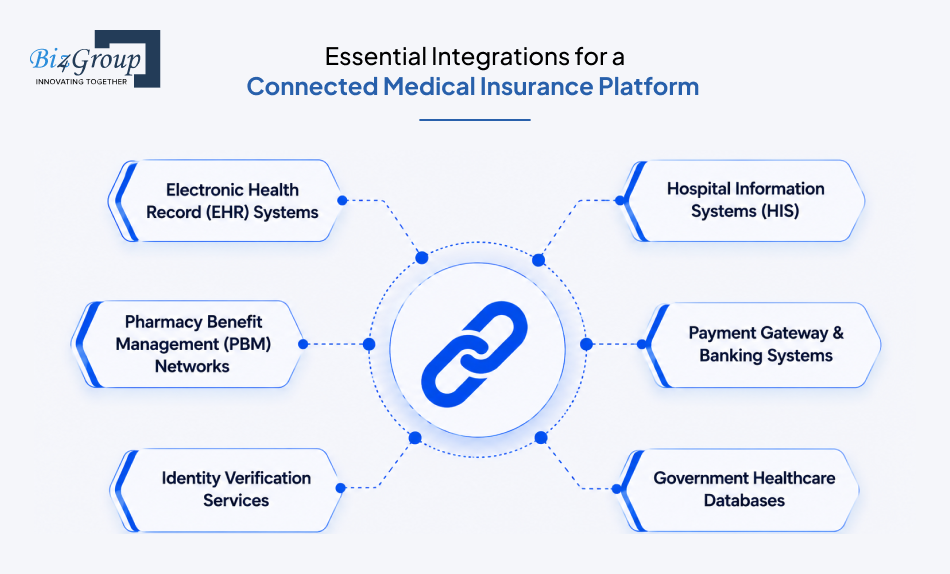
A medical insurance platform doesn't operate in isolation. It exchanges information with hospitals, pharmacies, payment providers, and healthcare databases throughout the policy lifecycle. These connections eliminate manual data exchange, reduce processing delays, and keep insurance operations moving without constant follow-ups.
The following integrations form the backbone of a connected medical insurance ecosystem.
1. Electronic Health Record (EHR) Systems
Claims and medical reviews often depend on access to accurate clinical information. Integrating with EHR systems allows insurers to retrieve diagnosis details, treatment history, laboratory reports, discharge summaries, and physician notes from a single source. That helps validate medical necessity, supports faster claim decisions, and reduces repeated document requests from providers.
Also Read: A Complete Guide to AI EMR/EHR Software Development
2. Hospital Information Systems (HIS)
Hospitals generate most of the information insurers need during treatment and claim processing. Connecting with HIS gives access to admission records, discharge details, hospital billing, procedure information, and attending physician records. This keeps hospital data synchronized with the insurer's platform and minimizes delays caused by manual verification.
3. Pharmacy Benefit Management (PBM) Networks
Prescription benefits are a major part of medical insurance, especially for members managing long-term conditions. PBM integration verifies formulary coverage, medication eligibility, pharmacy network participation, prescription pricing, and reimbursement rules before prescriptions are approved. This reduces claim disputes while helping members receive covered medications without unnecessary delays.
Also Read: A Complete Guide to E-prescription (eRx) Software
4. Payment Gateway & Banking Systems
Medical insurance involves continuous financial transactions, from premium collection to claim reimbursement. Payment integrations support online premium payments, electronic fund transfers (EFT), refund processing, recurring billing, and payment reconciliation through secure banking channels. This creates a transparent payment journey for members, providers, and finance teams alike.
5. Identity Verification Services
Accurate member identity is essential throughout enrollment, claims, and policy servicing. Identity verification services validate government-issued documents, confirm customer information, detect duplicate identities, and reduce fraudulent registrations before policies are issued. This creates a trusted member database while improving compliance with verification requirements.
6. Government Healthcare Databases
Many insurance decisions rely on information maintained by government healthcare programs and regulatory agencies. Connecting with these databases helps verify member eligibility, validate government-sponsored coverage, confirm payer information, and stay aligned with changing healthcare regulations. This reduces manual verification while improving operational accuracy across insurance workflows.
When you plan custom health insurance app development, these integrations determine how efficiently your platform exchanges information across the healthcare ecosystem. They also help enterprise decision-makers looking for AI-enabled insurance solutions build connected insurance operations that scale with growing business demands.
How Do You Ensure Security, HIPAA and Regulatory Compliance in Medical Insurance App Development?
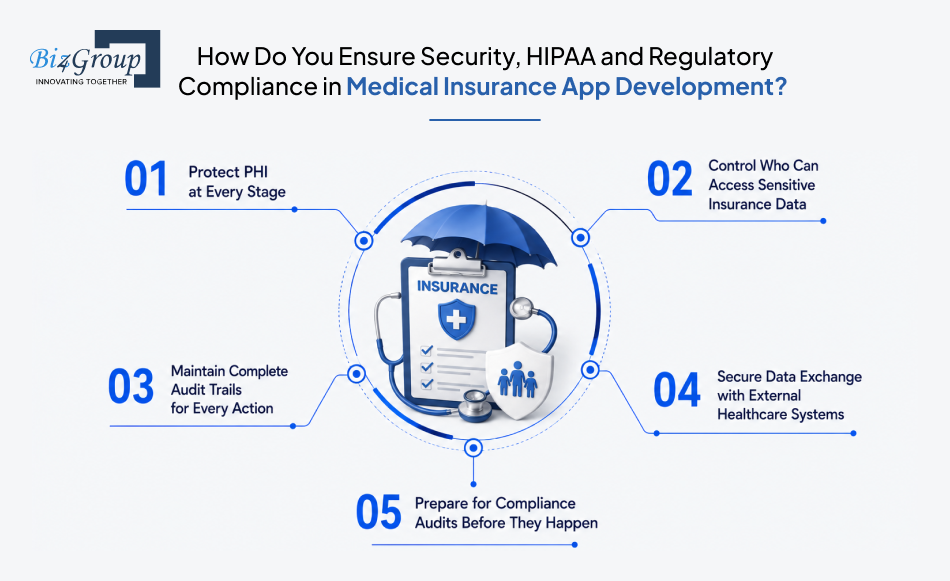
Security and compliance aren't features you add at the end. They shape every stage of medical insurance app development, from how health records are stored to who can access them and how every action is recorded.
Getting these foundations right protects sensitive information, reduces regulatory risk, and gives members confidence that their data is handled responsibly. Here's what that looks like in practice.
1. Protect PHI at Every Stage
Every medical insurance platform handles Protected Health Information (PHI), including medical records, policy details, claims, and payment information. Protecting that data starts long before it reaches production.
Information should remain encrypted while it's stored and while it's being shared, with clear rules that prevent unnecessary exposure across the platform.
A secure PHI strategy typically includes:
- Encrypting data at rest and during transmission using industry-standard encryption
- Applying the HIPAA Minimum Necessary Rule to limit unnecessary data access
- Separating sensitive healthcare information from general account data where appropriate
- Maintaining encrypted backups to support secure disaster recovery
Also Read: HIPAA Compliant AI App Development for Healthcare Providers
2. Control Who Can Access Sensitive Insurance Data
Not everyone inside an organization should see every piece of member information. Access should match each person's responsibilities, so sensitive records stay available only to authorized users. This reduces internal security risks while supporting HIPAA access control requirements.
Access management should include:
- Role-Based Access Control (RBAC) for employees, providers, and administrators
- Multi-factor authentication (MFA) for privileged accounts
- Least-privilege access policies that restrict unnecessary permissions
- Automatic session timeouts for inactive users
3. Maintain Complete Audit Trails for Every Action
Healthcare regulations expect more than secure data storage. They also require organizations to know who accessed information, what changed, and when those actions occurred. Detailed audit logs create accountability and simplify investigations during compliance reviews or security incidents.
Comprehensive audit trails should record:
- User login activity and authentication events
- Policy updates and claim modifications
- Access to PHI
- Time-stamped records that cannot be altered without authorization
4. Secure Data Exchange with External Healthcare Systems
Medical insurance apps constantly exchange information with hospitals, pharmacies, laboratories, and healthcare partners. Every connection should protect data from unauthorized access while ensuring information reaches the right destination without being modified during transmission.
A secure integration strategy should include:
- Encrypted API communication using HTTPS and TLS
- OAuth 2.0 or token-based authentication for connected systems
- Secure FHIR and HL7 data exchanges with healthcare partners
- API rate limiting and continuous monitoring to detect suspicious activity
Also Read: A Complete Guide to OpenAI API Integration for AI Applications
5. Prepare for Compliance Audits Before They Happen
Compliance becomes much easier when documentation is maintained throughout the project instead of being assembled before an audit. That approach helps organizations respond quickly to regulatory reviews while reducing operational disruption.
It's especially valuable for entrepreneurs building insurance technology platforms preparing to scale, as well as AI-driven digital transformation leaders managing complex healthcare ecosystems.
A strong compliance program should include:
- Regular HIPAA risk assessments
- Business Associate Agreements (BAAs) with third-party vendors handling PHI
- Incident response and breach notification procedures
- Disaster recovery and business continuity plans
- Security policies with documented review and retention schedules
Strong security and regulatory compliance protect far more than healthcare data. They create a dependable foundation for medical insurance operations, reduce compliance risks, and help your AI medical insurance app earn lasting trust from members, providers, and regulators alike.
Recommended Technology Stack for Medical Insurance App Development
The right technology stack depends on the capabilities you want your platform to deliver. Many businesses ask, "Which AI technologies are used in health insurance app development?"
The answer isn't one tool, but a combination of technologies that support secure operations, intelligent automation, and long-term scalability.
That's why companies with experienced mobile app development services evaluate every technology layer before writing the first line of code.
|
Architecture Layer |
Recommended Tools |
Purpose |
|---|---|---|
|
Mobile Application |
Flutter, Swift, Kotlin |
Flutter accelerates cross-platform delivery, while Swift and Kotlin provide native performance on iOS and Android. |
|
Web Portal |
ReactJS, Next.js |
ReactJS development creates fast, interactive user interfaces, while NextJS development improves page rendering, routing, and overall web performance. |
|
Backend Services |
Node.js (NestJS), Python (FastAPI) |
NodeJS development powers secure APIs and insurance workflows, while Python development supports AI services and data processing. |
|
API Gateway |
Kong, AWS API Gateway, Apigee |
Secures APIs, controls traffic, manages authentication, and monitors requests between connected systems. |
|
Authentication & Identity |
OAuth 2.0, OpenID Connect, Okta, Azure AD B2C |
Verifies user identities, supports single sign-on, strengthens authentication, and protects sensitive accounts. |
|
Database |
PostgreSQL, MongoDB |
PostgreSQL manages structured insurance data, while MongoDB stores flexible documents and operational records. |
|
Object Storage |
Amazon S3, Azure Blob Storage |
Stores medical reports, claim attachments, prescriptions, invoices, and other large healthcare documents securely. |
|
Cache Layer |
Redis |
Speeds up frequently requested information and reduces response time for everyday insurance operations. |
|
AI & LLM Services |
OpenAI, Claude, Gemini, LangChain |
Powers conversational assistance, policy guidance, intelligent summaries, and AI-driven workflow automation. |
|
OCR System & Document Intelligence |
Amazon Textract, Azure AI Document Intelligence, Google Document AI |
Extracts structured information from scanned claims, medical records, invoices, and handwritten documents. |
|
Predictive Analytics & Machine Learning |
PyTorch, TensorFlow, Scikit-learn |
Supports fraud detection, claim risk scoring, underwriting models, and predictive business insights. |
|
Healthcare Interoperability |
HL7, FHIR, SMART on FHIR |
Enables standardized and secure healthcare data exchange across hospitals, EHRs, laboratories, and insurers. |
|
Communication Services |
Twilio, SendGrid, Firebase Cloud Messaging |
Delivers OTPs, payment confirmations, claim updates, renewal reminders, and important member notifications. |
|
Workflow Automation |
Temporal, Camunda |
Automates approval flows, claim routing, prior authorization processes, escalations, and operational workflows. |
|
Monitoring & Observability |
Prometheus, Grafana, Datadog, ELK Stack |
Monitors application health, tracks performance, analyzes logs, and alerts teams before issues affect operations. |
|
DevOps & Cloud Infrastructure |
Docker, Kubernetes, GitHub Actions, AWS, Microsoft Azure, |
Automates deployment, scales workloads, manages containers, and maintains reliable cloud infrastructure for production environments. |
A well-planned technology stack does more than support day-to-day operations. It gives CTOs and CIOs in insurance companies the flexibility to scale securely while delivering reliable medical insurance app development backed by modern full stack development practices.
Also Read: Why to Choose the Full Stack Development for Modern Business
What is the Step-By-Step Process to Build HIPAA-Compliant Medical Insurance App with AI-Powered Automation from Discovery to Deployment
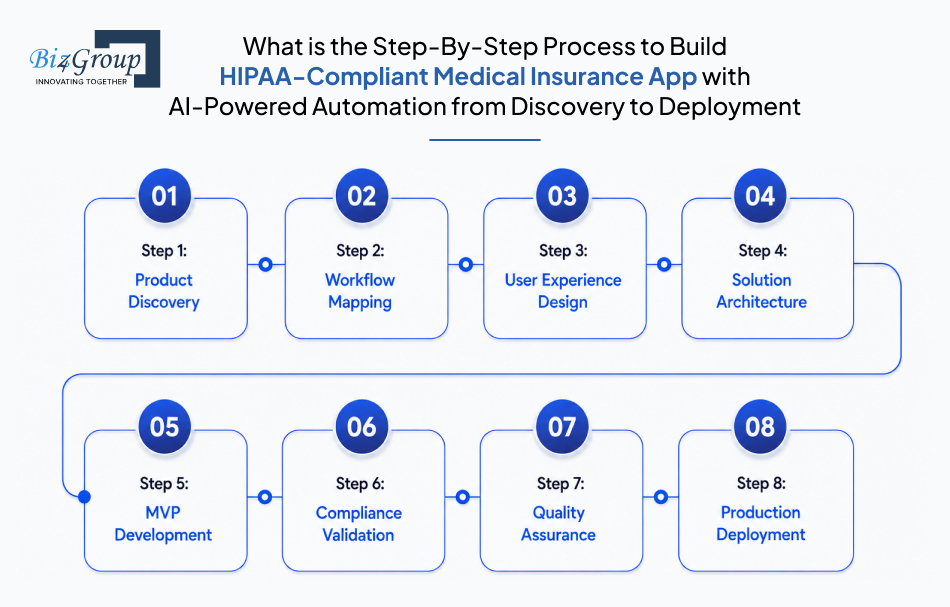
A successful medical insurance app with AI automation follows a structured roadmap long before coding begins. Every phase influences security, compliance, user experience, and operational efficiency.
That's why custom medical insurance app development focuses on disciplined execution from discovery through deployment. Here's how the complete development process unfolds.
Step 1: Product Discovery
Every successful project starts with understanding the business, not the technology. This stage defines the insurance products, target users, compliance obligations, operational challenges, and opportunities where AI integration services can deliver measurable value instead of adding unnecessary complexity.
Key activities include:
- Defining business objectives and project scope.
- Identifying member, provider, broker, adjuster, and administrator roles.
- Prioritizing AI use cases based on business impact.
- Preparing a phased product roadmap.
Also Read: How to Integrate AI into an App: Process and Cost
Step 2: Workflow Mapping
Medical insurance involves multiple operational journeys that must work together without friction. Mapping these workflows early prevents costly redesigns and ensures every process supports real insurance operations instead of assumptions.
This phase typically covers:
- Member enrollment and policy issuance.
- Claims lifecycle and approval routes.
- Prior authorization workflows.
- Policy renewal and servicing journeys.
Step 3: User Experience Design
People expect insurance apps to feel straightforward, even when the underlying processes are complex. Working with an experienced UI/UX design company helps simplify every interaction before development begins, reducing confusion for members and internal teams alike.
Design deliverables generally include:
- User journey mapping.
- Wireframes and interactive prototypes.
- Accessibility-focused interface design.
- Design validation with key stakeholders.
Also Read: Top UI/UX Design Companies in USA
Step 4: Solution Architecture
Once workflows are finalized, the technical foundation is planned to support future growth. This stage defines how applications, databases, AI services, integrations, and security controls will work together without creating operational bottlenecks later.
Architecture planning includes:
- Cloud infrastructure planning.
- API and integration strategy.
- Data flow design.
- Scalability and disaster recovery planning.
Step 5: MVP Development
The first release should focus on solving high-value business problems instead of delivering every possible feature. Many organizations use MVP development services to validate workflows, gather user feedback, and reduce investment risk before expanding the platform.
Initial development usually prioritizes:
- Member onboarding and authentication.
- Policy management.
- Core claims processing.
- Essential AI-powered automation capabilities.
Also Read: Top MVP Development Companies in USA
Step 6: Compliance Validation
Security and compliance checks in AI insurance app for medical shouldn't wait until the final release. They become part of the development lifecycle to ensure regulatory requirements are addressed before the platform reaches production.
Validation activities include:
- HIPAA compliance reviews.
- Encryption verification.
- Access control testing.
- Audit log validation.
- Risk assessment documentation.
Step 7: Quality Assurance
Testing goes beyond checking whether screens and buttons work correctly. Every insurance workflow, integration, and AI-assisted process should be verified under realistic operating conditions before launch.
Quality assurance typically covers:
- Functional testing.
- Performance testing.
- Integration testing.
- AI output validation.
- User acceptance testing.
Also Read: Top 15+ Software Testing Companies in USA
Step 8: Production Deployment
Deployment marks the beginning of continuous improvement rather than the end of development. Monitoring production performance helps teams identify enhancement opportunities while maintaining a reliable experience for users and insurance operations.
Post-launch activities include:
- Production deployment and configuration.
- Performance monitoring.
- Usage analytics and issue tracking.
- Continuous feature enhancements.
Following a structured development roadmap helps product managers in healthcare and insurance deliver reliable platforms with fewer surprises. It also enables health insurance companies to scale confidently while maintaining security, compliance, and long-term operational stability.
How Much Does It Cost to Develop a Medical Insurance App?
The cost to develop a medical insurance platform typically ranges from $40,000 to $350,000+, depending on product scope, AI capabilities, compliance requirements, integrations, and deployment scale.
Whether you're planning medical insurance app development for an early-stage product or an enterprise platform, understanding what each investment level delivers makes budgeting much easier.
|
Development Level |
Estimated Cost Range |
Scope |
|---|---|---|
|
MVP Level AI Medical Insurance App |
$40,000–$100,000 |
Member onboarding, policy management, claim submission, basic AI automation, HIPAA-ready architecture, essential healthcare integrations. |
|
Mid-Level AI Medical Insurance App |
$100,000–$200,000 |
Provider portal, AI-assisted claims, prior authorization, fraud detection, analytics dashboards, expanded integrations. |
|
Advanced Level AI Medical Insurance App |
$200,000–$350,000+ |
Predictive analytics, intelligent workflow automation, multi-role portals, enterprise integrations, advanced security, and scalable cloud infrastructure. |
Factors Affecting Medical Insurance App Development Cost
The final budget depends on several technical and business decisions made long before development begins. Understanding these cost drivers helps you plan investments more accurately and avoid expensive surprises later.
1. AI Model Strategy
The cost changes significantly depending on whether you use pre-trained AI models, fine-tune existing models, or invest in custom AI model development for claims, fraud detection, or underwriting. Each approach requires a different level of engineering effort and validation.
Estimated Cost Impact: +$10,000–$30,000
2. Clinical & Insurance Data Integrations
Connecting with EHRs, Hospital Information Systems (HIS), PBM networks, payment gateways, and government healthcare databases increases implementation effort. The overall AI integrations cost also grows as more systems exchange data securely.
Estimated Cost Impact: +$10,000–$35,000
Also Read: How to Integrate AI with EHR/EMR Systems to Transform Healthcare Operations?
3. Regulatory & Security Readiness
HIPAA compliance involves more than protecting data. Encryption, audit trails, role-based access controls, Business Associate Agreements (BAAs), penetration testing, and security documentation all contribute to the overall project budget.
Estimated Cost Impact: +$10-,000–$20,000
Also Read: How to Develop AI Compliance Software
4. AI Document Processing Requirements
Medical insurance platforms process prescriptions, invoices, referral letters, discharge summaries, and claim documents every day. Adding OCR, document intelligence, and automated data extraction increases both implementation time and AI infrastructure costs.
Estimated Cost Impact: +$15,000–$35,000
Also Read: AI Document Analysis Tool Development: A Complete Guide
5. Legacy Insurance System Modernization
Many insurers still rely on legacy policy administration, billing, and claims platforms. Connecting modern software with these systems often requires custom APIs, middleware, data mapping, and migration planning.
Estimated Cost Impact: +$15,000–$30,000
6. Multi-Role Platform Experience
Supporting members, providers, brokers, claims teams, and administrators requires separate workflows and interfaces. The UI/UX design cost increases because every user role needs an experience tailored to its daily responsibilities.
Estimated Cost Impact: +$10,000–$25,000
Hidden Costs in Medical Insurance App Development
Some costs don't become visible until implementation begins or the platform starts operating in production. Accounting for these expenses early helps you avoid budget surprises and keep the project on track.
|
Hidden Cost |
What It Is |
Estimated Cost Impact |
|---|---|---|
|
Legacy Data Cleansing & Normalization |
Cleansing, mapping, and standardizing historical policy, claims, provider, and member records before migration. |
$5,000–$15,000+ |
|
Medical Document Annotation |
Labeling claims, prescriptions, EOBs, invoices, and clinical documents to improve custom AI accuracy. |
$0.08–$1.50 per document or $10,000–$20,000 per project |
|
AI Model Monitoring & Drift Management |
Monitoring production models, validating outputs, and retraining them as healthcare data and claim patterns evolve. |
$10,000–$15,000 annually |
|
Production AI Inference Costs |
Usage-based charges for AI models as document processing, claim reviews, and member interactions increase. |
$5,000–$20,000+ annually |
|
Regulatory Audit Preparation |
Preparing audit evidence, updating compliance records, and maintaining documentation for ongoing regulatory reviews. |
$8,000–$15,000 annually |
Strategies to Optimize the Cost of AI Medical Insurance App Development
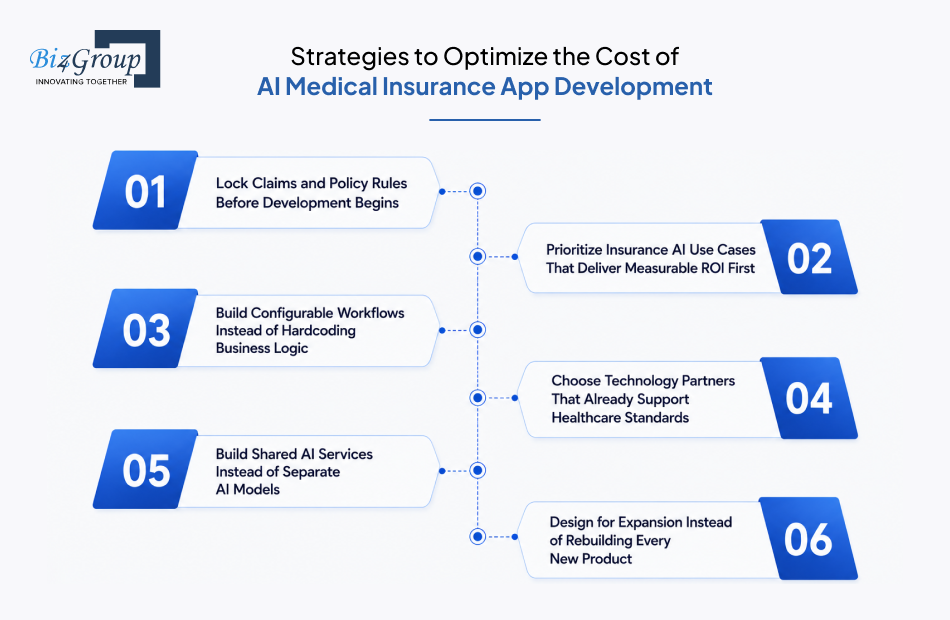
The smartest way to reduce development costs isn't by removing important features. It's by making better product, architecture, and delivery decisions from day one. These strategies help you maximize ROI while building an AI medical insurance app that's ready to scale.
1. Lock Claims and Policy Rules Before Development Begins
Nothing inflates a project budget faster than changing claim adjudication rules, member eligibility logic, or prior authorization workflows after development starts. Get business, operations, compliance, and engineering teams aligned early, so developers build once instead of rebuilding the same functionality throughout the project.
Estimated Cost Savings: 10–15% of the overall development budget
2. Prioritize Insurance AI Use Cases That Deliver Measurable ROI First
Don't automate every workflow at once. Start with high-impact medical insurance AI use cases like claims intake, fraud detection, document classification, prior authorization, and member support. Once these deliver measurable results, expand AI across additional workflows with greater confidence.
Estimated Cost Savings: $5,000–$15,000
3. Build Configurable Workflows Instead of Hardcoding Business Logic
Insurance products, payer policies, and regulatory requirements evolve constantly. A configurable rules engine lets your team update workflows without rewriting code every time a business rule changes, reducing long-term development and maintenance costs.
Estimated Cost Savings: $10,000–$15,000
4. Choose Technology Partners That Already Support Healthcare Standards
Selecting AI, interoperability, and integration partners with built-in support for FHIR, HL7, X12, and CMS interoperability reduces custom development, shortens implementation timelines, and minimizes expensive integration work as your platform grows.
Estimated Cost Savings: $8,000–$20,000
5. Build Shared AI Services Instead of Separate AI Models
Many generative AI use cases in insurance rely on the same capabilities, such as document summarization, medical record analysis, conversational assistance, and intelligent search. Building these as shared AI services avoids duplicate development and makes future enhancements significantly more cost-effective.
Estimated Cost Savings: $10,000–$20,000
6. Design for Expansion Instead of Rebuilding Every New Product
Your first release shouldn't become a dead end. Build reusable modules for member onboarding, provider management, claims processing, notifications, and document management so future insurance products can be launched without starting development from scratch.
Estimated Cost Savings: 20–35% lower development costs for future product expansions
The cost of developing an AI medical insurance app isn't defined by features alone. It depends on the decisions you make before the first line of code is written. Plan wisely, budget for the costs that often get overlooked, and invest where AI delivers measurable business value. That's how you build a HIPAA complaint medical insurance app with AI powered automation that grows without your budget growing out of control.
Build Smarter Before Spending Bigger
See where your budget creates real business value instead of paying for unnecessary complexity
Estimate My Project BudgetCommon Medical Insurance App Development Challenges (and How to Overcome Them)
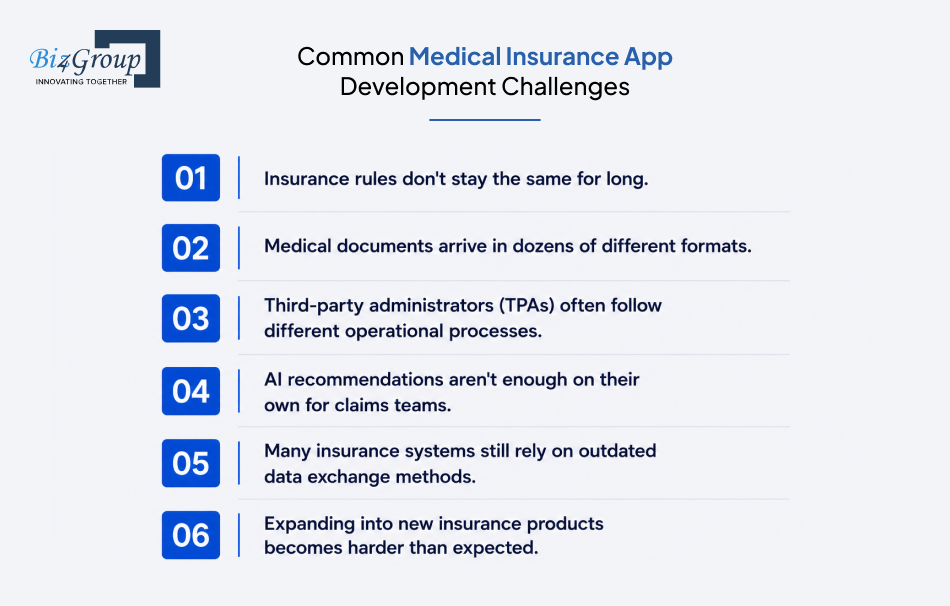
Even a well-planned project can run into unexpected hurdles once real insurance operations, healthcare data, and AI workflows come into the picture. Knowing these challenges upfront helps you make smarter technical decisions, avoid unnecessary delays, and keep the project moving with confidence.
|
Common Challenge |
How to Solve It |
|---|---|
|
Insurance rules don't stay the same for long. |
Use configurable business rules instead of hardcoded logic, so coverage criteria, prior authorization requirements, and reimbursement policies can be updated without major redevelopment. |
|
Medical documents arrive in dozens of different formats. |
Combine OCR with AI-powered document classification to standardize prescriptions, EOBs, referrals, invoices, and scanned records before they enter downstream workflows. |
|
Third-party administrators (TPAs) often follow different operational processes. |
Design configurable workflows that let each TPA manage claims, approvals, and exceptions without building separate versions of the platform. |
|
AI recommendations aren't enough on their own for claims teams. |
Show confidence scores, supporting evidence, and the source of each recommendation so reviewers can make informed decisions instead of treating AI as a black box. |
|
Many insurance systems still rely on outdated data exchange methods. |
Support modern APIs alongside secure batch processing and file-based exchanges to simplify communication with older policy administration and claims systems. |
|
Expanding into new insurance products becomes harder than expected. |
Build reusable modules for claims, member management, provider networks, and policy administration so new lines of business can be added without rebuilding core functionality. |
The right technology is only part of the equation. Success comes from anticipating operational challenges before they slow the project down. Experienced teams that hire AI developers with insurance expertise and back them with AI consulting services are better equipped to deliver enterprise grade AI solutions that continue to support changing business and regulatory needs.
Also Read: How to Hire an AI App Developer in USA for Your Business?
How to Choose the Right AI Development Partner for Your Medical Insurance App
Before you compare proposals, ask yourself one practical question: "As an insurance company planning digital transformation, how do I choose the right AI development company for building a scalable, cloud-based medical insurance app with advanced security features?"
Don't get distracted by polished presentations or oversized feature lists. Focus on the team you'll trust to solve real insurance challenges long after the contract is signed. Here's how you can decide the right AI app development partner for your medical insurance app
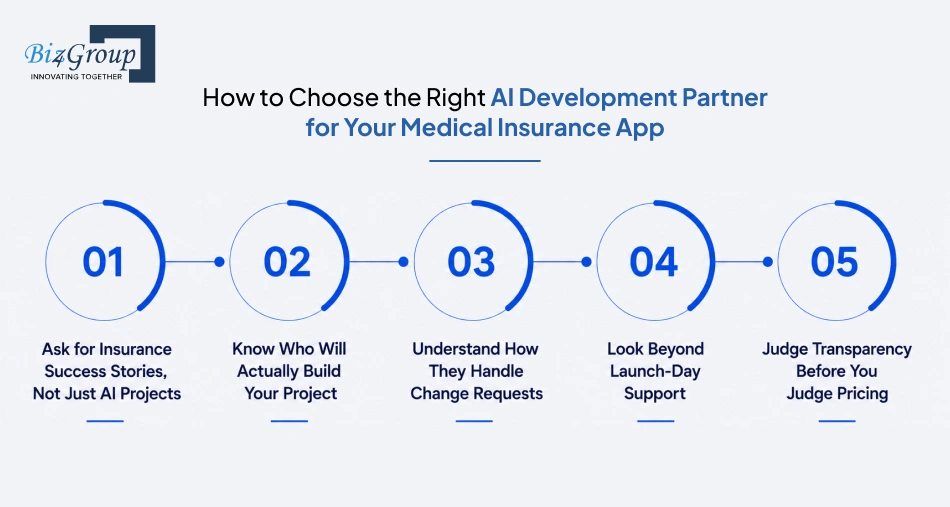
1. Ask for Insurance Success Stories, Not Just AI Projects
Every company has an AI portfolio. Ask for projects involving claims, provider workflows, member services, or healthcare operations to confirm they understand the insurance business.
2. Know Who Will Actually Build Your Project
The people pitching your project aren't always the people delivering it. Meet the architects, AI development team and project leads before making your final decision.
3. Understand How They Handle Change Requests
Requirements will change. A dependable partner manages new requests with a clear process instead of turning every update into an unexpected invoice or delay.
4. Look Beyond Launch-Day Support
Go-live is just the beginning. Ask how they'll handle product updates, AI improvements, security patches, and ongoing support as your business continues to grow.
5. Judge Transparency Before You Judge Pricing
The cheapest proposal can become the most expensive one later. A trustworthy AI healthcare app developer clearly explains what's included, what's optional, and where additional costs may appear.
So, with that laid down where do you find a partner that actually checks these boxes?
Well, Biz4Group LLC is the one that ends your search.
As a HIPAA-compliant AI healthcare software development company in USA, we know a successful medical insurance platform isn't judged by the number of AI features it offers. It's judged by how smoothly it handles claims, member services, provider workflows, prior authorizations, and everyday operations. That's exactly the kind of experience we bring when we build an AI app for medical insurance.
Before writing code, our team focuses on understanding how your business actually works, so every technical decision supports your long-term goals.
Here's what we bring to the table:
- Experience delivering AI-powered healthcare and insurance solutions with real operational workflows in mind.
- Product-first planning that aligns AI capabilities with measurable business outcomes instead of unnecessary features.
- Practical guidance on compliance, architecture, and scalability from discovery through post-launch enhancements.
- A collaborative delivery model that keeps priorities, timelines, and decisions transparent throughout the project.
A Quick Look at One of Our AI Insurance Success Stories
A great example of our insurance expertise is Insurance AI- a custom AI chatbot built to help insurance teams find accurate answers faster, reduce manual effort, and simplify access to internal knowledge.
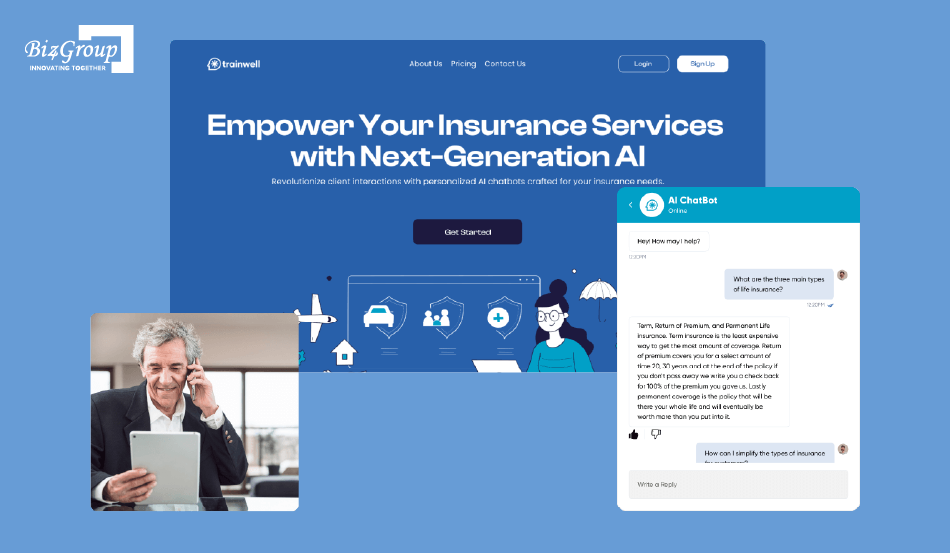
The objective wasn't to create another chatbot. It was to build an AI assistant that could understand insurance-specific queries, scale with growing demand, and stay easy for non-technical teams to manage.
What made it stand out?
- Trained on the client's insurance documents to deliver accurate, context-aware responses.
- Supported multiple user conversations simultaneously without compromising performance.
- Maintained conversation logs to support quality improvement and compliance.
- Allowed administrators to update knowledge, upload documents, and manage responses without writing code.
- Included a built-in feedback system that continuously improved answer quality over time.
How did we tackle the biggest challenges?
- The project required high response accuracy across complex insurance topics while fitting smoothly into the client's existing environment.
- We addressed this by combining advanced GPT models with a flexible integration approach that worked with the client's web platform.
- To keep the chatbot improving after launch, we also built an intuitive admin portal and a feedback-driven learning system, making ongoing updates simple for business users.
And, that's exactly how we approach every insurance AI project solving real operational challenges with practical AI that delivers measurable business results, not just impressive demos.
So, if you're also planning a medical insurance app, let's build it together.
Final Thoughts
The success of a medical insurance platform isn't measured by how many AI features it includes. It's measured by how well those features simplify claims, support members, improve operational efficiency, and deliver long-term business value. That's why every decision, from planning and budgeting to partner selection, deserves careful thought.
A well-planned approach to HIPAA compliant medical insurance app development with AI powered automation helps you build a solution that's ready for today's needs and tomorrow's growth. At Biz4Group LLC, we've helped businesses turn complex insurance ideas into practical insurance AI automation solutions that solve real operational challenges.
When you're ready to take the next step, connect with us to discuss your goals, we'd be happy to answer your questions, and help you build a medical insurance app that works as hard as your team does.
Disclaimer: This blog is for informational purposes only and does not constitute legal, regulatory, healthcare, or compliance advice.
FAQ’s
1. How much does custom AI medical insurance app development cost for a mid-sized insurance company?
For most mid-sized insurers, the investment typically ranges from $40,000 to $350,000+, depending on the number of user roles, AI capabilities, third-party integrations, compliance requirements, and deployment scope. Enterprise platforms with advanced automation and multiple insurance products can exceed this range.
2. How long does it take to build a HIPAA-compliant AI medical insurance app?
A focused MVP generally takes 3-5 weeks. A production-ready platform with AI-powered claims workflows, provider management, compliance, and enterprise integrations usually requires 8-12 weeks. The timeline depends more on business complexity than team size.
3. Should I build a custom AI medical insurance app or customize an existing insurance platform?
The right choice depends on your long-term goals. Custom development offers greater flexibility for unique workflows, AI-driven automation, and future expansion, while extending an existing platform may work better for organizations with standardized processes and limited customization needs.
4. Can AI medical insurance software work with existing claims management and policy administration systems?
Yes. Modern AI solutions can connect with existing claims, policy administration, billing, and provider systems using APIs, secure data exchanges, or middleware. The best approach depends on how your current systems store and exchange information.
5. Which insurance operations deliver the fastest ROI after implementing AI-powered automation?
Organizations often see the quickest returns by automating high-volume tasks such as claims intake, document classification, prior authorization support, fraud detection, and member query resolution. These workflows typically reduce manual effort while improving turnaround times.
6. What should insurers prepare before starting AI medical insurance app development?
Start by documenting your existing workflows, identifying repetitive manual processes, defining measurable business goals, reviewing available data sources, and involving business, compliance, and operations teams early. Better preparation leads to smoother development and fewer changes later.
