 Location :
Orlando, FL, USA
Location :
Orlando, FL, USA +1 (407) 714-1616
 info@biz4group.com

- Build an AI EHR SaaS platform for clinics to replace outdated systems with faster records, scheduling, billing, and smarter workflows.
- Success starts with clear MVP scope, clinic workflow mapping, clean UI/UX, phased rollout, and reliable user adoption planning.
- Strong products need HIPAA-ready security, role-based access, audit logs, encrypted data flow, and safe AI governance controls.
- Typical cost to build AI EHR SaaS platform ranges between $30,000 to $300,000+, depending on scope, integrations, AI depth, and scale goals.
- Revenue can grow through subscriptions, provider-based pricing, onboarding fees, AI add-ons, and transaction-based monetization models.
- Biz4Group LLC helps healthcare leaders develop AI EHR SaaS platform for clinics with strategy, engineering, compliance, and launch support.
Why are clinics still spending valuable hours on systems that slow work down instead of supporting it? Many teams deal with repeated data entry, scattered patient histories, delayed chart updates, and disconnected tools that create daily friction for staff and providers.
This is why many healthcare operators now want to build an AI EHR SaaS platform for clinics that improves speed, usability, and operational control. A well-planned platform can connect appointments, records, documentation, billing workflows, and reporting in one environment built around clinic needs.
Before we move ahead here’s what you should know:
- The global electronic health records market size is projected to reach USD 53.11 billion by 2033
- web and cloud-based EHR platforms accounted for 83.68% of total EHR market revenue in 2025.
- North America held over 43% of global EHR revenue share in 2025
- In the U.S., 88% of non-federal acute care hospitals had adopted a certified EHR system
With market momentum now clearly on the table, many clinic leaders start asking, we want to develop an AI-powered EHR system for clinics and are looking for the right approach to build it. Well, the first move is aligning technology decisions with real workflow gaps, staff expectations, compliance needs, and long-term growth goals.
When clinics invest in the right platform and work with a custom AI software development company, they often aim for outcomes such as:
- Faster documentation and reduced admin load
- Easier access to complete patient records
- Better scheduling and intake coordination
- Stronger visibility through analytics and reporting
Since the bigger picture is now clear, the next question that trouble healthcare leaders is, we are planning to build an AI EHR SaaS platform for our clinics but need guidance on features, cost, and strategy. That is where the real planning begins, and the next sections ahead break it down clearly for you.
What is AI-Powered EHR SaaS Platform and How Does it Operates?
Many clinic owners understand the need for better software yet still ask what the platform actually is and how it runs in day-to-day practice. That clarity matters because system structure affects records flow, staff coordination, and long-term scalability.
An AI-powered EHR SaaS platform is a subscription-based cloud software system used by clinics to manage electronic health records through the internet. It stores patient information, appointments, visit notes, prescriptions, billing data, and operational records inside one centralized platform.
Along with standard EHR functions, it includes AI automation tools that help organize data, assist documentation, and support tasks where AI integrated with EHR/EMR systems improves routine processes. Clinics that plan to build an AI EHR SaaS platform for clinics usually choose this model for easier access, centralized updates, and multi-location management.
How Does AI-Powered EHR SaaS Platform Operates
- Secure User Access: Clinic staff log in through role-based accounts. Front desk teams, providers, billing staff, and managers each see only the tools and records linked to their responsibilities.
- Patient Data Capture: When a patient books an appointment or completes intake forms, the system stores demographics, insurance details, medical history, and visit reasons in the patient profile.
- Clinical Record Updates: During consultations, providers enter notes, diagnoses, prescriptions, and treatment plans. An AI medical charting system can help convert inputs into structured records.
- Workflow Processing: The platform automatically routes tasks such as reminders, follow-ups, billing reviews, approvals, and internal notifications.
- Billing and Reporting Flow: Charges, claims data, and payment records move into finance modules, including tools that support AI medical billing automation.
- Cloud Sync and Integrations: Updates are saved centrally, so authorized users across locations access the latest records while connected systems exchange data securely.
At its core, the platform combines records management, automation, and connected workflows in one environment. That operating model becomes important when creating AI EHR SaS platform for clinic workflow automation and reporting that needs room to grow.
Understanding the Difference Between AI EHR SaaS Platform and Legacy Cloud EHR Platform for Clinics
Many clinics use cloud software today, yet not every cloud EHR is built the same way. Some platforms simply moved older systems online, while newer products are designed around automation, cleaner workflows, and smarter data handling from the start.
|
Comparison Area |
AI EHR SaaS Platform |
Legacy Cloud EHR Platform |
|---|---|---|
|
Core Design |
Built as a modern SaaS product with continuous upgrades |
Older EHR moved to cloud hosting with dated core structure |
|
User Experience |
Clean dashboards with role-based workflows |
Complex screens with heavy navigation steps |
|
Documentation Flow |
Supports smart SOAP note capture and assisted charting |
Mostly manual note entry and repetitive clicks |
|
Data Handling |
Organizes records with structured search and summaries |
Records stored digitally but harder to filter quickly |
|
Workflow Automation |
Automates reminders, routing, follow-ups, approvals |
Relies more on manual staff actions |
|
Reporting |
Real-time dashboards and flexible analytics |
Static reports with limited customization |
|
Integrations |
Easier API connections with labs, billing, and apps |
Integrations often slower or costly to extend |
|
Multi-Location Operations |
Centralized management for growing clinic groups |
Expansion may need added setup effort |
|
Update Model |
Frequent feature releases across all users |
Slower update cycles and version limitations |
|
Scalability |
Built to support higher usage, added locations, and evolving workflows |
Functional for stable operations with limited change plans |
The real difference often comes down to how the platform supports daily clinic operations and future growth. Once clinics see where older systems create friction, they begin reassessing where their next technology investment should go.
Still Paying for Old Logic?
See what a smarter clinic platform could unlock for your growth
See Your Upgrade PathWhy Clinics in USA Invest is AI-Powered EHR SaaS Platform Development?
Many clinics across the U.S. are not investing in new software just to modernize screens. They are investing to improve margins, increase capacity, strengthen control, and build operations that can scale. That is why developing AI EHR SaaS platform for clinics with patient data management and analytics is becoming a serious business priority.
1. Protect Profitability from Rising Administrative Costs
Administrative work consumes a large share of clinic resources. Staff time often gets absorbed by repetitive entry, eligibility checks, document chasing, claim follow-ups, and fragmented handoffs between teams. These hidden inefficiencies directly affect margins.
U.S. healthcare administrative waste is estimated at $350 billion annually, with $266 billion tied to complexity and $59–$84 billion linked to fraud and abuse. Clinics invest in AI-powered EHR SaaS platforms to reduce these avoidable cost centers.
2. Expand Patient Capacity Without Expanding Payroll
Many clinics have demand but limited operational capacity. Appointment gaps, scheduling errors, and front-desk overload reduce the number of patients that can be served each week. AI-powered scheduling and EHR entry can help clinics increase patient volume by up to 15% without adding new staff, making growth more efficient.
3. Improve Documentation Quality That Impacts Revenue
Incomplete notes and missed details often create billing delays, coding issues, and rework for staff. AI-driven transcription and documentation saw a 29% decrease in clinical note errors. Cleaner records improve operational accuracy while supporting stronger reimbursement outcomes.
4. Shorten Approval Cycles That Slow Cash Flow
Prior authorizations and internal reviews often delay treatment and payment timelines. AI-enhanced workflows are cutting the time required for clinical review in prior authorizations by 45%. Faster movement across these steps helps clinics improve service speed and financial predictability.
5. Recover Revenue Lost Through Coding Gaps
Many clinics lose income when billable details are not captured correctly during visits. AI-powered coding tools integrated into SaaS platforms are estimated to increase reimbursement by around $13,000 per clinician annually through better documentation accuracy.
6. Invest in Systems with Faster Measurable Payback
Technology budgets are now judged by results, not promises. 61% of healthcare organizations expect a positive ROI from AI within the next 12 to 24 months, which shows why clinic leaders are moving from interest to action.
These investments are rooted in financial performance and operational strength. For clinics planning their next phase of growth, the logical move is to build an AI EHR SaaS platform for clinics around clear business outcomes.
What are the Real-World Applications of AI EHR SaaS Platform for Clinics
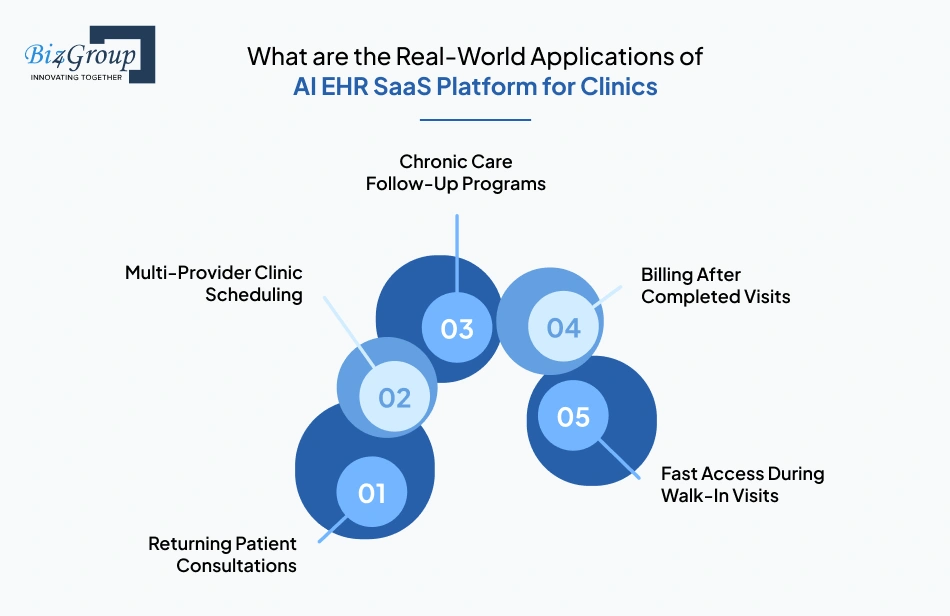
Clinic teams usually want to know where these platforms are actually used before investing in one. That is the right question to ask. Providers considering creating AI EHR platform for clinic management need practical clinic scenarios tied to daily care delivery.
1. Returning Patient Consultations
- Doctors open past visits, medications, allergies, and notes before the appointment
- Recent tests and treatment history appear inside one patient file
- New consultation notes are added to the same ongoing record
2. Multi-Provider Clinic Scheduling
- Front desk teams manage calendars for several doctors in one system
- Appointment conflicts, cancellations, and room allocations are handled centrally
- Visit queues stay updated throughout the day
3. Chronic Care Follow-Up Programs
- Clinics track patients with diabetes, hypertension, or asthma over time
- Review dates, pending tests, and repeat visits stay linked to records
- Patient journey automation helps keep follow-up timelines active
4. Billing After Completed Visits
- Charges from consultations move into billing review after appointments close
- Insurance details, visit codes, and payment status remain attached to records
- Many providers run this flow inside AI EHR/EMR software environments
Also Read: Your Guide on AI EHR App Development for Hospitals and Clinics
5. Fast Access During Walk-In Visits
- Staff search patient history during urgent or same-day appointments
- Prior prescriptions, past complaints, and visit summaries appear quickly
- Patient management using AI helps surface relevant records faster
Also Read: AI Patient Portal Development Guide for Healthcare
These examples show how modern clinics use one connected platform across appointments, records, follow-ups, and billing every day. For organizations planning to build an AI EHR SaaS platform for clinics, the next step is deciding which features matter most first.
Must Have Features in AI-Powered EHR SaaS Platform for Clinics
Clinic leaders often ask which features truly matter before investing in a new platform. That is the right place to focus, because the wrong feature mix creates staff friction, slow adoption, and wasted budget. Strong AI EHR SaaS platform development for clinics starts with practical priorities.
|
Feature |
What Each Feature Does |
|---|---|
|
Patient Registration & Profiles |
Stores demographics, insurance and medical claim processing details, consent forms, and complete patient records in one profile. |
|
Appointment Scheduling |
Manages bookings, rescheduling, cancellations, provider calendars, and daily visit queues. |
|
Clinical Notes & Charting |
Lets providers record consultations, diagnoses, prescriptions, and treatment plans during visits. |
|
AI Documentation Assistant |
Converts typed or voice inputs into structured notes and reduces manual chart entry time. |
|
Medical History Timeline |
Displays past visits, medications, allergies, labs, and procedures in chronological order. |
|
ePrescription Management |
Creates and tracks prescriptions while storing medication history in patient records. |
|
Billing & Claims Module |
Captures charges, insurance details, invoices, payment status, and claim submissions. |
|
AI Coding & Billing Review |
Flags missing billing fields, possible coding gaps, and incomplete claim information. |
|
Smart Search & Record Retrieval |
Helps staff find patient files, reports, and past records quickly. |
|
Alerts & Reminders |
Sends appointment reminders, follow-up notices, vaccine alerts, and pending task prompts. |
|
Reports & Analytics Dashboard |
Shows revenue trends, appointment volume, provider activity, and clinic performance data. |
|
Role-Based Access & Audit Logs |
Controls user permissions and tracks who viewed or changed records. |
|
Integrations Layer |
Connects labs, pharmacies, payment tools, medical imaging systems, and other healthcare CRM software. |
The right feature set should support front-desk staff, providers, billing teams, and managers inside one system. Once these essentials are clear, the next step is to understand and implement them.
Missing Features Cost More Later
Plan the right feature set before rework drains your budget
Map My Feature SetHow to Develop AI-Based EHR SaaS System for Clinics from Scope Definition to Deployment
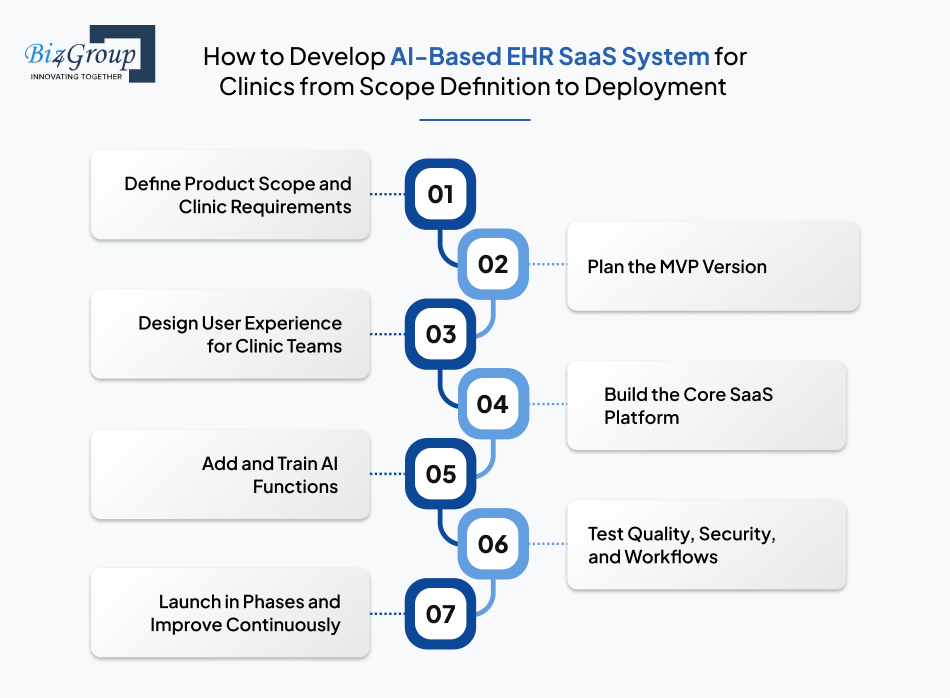
Many founders see the market demand but still need a clear execution path. Teams often ask how to develop AI-based electronic health record system for clinics without wasting budget or delaying launch. Well, the strongest products are built through planned stages with clear deliverables.
1. Define Product Scope and Clinic Requirements
The project should begin with a deep review of how the clinic currently handles appointments, charting, billing, reporting, and staff coordination. This stage converts real operational needs into a practical product roadmap and prevents random feature expansion later.
- Identify daily pain points in front desk, provider, and billing workflows
- Define user roles, access levels, and approval responsibilities
- Decide which features belong in launch phase versus later releases
- Document compliance, data privacy, and record retention needs
2. Plan the MVP Version
The first release should focus on core functions clinics need immediately. Many teams use MVP development services to validate product demand and collect user feedback before expanding the platform.
- Include patient profiles, scheduling, notes, billing basics, and user login
- Remove non-essential features that slow launch timelines
- Prioritize fast onboarding for early clinic users
- Finalize the AI EHR MVP success metrics for adoption and usage
Also Read: Top MVP Development Companies in USA
3. Design User Experience for Clinic Teams
Clinic software must feel simple during busy patient hours. A strong UI/UX design company maps user journeys before development starts, which reduces confusion and retraining later.
- Design separate dashboards for front desk, doctors, billing teams, and admins
- Reduce clicks required for scheduling, charting, and record search
- Create mobile-friendly screens for staff working across rooms or locations
- Build prototypes for feedback before coding begins
Also Read: Top UI/UX Design Companies in USA
4. Build the Core SaaS Platform
This stage creates the secure cloud foundation where clinics log in, manage records, and run daily workflows. The architecture should support future expansion across multiple locations.
- Set up centralized databases for records, appointments, billing, and users
- Build admin controls for permissions, settings, and clinic accounts
- Develop APIs for labs, payments, and external healthcare tools
- Configure backups, uptime monitoring, and access security controls
5. Add and Train AI Functions
AI should be introduced where it solves real workload problems for clinics. That usually starts with selecting AI models suited for documentation, search, summaries, and billing review tasks.
- Configure smart note drafting from provider text or voice inputs
- Train AI models on approved data patterns for accurate output formatting
- Add search tools that surface relevant patient history quickly
- Complete integration of AI models into live clinic workflows
6. Test Quality, Security, and Workflows
Healthcare platforms need strong reliability before staff depend on them daily. Many teams work with software testing companies to validate performance across devices, users, and real scenarios.
- Test booking, charting, billing, login, and reporting flows end to end
- Validate permission controls for every user type
- Check system speed under heavy daily usage volumes
- Fix defects found during staff review sessions
7. Launch in Phases and Improve Continuously
A phased rollout helps clinics adopt the platform with less disruption. Early feedback should guide the next releases and feature priorities.
- Start with one pilot clinic or selected departments first
- Train staff and track adoption barriers during launch weeks
- Monitor usage, errors, and support requests after go-live
- Release improvements through planned updates and future modules
Custom AI EHR SaaS platform development for clinics works best when scope, MVP planning, AI setup and rollout follow a disciplined order instead of rushed execution.
What is the Right Technology Stack to Build AI-Powered EHR SaaS Platform for Clinics
Many clinic owners know their current software is slowing growth but are unsure what should replace it. For business leaders asking, we are struggling with outdated EHR systems in our clinic, how can we build an AI-powered replacement. So, it starts with a practical technology stack that supports security, speed, integrations, and future expansion.
|
Architecture Layer |
Recommended Tools |
What It Handles |
|---|---|---|
|
Frontend Web Portal |
Staff dashboards, scheduling screens, billing views, admin panels |
|
|
Mobile Access Layer |
React Native, Flutter |
Mobile workflows for doctors, staff, and managers |
|
Backend Application Layer |
Node.js, NestJS, Python FastAPI |
Business logic, APIs, workflow automation, user actions |
|
Database Layer |
PostgreSQL, MySQL |
Patient records, appointments, billing data, user accounts |
|
File Storage Layer |
AWS S3, Azure Blob Storage |
Medical files, scanned forms, reports, images |
|
AI Services Layer |
Python, OpenAI models, Claude models, custom ML models |
Note drafting, summaries, smart search, billing checks |
|
Authentication Layer |
OAuth 2.0, JWT, Okta, Auth0 |
Secure login, session control, role-based access |
|
Integration Layer |
REST APIs, HL7, FHIR |
Labs, pharmacies, insurers, third-party healthcare tools |
|
Real-Time Communication Layer |
WebSockets, Twilio, SendGrid |
Alerts, reminders, notifications, messaging |
|
Analytics Layer |
Power BI, Metabase, Tableau |
Clinic reports, revenue dashboards, usage insights |
|
Cloud Infrastructure Layer |
AWS, Microsoft Azure, Google Cloud |
Hosting, scaling, backups, uptime monitoring |
|
DevOps & Monitoring Layer |
Docker, Kubernetes, GitHub Actions, Datadog |
Deployment pipelines, updates, system health tracking |
The right stack should support current clinic operations while leaving room for growth, automation, and integrations later. Strong decisions at this stage reduce costly rebuilds when developing AI EHR SaaS solutions for clinics at scale.
What is the Cost to Developing AI EHR SaaS Solutions for Clinics?
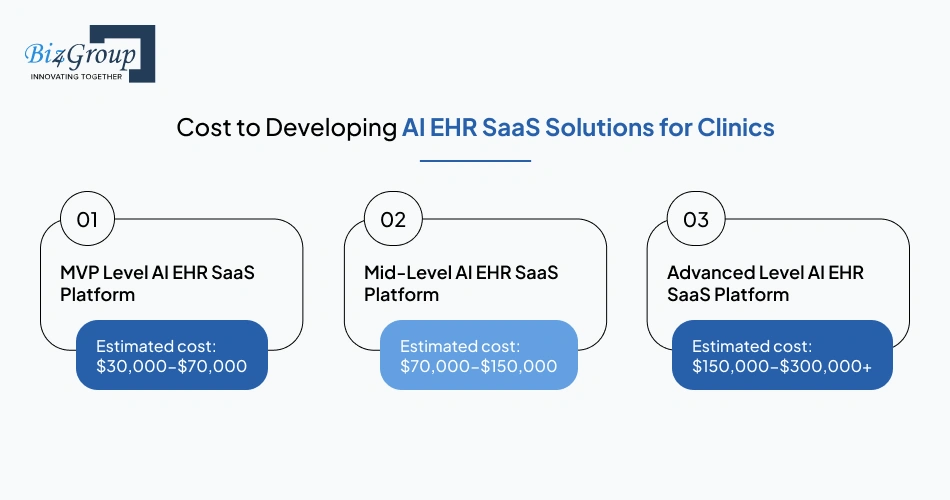
Many founders know the opportunity but need realistic numbers before moving ahead. Teams planning to build an AI EHR SaaS platform for clinics usually find that cost depends on product depth, AI scope, integrations, security needs, and rollout stages. Most projects fall between $30,000-$300,000+.
|
Development Level |
Estimated Cost Range |
Time Taken |
What is Included |
|---|---|---|---|
|
MVP Level AI EHR SaaS Platform |
$30,000-$70,000 |
3-6 weeks |
Core patient records, scheduling, charting, billing basics, secure login, simple reporting, limited AI features |
|
Mid-Level AI EHR SaaS Platform |
$70,000-$150,000 |
6-9 weeks |
Expanded workflows, mobile access, stronger analytics, integrations, AI documentation tools, role-based controls |
|
Advanced Level AI EHR SaaS Platform |
$150,000-$300,000+ |
9-14 weeks |
Multi-location SaaS platform, advanced AI automation, custom dashboards, large integrations, enterprise security, scalability layers |
The right budget depends on scope, rollout priorities, and long-term growth plans. Teams aiming to create AI EHR software for healthcare clinics should plan costs in stages. To understand pricing drivers, hidden expenses, and ways to optimize spend, reviewing AI EHR software development cost benchmarks early can help.
Also Read: AI SaaS Product Development Cost
How Can Healthcare Leaders Monetize AI-Powered EHR SaaS Platform for Clinics?
Many founders focus on product launch, but revenue planning should begin much earlier. Teams preparing to build an AI EHR SaaS platform for clinics need monetization models that match clinic buying behavior, recurring software usage, and long-term expansion potential.
1. Monthly Subscription Plans
This is the most common SaaS model. Clinics pay a recurring monthly or yearly fee to keep using the platform. Pricing is usually divided into plans based on features, user limits, support level, or number of locations. It creates stable recurring income and helps forecast growth.
Revenue can be generated through:
- Starter plans for solo or small clinics
- Growth plans for multi-provider practices
- Premium plans for multi-location groups
- Annual billing with discounted pricing
Example: 20 small clinics subscribe to a $399 starter plan for scheduling and records, while 10 larger clinics choose an $899 growth plan with billing and analytics. That creates $16,970 in monthly recurring revenue, or $203,640 yearly before renewals and upgrades.
2. Per Provider Pricing
This model charges based on the number of doctors, therapists, or practitioners using the software. It works well for growing clinic groups because revenue increases when their team size increases.
Revenue can be generated through:
- Charge one fee per active provider account
- Offer lower rates for high-volume groups
- Add charges for temporary or contract providers
- Combine with a base platform fee
Example: A clinic network has 35 active providers paying $109 each per month. That generates $3,815 monthly from one client. Five similar groups would generate $19,075 monthly.
3. Setup and Onboarding Fees
Many clinics need support before going live. Charging one-time onboarding fees covers migration work, configuration, training, and implementation time. This helps recover early delivery costs.
Revenue can be generated through:
- Patient data migration from old systems
- Workflow setup for each clinic
- Staff onboarding sessions
- Go-live assistance
Example: 8 new clients pay a $5,000 onboarding package that includes migration and staff setup. That brings $40,000 in one-time revenue alongside recurring subscriptions.
4. Premium AI Add-Ons
Advanced automation tools can be sold separately from the main subscription. This keeps core pricing affordable while creating expansion revenue from customers who need more advanced capabilities.
- AI charting and note drafting tools
- Smart billing review automation
- Predictive scheduling tools
- Advanced reporting assistants
Example: 25 clinics add an AI charting module at $149 per month. That creates $3,725 in extra monthly revenue without selling new base subscriptions.
5. Transaction-Based Revenue
The platform earns money whenever claims, invoices, payments, or bookings are processed through the system. This model grows naturally as clinic activity grows.
Revenue can be generated through:
- Fee per insurance claim submitted
- Fee per patient payment collected
- Fee per telehealth booking processed
- Revenue share on payment transactions
Example: A client group processes 18,000 insurance claims monthly at $0.60 each. That produces $10,800 monthly from transaction volume alone.
6. White-Label Licensing
Healthcare groups or regional operators may want the platform under their own brand. You license the software while they sell it as their own service. This often creates larger contracts and longer commitments.
- Monthly platform licensing fee
- Additional branding and setup fee
- Ongoing support retainers
- Multi-year enterprise agreements
Example: 3 healthcare partners license the platform at $4,000 per month each. That generates $12,000 monthly recurring revenue, plus setup fees for each deployment.
The strongest platforms rarely rely on one pricing stream. Leaders who develop AI EHR SaaS platform for clinics usually combine subscriptions, onboarding fees, AI upgrades, and transaction income to build stronger long-term revenue with lower customer concentration risk.
Revenue Needs Better Architecture Too
Turn your platform into recurring income with sharper pricing models
Contact UsBest Practices to Follow for AI-Powered EHR SaaS Platform Development
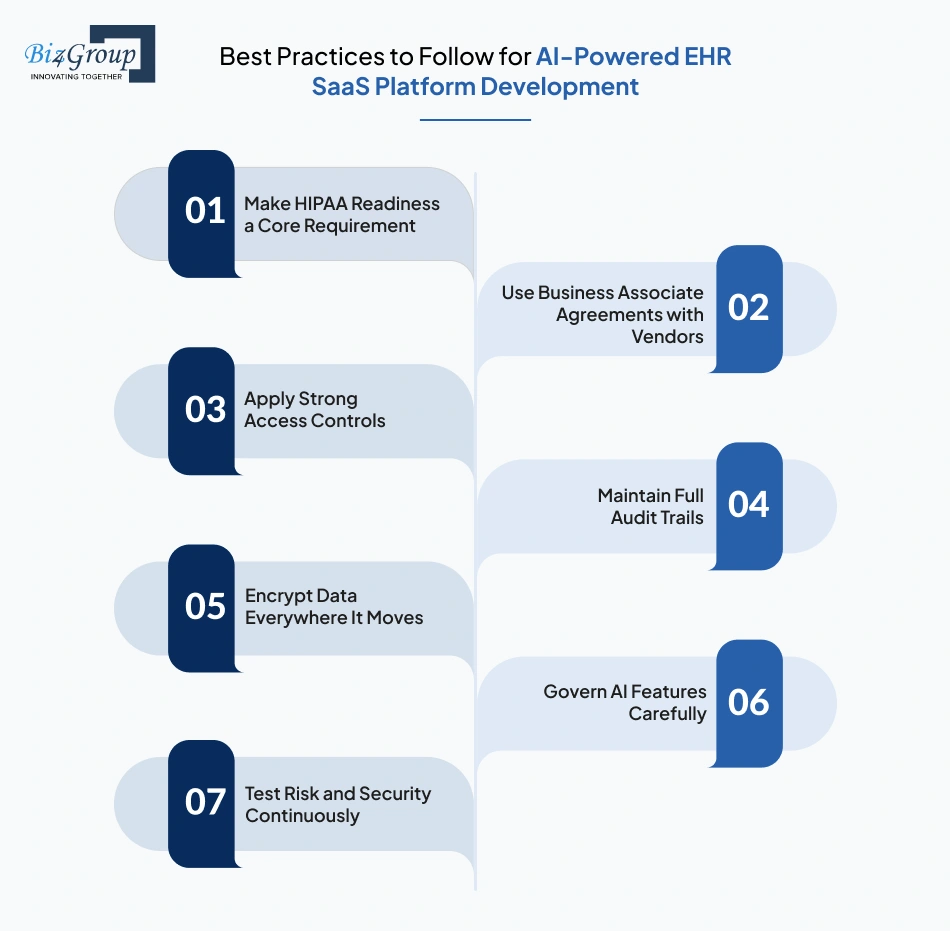
Clinic buyers often evaluate trust before features. Teams that want to build secure and compliant AI EHR SaaS solution for healthcare need security controls and healthcare compliance built into the product from the start. For U.S. clinics, that usually begins with HIPAA compliance software readiness and disciplined data protection.
1. Make HIPAA Readiness a Core Requirement
- Map how PHI is collected, stored, shared, and deleted across the platform
- Build safeguards that support HIPAA Privacy Rule and Security Rule expectations
- Keep written policies for workforce access, data handling, and incident response
Also Read: Cost to Develop HIPAA-Compliant AI Healthcare Software
2. Use Business Associate Agreements with Vendors
- Sign BAAs with cloud providers handling patient data
- Review AI vendors and connected services that may process PHI
- Keep vendor responsibilities clear for privacy and breach response
3. Apply Strong Access Controls
- Use role-based permissions for doctors, staff, billing teams, and admins
- Enable multi-factor login for sensitive accounts
- Remove or update access quickly when staff roles change
4. Maintain Full Audit Trails
- Record logins, patient record views, edits, exports, and permission changes
- Keep time-stamped logs for compliance reviews and investigations
- Monitor unusual activity patterns regularly
5. Encrypt Data Everywhere It Moves
- Encrypt patient records in storage databases and file systems
- Protect data shared through browsers, mobile devices, and APIs
- Secure backups with the same protection standards
6. Govern AI Features Carefully
- Limit PHI exposure during testing and model training
- Keep human review for AI-generated notes or suggestions
- Use trusted AI integration services with clear data controls
7. Test Risk and Security Continuously
- Run regular vulnerability checks and access reviews
- Test backups, recovery plans, and downtime readiness
- Work with an experienced AI development company and healthcare AI developers familiar with regulated systems
Strong clinic platforms earn trust through compliance discipline, not promises. Teams that follow these standards are better prepared to build an AI EHR SaaS platform for clinics that meets operational needs while protecting sensitive healthcare data.
What Challenges Are Faced During AI EHR SaaS Platform Development and How to Overcome Them?
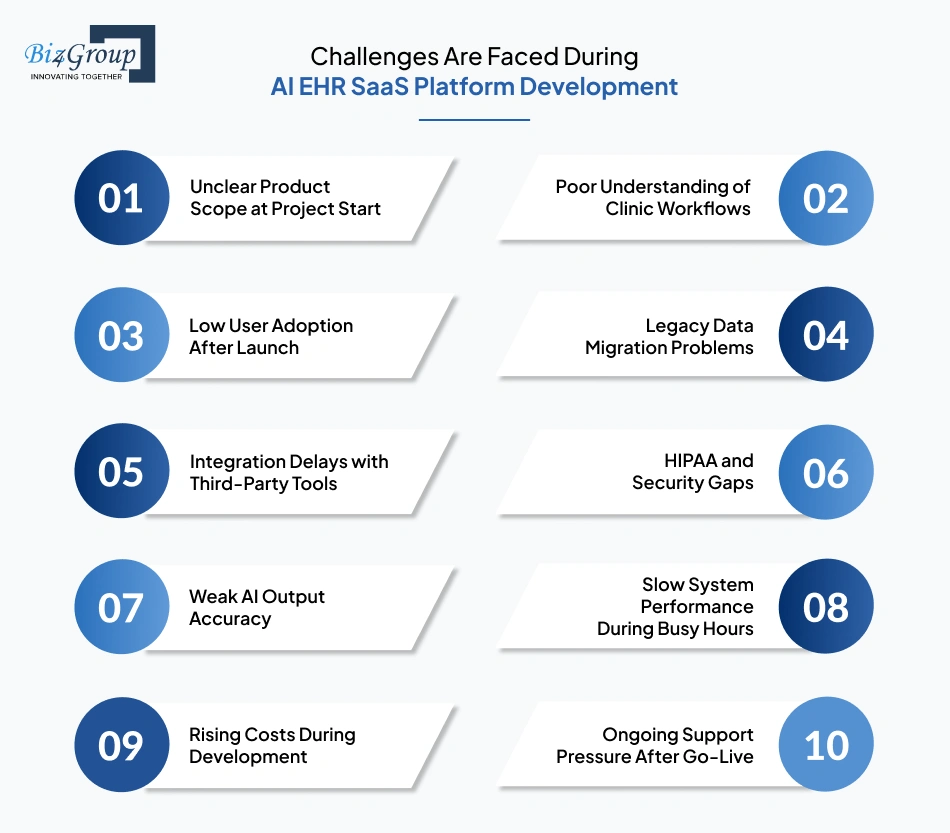
Many healthcare software ideas look strong on paper, yet execution becomes difficult once real clinic workflows, patient data, and compliance needs enter the project. Teams planning to build cloud-based AI EHR SaaS system should expect common roadblocks early and solve them with clear planning.
|
Challenge |
How to Overcome It |
|---|---|
|
Unclear Product Scope at Project Start |
Many teams try to launch scheduling, billing, analytics, telehealth, AI charting, and custom workflows at once. This stretches budget and delays delivery. Start with a clear MVP focused on core clinic needs, then release advanced modules in later phases. |
|
Poor Understanding of Clinic Workflows |
Software often fails when developers do not understand how front desk staff, providers, and billing teams actually work. Run workflow discovery sessions with real clinic users before design begins so screens match daily operations. |
|
Low User Adoption After Launch |
Staff may resist new systems when navigation feels slow or training is weak. Use simple interfaces, role-based dashboards, guided onboarding, and pilot testing with selected clinic teams before full rollout. |
|
Legacy Data Migration Problems |
Older systems may contain duplicate patients, missing fields, outdated insurance data, or inconsistent records. Clean and map data before migration, move records in batches, and validate sample records before final transfer. |
|
Integration Delays with Third-Party Tools |
Labs, pharmacies, payment tools, and imaging systems often use different connection standards. Prioritize integrations early, use tested APIs, and keep backup manual workflows during rollout periods. |
|
HIPAA and Security Gaps |
Security issues discovered late can delay launch and increase legal risk. Add encryption, audit logs, access controls, secure backups, and vendor compliance reviews from the first development phase. |
|
Weak AI Output Accuracy |
AI note drafting or search tools may return incomplete or incorrect results when trained poorly. Limit AI to focused use cases, review outputs with staff, and improve models using controlled feedback cycles. |
|
Slow System Performance During Busy Hours |
Clinics need speed during appointment peaks. Heavy databases or poor architecture can slow charting and scheduling. Use cloud scaling, efficient queries, caching, and regular load testing before launch. |
|
Rising Costs During Development |
Frequent feature changes, delayed approvals, and added integrations can increase spend quickly. Use milestone budgets, strict change control, and weekly scope reviews to keep costs predictable. |
|
Ongoing Support Pressure After Go-Live |
Prepare training materials, support channels, release schedules, and targeted AI automation services for repetitive support tasks. |
Most platform risks are manageable when handled early with discipline and realistic planning. Teams that solve these issues properly are far better positioned to build an AI EHR SaaS platform for clinics that launches smoothly, earns trust, and scales with demand.
Why You Should Choose Biz4Group LLC for AI-Powered EHR SaaS Platform Development?
Many healthcare leaders compare vendors and still struggle to identify who can truly deliver a reliable clinic platform. If you’re someone wondering, “we are evaluating vendors for AI-powered EHR SaaS development for our clinic, who should we choose.” Then Biz4Group LLC might be the answer you’re looking for.
As an AI healthcare software development company, we combine healthcare understanding, AI capability, and product execution. Here why you should be us:
1. Proven Healthcare AI Product Experience
We have worked on healthcare-focused digital solutions where usability, personalization, and trust matter. That experience becomes valuable when you need to build an AI EHR SaaS platform for clinics with real operational depth instead of generic software features.
Here’s the proof:
a) Real Innovation Through Semuto

Semuto was developed as a wellness-focused intelligent platform that uses user preferences and health inputs to deliver more personalized recommendations. This reflects practical experience in handling health data, personalization logic, and user-centered healthcare journeys that modern clinic platforms increasingly need.
b) Human-Centered Intelligence Through Truman
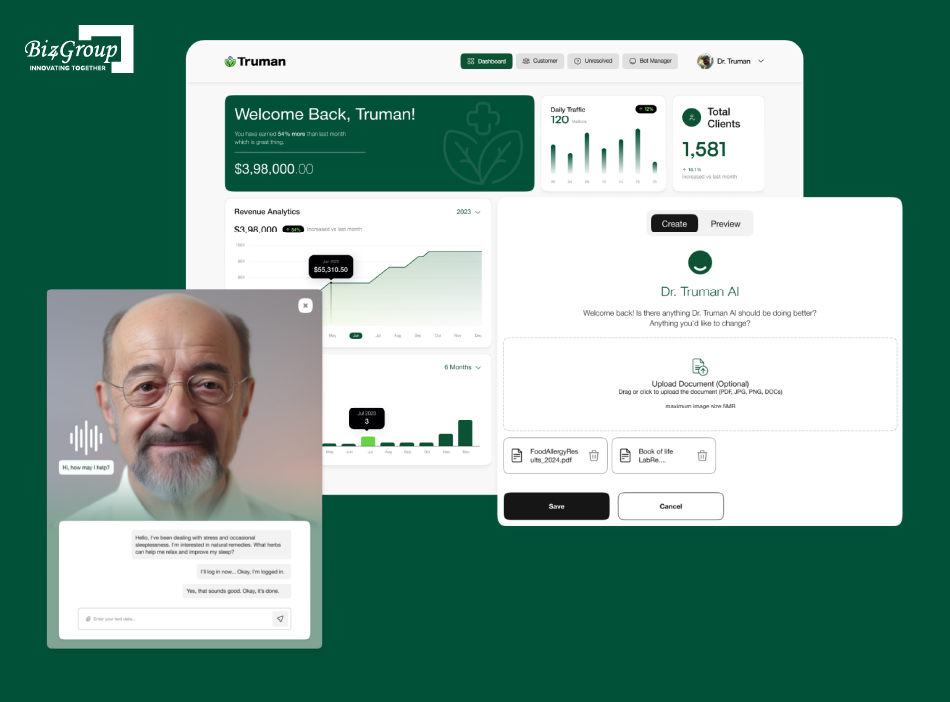
Truman was created as an AI-enabled virtual health companion with a digital avatar experience designed to guide users through wellness interactions. It demonstrates how conversational interfaces, record awareness, and guided engagement can support future-ready patient communication models.
2. Custom Platforms Instead of Generic Templates
Every clinic operates differently. We focus on tailored architecture, workflow-driven modules, and scalable SaaS systems that align with your service model, staffing structure, and growth plans.
3. Security and Compliance Mindset
Healthcare software requires disciplined delivery. The team builds with privacy controls, secure access layers, audit readiness, and structured governance in mind from the beginning of the project.
4. End-to-End Product Partnership
From strategy and UX planning to development, testing, launch, and post-release growth, we support clients through the full journey instead of only the coding phase.
With that being said, clinics need more than just a vendor; they usually need a strategic product partner, which is why many healthcare teams turn to Biz4Group LLC for serious AI EHR SaaS execution.
Ready to Build It Right?
Work with experts who know healthcare SaaS execution deeply
Book an AppointmentWrapping Up
The clinics that lead tomorrow will be the ones that modernize decisions today. Legacy systems often slow teams, limit visibility, and create friction across patient care and operations. A well-planned move to an intelligent SaaS platform creates room for better workflows, stronger scalability, and long-term growth.
For founders and healthcare leaders planning to build an AI EHR SaaS platform for clinics, success usually depends less on the idea and more on execution discipline, product clarity, and the right technology partner. That is why many buyers carefully evaluate companies that develop AI EHR SaaS platforms for clinics in USA before making the next move.
Working with an experienced team that understands healthcare delivery, SaaS architecture, and AI product development services can shorten risk and improve outcomes. Biz4Group LLC helps healthcare innovators turn strong ideas into scalable products. When you are ready to move forward, connect with us and start planning your platform.
FAQ’s
1. How much does it cost to launch an AI-powered EHR SaaS platform for clinics in the USA?
Most projects start around $30,000 for a focused MVP and can exceed $300,000+ for advanced multi-location platforms with integrations, AI workflows, and enterprise-grade security. Final pricing depends on scope, data migration, compliance needs, and rollout stages.
2. How long does it take to build an AI EHR SaaS platform for clinics from scratch?
A basic MVP may take 3 to 6 weeks, mid-level platforms often need 6 to 9 weeks, and larger custom systems can take 9 to 14+ weeks. Timelines usually increase when custom workflows, integrations, and phased launches are involved.
3. Can an AI-powered EHR platform connect with existing clinic software and legacy systems?
Yes, many modern platforms are designed to connect with labs, billing tools, pharmacies, imaging systems, and older databases through APIs or healthcare standards like HL7 and FHIR. Integration planning should happen early to avoid delays later.
4. How do clinics migrate patient records from an old EHR into a new AI EHR SaaS platform?
Migration usually starts with data cleanup, duplicate removal, field mapping, and staged transfers. Most clinics move records in batches, validate sample data first, and keep backup access to legacy records during transition.
5. What should clinic owners look for in companies that develop AI EHR SaaS platforms for clinics in USA?
Look for healthcare domain experience, HIPAA-ready development practices, SaaS product expertise, integration capability, AI implementation depth, and long-term support. A strong partner should understand both clinic workflows and scalable product architecture.
6. How can an AI EHR SaaS platform improve staff adoption after launch?
Adoption improves when the platform uses simple navigation, role-based dashboards, faster charting flows, guided onboarding, and real staff feedback during pilot rollout. Systems built around daily clinic workflows usually gain acceptance faster.
