Location :
Orlando, FL, USA
Location :
Orlando, FL, USA +1 (407) 714-1616
 info@biz4group.com


















Imagine a digital system that doesn’t wait for instructions but instead, understands your business goals, learns from real-time feedback, and takes independent actions to get the job done.
Read More

Why are healthcare organizations investing in AI, yet still delaying decisions on implementation?
The pressure often begins with daily operations. Administrative teams handle repetitive tasks, billing cycles move slowly, approvals get delayed, and staff spend valuable time switching between disconnected systems. In the U.S., administrative costs account for 15% to 30% of total healthcare spending. That level of waste is pushing providers to look for more efficient ways to operate with AI gaining attention.
AI in healthcare can solve many of these process bottlenecks. From patient intake to scheduling, claims handling, and support workflows, automation can reduce manual effort and improve speed. Industry estimates show AI could save U.S. healthcare $200 billion to $360 billion annually, equal to 5% to 10% of total spending.
Once organizations decide AI deserves serious attention, the next challenge is how to adopt it. Some healthcare groups prefer software that is ready to deploy while others want custom AI solutions built around their own workflows, data rules, and operational goals.
But once the need becomes clear, a more difficult question follows for healthcare business owners which is, “we are a healthcare organization and confused between building custom AI solutions or using SaaS platforms for our operations,” the uncertainty often comes from practical concerns, not technology itself. It often includes concerns like:
This is where the conversation around custom AI vs SaaS in healthcare becomes important. One path may solve speed issues while another may support deeper control, workflow alignment, and long-term ownership. What works best depends on how your organization operates today and where it plans to grow next.
If you’re running a healthcare organization and confused between building custom AI solutions or using SaaS platforms for healthcare operations, this guide is built for that exact decision. We’ll walk you through the real cost, control, workflow, and compliance factors behind each path, so you can move ahead with clarity instead of confusion.
Healthcare organizations often know they need AI support, but confusion usually starts when deciding which delivery model fits real operations. Some teams need a solution that can launch quickly with less internal effort. Others need software shaped around their workflows, systems, and long-term goals. Understanding the difference early helps avoid costly missteps later.
Custom AI solutions are built specifically for your organization. They are designed around how your teams operate, what systems you already use, and where efficiency gaps exist. Instead of forcing staff to adapt to standard software, custom healthcare AI solutions are created to match internal processes.
This path is common when healthcare groups need deeper control, unique workflows, or stricter governance.
It may include:
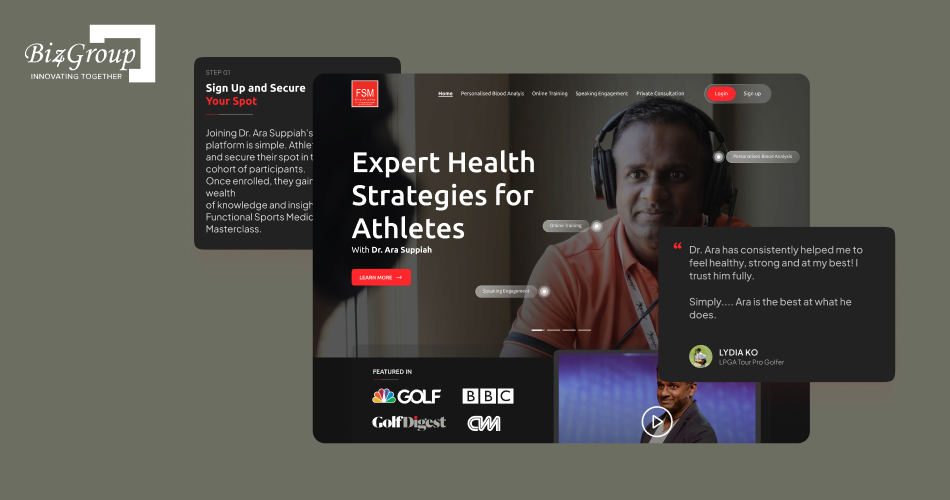
Dr. Ara is an AI-powered athletic health platform built for athletes and active users who want deeper insight into performance, recovery, and overall wellness. It analyzes uploaded blood reports to deliver personalized guidance around hydration, nutrition, sleep, cholesterol, oxygen levels, and training readiness.
Users can also schedule one-on-one consultations and track progress over time. It reflects how custom AI in healthcare can turn complex health data into practical, personalized action.
SaaS AI is ready-made software provided by an outside vendor through a subscription model. The platform is already built, hosted, maintained, and updated by the provider. Your team uses it with faster deployment and less internal development effort.
This path is common when speed, standard features, and easier rollout matter most.
It may include:
If you are reviewing SaaS vs custom AI healthcare solutions, this comparison below gives a clearer picture of how both models differ in day-to-day business use.
|
Factor |
Custom AI in Healthcare |
SaaS AI in Healthcare |
|---|---|---|
|
Development Approach |
Built from scratch around your workflows, systems, and goals |
Prebuilt platform configured for your organization |
|
Deployment Timeline |
Requires planning, development, testing, and phased rollout |
Usually faster to launch after setup and onboarding |
|
Initial Investment |
Higher upfront spend for design, build, and implementation |
Lower starting cost with recurring vendor fees |
|
Workflow Alignment |
Designed around internal processes and team needs |
Teams may need to adapt to platform limits |
|
Integration Capability |
Can be built for legacy tools, EHRs, and custom systems |
Often supports common integrations set by vendor |
|
Data Governance |
Greater control over storage, access, and internal policies |
Shared responsibility based on vendor model |
|
Product Changes |
Roadmap driven by your priorities |
Roadmap driven by vendor releases |
|
Long-Term Flexibility |
Easier to expand based on changing needs |
Expansion depends on available features or tiers |
The discussion around custom AI vs SaaS in healthcare is rarely about software alone. It usually reflects how much speed, control, flexibility, and ownership your organization truly needs. The next sections will break those factors down in detail.
See which model fits your operations growth and control goals
Get Expert Clarity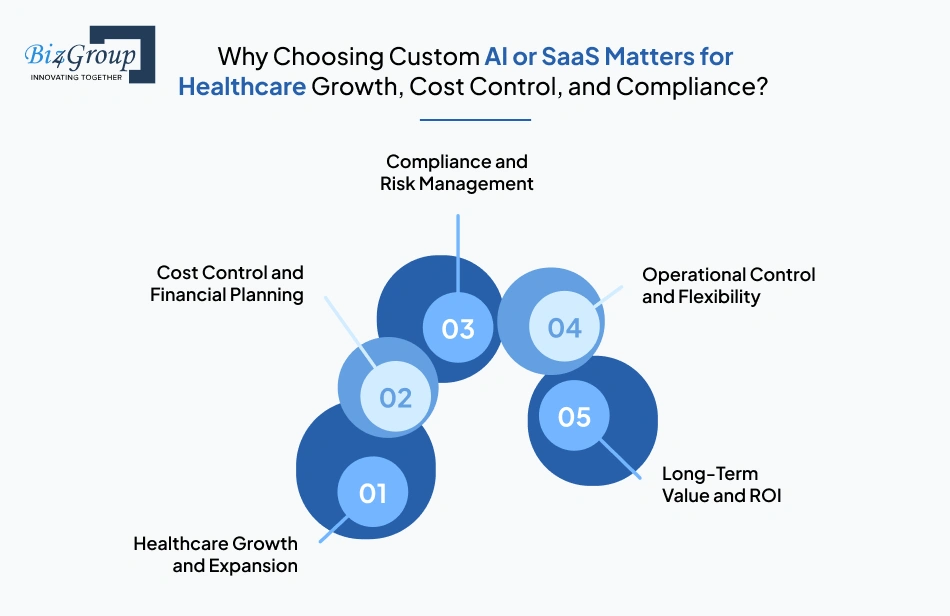
Many healthcare organizations focus on getting AI into operations, but the bigger business question is how that decision affects revenue, margins, service quality, and risk over time. A rushed move can create expensive limitations later. A well-planned move can strengthen growth and operational control.
Before looking at how custom AI and SaaS approaches impact healthcare businesses let us see what the market has to say:
For a market growing at this pace, the real value of understanding custom AI vs SaaS in healthcare goes beyond technology selection. It becomes a business decision tied to expansion plans, cost structure, operational flexibility, and regulatory confidence. That is where choosing the right model starts shaping long-term competitive advantage for healthcare providers.
Below we have mentioned the areas where the custom AI and SaaS approaches create measurable impact:
Growth often brings more patients, new service lines, added staff, and multiple locations. Systems that cannot keep pace can slow expansion and create pressure on internal teams. Growth works better when operations stay efficient as healthcare leaders often look for support with:
Many providers lose revenue through manual tasks, billing delays, scheduling gaps, and staff time spent on repetitive work. Technology decisions should reduce waste and improve financial visibility. This is where AI healthcare platform development vs SaaS becomes an important budgeting discussion. Business owners usually assess:
Healthcare growth means little when compliance risk increases at the same time. Data privacy failures can damage trust, interrupt operations, and create financial exposure. Choosing the right approach is essential as healthcare organizations need confidence in:
As healthcare needs change, workflows and priorities change too. Limited control can slow updates, process changes, and future expansion plans. The difference for the healthcare leaders matter as they often think about:
Short-term convenience does not always create lasting value. Real returns come from systems that continue improving efficiency as usage grows. That may include:
Understanding custom AI vs SaaS in healthcare helps healthcare leaders make decisions that support growth, protect margins, reduce risk, and create lasting operational value. The next sections break down the financial and compliance factors in more detail.
Cost is usually where AI interest becomes a real buying decision. Healthcare leaders need more than a price range. They need to know what creates the cost, what continues after launch, and what scales with growth.
Custom AI solutions generally range from $50,000 to $400,000+ based on scope, integrations, security needs, and workflow complexity. SaaS healthcare AI platforms usually range from $30,000 to $250,000+ depending on users, modules, locations, and contract structure. A proper AI healthcare software cost comparison should always look deeper than entry pricing.
For healthcare leaders asking, “we are evaluating AI healthcare solutions and want to understand whether SaaS or custom AI is better for cost and scalability.” The next step is to break pricing into the business areas that shape long-term spending and returns.
Custom AI often needs a larger starting budget because planning, design, development, and deployment are tailored to your organization. SaaS platforms usually reduce the first investment because the product is already built and ready to configure. This creates different entry points for healthcare buyers.
Typical upfront cost areas include:
Costs rise when organizations need more workflows, more departments, or deeper automation. A basic scheduling tool costs far less than a broader operational system. The wider the scope, the greater the investment required.
Pricing often changes based on:
Healthcare software rarely works alone. Costs increase when AI tools must connect with EHR systems, billing tools, or an AI patient portal already used by patients and staff. Data quality can also affect implementation budgets.
Major cost drivers include:
Also Read: A Complete Guide to OpenAI API Integration for AI Applications
The launch price is only one part of the total investment. Ongoing spending often determines whether the solution remains financially sustainable. This is where many healthcare buyers need clearer planning.
Recurring cost areas may include:
The strongest return usually comes from time savings, lower admin pressure, and better output across teams. That is why healthcare digital transformation SaaS vs custom AI should be reviewed through long-term efficiency, not price alone. Sustainable gains matter more than short-term savings.
Organizations often track value through:
|
Cost Factor |
Custom AI in Healthcare |
SaaS AI in Healthcare |
|---|---|---|
|
Typical Cost Range |
$50,000 to $400,000+ |
$30,000 to $250,000 |
|
Starting Cost |
Higher tailored investment |
Lower entry pricing |
|
Feature Expansion Cost |
Based on new scope |
Tier or module based |
|
Integration Cost |
Depends on systems involved |
Depends on vendor support |
|
Ongoing Cost Model |
Maintenance and updates |
Subscription renewals |
|
Long-Term Cost Control |
Higher ownership flexibility |
Vendor pricing dependent |
Understanding custom AI vs SaaS in healthcare through a cost lens helps healthcare leaders budget smarter, scale responsibly, and avoid decisions based only on surface pricing.
Uncover real costs beyond quotes subscriptions and hidden spend
Review My Cost PlanIn healthcare, privacy decisions affect revenue, reputation, and daily operations. A useful AI tool still becomes a risk when data handling is weak or compliance ownership is unclear. That is why this decision goes far beyond software features.
When reviewing custom AI vs SaaS in healthcare, leaders need to understand how each model manages patient data, access controls, vendor responsibility, and future governance. This is where healthcare AI compliance SaaS vs custom becomes a serious operational decision.
Custom AI solutions usually gives organizations more direct control over where data is stored, how access is managed, and how internal rules are enforced. SaaS platforms often use vendor-managed environments with predefined controls and shared governance models.
Healthcare teams often compare:
Custom AI systems can be designed around internal privacy policies, department workflows, and approval structures from the start. SaaS platforms may already support healthcare compliance standards, but organizations still need to confirm how those controls match internal requirements.
Leaders usually review:
Also Read: HIPAA Compliant AI App Development for Healthcare
SaaS can reduce technical workload because the vendor manages hosting, updates, and parts of security operations. Custom AI solutions places more responsibility internally, but it also gives stronger control over priorities and risk management.
Common decision points include:
Privacy performance matters most during everyday use. Tools such as AI patient triage software, a healthcare AI agent, or AI chatbots for healthcare must protect patient data
Operational checks often include:
Also Read: Top 10 AI Chatbot Development Companies for Healthcare
As healthcare organizations grow, privacy management becomes harder across locations and teams. Custom AI systems can be expanded around internal governance models, while SaaS growth often depends on vendor settings and platform structure.
Teams often assess:
A smart healthcare SaaS AI platforms comparison should always include compliance, privacy control, accountability, and long-term risk, so healthcare leaders can move forward with greater clarity and fewer future surprises.
Most healthcare organizations already know AI tools need to connect with existing systems. The real question is how that integration happens in practice. Data has to move accurately, staff should not switch between multiple screens, and daily workflows must continue without disruption.
A closer look at the difference between SaaS and custom AI healthcare software for hospitals and clinics will better help you understand how each model connects with healthcare platforms, exchanges data, and supports operational continuity across critical systems.
Also Read: Top 10 AI EHR Software Development Companies in USA
Successful integration is not just about connecting software. It is about moving accurate data, reducing manual work, and keeping healthcare teams productive while new AI capabilities are introduced.
Find the smartest path for smoother healthcare integrations
Map My Integrations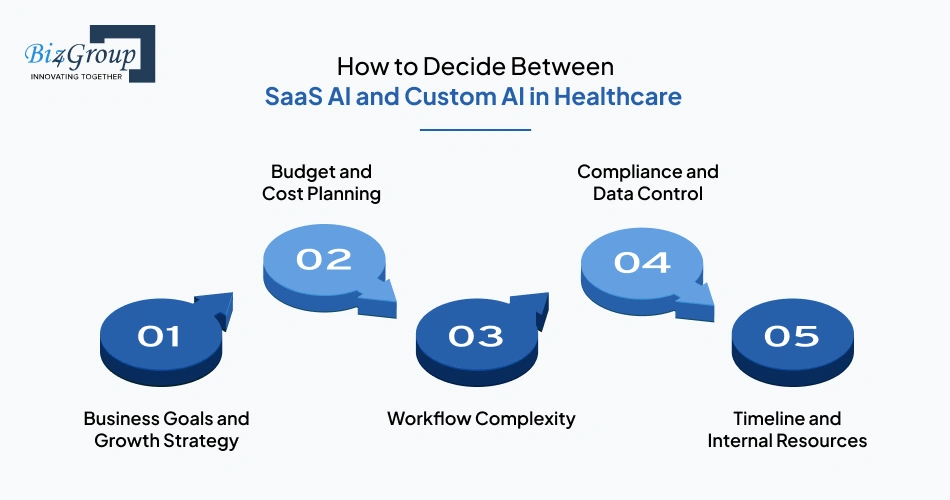
The right AI decision is rarely about features alone. It depends on how well the solution fits your growth plans, internal workflows, compliance needs, available budget, and long-term operating model. Healthcare leaders need a practical framework that reduces confusion and supports confident investment decisions.
For organizations asking how to choose between SaaS and custom AI solutions in healthcare industry, the clearest way is to evaluate the business factors that shape performance after launch, not just during the buying stage.
Your first filter should be the result you want to create. Some healthcare organizations need fast operational improvement in scheduling, support, or intake. In those cases, SaaS platforms can deliver quicker wins because the product is already built and ready to deploy.
Other organizations are focused on long-term differentiation. They may want unique patient journeys, smarter internal workflows, or a stronger competitive position in their market. Custom AI is often the stronger fit because it can be built around those specific growth goals.
Budget is not only about starting price. It is about how the investment behaves over time. SaaS usually lowers the barrier to entry because costs are spread through subscriptions or annual contracts. This works well for providers protecting short-term cash flow.
Custom AI often requires a larger upfront investment. However, organizations with growing operations may see stronger returns later through automation gains, fewer vendor limitations, and better ownership of the solution.
Healthcare operations are rarely identical across organizations. A clinic with standard intake and appointment flows may work well with SaaS tools designed for common use cases.
Larger providers, hospital groups, and specialty networks often run more complex processes. They may need custom approvals, department-level routing, or workflow logic that standard platforms cannot match easily. Custom AI is often more effective in these environments.
Healthcare decisions must account for privacy, governance, and patient trust. SaaS can be a practical route when approved vendors already meet internal compliance requirements and offer secure operating environments.
Custom AI becomes more valuable when organizations need tighter control over data access, custom privacy workflows, or internal governance rules that do not align neatly with vendor platforms.
Urgency matters. Organizations that need faster rollout and have limited internal technical resources often prefer SaaS because deployment can move quickly with less internal lift.
Custom AI is usually better suited to organizations that can invest time in planning, testing, and phased implementation. That patience often results in a more precise solution aligned with long-term priorities.
|
Decision Factor |
SaaS AI in Healthcare |
Custom AI in Healthcare |
Best Fit |
|---|---|---|---|
|
Growth Goals |
Faster short-term improvement |
Stronger long-term advantage |
Depends on roadmap |
|
Budget |
Lower upfront spend |
Higher initial investment |
Depends on cash strategy |
|
Workflow Needs |
Standard processes |
Unique operations |
Depends on complexity |
|
Compliance |
Vendor-led controls |
Greater internal control |
Depends on governance |
|
Timeline |
Faster deployment |
Longer implementation |
Depends on urgency |
The better option depends on operating priorities, available resources, compliance expectations, and future growth plans. Once those factors are clear, the right direction becomes far easier to identify and far more valuable over the long term.
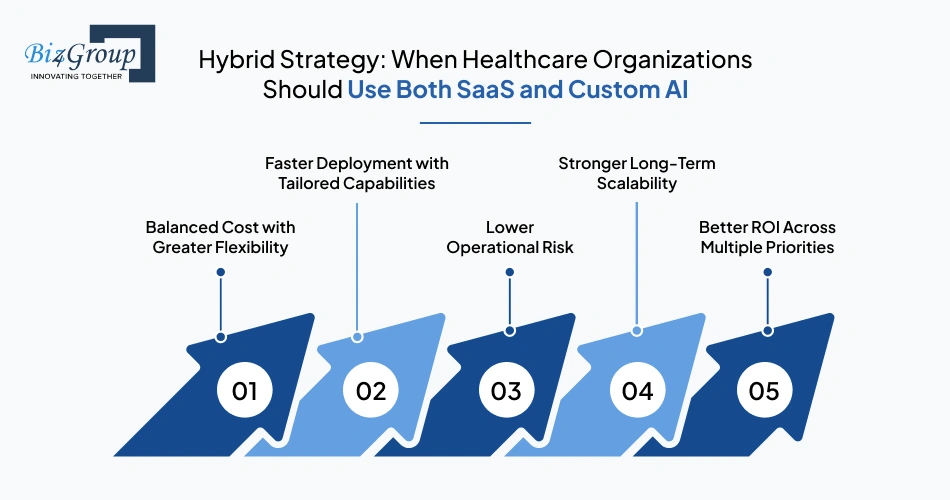
Not every healthcare organization fits neatly into one model. A hybrid model allows healthcare providers to use SaaS tools for common operational needs while adding custom AI where unique workflows or strategic value matter most. This creates a more practical path than forcing one model across the entire organization.
Hybrid strategies help healthcare organizations control early spending while still investing in high-value customization where it matters most. Instead of funding a full custom rollout, leaders can prioritize targeted AI investments.
This approach often supports:
Many providers need results quickly but still require certain workflows to reflect internal operations. A hybrid model allows faster rollout through SaaS tools while custom AI is added in areas needing deeper alignment.
This often works well for:
Relying fully on one model can create different risks. Full custom projects may take longer, while fully standardized tools may not fit important workflows. Hybrid strategies reduce that pressure by balancing speed and customization.
Healthcare organizations often benefit through:
Healthcare needs change with growth, acquisitions, new locations, and rising patient demand. Hybrid models allow organizations to start with practical tools today and expand custom capabilities over time.
This supports:
Many healthcare leaders need both short-term efficiency and long-term strategic value. Hybrid strategies help capture faster returns from SaaS while building custom AI where larger gains can be created.
This often improves:
A hybrid strategy gives healthcare organizations the speed of SaaS and the precision of custom AI in one practical model. For many providers, that balance creates the most realistic path to growth, efficiency, and long-term value.
Blend speed and customization into one smarter healthcare strategy
Build My Hybrid Plan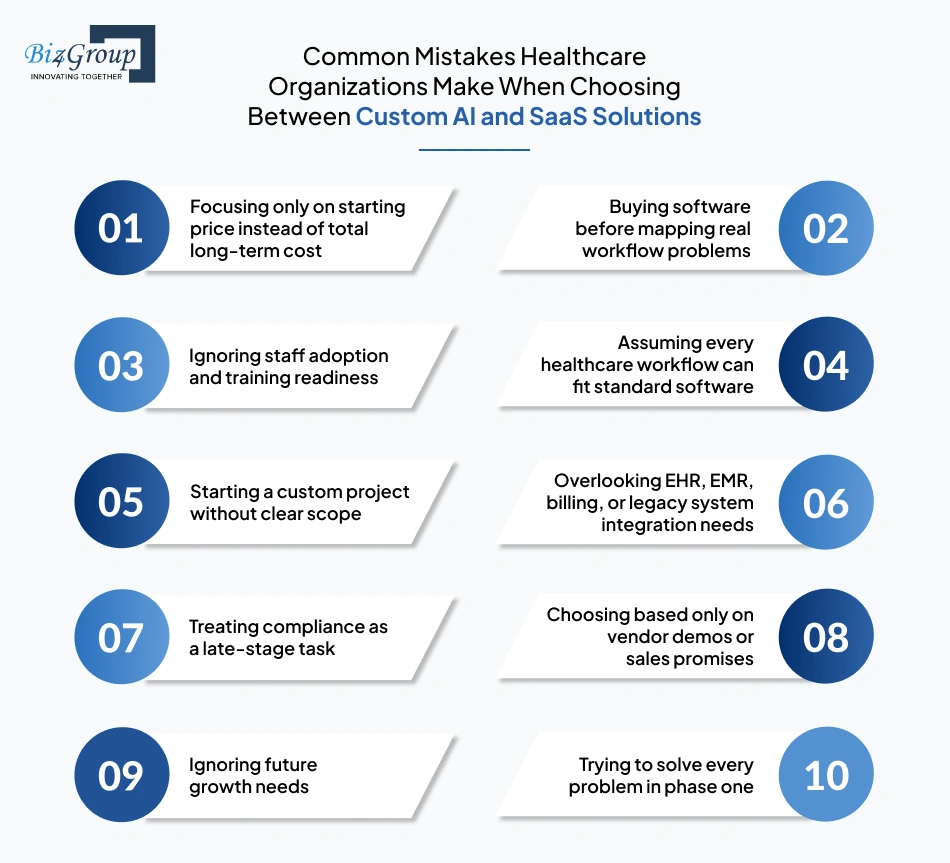
Many organizations get stuck in the debate around SaaS vs custom AI healthcare solutions which is better for hospitals and startups and make avoidable mistakes along the way. Reviewing the mistakes below can help you make a smarter and more stable decision.
|
Mistake |
How to Avoid |
|---|---|
|
Focusing only on starting price instead of total long-term cost |
Review upfront spend, recurring fees, support costs, expansion costs, and expected ROI before committing. |
|
Buying software before mapping real workflow problems |
Identify where delays, manual work, or bottlenecks exist first, then match the solution to those needs. |
|
Ignoring staff adoption and training readiness |
Include onboarding plans, role-based training, and internal champions early in the rollout. |
|
Assuming every healthcare workflow can fit standard software |
Evaluate where standard tools work well and where custom logic may be required. |
|
Starting a custom project without clear scope |
Define business goals, workflows, success metrics, and rollout phases before development begins. |
|
Overlooking EHR, EMR, billing, or legacy system integration needs |
Audit current systems early and confirm how data will move between platforms. |
|
Treating compliance as a late-stage task |
Review privacy, access controls, audit needs, and vendor responsibilities from the start. |
|
Choosing based only on vendor demos or sales promises |
Request real use cases, implementation plans, and proof of results in healthcare settings. |
|
Ignoring future growth needs |
Assess whether the solution can support more users, locations, departments, and new workflows later. |
|
Trying to solve every problem in phase one |
Start with priority use cases, measure results, then expand in stages. |
The discussion around custom AI vs SaaS in healthcare often becomes confusing because leaders focus on software promises instead of operational fit. Clear priorities, realistic planning, and operational focus usually lead to far better outcomes.
Healthcare organizations often know they need AI, but many still need a partner who can turn strategy into secure and practical execution. For businesses wondering, “we are evaluating vendors and need guidance on SaaS vs custom AI for healthcare compliance and security.” Then, Biz4Group LLC might be the answer you’re looking for. It helps navigate decision with clarity and real delivery experience.
We work as a HIPAA-compliant AI healthcare software development company focused-on solutions that align with healthcare operations, privacy standards, and long-term scalability. Our team supports organizations that need custom platforms, SaaS product execution, secure integrations, and AI roadmaps grounded in business outcomes rather than generic technology promises.
Our delivery experience is reflected through healthcare-focused implementations across wellness, patient engagement, and personalized care use cases. Have a look:
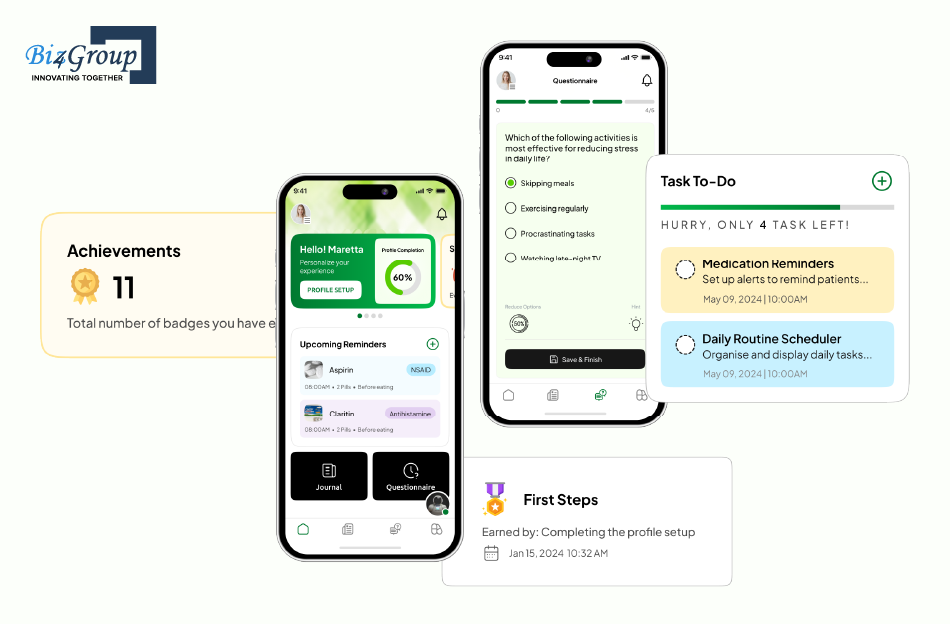
CogniHelp is an AI-powered mobile solution created to support people in the early to mid-stage of dementia with safer, more independent daily living. It combines personalized memory quizzes, journaling, medication reminders, voice-to-text entries, emotional check-ins, and cognitive progress tracking.
Caregivers also gain useful insights through monitored trends, helping them respond with more informed and timely support. Solutions like this also show how custom-built healthcare AI can address needs that standard platforms often struggle to serve precisely.
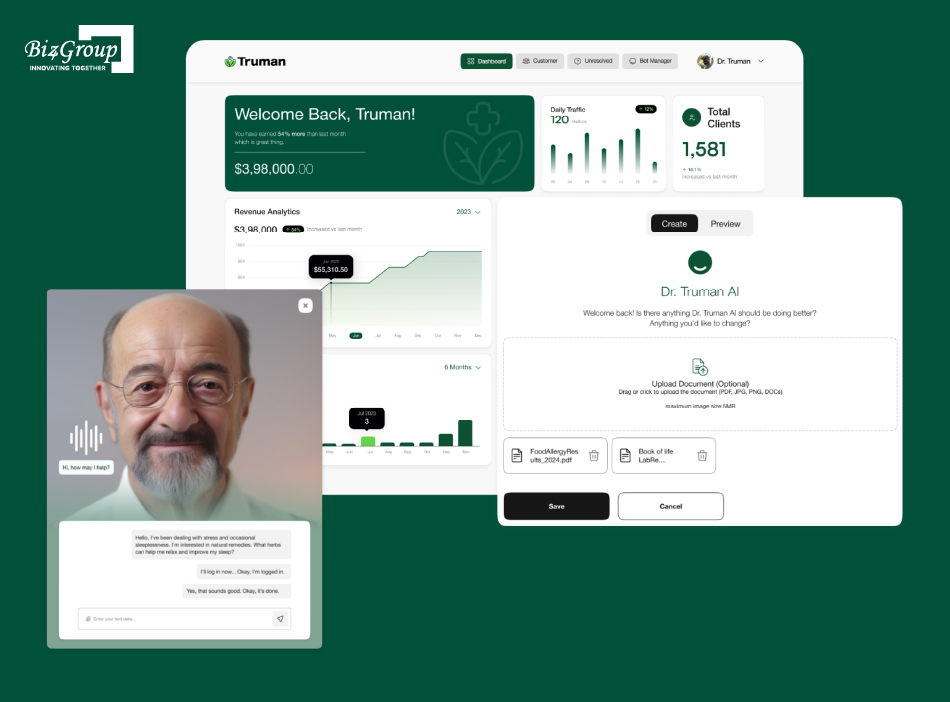
Truman is an AI-enabled wellness platform centered around a lifelike avatar that delivers personalized health guidance through natural conversations. Users can receive supplement recommendations, track health history, upload medical reports, access membership benefits, and shop within the platform.
It also extends into a web-based wellness framework with tailored herbal guidance and dosage suggestions. Solutions like this show how custom healthcare AI can combine engagement, personalization, and operational value beyond standard platforms.
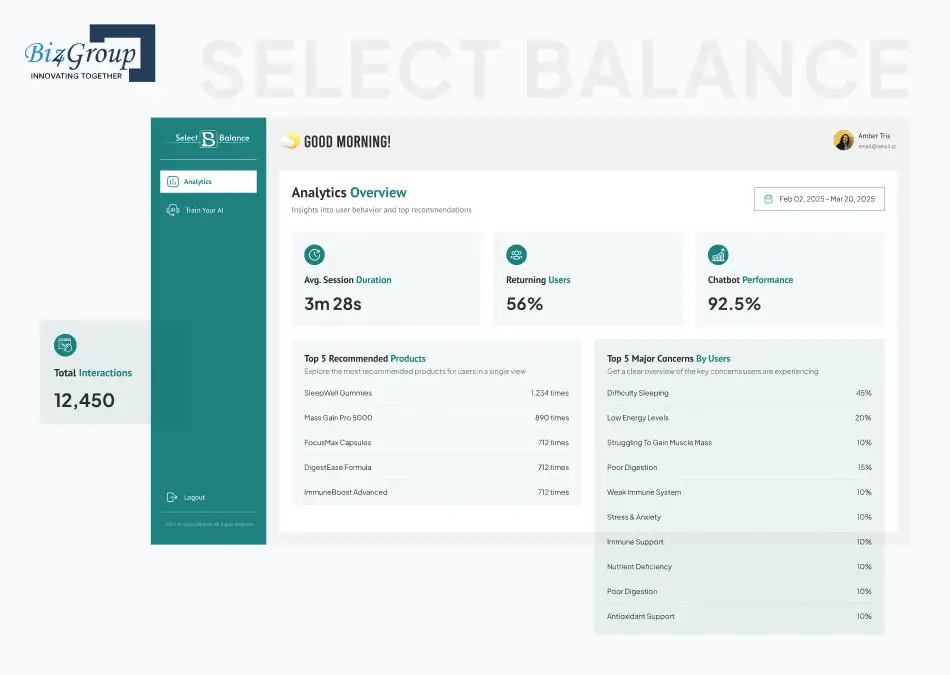
Select Balance is an AI-powered chatbot for personalized supplement recommendations that helps users find the right wellness products through a guided quiz or natural conversation. It analyzes health goals such as energy, digestion, or immunity, then delivers real-time suggestions from a live product database.
Admin controls also allow ongoing updates to recommendations and content. It reflects how specialized healthcare AI can solve focused user needs with greater precision than standard platforms.
The right AI investment needs more than development capacity. It needs a partner who understands healthcare operations, compliance expectations, and execution realities. Biz4Group LLC stands out as a practical partner for organizations ready to move from planning to measurable results. Let’s Talk.
Turn AI ideas into secure scalable healthcare results faster
Start With UsThe discussion around custom AI vs SaaS in healthcare does not end with one universal answer. Every healthcare organization operates with different priorities, budgets, internal systems, and growth plans. What feels practical for one provider may feel limiting for another. That is why the real value lies in understanding your own operating reality before moving forward with any AI development company or technology model.
Many leaders still ask should healthcare companies build custom AI or use SaaS platforms. The right direction usually depends on how your organization views speed, ownership, workflow fit, and long-term scalability rather than outside trends or broad assumptions.
Others are more focused on when to choose custom AI over SaaS in healthcare applications. That decision often becomes clearer once internal complexity, compliance expectations, and future expansion plans are properly evaluated.
For healthcare teams that need experienced guidance, Biz4Group LLC can help turn strategy into practical execution. To discuss your next step, connect with us.
SaaS healthcare platforms usually launch faster because the core system is already built and ready for configuration. Custom AI projects often take longer because workflows, integrations, security controls, and testing are tailored to the organization. Timelines depend on project scope, internal approvals, and system complexity.
Yes, many providers begin with SaaS to solve immediate operational needs and gain faster results. As workflows become more specialized or scale increases, custom AI may become a stronger long-term option. This phased path can reduce early risk while preserving future flexibility.
Data ownership depends on contract terms, hosting structure, and platform design. Custom AI environments often provide greater control over storage, access rules, and internal governance. SaaS platforms may use shared responsibility models, so healthcare leaders should review data rights carefully before signing.
Custom AI healthcare solutions commonly range from $50,000 to $400,000+ depending on complexity, integrations, and feature scope. SaaS healthcare platforms often range from $30,000 to $250,000 based on users, modules, and contract size. Total cost should always include long-term support and expansion needs.
Vendor lock-in can be more common with SaaS when pricing, upgrades, data migration, or feature access depend heavily on one provider. Custom AI often gives more ownership and roadmap control, though it also requires internal planning and support. Exit flexibility should be reviewed early in either model.
The decision usually depends on business stage, available budget, speed requirements, workflow uniqueness, and future growth plans. Startups may value faster deployment, while established providers may focus more on control and operational fit. The strongest decision is based on long-term business priorities rather than trends alone.

with Biz4Group today!
Our website require some cookies to function properly. Read our privacy policy to know more.