 Location :
Orlando, FL, USA
Location :
Orlando, FL, USA +1 (407) 714-1616
 info@biz4group.com

- Voice AI platform development for healthcare helps automate patient calls, scheduling, follow-ups, and communication workflows with better operational consistency.
- Core features include speech recognition, secure access controls, appointment handling, analytics, and live agent handoff support.
- Strong healthcare Voice AI platform development requires EHR, billing, CRM, and telephony integrations for smooth daily operations.
- Clear development planning, phased execution, and workflow testing reduce risk and improve long-term platform scalability.
- The cost to develop AI voice platform for healthcare ranges between $20,000-$150,000+ based on scope, integrations, security needs, and platform complexity.
- Smart budgeting includes controlled integrations, phased rollout planning, hidden cost awareness, and sustainable profitability goals.
- AI healthcare software development company such as Biz4Group LLC helps organizations build secure and scalable custom voice AI platforms.
How much growth can a healthcare organization handle when staff time is already stretched thin? Many hospitals and clinics are managing rising patient requests while doctors and support teams remain tied up with scheduling calls, follow-ups, documentation, and repeated queries. This creates slower responses, less patient-facing time, and added pressure across daily operations impacting patient trust, especially when 48% of patients feel discouraged when they cannot speak with a real person.
The immediate need is not more manual effort. It is a smarter communication layer that can respond quickly, capture information accurately, and support teams during busy hours. That is where voice AI is creating real value by answering routine patient questions, assist with bookings, and route urgent requests.
For healthcare leaders, this usually means solving connected challenges such as:
- High appointment call volumes during peak hours
- Delayed follow-ups and unanswered patient queries
- Time lost in manual notes and reporting tasks
- Staff moving across systems for basic information
- Limited hands-free support during consultations
Once these gaps become clear, the next logical step is structured voice AI platform development for healthcare. The focus should be on building a secure and scalable platform that fits existing workflows, connects with healthcare systems, and improves service quality over time.
With that in picture now many businesses start wondering, “we are planning to build a Voice AI platform for healthcare but need guidance on where to start and what features are required.” Well, the right path starts with use cases, integrations, privacy planning, and rollout priorities. Industry demand also reflects this shift, with the AI voice generator market projected to grow from $2.97 billion in 2026 to $5.65 billion in 2030.
Up next, we will break down how to build a scalable voice AI platform solution for hospitals and clinics in a practical and decision-focused way and see how an experienced AI product development company supports the process.
Understanding the Basics Before You Develop Voice AI Platform for Healthcare
Before we dive deeper, let us first build a clear foundation around voice AI platforms in healthcare, so the next decisions make practical sense.
What Is a Voice AI Platform for Healthcare?
A Voice AI platform is a software system that allows patients, staff, and care teams to interact through natural voice conversations while the platform handles actions in the background. Instead of depending only on manual calls or basic phone menus, it can understand spoken requests, respond clearly, and guide users to the next step.
In a healthcare setting, this may include booking appointments, answering routine questions, sending reminders, collecting intake details, routing urgent calls, or helping staff retrieve information quickly. The goal is to reduce communication friction while keeping service responsive. A modern platform often combines voice workflows, automation rules, reporting tools, and secure integrations with hospital systems.
How Does AI Voice Platform for Healthcare Work?
To understand the real value of a voice platform, let’s see how each layer works together behind a patient or staff conversation:
- AI Voice Input Layer: The process starts when a patient or staff member speaks through a phone call, mobile app, kiosk, or smart device. The platform captures the request in real time, whether it is about booking an appointment, checking timings, or asking for support.
- AI Speech Recognition Engine: The spoken request is converted into text using AI speech recognition. This allows the system to understand words clearly during live conversations, even when speech patterns vary.
- AI Intent Detection Layer: After converting speech to text, the platform identifies what the user wants. It can detect common intents such as appointment booking, prescription refill requests, billing help, or urgent care routing.
- Conversation Logic AI Engine: Once intent is identified, the platform decides the next step. It may ask follow-up questions, confirm patient details, present available slots, or transfer the request to a staff member.
- Healthcare System Integration Layer: The platform connects with scheduling tools, EHR systems, billing software, and internal databases. A healthcare speech recognition AI system becomes more useful when it can take action instead of only answering questions.
- AI Voice Response Layer: The selected response is spoken back naturally to the user. This may include confirmations, reminders, instructions, or next-step guidance.
- Security and Access Control Layer: Patient conversations, identity checks, and data movement are protected through secure access rules, encryption, and activity logs.
- Analytics and Improvement Layer: Every interaction creates useful data such as missed intents, common requests, wait times, and completion rates. This helps improve future performance.
When these layers are built correctly, voice AI platform development for healthcare creates a reliable system that handles communication efficiently while fitting daily clinical operations.
How AI Adds Value to the Voice Platform for Healthcare
- Patient conversations become easier to manage when the platform can understand natural speech, different accents, and unclear requests with stronger accuracy.
- Routine tasks such as appointment booking, rescheduling, reminders, and common support queries can be handled faster with less staff dependency.
- Smarter conversation flows allow the system to ask follow-up questions, capture missing details, and guide patients to the right next step.
- Incoming calls can be prioritized based on urgency, then routed to the correct department, care team, or support desk.
- Administrative pressure reduces when repetitive communication tasks move away from front-desk and coordination teams.
- Service availability improves because patients can receive assistance and complete basic requests outside standard working hours.
- Ongoing interactions generate useful data that helps improve response quality, reduce missed intents, and strengthen workflows over time.
- More personalized experiences become possible when approved patient preferences and previous interactions inform future conversations.
Understanding these fundamentals helps healthcare leaders evaluate the opportunity with more clarity and fewer assumptions. A voice platform delivers the most value when its purpose, workflow fit, and AI capabilities are clearly defined before implementation begins.
That is why successful AI voice platform development for healthcare starts with operational goals, patient needs, and long-term scalability in mind. With the basics now clear, the next question is why healthcare businesses should invest in this shift early.
Know The Gaps Before You Build
Turn early clarity into smarter platform decisions with expert guidance today
Talk With Our AI ExpertWhy Should Healthcare Businesses Invest in Voice AI Platform Development in 2026
Rising patient demand often exposes hidden operational costs that many providers carry for years. If the current concern is, we are struggling with high administrative workload in hospitals, how can voice AI platform help solve this problem? The real opportunity is not just automation, rather it is stronger margins, better capacity use, and measurable service efficiency.
Have a look:
1. Lower Administrative Cost Per Interaction
Routine calls, confirmations, reminders, and status requests consume paid staff hours every day. When those requests move to automated voice workflows, teams can focus on higher-value tasks. Healthcare providers using Voice AI report up to 70% reduction in administrative tasks. It helps in:
- Fewer repetitive front-desk calls
- Better use of clinical support staff time
- Lower overtime pressure
- Reduced hiring urgency during peak demand
2. Recover Revenue Lost Through Scheduling Friction
Delayed booking flows often lead to missed appointments and lost revenue opportunities. A U.S. patient survey found 41% of patients are frustrated by difficulty scheduling appointments. Faster booking journeys supported by an AI voice assistant for medical appointment scheduling can improve conversion rates by
- Faster appointment confirmations
- Lower booking abandonment
- Better calendar utilization
- More completed visits per month
3. Increase Capacity Without Matching Headcount Growth
Growth usually increases communication volume before revenue fully catches up. Some providers are now developing voice AI platform solutions for hospitals and clinics to scale service operations without proportional staffing expansion. AI voice platform can handle the workload of 100+ full-time employees while processing requests 4x faster and
- Support expansion across locations
- Reduce pressure on support teams
- Handle surges more efficiently
- Improve service continuity
4. Reduce Wait Times That Hurt Retention
Slow responses often damage patient trust and repeat engagement. A healthcare implementation report found voice AI reduced patient wait times by up to 97% through automated front-desk and communication workflows enabling:
- Faster first response times
- Better patient satisfaction
- Stronger retention potential
- Less queue congestion
5. Build Long-Term Operational Efficiency
Short-term fixes often create more fragmented processes later. Well-planned voice systems align communication, scheduling, reporting, and service workflows under one model, making them valuable enterprise AI solutions for growing healthcare organizations, allowing:
- Cleaner operations at scale
- Better visibility into demand patterns
- Stronger resource planning
- Lower cost-to-serve over time
Healthcare leaders investing now are usually targeting measurable returns, not trend adoption. The strongest gains come when voice AI platform development for healthcare is planned around staffing efficiency, patient access, and sustainable operating performance.
Top Use Cases for Developing Voice AI Platform Solutions for Hospitals and Clinics
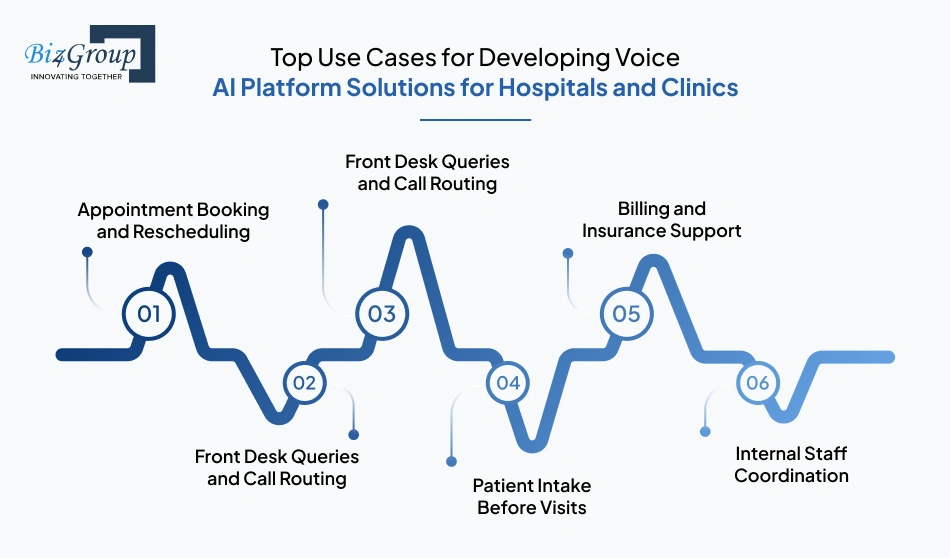
Many healthcare leaders reach a similar point of pressure and ask, we want to develop a voice AI platform for our hospital to reduce staff workload and improve patient communication. That usually means the next step is understanding where voice systems create practical value first. Clear use cases help shape smarter investment decisions.
1. Appointment Booking and Rescheduling
- Patients can book visits through natural voice conversations anytime.
- The platform can confirm doctor availability in real time.
- Rescheduling requests can be completed without staff intervention.
- A conversation AI agent can reduce booking delays during peak hours.
- Patients receive spoken confirmations and reminder details instantly.
2. Front Desk Queries and Call Routing
- Patients can ask for OPD timings and department availability.
- Callers can request directions to clinics or diagnostic centers.
- The platform can route urgent callers to the right desk.
- Overflow calls can be managed during high-volume hours.
- AI automation services manage common front-desk queries without manual routing.
3. Prescription Refill and Follow-Up Requests
- Patients can request refill support through guided voice prompts.
- Follow-up visit requests can be captured after treatment cycles.
- Recovery check-in calls can ask simple health status questions.
- Missed callback requests can be logged for staff action.
- Routine communication stays organized across departments.
4. Patient Intake Before Visits
- Patients can share symptoms before reaching the facility.
- Insurance basics and contact details can be collected early.
- Visit reasons can be captured before consultation begins.
- A conversational AI agent can guide users step by step.
- Staff receive pre-visit details before patient arrival.
5. Billing and Insurance Support
- Patients can hear payment balance and invoice details.
- Claim status requests can be handled through voice menus.
- Coverage questions can be routed to billing teams.
- AI medical claim processing workflows can connect status checks faster.
- Payment reminder calls can be scheduled automatically.
Portfolio Spotlight: AI IVR For Healthcare
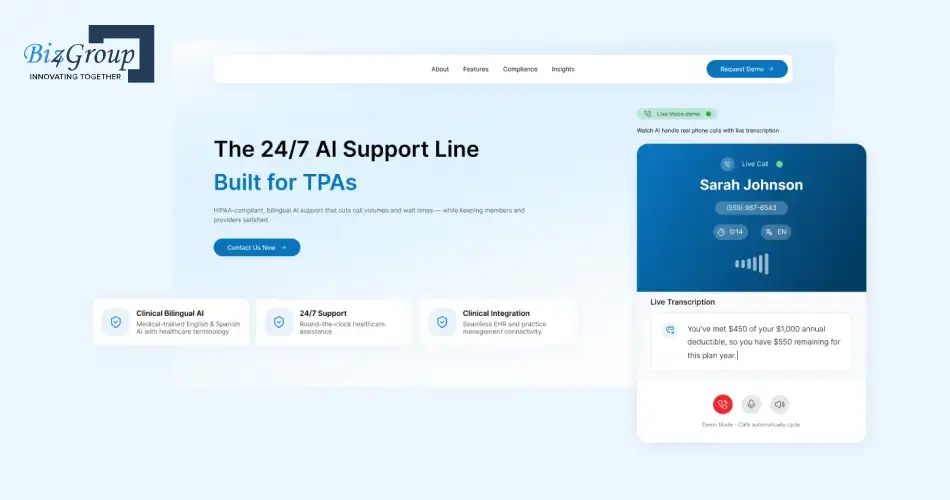
A HIPAA-compliant healthcare AI IVR platform that automates eligibility checks, claim status requests providing multilingual voice support. It helps service teams handle high call volumes with faster responses.
Core Features:
- Instant eligibility verification through automated voice calls
- Real-time claim status and payment information access
- Benefits guidance for members without agent dependency
- Provider support for documentation and claim inquiries
- Multilingual voice interactions with natural call experiences
6. Internal Staff Coordination
- Nurses can request room readiness updates through voice prompts.
- Reception teams can check doctor schedule changes quickly.
- Staff can route housekeeping or transport requests faster.
- Conversational AI for healthcare can support internal service desks.
- Shift teams can access routine updates while moving.
The best implementations usually begin with one high-friction workflow, then expand carefully across departments. Once priorities are clear, voice AI platform development for healthcare becomes easier to scope, launch, and scale with confidence.
Ready To Prioritize High-Value Use Cases
Identify the workflows worth automating first and avoid costly wrong starts
Plan My Use CasesWhat Healthcare Integrations Required for Voice AI Platform Development?
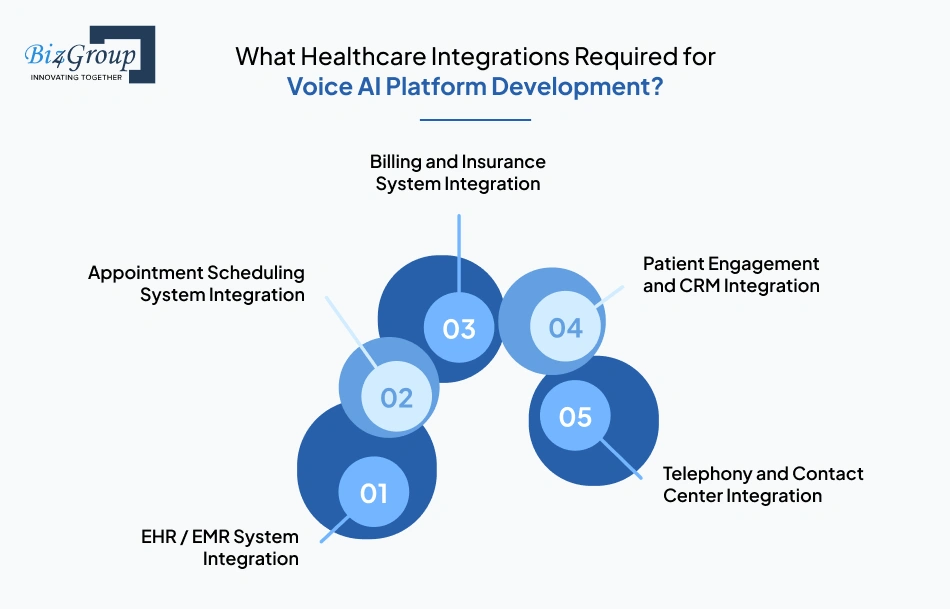
Voice platforms perform best when they connect with the systems your teams already use daily. If the current focus is developing a voice AI platform for healthcare workflow automation, AI integration planning should happen early, because disconnected tools often create delays, repeated work, and incomplete patient interactions.
1. EHR / EMR System Integration
Electronic health record systems store patient history, visit notes, medications, allergies, and appointment records. A voice AI platform should connect securely with this data so approved information can be accessed or updated during interactions. Many providers prioritize AI integrated with EHR/EMR systems for reliable workflow continuity.
Why This Integration Is Important:
- Keeps patient records aligned across connected systems
- Reduces repeated manual data entry work
- Supports accurate patient identification workflows
- Improves access to current visit information
Also Read: A Complete Guide to AI EMR/EHR Software Development
2. Appointment Scheduling System Integration
Scheduling systems manage provider calendars, available slots, cancellations, and rescheduling requests. A direct connection helps the voice AI platform book or modify appointments using live availability instead of outdated data.
Why This Integration Is Important:
- Prevents double bookings and slot conflicts
- Keeps calendars updated across departments
- Supports faster booking confirmations
- Improves rescheduling accuracy during calls
3. Billing and Insurance System Integration
Medical billing platforms manage balances, invoices, claims, coverage records, and payment details. When connected properly, the voice AI platform can handle approved account requests and status checks with greater consistency.
Why This Integration Is Important:
- Speeds up balance and payment inquiries
- Supports smoother claim status requests
- Reduces repetitive billing call handling
- Keeps financial records synchronized
Also Read: Develop an AI Medical Coding Automation System for Healthcare
4. Patient Engagement and CRM Integration
Many healthcare providers use a healthcare CRM to manage reminders, follow-ups, communication history, and service requests. Connecting the voice AI platform with CRM records helps maintain continuity across patient interactions.
Why This Integration Is Important:
- Keeps communication history in one place
- Supports organized follow-up workflows
- Improves visibility into open service requests
- Helps teams manage patient outreach better
Also Read: Artificial Intelligence in CRM
5. Telephony and Contact Center Integration
Voice AI platforms should connect with phone systems, call routing tools, and support desks already used by hospitals or clinics. This allows smoother transfers, queue management, and call continuity without disruption.
Why This Integration Is Important
- Improves routing accuracy between departments
- Reduces dropped or missed transfers
- Supports queue visibility during peak hours
- Keeps support operations more organized
Strong outcomes depend on how well every system works together behind the scenes. Smart voice AI platform development for healthcare begins with the right integrations, then scales communication, access, and workflow reliability with confidence.
Core Features for Building Custom Voice AI Platform for Healthcare Organizations
Feature planning often decides whether a platform performs well after launch or creates friction later. When you plan to develop voice AI platform for healthcare, focus on capabilities that support patient communication, secure access, and reliable day-to-day healthcare workflows.
|
Core Feature |
What This Feature Does |
|---|---|
|
Natural Voice Conversations |
Understands patient requests spoken in everyday language and responds through guided voice interactions during live calls. |
|
Speech-to-Text Processing |
Converts spoken conversations into text so requests can be processed, logged, or shared with internal systems. |
|
Text-to-Speech Replies |
Delivers clear spoken confirmations, reminders, instructions, and status updates during automated conversations. |
|
Real-Time Appointment Management |
Books, reschedules, or cancels appointments using live provider calendars and current slot availability. |
|
Patient Identity Verification |
Confirms caller identity using approved details before sharing records, balances, or sensitive account information. |
|
Human Handoff Escalation |
Transfers urgent, complex, or sensitive conversations to live staff with relevant call context attached. |
|
Real-Time Patient Record Access |
Pulls approved patient details from EHR’s integrated with healthcare platforms during active support interactions. |
|
AI Patient Portal Sync |
Connects voice requests with an AI patient portal so updates remain consistent across channels. |
|
Consent and Privacy Controls |
Captures permissions and applies access rules before storing, using, or sharing patient information. |
|
Sentiment Analysis Alerts |
Detects frustration, confusion, or urgency in conversations and flags priority handling when needed. |
|
Role-Based Admin Dashboard |
Lets authorized teams manage users, permissions, reports, workflows, and platform settings securely. |
The strongest platforms are shaped by practical features, not unnecessary complexity. Voice AI platform development for healthcare begins with essential capabilities first, then expands as workflows, departments, and patient demand continue growing.
Also Read: Top 10 AI Patient Portal Development Companies in USA
Features Decide Future Performance Early
Build only what creates value and skip features that slow adoption
Define My FeaturesHow to Build Scalable Voice AI Platform Solution for Hospitals and Clinics In 7 Steps?
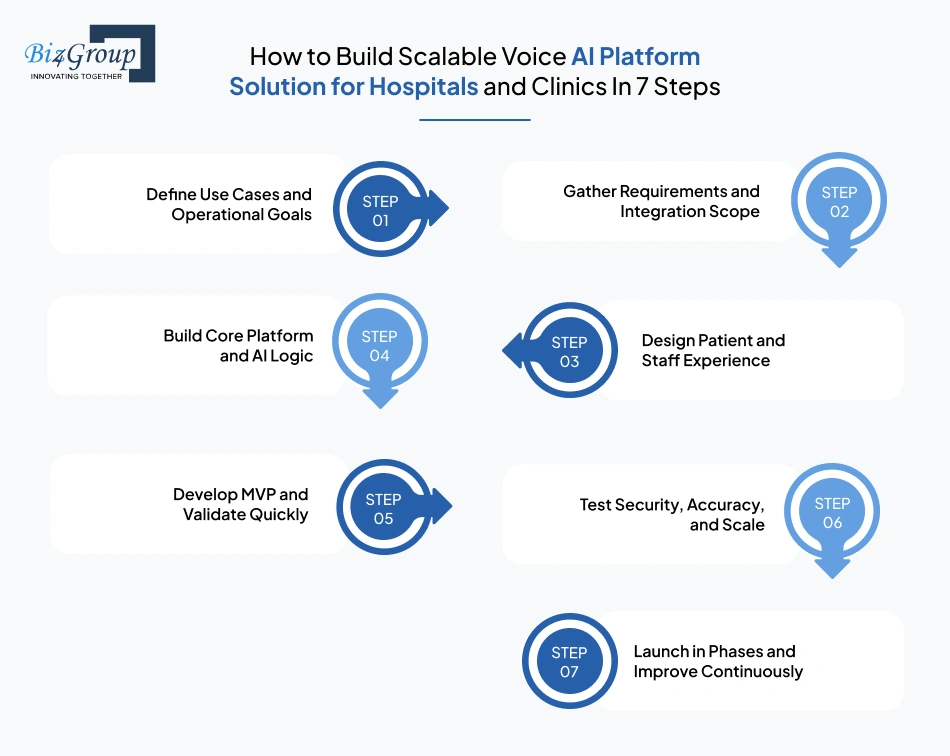
Strong healthcare products usually come from clear execution, not rushed development. When building a custom voice AI platform for healthcare organizations, the safest path is a phased process that validates workflows early, controls risk and prepares the platform for scale.
Step 1: Define Use Cases and Operational Goals
Start by identifying where voice workflows will be used first. Focus on real operational gaps instead of broad feature lists.
- Map high-volume patient communication tasks
- Identify staff pain points and delays
- Define measurable launch goals
- Prioritize first-phase workflows carefully
Step 2: Gather Requirements and Integration Scope
Turn internal needs into a working product plan. List systems, data access needs, and workflow dependencies before design starts.
- Document scheduling and record system needs
- Define user roles and access levels
- Confirm compliance expectations early
- Create a phased delivery roadmap
Step 3: Design Patient and Staff Experience
Simple experiences improve adoption and reduce confusion after launch. Many teams work with a UI/UX design company to streamline journeys.
- Design call flows for common requests
- Plan clear prompts and response paths
- Reduce unnecessary conversation steps
- Support smooth patient journey automation
Also Read: Top UI/UX Design Companies in USA
Step 4: Build Core Platform and AI Logic
This stage turns approved plans into a working product. Focus first on essential functions that solve real healthcare needs.
- Build AI voice conversation workflows
- Add identity verification controls
- Connect scheduling and support systems
- Create admin controls and reporting tools
Step 5: Develop MVP and Validate Quickly
An early version helps test real demand before full rollout enabling a smooth patient journey experience. Many organizations use MVP development services to shorten learning cycles.
- Launch limited workflows to pilot users
- Track usage and completion rates
- Collect staff and patient feedback
- Refine priorities using real behavior
Also Read: Top MVP Development Companies in USA
Step 6: Test Security, Accuracy, and Scale
Before expansion, validate performance under real conditions. Testing should cover reliability, privacy, and high-volume readiness.
- Run voice accuracy checks regularly
- Test heavy call traffic scenarios
- Verify secure data handling flows
- Review handoff performance to staff
Also Read: Top 15+ Software Testing Companies in USA
Step 7: Launch in Phases and Improve Continuously
Controlled rollout reduces disruption and improves adoption. Expand by department, workflow, or facility after proven results.
- Start with one location or team
- Review weekly operational metrics
- Add new workflows gradually
- Use insights for future releases
Scalable healthcare platforms are built through disciplined phases, not oversized first launches. Following this roadmap to create voice AI platform for hospitals can help with stronger adoption, lower risk, and clearer long-term growth potential.
Recommended Tech Stack to Develop Voice AI Platform for Healthcare
Technology decisions often shape long-term platform performance more than visual design. Strong planning across full stack development also reduces costly rebuilds later. During voice AI platform development for healthcare, the best results come from clear architecture choices that support security, integrations, and stable growth.
Here’s the recommended tech stack required to build voice AI platform for healthcare:
|
Architecture Layer |
Recommended Technology / Tool |
Purpose |
|---|---|---|
|
Frontend Web Dashboard |
Builds admin panels, reports, user controls, and workflow management screens. |
|
|
Mobile Access Layer |
Flutter, React Native |
Supports staff mobile access for alerts, approvals, and live monitoring. |
|
Backend Application Layer |
Runs APIs, business logic, automation rules, and core platform workflows. |
|
|
Telephony Layer |
Twilio, Vonage, Plivo |
Manages inbound calls, outbound calls, queues, and call routing. |
|
Speech-to-Text Layer |
Google Speech-to-Text, Azure Speech |
Converts spoken conversations into text for request processing. |
|
Text-to-Speech Layer |
Amazon Polly, Azure Neural Voice |
Delivers natural voice replies, reminders, and guided responses. |
|
AI Conversation Layer |
OpenAI, Dialogflow, Rasa |
Understands caller intent and manages conversation flows. |
|
Database Layer |
PostgreSQL, MySQL |
Stores users, settings, logs, and structured operational data. |
|
Healthcare Integration Layer |
FHIR APIs, HL7, Epic APIs |
API development Connects records, scheduling tools, billing systems, and AI EHR MVP workflows. |
|
Security and Identity Layer |
OAuth 2.0, Okta, Azure AD |
Manages secure login, user roles, and controlled access permissions. |
|
Monitoring and Cloud Layer |
AWS, Azure, Docker, Kubernetes, Datadog |
Supports hosting, scaling, deployments, uptime tracking, and system monitoring. |
The right stack should fit call volume, compliance goals, and future expansion plans from the start. A strong technical foundation helps teams build voice AI healthcare solutions that remains secure, scalable, and easier to improve over time.
Also Read: Why to Choose the Full Stack Development for Modern Business
Your Stack Should Scale Smoothly
Choose architecture that supports growth security and future integrations confidently
Review My Tech StackSecurity And Compliance Standards for Healthcare Voice AI Platform Development
Patient trust can be lost much faster than it is earned. During voice AI platform development for healthcare, security and compliance planning should begin early, because voice conversations often involve identity details, health information, and sensitive service requests that need strong protection.
1. HIPAA Compliance Readiness
Healthcare voice platforms handling protected health information must align with HIPAA requirements. This includes privacy safeguards, controlled access, secure storage, and clear data handling policies. A well-planned HIPPA compliance system should also define how voice data is collected, processed, retained, and deleted.
Also Read: HIPAA Compliant AI App Development for Healthcare
2. End-to-End Data Encryption
Voice recordings, transcripts, account details, and connected records should remain protected during transfer and storage. Strong encryption helps reduce exposure risks when data moves between telephony tools, internal systems, and cloud environments. This should apply to both active conversations and stored records.
3. Identity Verification and Access Control
Not every caller or employee should access the same information. Platforms need identity checks before sharing balances, records, appointments, or claim details. Internal teams should also receive role-based permissions, so they only access what their job requires.
4. Consent Management and Recording Policies
Some healthcare workflows may require patient consent before recording calls or using voice data. The voice AI platform for healthcare should capture permissions clearly and store proof when required. Clear recording notices and privacy choices help support compliance expectations.
5. Audit Logs and Activity Tracking
Every sensitive action should be traceable. Secure logs help track logins, record access, workflow changes, data exports, and escalations. This creates accountability and supports faster internal reviews when issues occur.
6. Secure Third-Party Integrations
Voice AI platforms often connect with scheduling, billing, EHR, and support systems. Each connection should use secure authentication methods and controlled data exchange. Weak external integrations can create avoidable risk even when the main platform is secure.
7. Ongoing Security Testing and Monitoring
Security is not a one-time checklist. Regular testing helps detect access gaps, failed workflows, unusual activity, and outdated controls before they become larger problems. Continuous monitoring is essential for live healthcare environments.
Strong protection standards support growth, trust, and smoother operations over time. Reliable healthcare voice AI platform development depends on security controls that protect patient data while keeping workflows practical and scalable.
How Much Does It Cost to Develop Voice AI Platform Development for Healthcare?
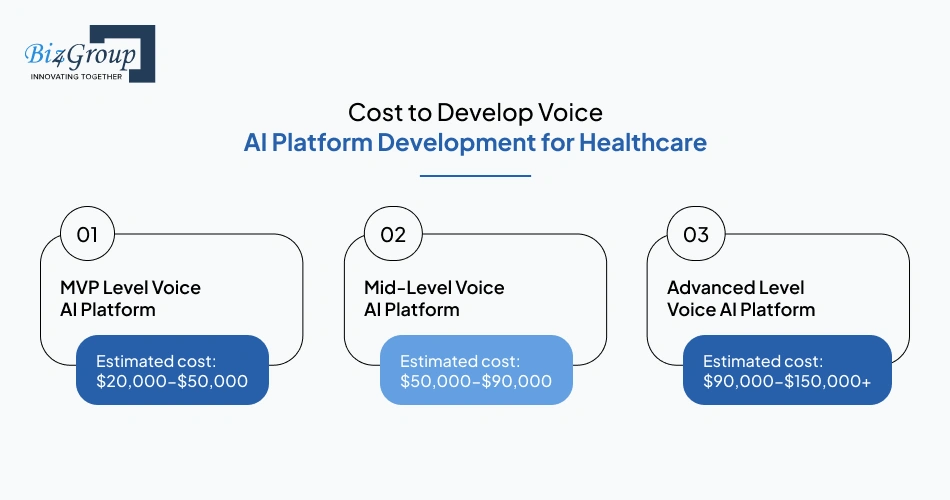
Budget discussions become easier when the cost picture is clear early. A planned roadmap helps avoid scope confusion, delayed decisions, and unrealistic expectations later. Most healthcare voice AI platforms fall between $20,000-$150,000+ depending on integrations, workflow depth, security needs, and rollout scale.
Some organizations begin with a focused MVP and expand in phases. Others move directly toward enterprise deployment with multi-location requirements and deeper automation.
|
Development Level |
Description |
Estimated Cost Range |
|---|---|---|
|
MVP Level Voice AI Platform |
Core voice workflows, simple dashboards, limited integrations, pilot-ready release, basic analytics. |
$20,000-$50,000 |
|
Mid-Level Voice AI Platform |
Multi-workflow platform, stronger admin controls, scheduling sync, billing support, better reporting. |
$50,000-$90,000 |
|
Advanced Level Voice AI Platform |
Enterprise rollout, complex integrations, advanced security, custom workflows, and high-volume infrastructure. |
$90,000-$150,000+ |
This gives you a realistic baseline. The next step is understanding what actually drives these numbers during development.
Primary Cost Drivers When You Build Voice AI Platform for Healthcare
Project budgets usually rise or fall based on a few core components. These areas shape engineering effort, delivery timelines, and long-term platform readiness.
|
Cost Driver |
Why It Matters |
Estimated Cost Impact |
|---|---|---|
|
Voice Workflow Development |
Covers booking flows, billing requests, support routing, reminders, and custom call journeys. |
Adds $5,000-$25,000 |
|
Connects speech recognition, voice response engines, and automation logic. |
Adds $5,000-$30,000 |
|
|
Healthcare System Integrations |
Connects EHR, scheduling, billing, and internal support systems. |
Adds $8,000-$35,000 |
|
Security and Compliance Setup |
Includes encryption, access controls, logs, privacy rules, and audit readiness. |
Adds $5,000-$20,000 |
|
Admin Dashboard and Reporting |
Gives teams workflow control, user management, and operational visibility. |
Adds $4,000-$15,000 |
|
QA and Performance Testing |
Validates uptime, call quality, traffic handling, and issue prevention. |
Adds $3,000-$12,000 |
This explains why two healthcare platforms with similar goals can still have different final budgets.
Hidden Costs You Should Plan for When You Develop a Scalable Voice AI Platform for Healthcare
Visible development costs are only part of the investment. Many teams underestimate post-launch expenses that affect long-term sustainability.
1. Cloud Hosting and Usage Growth
Voice platforms rely on storage, call processing, and live workloads. As usage rises, monthly infrastructure costs usually increase.
- Typical impact: $500-$5,000 monthly
- Higher traffic increases compute and storage needs
- Multi-location usage raises operating spend
2. Ongoing AI Improvement
Speech accuracy, routing logic, and workflows often need refinement after launch. Continuous improvement keeps service quality strong.
- Typical impact: $2,000-$15,000 periodically
- New workflows need tuning and testing
- Language expansion increases update effort
3. Future Integrations
Many healthcare organizations add more systems after phase one. New connections often create extra budget needs later.
- Typical impact: $3,000-$20,000+
- New departments may need custom workflows
- Legacy systems can increase integration effort
4. Compliance Reviews and Policy Updates
Healthcare regulations, vendor reviews, and internal governance needs can create recurring costs over time.
- Typical impact: $2,000-$10,000 annually
- Security reviews may be scheduled yearly
- Documentation updates require internal effort
5. Training and Change Management
Staff adoption is often overlooked during budgeting. Teams need onboarding, workflow training, and rollout support.
- Typical impact: $1,000-$8,000
- Multi-site rollouts increase training needs
- New workflows may require refresher sessions
Development Cost Optimization Techniques
A disciplined budget plan can reduce waste without lowering product quality. The methods below are commonly used to control spend during healthcare voice platform projects.
|
Optimization Method |
How It Helps |
Saving Potential |
|---|---|---|
|
Build an MVP First |
Launches only core workflows before wider expansion. |
Saves $10,000-$30,000 in phase one |
|
Use Prebuilt Voice Models |
Reduces early custom model training and setup costs. |
Cuts initial AI spend by 20%-40% |
|
Prioritize High-Value Integrations First |
Delays nonessential system connections until later phases. |
Saves $5,000-$20,000 early |
|
Use Modular Architecture |
Makes future updates easier without full rebuilds. |
Reduces future engineering cost by 15%-30% |
|
Reuse UI Components |
Speeds dashboard and admin panel development cycles. |
Saves 5%-15% of frontend cost |
|
Use Scalable Cloud Plans |
Pay for actual usage during early growth stages. |
Saves 10%-25% in lower traffic periods |
|
Automate QA Testing |
Reduces manual testing effort and release delays. |
Cuts QA cost by 15%-30% long term |
Clear budgeting creates better timelines and stronger rollout decisions. Successful voice AI platform development for healthcare starts with realistic scope, phased investment, and enough flexibility to support future integrations, growing patient demand, and long-term operational scale.
Want Clear Numbers Not Guesses
Get realistic cost ranges based on scope workflows and rollout plans
Estimate My BudgetChallenges And Risks in AI Voice Generator Platform Development for Healthcare
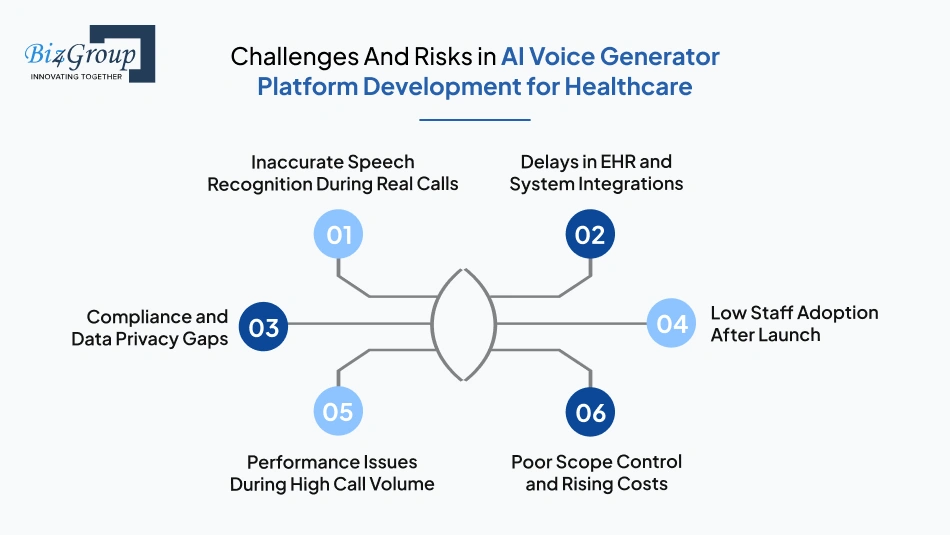
Healthcare platforms usually face more pressure than standard software products because they handle sensitive data, live patient communication, and operational continuity. During voice AI platform development for healthcare, understanding risks early helps you avoid delays, rework, and poor adoption after launch.
1. Inaccurate Speech Recognition During Real Calls
Different accents, background noise, and unclear speech can reduce response accuracy. This creates frustration and incomplete workflows during patient interactions.
Solutions:
- Train AI models using healthcare call examples
- Add noise filtering before request processing
- Use fallback prompts when confidence is low
2. Delays in EHR and System Integrations
Many projects slow down when legacy systems, scheduling tools, or records platforms are harder to connect than expected.
Solutions:
- Audit systems before development begins
- Prioritize critical integrations first
- Work with healthcare AI developers who understand healthcare workflows
3. Compliance and Data Privacy Gaps
Voice AI platforms may process protected patient details, recordings, and account information. Weak controls can create serious legal and trust risks.
Solutions:
- Define privacy rules before launch
- Use encryption and role-based access
- Involve an experienced AI development company early
4. Low Staff Adoption After Launch
Even strong platforms can fail if teams find workflows confusing or disruptive to daily routines.
Solutions:
- Keep interfaces simple and task-focused
- Train teams before rollout phases
- Collect staff feedback after launch
5. Performance Issues During High Call Volume
Growing call traffic can create delays, failed responses, or dropped conversations if infrastructure is not prepared.
Solutions:
- Use scalable cloud infrastructure
- Run load testing before expansion
- Monitor peak-hour traffic regularly
6. Poor Scope Control and Rising Costs
Projects often become expensive when new requests are added without priorities or phased planning.
Solutions
- Launch with a clear MVP scope
- Approve changes through roadmap reviews
- Hire experienced AI developers for phased execution
Also Read: Cost to Hire an AI Software Developer in 2026
Challenges are easier to manage when they are identified before development begins. With the right roadmap, team, and governance model, organizations can develop Voice AI platform for healthcare industry with stronger stability, safer compliance, and better long-term adoption.
Why Businesses in the USA Trust Biz4Group LLC to Develop a Scalable Voice AI Platform for Healthcare?
Many healthcare leaders reach the same decision stage once internal planning begins. They start asking practical questions such as:
- I need a company that can develop a custom voice AI platform for my hospital,
- I want to find a reliable company to build a voice AI healthcare platform, or
- we are comparing companies that develop voice AI platform for healthcare, which one is the best.
If those questions sound familiar, Biz4Group LLC is the answer you’re looking for
Biz4Group is US based AI healthcare software development company with proven experience delivering custom digital products that combine product strategy, engineering quality, and long-term scalability. The team has worked across healthcare systems, AI products, voice technologies, automation platforms, and enterprise-grade software where performance and reliability matter from day one.
What often separates successful healthcare platforms from stalled projects is execution discipline. Biz4Group LLC works as an extension of your internal team, aligning every milestone with business goals, user needs, and compliance expectations. From early discovery through launch readiness, decisions stay focused on measurable outcomes.
Why Healthcare Businesses Choose Biz4Group LLC
- Strong AI portfolio of custom AI and voice-led platforms
- Real product thinking beyond surface-level development
- Experience building scalable AI voice agents for live workflows
- Clear communication with accountable delivery teams
- Reliable backend architecture built for growth
- Practical AI consulting services for roadmap clarity
- Long-term support after launch and rollout phases
Healthcare organizations often need more than coders. They need a partner who can translate operational pain points into working software that teams actually adopt. That is where we continue to earn trust across the USA.
If your goal is a secure, scalable, and market-ready healthcare voice platform, Biz4Group LLC is ready to help turn that vision into a working product. So, Let’s talk.
Wrapping Up
Healthcare organizations are not evaluating voice AI platforms as experimental tools. They are investing in AI systems that can improve responsiveness, reduce operational strain, and support better patient experiences at scale. That shift is why demand for healthcare Voice AI platform development services continues to rise across hospitals, clinics, and care networks.
The real difference often comes from execution quality. Reliable voice AI platform development for healthcare depends on secure architecture, thoughtful workflows, and dependable AI integration services that fit existing healthcare systems without creating disruption later.
If your team is assessing the next move and wants a practical development partner, Biz4Group LLC is ready to help shape the right solution for your goals. Get in touch to discuss your custom healthcare voice platform roadmap.
FAQ’s
1. How can voice AI platform development for healthcare help reduce front-desk workload in hospitals?
A custom voice platform can handle repetitive calls such as appointment requests, follow-ups, basic inquiries, and routing. This allows front-desk teams to focus on urgent patient needs, in-person support, and higher-value administrative tasks.
2. What is the typical timeline to build voice AI healthcare solution for hospitals or clinics?
Most projects take 2-4 weeks for an MVP, 4-7 weeks for a mid-level platform, and 7-12 weeks for enterprise-grade deployments with multiple integrations, compliance layers, and custom workflows.
3. How much does Healthcare Voice AI platform development usually cost?
Costs usually start around $20,000-$50,000 for MVP builds, $50,000-$90,000 for mid-level solutions, and $90,000-$150,000+ for advanced enterprise platforms with deeper integrations and scalability needs.
4. Can startups develop voice AI platform for healthcare without enterprise-level budgets?
Yes. Many healthtech startups begin with a focused MVP covering one workflow such as appointment automation or patient support. This lowers initial cost while validating adoption before expanding features.
5. What should healthcare CTOs evaluate before selecting companies that develop Voice AI platform for healthcare industry?
Key areas include healthcare domain experience, security readiness, integration capability, voice workflow expertise, scalability planning, post-launch support, and a clear product delivery process.
6. How do clinics know if building custom Voice AI platform for healthcare organizations is better than buying ready-made software?
Custom development is often better when clinics need branded patient experiences, workflow-specific automation, deeper system integrations, or long-term control over features, data handling, and future expansion.
